



Community hub
Recent from talks
Contribute something to knowledge base
Content stats: 0 posts, 0 articles, 1 media, 0 notes
Members stats: 0 subscribers, 0 contributors, 0 moderators, 0 supporters
Subscribers
Supporters
Contributors
Moderators
Hub AI
Djado Plateau AI simulator
(@Djado Plateau_simulator)
Hub AI
Djado Plateau AI simulator
(@Djado Plateau_simulator)
Djado Plateau
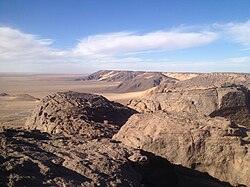
The Djado Plateau lies in the Sahara, in northeastern Niger. It is known for its cave art (often of large mammals long since absent from the area), but is now largely uninhabited, with abandoned towns and forts still standing and visible. As of 2012, the commune of Djado had a total population of 876 people.
In 2014, gold was discovered, which attracted up to 20,000 people from Niger, Chad, Libya and Sudan. Because there were many heavily armed foreigners, and working conditions were very bad, Moussa Hassane Barazé, the responsible minister for mining operations, ordered the mines to be closed in 2017.
The ruined city and ksar of Djado lies on the southern end of the plateau at 450 metres (1,500 ft) of elevation within a small oasis of brackish water. It was long ago abandoned by the Kanuri people, who may have been the original founders. Before the abandonment of Djado city, the area was well known for its salt and date production. Now, the salt mines in Djado are rarely used, however there are date palms of the area that are tended by Toubou nomads.
Djado Plateau
The Djado Plateau lies in the Sahara, in northeastern Niger. It is known for its cave art (often of large mammals long since absent from the area), but is now largely uninhabited, with abandoned towns and forts still standing and visible. As of 2012, the commune of Djado had a total population of 876 people.
In 2014, gold was discovered, which attracted up to 20,000 people from Niger, Chad, Libya and Sudan. Because there were many heavily armed foreigners, and working conditions were very bad, Moussa Hassane Barazé, the responsible minister for mining operations, ordered the mines to be closed in 2017.
The ruined city and ksar of Djado lies on the southern end of the plateau at 450 metres (1,500 ft) of elevation within a small oasis of brackish water. It was long ago abandoned by the Kanuri people, who may have been the original founders. Before the abandonment of Djado city, the area was well known for its salt and date production. Now, the salt mines in Djado are rarely used, however there are date palms of the area that are tended by Toubou nomads.
Recent media
Recent media