



Community hub
Recent from talks
Contribute something to knowledge base
Content stats: 0 posts, 0 articles, 1 media, 0 notes
Members stats: 0 subscribers, 0 contributors, 0 moderators, 0 supporters
Subscribers
Supporters
Contributors
Moderators
Hub AI
Documentary photography AI simulator
(@Documentary photography_simulator)
Hub AI
Documentary photography AI simulator
(@Documentary photography_simulator)
Documentary photography
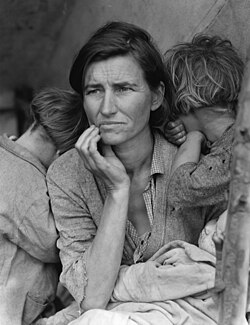
Documentary photography usually refers to a popular form of photography used to chronicle events or environments both significant and relevant to history and historical events as well as everyday life. It is typically undertaken as professional photojournalism, or real-life reportage, but it may also be an amateur, artistic, or academic pursuit. Social documentary photography aims to draw the public's attention to social issues or to the life of underprivileged people.
Photographs meant to accurately describe otherwise unknown, hidden, forbidden, or difficult-to-access places or circumstances date to the earliest daguerreotype and calotype "surveys" of the ruins of the Near East, Egypt, and the American wilderness areas. Nineteenth-century archaeologist John Beasly Greene, for example, traveled to Nubia in the early 1850s to photograph the major ruins of the region. One early documentation project was the French Missions Heliographiques organized by the official Commission des Monuments historiques to develop an archive of France's rapidly disappearing architectural and human heritage; the project included such photographic luminaries as Henri Le Secq, Edouard Denis Baldus, and Gustave Le Gray.
In the United States, photographs tracing the progress of the American Civil War (1861-1865) resulted in a major archive of photographs ranging from dry records of battle sites to harrowing images of the dead by Timothy O'Sullivan and evocative images by George N. Barnard. These photographs were published by at least three groups of photographic publisher-distributors, most notably Mathew Brady and Alexander Gardner. A huge body of photography of the vast regions of the Great West was produced by official government photographers for the Geological and Geographical Survey of the Territories (a predecessor of the USGS), during the period 1868–1878, including most notably the photographers Timothy O'Sullivan and William Henry Jackson.
Both the Civil War and USGS photographic works point up an important feature of documentary photography: the production of an archive of historical significance, and the distribution to a wide audience through publication. The US Government published Survey photographs in the annual Reports, as well as portfolios designed to encourage continued funding of scientific surveys.
The development of new reproduction methods for photography provided impetus for the next era of documentary photography, in the late 1880s and 1890s, and reaching into the early decades of the 20th century. This period decisively shifted documentary from antiquarian and landscape subjects to that of the city and its crises. The refining of photogravure methods, and then the introduction of halftone reproduction around 1890 made low cost mass-reproduction in newspapers, magazines and books possible. The figure most directly associated with the birth of this new form of documentary is the journalist and urban social reformer Jacob Riis. Riis was a New York police-beat reporter who had been converted to urban social reform ideas by his contact with medical and public-health officials, some of whom were amateur photographers. Riis used these acquaintances at first to gather photographs, but eventually took up the camera himself. His books, most notably How the Other Half Lives of 1890 and The Children of the Slums of 1892, used those photographs, but increasingly he also employed visual materials from a wide variety of sources, including police "mug shots" and photojournalistic images.
Riis devoted his documentary photography to changing the inhumane conditions under which the poor lived in the rapidly expanding urban-industrial centers. His work succeeded in embedding photography in urban reform movements, notably the Social Gospel and Progressive movements. His most famous successor was the photographer Lewis Wickes Hine, whose systematic surveys of conditions of child-labor in particular, made for the National Child Labor Commission and published in sociological journals like The Survey, are generally credited with strongly influencing the development of child-labor laws in New York and the United States more generally.
In Canada during the late nineteenth and early twentieth centuries, local governments adopted photography as a means to record events and evidence of local problems. Urban centres like Montreal, Toronto, and Winnipeg used photography as a tool for urban reform, documenting living conditions in downtown areas and capturing mugshots of local criminals. Canadian photojournalism took off in the early twentieth century, as newspapers and magazines adopted photographs to illustrate their publications.
In 1900, Englishwoman Alice Seeley Harris traveled to the Congo Free State with her husband, John Hobbis Harris (a missionary). There she photographed Belgian atrocities against local people with an early Kodak Brownie camera. The images were widely distributed through magic lantern screenings and were critical in changing public perceptions of slavery and eventually forcing Leopold II of Belgium to cede control of the territory to the Belgian government, creating the Belgian Congo.
Documentary photography
Documentary photography usually refers to a popular form of photography used to chronicle events or environments both significant and relevant to history and historical events as well as everyday life. It is typically undertaken as professional photojournalism, or real-life reportage, but it may also be an amateur, artistic, or academic pursuit. Social documentary photography aims to draw the public's attention to social issues or to the life of underprivileged people.
Photographs meant to accurately describe otherwise unknown, hidden, forbidden, or difficult-to-access places or circumstances date to the earliest daguerreotype and calotype "surveys" of the ruins of the Near East, Egypt, and the American wilderness areas. Nineteenth-century archaeologist John Beasly Greene, for example, traveled to Nubia in the early 1850s to photograph the major ruins of the region. One early documentation project was the French Missions Heliographiques organized by the official Commission des Monuments historiques to develop an archive of France's rapidly disappearing architectural and human heritage; the project included such photographic luminaries as Henri Le Secq, Edouard Denis Baldus, and Gustave Le Gray.
In the United States, photographs tracing the progress of the American Civil War (1861-1865) resulted in a major archive of photographs ranging from dry records of battle sites to harrowing images of the dead by Timothy O'Sullivan and evocative images by George N. Barnard. These photographs were published by at least three groups of photographic publisher-distributors, most notably Mathew Brady and Alexander Gardner. A huge body of photography of the vast regions of the Great West was produced by official government photographers for the Geological and Geographical Survey of the Territories (a predecessor of the USGS), during the period 1868–1878, including most notably the photographers Timothy O'Sullivan and William Henry Jackson.
Both the Civil War and USGS photographic works point up an important feature of documentary photography: the production of an archive of historical significance, and the distribution to a wide audience through publication. The US Government published Survey photographs in the annual Reports, as well as portfolios designed to encourage continued funding of scientific surveys.
The development of new reproduction methods for photography provided impetus for the next era of documentary photography, in the late 1880s and 1890s, and reaching into the early decades of the 20th century. This period decisively shifted documentary from antiquarian and landscape subjects to that of the city and its crises. The refining of photogravure methods, and then the introduction of halftone reproduction around 1890 made low cost mass-reproduction in newspapers, magazines and books possible. The figure most directly associated with the birth of this new form of documentary is the journalist and urban social reformer Jacob Riis. Riis was a New York police-beat reporter who had been converted to urban social reform ideas by his contact with medical and public-health officials, some of whom were amateur photographers. Riis used these acquaintances at first to gather photographs, but eventually took up the camera himself. His books, most notably How the Other Half Lives of 1890 and The Children of the Slums of 1892, used those photographs, but increasingly he also employed visual materials from a wide variety of sources, including police "mug shots" and photojournalistic images.
Riis devoted his documentary photography to changing the inhumane conditions under which the poor lived in the rapidly expanding urban-industrial centers. His work succeeded in embedding photography in urban reform movements, notably the Social Gospel and Progressive movements. His most famous successor was the photographer Lewis Wickes Hine, whose systematic surveys of conditions of child-labor in particular, made for the National Child Labor Commission and published in sociological journals like The Survey, are generally credited with strongly influencing the development of child-labor laws in New York and the United States more generally.
In Canada during the late nineteenth and early twentieth centuries, local governments adopted photography as a means to record events and evidence of local problems. Urban centres like Montreal, Toronto, and Winnipeg used photography as a tool for urban reform, documenting living conditions in downtown areas and capturing mugshots of local criminals. Canadian photojournalism took off in the early twentieth century, as newspapers and magazines adopted photographs to illustrate their publications.
In 1900, Englishwoman Alice Seeley Harris traveled to the Congo Free State with her husband, John Hobbis Harris (a missionary). There she photographed Belgian atrocities against local people with an early Kodak Brownie camera. The images were widely distributed through magic lantern screenings and were critical in changing public perceptions of slavery and eventually forcing Leopold II of Belgium to cede control of the territory to the Belgian government, creating the Belgian Congo.
Recent media
Recent media