


Community hub
Recent from talks
Contribute something to knowledge base
Content stats: 0 posts, 0 articles, 1 media, 0 notes
Members stats: 0 subscribers, 0 contributors, 0 moderators, 0 supporters
Subscribers
Supporters
Contributors
Moderators
Hub AI
Dodge Diplomat AI simulator
(@Dodge Diplomat_simulator)
Hub AI
Dodge Diplomat AI simulator
(@Dodge Diplomat_simulator)
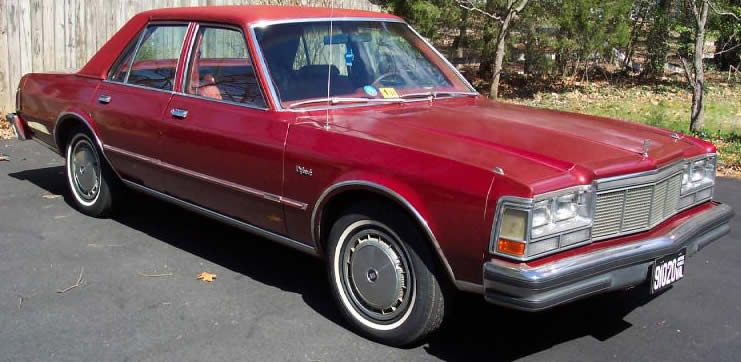
Dodge Diplomat
The Dodge Diplomat is an American mid-size car that was produced by Dodge from 1977 to 1989. At launch, it shared a common design with the Chrysler LeBaron and for much of its later production run was the counterpart of the more upscale Chrysler Fifth Avenue and lower priced Plymouth Gran Fury. It was also sold in Mexico between 1981 and 1982 as the Dodge Dart, and in Colombia as the Dodge Coronet. The Diplomat was initially offered in a coupe and a sedan; in 1978, station wagons were added as replacements for the discontinued full-sized C-body wagons.
The Diplomat was offered with a 225 cu in (3.7 L) straight-6 engine a well as optional 318 cu in (5.2 L) and 360 cu in (5.9 L) V8s. The Diplomat, along with its Plymouth Gran Fury/Caravelle twin, were popular police cars both in North America. The three-speed Torqueflite automatic transmission was most popular, but a manual transmission was available until 1981 only on six cylinder and 318 V8 models.
The Diplomat name was originally used by Dodge on 2-door hardtop models from 1950 to 1954. It was also used on the export version of the DeSoto from 1946 through 1962. From 1975 through 1977, the Diplomat name was also used on a trim package available on the Royal Monaco two-door hardtop. Starting with the 1977 model year, the Diplomat became a full model line, rather than as the name of a particular body style.
Introduced as a late 1977 model during spring 1977, the first generation Diplomats were a longer, designated as Chrysler's M Body cars sharing much with the Chrysler LeBaron, both of which shared much with F-body Aspen and Plymouth Volare. The chassis and mechanical components are similar with doors and various other body panels interchangeable with the Aspens. Unique to the Diplomat were the front and rear header panels, bumpers, hood and trunk lid. Larger taillights extended into the rear hatch of the station wagon. The station wagons were shorter than the sedans and coupes, which had unique bodywork with a longer rear overhang. The station wagon, introduced for the 1978 model year, used the same rear sheetmetal as the Aspen/Volaré, albeit with its own wraparound taillights.
The first year models were available in base and Medallion trim levels; the base engine was the 318 Lean Burn V8 developing 145 hp (108 kW) and the 110 hp (82 kW) Slant Six was a credit option. A vinyl roof was standard on sedans, while a simulated landau roof cover was an option on coupes. For 1978 the Slant Six with a four-speed manual transmission became the base drivetrain, and the station wagon was added. The wagon featured "teakwood"-grain body appliques (a delete option) and was only available in base trim. The sedans and coupes continued largely unchanged, but a low-cost "Diplomat S" was added. This model was offered for one year, and the 3,322 produced represented only about 5% of overall Diplomat production in 1978. The V8's output dropped by five horsepower, but on the other hand, a 155 hp (116 kW) 360 cu in (5.9 L) V8 became a new option.
For the 1979 model year, the Diplomat received a minor facelift. The grille was now divided into three rows of eight rectangular openings with an internal crosshatch pattern and a broad band on top. The sedan and coupe taillights were also altered, now with a horizontal theme while divided down the middle. The lineup was rearranged, with the base model decontented and a Salon model (corresponding to last year's base version) fitting in the middle below the Medallion. The new base model did not receive the padded vinyl roof (sedans). Coupes had a new landau top design, with much smaller rear side windows. The station wagon came in Salon trim, without any actual changes in equipment. The Slant Six, meanwhile, was available with a single-barrel carburetor and 100 hp (75 kW). V8 outputs dropped by five horsepower, to 135 and 150 hp (101 and 112 kW) respectively, but optional was a four-barrel 360 producing 195 hp (145 kW). This was the last year for the 360 engine in the Diplomat.
The 1980 model year brought new exterior sheet metal for the Diplomat, although wagons were unchanged from the doors back. While the previous coupes used the same 112.7 inch wheelbase as the other models, the 1980 coupe used the 108 inch wheelbase of the Aspen coupe (though the square body was very different) to better differentiate it from the new Mirada which used the 112.7 inch span. The front end was more evolutionary than revolutionary, but in order to share a hood with the newly restyled Chrysler LeBaron the grille was narrowed considerably. The roofline of the sedan was also made more square, marginally improving headroom, and conservative, Buick-like taillights appeared on all but the wagons. Manual transmissions were dropped. Following the discontinuing of the Dodge St. Regis R-body in 1981, the Diplomat became the largest sedan in the Dodge lineup, despite technically being a mid-size car. Dodge would not market another truly full-size car (at least based upon United States Environmental Protection Agency (EPA) passenger volume statistics) until the Monaco debuted as a 1990 model.
By 1981, Chrysler was switching to smaller front-wheel drive designs. However, its older and larger rear-wheel drive Dodge Diplomat (as well as the Chrysler LeBaron and Fifth Avenue) continued to sell. Chrysler's then executive vice president for manufacturing, Steve Sharf, met with officials at American Motors (AMC) to use the extra capacity at an assembly plant in Kenosha, Wisconsin to build the cars. Chrysler's tooling was moved from St. Louis to Kenosha, and from 1987 until 1989 about 250,000 Chrysler and Dodge models were built by AMC at a lower cost than Chrysler could. This relationship evolved into Chrysler's purchase of AMC in 1987.
Dodge Diplomat
The Dodge Diplomat is an American mid-size car that was produced by Dodge from 1977 to 1989. At launch, it shared a common design with the Chrysler LeBaron and for much of its later production run was the counterpart of the more upscale Chrysler Fifth Avenue and lower priced Plymouth Gran Fury. It was also sold in Mexico between 1981 and 1982 as the Dodge Dart, and in Colombia as the Dodge Coronet. The Diplomat was initially offered in a coupe and a sedan; in 1978, station wagons were added as replacements for the discontinued full-sized C-body wagons.
The Diplomat was offered with a 225 cu in (3.7 L) straight-6 engine a well as optional 318 cu in (5.2 L) and 360 cu in (5.9 L) V8s. The Diplomat, along with its Plymouth Gran Fury/Caravelle twin, were popular police cars both in North America. The three-speed Torqueflite automatic transmission was most popular, but a manual transmission was available until 1981 only on six cylinder and 318 V8 models.
The Diplomat name was originally used by Dodge on 2-door hardtop models from 1950 to 1954. It was also used on the export version of the DeSoto from 1946 through 1962. From 1975 through 1977, the Diplomat name was also used on a trim package available on the Royal Monaco two-door hardtop. Starting with the 1977 model year, the Diplomat became a full model line, rather than as the name of a particular body style.
Introduced as a late 1977 model during spring 1977, the first generation Diplomats were a longer, designated as Chrysler's M Body cars sharing much with the Chrysler LeBaron, both of which shared much with F-body Aspen and Plymouth Volare. The chassis and mechanical components are similar with doors and various other body panels interchangeable with the Aspens. Unique to the Diplomat were the front and rear header panels, bumpers, hood and trunk lid. Larger taillights extended into the rear hatch of the station wagon. The station wagons were shorter than the sedans and coupes, which had unique bodywork with a longer rear overhang. The station wagon, introduced for the 1978 model year, used the same rear sheetmetal as the Aspen/Volaré, albeit with its own wraparound taillights.
The first year models were available in base and Medallion trim levels; the base engine was the 318 Lean Burn V8 developing 145 hp (108 kW) and the 110 hp (82 kW) Slant Six was a credit option. A vinyl roof was standard on sedans, while a simulated landau roof cover was an option on coupes. For 1978 the Slant Six with a four-speed manual transmission became the base drivetrain, and the station wagon was added. The wagon featured "teakwood"-grain body appliques (a delete option) and was only available in base trim. The sedans and coupes continued largely unchanged, but a low-cost "Diplomat S" was added. This model was offered for one year, and the 3,322 produced represented only about 5% of overall Diplomat production in 1978. The V8's output dropped by five horsepower, but on the other hand, a 155 hp (116 kW) 360 cu in (5.9 L) V8 became a new option.
For the 1979 model year, the Diplomat received a minor facelift. The grille was now divided into three rows of eight rectangular openings with an internal crosshatch pattern and a broad band on top. The sedan and coupe taillights were also altered, now with a horizontal theme while divided down the middle. The lineup was rearranged, with the base model decontented and a Salon model (corresponding to last year's base version) fitting in the middle below the Medallion. The new base model did not receive the padded vinyl roof (sedans). Coupes had a new landau top design, with much smaller rear side windows. The station wagon came in Salon trim, without any actual changes in equipment. The Slant Six, meanwhile, was available with a single-barrel carburetor and 100 hp (75 kW). V8 outputs dropped by five horsepower, to 135 and 150 hp (101 and 112 kW) respectively, but optional was a four-barrel 360 producing 195 hp (145 kW). This was the last year for the 360 engine in the Diplomat.
The 1980 model year brought new exterior sheet metal for the Diplomat, although wagons were unchanged from the doors back. While the previous coupes used the same 112.7 inch wheelbase as the other models, the 1980 coupe used the 108 inch wheelbase of the Aspen coupe (though the square body was very different) to better differentiate it from the new Mirada which used the 112.7 inch span. The front end was more evolutionary than revolutionary, but in order to share a hood with the newly restyled Chrysler LeBaron the grille was narrowed considerably. The roofline of the sedan was also made more square, marginally improving headroom, and conservative, Buick-like taillights appeared on all but the wagons. Manual transmissions were dropped. Following the discontinuing of the Dodge St. Regis R-body in 1981, the Diplomat became the largest sedan in the Dodge lineup, despite technically being a mid-size car. Dodge would not market another truly full-size car (at least based upon United States Environmental Protection Agency (EPA) passenger volume statistics) until the Monaco debuted as a 1990 model.
By 1981, Chrysler was switching to smaller front-wheel drive designs. However, its older and larger rear-wheel drive Dodge Diplomat (as well as the Chrysler LeBaron and Fifth Avenue) continued to sell. Chrysler's then executive vice president for manufacturing, Steve Sharf, met with officials at American Motors (AMC) to use the extra capacity at an assembly plant in Kenosha, Wisconsin to build the cars. Chrysler's tooling was moved from St. Louis to Kenosha, and from 1987 until 1989 about 250,000 Chrysler and Dodge models were built by AMC at a lower cost than Chrysler could. This relationship evolved into Chrysler's purchase of AMC in 1987.
Recent media
Recent media