Hubbry Logo
Dodi FayedDodi FayedMain
Open search
Dodi Fayed
Community hub
Dodi Fayed
logo
17 pages, 0 posts
0 subscribers
Be the first to start a discussion here.
Dodi Fayed
Dodi Fayed
from Wikipedia

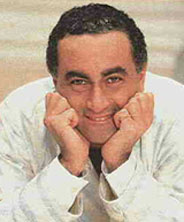
Emad El-Din Mohamed Abdel Mena'em "Dodi" Fayed (/ˈf.ɛd/ FY-ed;[b] 15 April 1955[a] – 31 August 1997) was an Egyptian film producer and the eldest child of the businessman Mohamed Al-Fayed. He was romantically involved with Diana, Princess of Wales, when they both died in a car crash in Paris on 31 August 1997.

Key Information

Biography

[edit]

Early life and education

[edit]

Fayed was born in Alexandria, Egypt, on 15 April 1955.[a] He was the eldest child of Mohamed Al Fayed (1929–2023), who later became the owner of Harrods department store, Fulham Football Club, and the Hôtel Ritz Paris.[11] Fayed's mother Samira Khashoggi (1935–1986),[12] was a Saudi author.[13] She was a daughter of Muhammad Khashoggi and sister of Saudi billionaire arms dealer Adnan Khashoggi. She and her brother were first cousins of the late Washington Post Saudi journalist Jamal Khashoggi, who was assassinated in the Saudi Arabian consulate in Istanbul in 2018.[14]

Fayed had four half siblings from his father's second marriage to Heini Wathén: Omar, Camilla, Karim, and Jasmine Fayed.[12][15]

Fayed was a student at Collège Saint Marc in Alexandria before attending the Institut Le Rosey in Rolle, Switzerland.[16][17] He also briefly attended the Royal Military Academy Sandhurst.[11]

Career

[edit]

After completing his education, he worked as an attaché at the United Arab Emirates Embassy in London.[17]

Through his family's production company, Allied Stars, Fayed was an executive producer for the films Chariots of Fire, Breaking Glass, F/X and its sequel F/X2, Hook, and The Scarlet Letter, and also as an executive creative consultant for F/X: The Series. He also worked for his father on marketing for Harrods.[2]

Personal life

[edit]

In 1986, Fayed married model Suzanne Gregard. They divorced eight months later. According to her memoir, Babylon Confidential, Claudia Christian had an on-again, off-again romance with Fayed.[18]

In 1997, Fayed reportedly became engaged to American model Kelly Fisher. With money from his father, he bought a house in Malibu, California, for Fisher and himself.[19]

In July 1997, Fayed became romantically involved with Diana, Princess of Wales, after entertaining her on his yacht Cujo.[20][21] Fisher learned of Fayed's relationship with Diana only after seeing paparazzi photos of the two embracing. Fisher announced that she was filing a breach of contract suit against him, saying he had "led her emotionally all the way up to the altar and abandoned her when they were almost there," and that he "threw her love away in a callous way with no regard for her whatsoever".[22] Fayed denied that he was ever engaged to Fisher.[23] Fisher dropped the lawsuit shortly after Fayed's death.[24]

Death

[edit]
Innocent Victims, one of two memorials in Harrods

In the early hours of 31 August 1997, Diana and Fayed died in a car crash in the Pont de l'Alma underpass in Paris. They had stopped in Paris en route to London after spending nine days on holiday in the French and Italian Rivieras aboard his family's yacht, the Jonikal. Neither Fayed nor Diana was wearing a seat belt at the time of the crash.[25] The only survivor of the crash was bodyguard Trevor Rees-Jones.

Investigations by French and British police concluded that the chauffeur, Henri Paul, was driving under the influence of alcohol and prescription drugs. They also reported that paparazzi chasing the couple were believed to have contributed to the accident.[26][27]

Fayed's father, Mohamed Al-Fayed, said that the couple "were executed by MI6 agents".[28] Fayed's former spokesman, Michael Cole, has said that the couple became engaged before their deaths.[29]

Fayed was originally buried in Brookwood Cemetery near Woking, Surrey, but was re-interred in October 1997 on the grounds of Barrow Green Court, the family estate in Oxted, Surrey.[30][31]

Legacy

[edit]
Memorial to Diana, Princess of Wales, and Dodi Fayed in Harrods

Fayed's father erected two memorials to his son and Diana at Harrods. The first, unveiled on 12 April 1998, consists of photos of them behind a pyramid-shaped display containing a wine glass smudged with lipstick from Diana's final dinner, and the ring Fayed had purchased for her the day before they died.[32] The second, unveiled in 2005 and titled Innocent Victims, is a 3-metre (9.8-foot) high bronze statue of the two dancing on a beach, beneath the wings of an albatross, a symbol of freedom and eternity.[33]

The memorials were designed by Bill Mitchell, a close friend of Fayed's father who had worked for the Fayed family for more than 40 years, including as a designer at Harrods.[34] Fayed's father sold Harrods in 2010.

In January 2018, the manager of Harrods announced that the statue would be returned to the Al-Fayed family. He noted that Diana's sons William and Harry had commissioned a memorial to be installed at Kensington Palace, which the public could visit.[35]

Representation in other media

[edit]

See also

[edit]

Notes

[edit]

References

[edit]
[edit]
Revisions and contributorsEdit on WikipediaRead on Wikipedia
from Grokipedia
Emad El-Din Mohamed Abdel Moneim Fayed (15 April 1955 – 31 August 1997), commonly known as Dodi Fayed, was an Egyptian film producer and the eldest son of , the Egyptian-born businessman who owned and Football Club. Born in , , Fayed pursued a career in Hollywood, serving as on films such as (1981), (1991), and (1986), often leveraging financial support from his father to establish , his production company. In the summer of 1997, Fayed entered a brief romantic relationship with , following her divorce from Prince Charles; the pair were photographed together on luxury yachts and in European resorts, drawing intense media scrutiny. Their relationship ended tragically on 31 August 1997, when the in which they were passengers, driven by Henri Paul, crashed in the tunnel in , killing Fayed, Diana, and Paul, while Trevor Rees-Jones survived with severe injuries; official investigations by French authorities and the 2004–2008 British inquest determined the crash resulted from Paul's intoxication, speeding, and pursuit by vehicles, ruling out mechanical failure or deliberate sabotage despite persistent claims by of a conspiracy involving the .

Early Life and Family

Birth and Upbringing in Egypt

Emad El-Din Mohamed Abdel Mena'em Fayed was born on 15 April 1955 in , , the eldest son of , an aspiring Egyptian businessman, and Samira Khashoggi, a Saudi Arabian and sister of arms dealer . His parents had married in 1954, but the union dissolved by 1956, leaving Dodi as their while later had four children with his second wife, Heini Wathen. At the time of Dodi's birth, his father held a position as a commercial manager in , earning a monthly salary of about $280, reflecting the family's modest circumstances amid Mohamed Al-Fayed's early entrepreneurial efforts in post-colonial . Dodi spent his early childhood in , immersed in the city's cosmopolitan yet traditionally Egyptian environment, where French cultural influences were evident through local institutions. For his primary education, Fayed attended the French Lycée La Salle in , a Catholic institution emphasizing bilingual instruction, before transitioning to international boarding schools in as his father's business ventures expanded beyond . This early phase in laid the foundation for Dodi's exposure to multicultural settings, though academic records indicate he did not distinguish himself scholastically during these years.

Influence of Mohamed Al-Fayed

Mohamed Al-Fayed exerted significant influence over Dodi Fayed's upbringing and lifestyle, providing him with extraordinary wealth and opportunities from a young age. Born in Alexandria, Egypt, in 1955 to Mohamed and Samira Khashoggi, Dodi experienced parental separation early, with custody awarded to Mohamed following their 1959 divorce in line with Muslim custom. Raised amid luxury, Dodi split time between family homes on the French Riviera, in Paris, Cairo, and Alexandria, often under the care of servants while Mohamed pursued business ventures. By age 15, Mohamed had granted Dodi his own flat in Mayfair and a Rolls-Royce, establishing a pattern of indulgence that defined his son's early adulthood. Mohamed's financial support enabled Dodi's elite education and extravagant habits. He enrolled Dodi at in in 1968, though Dodi departed after one year, and later at the Royal Military Academy Sandhurst in 1974, where Dodi completed a six-month course and received a commission before briefly joining the . Mohamed supplied a monthly allowance reported as $100,000, funding Dodi's ownership of five Ferraris, high-profile parties in frequented by celebrities like , and romances with figures such as and . Access to family properties, including a Park Lane apartment and vacation homes, further reinforced Dodi's jet-setting existence, though Mohamed occasionally withheld funds for excessive spending, such as unpaid bills. In Dodi's professional life, Mohamed played a dominant role, particularly in . In 1979, Mohamed capitalized Ltd., Dodi's , with £1.2 million, backing projects like Breaking Glass (1980) and co-financing (1981) with $3 million, where Mohamed dictated key decisions despite Dodi's nominal credit. Dodi's later involvements in films such as (1986) and (1991) similarly relied on paternal funding. Mohamed also drew Dodi into operations, requiring three months annually for product development and branding efforts. This support facilitated Dodi's Hollywood aspirations but limited his autonomy, as associates noted Mohamed's overarching control. The father-son dynamic was marked by a blend of spoiling and domination, fostering dependence while instilling deference. Dodi reportedly called Mohamed daily when apart, reflecting a protective yet inconsistent strictness that kept him "off-balance." Biographer described their bond as complicated, with Mohamed alternating between dominance and indulgence, pinning personal ambitions on Dodi, including pressures to elevate family status through high-society ties. This influence extended to Dodi's personal relationships, enabling pursuits of glamour but tying them to Mohamed's wealth and expectations, ultimately shaping a life of status-seeking in his father's shadow.

Education and Professional Beginnings

Formal Education

Dodi Fayed, born Emad El-Din Mohamed Abdel Mena'em Fayed on April 15, 1955, in , , began his formal education at Collège Saint Marc, an elite French-language Catholic school in . This institution provided early instruction in a rigorous, traditional environment suited to the children of Egypt's . In 1968, at age 13, Fayed was enrolled at , a prestigious international boarding school in and , , known for educating the offspring of global elites with a emphasizing , sports, and cultural exposure. His academic performance there was described as mediocre, reflecting challenges in adapting to the school's demanding standards despite its reputation for fostering social connections among the wealthy. Fayed completed his at Le Rosey, which marked a shift from his Egyptian roots toward a more cosmopolitan upbringing influenced by his father's rising business ambitions. In 1974, at age 19, Fayed enrolled in a six-month officer training course at the Royal Military Academy Sandhurst in the , a institution renowned for preparing officers and attracting international students seeking prestige and discipline. His time at Sandhurst was brief and did not lead to a full commission or further ; instead, it served as a transitional experience before entering his father's business world. No records indicate completion of a degree or advanced formal studies beyond these institutions, with Fayed's path diverging toward practical professional roles rather than prolonged academia.

Entry into Business and Film

Emad El-Din Mohamed Abdel Mena'em Fayed, known as Dodi Fayed, leveraged his father Mohamed Al-Fayed's financial resources to establish himself in , particularly in the industry. In 1979, at age 24, he founded the production company Allied Stars Ltd., which served as his primary entry into professional endeavors. The venture was backed by his father's wealth, enabling Fayed to finance independent films during a period when Hollywood sought alternative funding sources amid industry challenges. Allied Stars marked Fayed's initial foray into film production, with the company executive-producing early projects such as the 1980 British drama Breaking Glass. This involvement positioned him as a financier rather than a creative force, relying on family capital to co-finance scripts and attract talent. By 1980, Fayed identified the dormant script for at Films, securing investment from his father to propel the project forward, which premiered in 1981 and earned critical acclaim. His role as on garnered an , providing early validation despite limited prior experience. Prior to film, Fayed's business exposure was informal, shadowing his father's enterprises in shipping and retail, though no independent ventures predated . This reliance on familial support characterized his entry, blending opportunistic investment with a that drew media attention in circles. Over the subsequent years, expanded to six financed films, solidifying Fayed's niche as a Hollywood outsider financier.

Film Production Career

Key Productions and Roles

Dodi Fayed's involvement in film primarily centered on production roles, facilitated by his family's company, where he contributed financing and executive oversight rather than creative direction. His early credit came as producer on the British musical drama Breaking Glass (1980), directed by Brian Gibson, which featured singer and explored the scene in . In 1981, Fayed served as on , directed by , a historical sports drama about British runners at the 1924 Olympics that earned four , including Best Picture. This project marked a significant early success, grossing over $58 million against a modest budget and highlighting Fayed's entry into high-profile international cinema. Fayed produced the action-thriller (1986), directed by , starring as a special effects expert entangled in a mob assassination plot; the film earned $20.9 million at the U.S. box office and spawned a sequel. He extended involvement to (1991), again as producer, which continued the franchise with a focus on illusion and espionage, though it received mixed reviews and lower commercial returns. As , Fayed backed Steven Spielberg's fantasy adventure (1991), a Peter Pan sequel starring and , which had a $70 million budget and grossed $300 million worldwide despite critical pans for its length and sentimentality. Later, he executive produced (1995), directed by and starring in Nathaniel Hawthorne's adaptation, a $46 million production that underperformed commercially with $46 million in global earnings and faced backlash for historical inaccuracies. These roles underscored Fayed's pattern of supporting mid-to-high-budget genre films, often leveraging family resources for Hollywood access, though none positioned him as a hands-on creative force.

Professional Achievements and Setbacks

Dodi Fayed assumed the role of chief executive at , the film production company founded by his father in 1979. Under his oversight, the company executive produced (1981), a historical sports drama that secured four , including Best Picture; Fayed discovered the dormant script and facilitated family financing to complete production. Additional credits encompassed Breaking Glass (1980), the action thriller (1986) and its 1991 sequel , Steven Spielberg's fantasy adventure (1991), and the period drama (1995). These productions represented Fayed's primary professional accomplishments, leveraging familial resources to gain entry into Hollywood circles. However, his involvement was frequently characterized as peripheral, reliant on his father's capital rather than demonstrated expertise in development or oversight. Fayed encountered setbacks through persistent allegations of fiscal irresponsibility in his dealings. He was accused of neglecting to remit hundreds of thousands of dollars in rental payments, inflicting damage on leased properties, vending rights without ownership, and reneging on commitments to associates. Such conduct contributed to a reputation overshadowed by extravagance and transience, limiting sustained independent ventures beyond . Tensions with his over autonomy further impeded efforts to establish a distinct professional trajectory.

Personal Relationships

Prior Romances and Lifestyle

Dodi Fayed married American model Suzanne Gregard in 1986, but the union ended in divorce after less than one year. Prior to his romance with Diana, Princess of Wales, Fayed maintained a relationship with American model Kelly Fisher beginning around 1995. Fisher later claimed they were engaged and scheduled to wed on August 9, 1997, after Fayed had purchased a $200,000 ring and advanced her $60,000 toward wedding expenses, though a subsequent $200,000 check reportedly bounced. On August 8, 1997, Fisher filed a $440,000 breach-of-contract lawsuit against Fayed in Los Angeles Superior Court, alleging he abandoned their agreement after pursuing Diana; the suit was dropped following Fayed's death later that month. Fayed's personal life reflected a jet-set existence enabled by his father Mohamed Al-Fayed's wealth from ownership of and the Ritz Hotel. He frequently traveled by private jet and yacht, socialized in Hollywood circles as a , and was known for hosting parties at properties including a Beverly Hills and a estate. Associates described Fayed as a habitual partier who indulged in use, contributing to a reputation as a overshadowed by substance-related rather than professional or romantic stability. Despite producing films like (1981), which earned an Academy Award for Best Original Screenplay, Fayed's lifestyle prioritized leisure and high-society connections over sustained career focus.

Romance with Diana, Princess of Wales

Dodi Fayed and , first met in 1986 at a polo match in , where Fayed's team competed against Diana's then-husband, Prince Charles. Their romantic involvement began over a decade later, in July 1997, when Diana accepted an invitation from Fayed's father, , to vacation in with her sons, Prince William and Prince Harry. From July 11 to 20, 1997, Diana stayed at Mohamed Al-Fayed's in and spent time aboard the family yacht Jonikal, where she reconnected with Dodi Fayed, who joined the group on July 14. The pair's relationship quickly progressed during this Mediterranean holiday, marked by shared outings and seclusion on the yacht, which cruised to by July 31. photographs of the couple kissing, taken during this trip, were published in the on August 10, providing the first public confirmation of their romance. At the time, Fayed was engaged to American model , whom he had proposed to in earlier in 1997 with a $200,000 ring; however, he terminated the engagement to pursue Diana, prompting Fisher to file a breach-of-promise against him on 15. Diana briefly returned to , visiting Fayed's apartment at 60 on August 7, before rejoining him in on August 21 for a second yacht vacation on the Jonikal. This trip, lasting until August 30 and spanning , , and , featured further public displays of affection, including Diana posing on the yacht's diving board on August 24 and a visit to the jewelry store in . The romance, spanning roughly , drew intense media scrutiny due to Diana's status and the couple's high-profile escapades, but it remained a fleeting summer liaison amid her post-divorce .

The 1997 Paris Car Crash

Prelude to the Fatal Evening

On August 30, 1997, , and Dodi Fayed departed aboard a chartered private jet, arriving at Airport in at approximately 3:20 p.m. local time. They were met by Henri Paul, the deputy head of security at the Ritz Hotel, owned by Dodi's father, , and driven to the hotel, entering through the rear entrance to evade awaiting . The couple checked into the Imperial Suite, where they rested briefly amid intensifying media pursuit. Later that afternoon, around 5:00 p.m., Diana and Dodi left the Ritz in a chauffeur-driven for a short visit to Dodi's nearby apartment at 23 Rue Arsène Houssaye, returning to the hotel by approximately 7:00 p.m. swarmed the location, prompting the decision to dine privately at the Ritz rather than at an external . They shared a in Diana's suite, joined briefly by Trevor Rees-Jones, focusing on a low-profile evening amid the . By midnight, with still gathered at the front, the group planned to depart via the hotel's rear exit for Dodi's apartment, opting for a S280 over the expected to confuse followers; two decoy vehicles were dispatched from the front as a diversion. Henri Paul, who had consumed alcohol earlier in the evening, assumed the driving role, with Rees-Jones in the front passenger seat, while Diana and Dodi occupied the rear. The vehicle exited the Ritz at around 12:23 a.m. on August 31, immediately accelerating into the streets pursued by photographers on motorcycles.

Crash Details and Casualties

The S280 sedan carrying Dodi Fayed, , driver Henri Paul, and Trevor Rees-Jones departed the rear entrance of the Ritz Hotel in at approximately 00:23 local time on 31 August 1997, heading toward the tunnel en route to Fayed's apartment. The vehicle, pursued by motorcycles, entered the tunnel's right-hand lane at an estimated speed of 105-120 km/h—roughly double the 50 km/h limit—before swerving left, clipping the kerb, and colliding with the tunnel's 13th concrete pillar at high velocity. The impact caused the car to rebound and come to rest against the tunnel wall, with debris scattering across the roadway; no other vehicles were directly struck in the collision, though a white was later reported in the vicinity by witnesses. Henri Paul, the deputy security manager at the Ritz, and Dodi Fayed were both killed instantly at the crash site from massive trauma. Diana sustained severe internal injuries, including and ruptured blood vessels, and was rushed to , where she was pronounced dead at 04:00 despite surgical efforts to revive her. Trevor Rees-Jones, the sole survivor, suffered extensive injuries including multiple facial fractures, a broken arm, and chest trauma—described by his surgeon as the worst case of fractures in a living patient—but recovered after prolonged hospitalization and . Post-crash analysis confirmed Paul's blood alcohol concentration at 1.74 grams per liter—over three times France's legal limit of 0.5 grams per liter—along with traces of prescription antidepressants, contributing to impaired control during the high-speed maneuver.

Official Investigations

French and British Probes

The French judicial investigation into the 31 August 1997 Paris car crash began immediately under the direction of the Paris prosecutor's office, involving forensic examinations, autopsies, and witness interviews conducted by magistrates Hervé Stéphan and Marielle Allibert. Toxicology tests on deputy hotel manager Henri Paul, the driver of the Mercedes S280, revealed a blood alcohol concentration of 1.74 grams per liter—more than three times France's legal limit of 0.5 grams per liter—along with traces of the prescription antidepressant and from a prior car fire. The vehicle's speed was estimated at 95 to 110 kilometers per hour upon entering the 50 kilometer per hour tunnel, contributing to the loss of control after clipping a white . French authorities attributed the crash to Paul's impaired state from alcohol and , combined with excessive speed, while pursuit was deemed a secondary factor without direct causation for criminal liability. No evidence emerged of mechanical failure in the Mercedes, which had been serviced recently, or such as tampered brakes, despite later claims. The probe cleared the vehicle of modifications that could explain the crash dynamics, confirming it as an rather than deliberate action. In September 1999, after two years of inquiry, the magistrates issued a formal ruling of , dismissing conspiracy elements and closing the case against systemic foul play. Subsequent French proceedings focused on manslaughter charges against Paul (posthumously) and pursuing paparazzi. Nine photographers faced trial in 2002 but were acquitted of involuntary homicide, with the court upholding the accident verdict while noting the paparazzi's role in heightening the chase's risks without legal culpability. This outcome aligned with empirical crash reconstruction, which emphasized Paul's decisions—including evading paparazzi via back routes and not wearing seatbelts—as primary causal factors, absent any verifiable external interference. In Britain, initial post-crash scrutiny was limited due to jurisdictional deference to French authorities, but mounting public speculation and allegations by Dodi Fayed's father, , prompted the to launch in January 2004 at the request of the royal coroner. Led by former Commissioner Lord Stevens (John Stevens), the inquiry examined 175 specific conspiracy claims, including assertions of orchestration, a staged pregnancy, or involvement in engineering the crash to prevent a Muslim marriage. Over three years, it involved re-interviewing witnesses, forensic re-analysis of evidence shared from , and review of intelligence files, costing approximately £12.5 million. Operation Paget's December 2006 report corroborated the French findings, concluding no credible evidence supported or ; the deaths resulted from Paul's grossly negligent driving while intoxicated (alcohol level confirmed via multiple samples) and speeding, exacerbated by pursuit but without orchestration. It dismissed key fringe elements, such as claims of a blinding flash or Fiat Uno driver links to intelligence services, as unsubstantiated by , CCTV, or witness corroboration, emphasizing causal realism in attributing fault to over speculative plots. The probe highlighted cooperation with French officials, reinforcing the narrative through independent verification of and crash forensics.

2004-2008 Inquest Verdict

The British inquest into the deaths of , and Dodi Fayed was initiated following persistent allegations of conspiracy by , Dodi's father, prompting the to launch in January 2004 under former Commissioner Lord Stevens. This three-year investigation examined over 175 conspiracy claims, including assertions of murder orchestrated by the or security services to prevent a marriage between Diana and Dodi, but concluded in December 2006 that the crash resulted from Henri Paul's impaired driving and pursuit, with no evidence supporting foul play. The report, spanning 832 pages, verified French forensic evidence showing Paul's blood alcohol level at 1.74 grams per liter—three times the French legal limit—along with traces of antidepressants and , confirming he was unfit to drive the Mercedes S280 at speeds exceeding 100 km/h (62 mph) in the tunnel on August 31, 1997. The formal inquest, presided over by judge Lord Justice Scott Baker, opened on October 8, 2007, at the , hearing testimony from 278 witnesses over six months, including reconstructions of the crash sequence and analysis of vehicle damage consistent with a high-speed impact against pillar 13. Expert evidence ruled out sabotage, such as the allegedly involved in flashing the Mercedes, attributing any contact to post-crash debris rather than premeditated interference, while dismissing claims of a blinding or switched blood samples for Paul. The inquest rejected Mohamed Al-Fayed's narrative of a for Diana or an imminent , finding no corroborating medical or eyewitness support, and clarified that the "ring" presented to Diana was a non-committal from Dodi, not a betrothal item. On April 7, 2008, the jury delivered a verdict of —equivalent to —for both Diana and Dodi, attributing the deaths to the grossly negligent driving of Henri Paul, who was speeding and intoxicated, and the reckless pursuit by in seven vehicles, whose flashing cameras and blocking tactics contributed to the chaos without direct causation of the collision. The ruling explicitly cleared the royal family, British intelligence, and French authorities of involvement, emphasizing that the crash stemmed from a combination of and media intrusion rather than orchestrated , a conclusion bolstered by synchronized timelines from security footage and witness accounts showing no opportunity for third-party intervention. This outcome, after £12.5 million in costs, underscored the evidentiary primacy of and crash dynamics over unsubstantiated speculation.

Conspiracy Theories and Controversies

Claims by Mohamed Al-Fayed

, father of Dodi Fayed, alleged that the August 31, 1997, car crash was a premeditated murder orchestrated by on orders from the , specifically Prince Philip, to thwart Diana's impending marriage to his son and the birth of their child. He claimed the royal family viewed a union with a Muslim as intolerable, prompting the . Al-Fayed asserted that Diana had confided her pregnancy with Dodi's child to him via telephone about one hour before departing the Ritz Hotel, emphasizing the motive to eliminate the perceived threat to royal interests. He further maintained that Henri Paul, the Mercedes driver, was not impaired by alcohol but served as a paid operative, having vanished for three hours prior to the crash and carrying 20,000 French francs received for his briefing. In detailing the mechanics of the alleged plot, Al-Fayed accused British intelligence of deploying a white , driven by an agent, to ram the couple's vehicle and initiate the fatal collision. He rejected official narratives of pursuit and driver error, insisting instead on including manipulated braking systems and staged evidence. Al-Fayed characterized the 2004-2006 inquiry, launched in response to his complaints, as a fabricated by to shield the perpetrators. During his February 18, 2008, testimony at the London inquest, he branded the royal family the " family" and reiterated the , decrying the proceedings as rigged.

Evidence Against Conspiracy Narratives

The inquiry, conducted by London's from 2004 to 2006, examined over 175 conspiracy allegations raised by and concluded there was no of or orchestration by British intelligence, the royal family, or other entities; the crash resulted from a tragic accident exacerbated by the driver's impairment and paparazzi pursuit. The 832-page report detailed forensic, witness, and ballistic analyses, finding no substantiation for claims of a staged collision, such as the alleged use of a white to ram the Mercedes or a blinding flash from another vehicle. The 2008 British inquest into the deaths of Diana, Dodi Fayed, and driver Henri Paul delivered a of unlawful killing attributable to Paul's grossly negligent driving and the paparazzi's reckless pursuit, explicitly rejecting or conspiracy. Coroner Lord Justice Scott Baker instructed the jury that no credible evidence supported involvement or assassination, dismissing Al-Fayed's assertions of a royal plot to prevent Diana's marriage to Dodi as baseless after reviewing intelligence files and witness testimonies. The inquest confirmed the Mercedes S280 was traveling at approximately 65-100 km/h (40-62 mph) in the tunnel, consistent with loss of control due to speed and impairment rather than external sabotage. Henri Paul's toxicology results, verified through multiple post-mortem samples and DNA confirmation, showed a blood alcohol concentration of 1.74 grams per liter—three times the French legal limit of 0.5 g/L—and traces of antidepressants that impaired his judgment and reaction time. French and British forensic experts ruled out sample tampering, as independent laboratories corroborated the levels, countering defense claims of substitution with higher-alcohol blood from an unnamed donor. No evidence emerged of mechanical failure in the vehicle or prior tampering, with crash reconstruction attributing the impact to the driver's swerve into the 13th pillar. Specific allegations, such as Diana's supposed or an to Dodi, were refuted by findings showing no fetal tissue and accounts indicating the relationship was casual and short-term, not preparatory for marriage. Ballistic tests on the , traced to a with no ties to services, revealed paint transfer consistent with accidental contact post-crash, not deliberate ramming. The absence of any forensic traces of explosives, poisons, or modifications in the Mercedes further undermined theories, aligning with eyewitness reports of motorcycles contributing to the chaos without coordinated malice.

Broader Criticisms and Media Role

The paparazzi's aggressive pursuit of Diana and Dodi Fayed's Mercedes in the Pont de l'Alma tunnel on August 31, 1997, was a key factor in the crash, as their high-speed chase created hazardous conditions that pressured driver Henri Paul to accelerate. The 2008 British inquest concluded that the deaths were unlawful killings attributable to Paul's reckless driving—exacerbated by his blood alcohol level three times the French legal limit and use of prescription drugs—and the paparazzi's dangerous following tactics, which involved motorbikes closing in on the vehicle. French authorities had previously charged nine paparazzi with manslaughter and privacy violations for photographing the victims at the crash scene rather than rendering immediate aid, though most charges were later dropped or resulted in light penalties. Critics have lambasted the tabloid media's pre-crash , which portrayed the Diana-Dodi romance—sparked during a July 1997 Mediterranean holiday—as a whirlwind scandal, fueling relentless intrusion that eroded the couple's privacy and safety. British outlets like The Mirror and The Sun published intrusive images from and , generating profits exceeding £1 million for individual photographers, while contributing to a culture where evasion tactics escalated risks. Post-crash, some photographers prioritized documenting the wreckage over assisting, with images of the dying Diana sold to agencies, drawing widespread condemnation for ethical lapses in journalistic practice. Beyond the immediate pursuit, broader media amplification of unsubstantiated claims has faced scrutiny for perpetuating doubt about the official accident narrative. Mohamed Al-Fayed's persistent allegations of orchestration received coverage in outlets like the , which ran campaigns questioning the findings despite Operation Paget's 2006 report—commissioned by the Royal —dismissing evidence after reviewing 175 allegations and finding no credible proof of . Such reporting, often prioritizing over verification, prolonged public , though independent probes consistently affirmed driver error and pursuit dynamics as causal, without institutional foul play. This pattern underscores criticisms of media incentives favoring controversy, which hindered closure and respect for empirical investigations.

Posthumous Legacy

Family and Business Inheritance Issues

Dodi Fayed died intestate on August 31, 1997, without a spouse or children, resulting in his estate passing directly to his father, , under French inheritance law applicable to his assets in . The estate included personal wealth, properties, and interests tied to the family production company , though its value was not publicly detailed and appeared modest compared to Mohamed's holdings. Mohamed Al-Fayed exercised tight personal control over his business empire post-Dodi's death, with no evidence of grooming other children as successors to key assets like Harrods or Fulham Football Club. Dodi himself had limited operational involvement in these ventures, focusing instead on film production and personal pursuits rather than executive roles. Mohamed sold Harrods in May 2010 to Qatar Holding for £1.5 billion and Fulham FC in July 2013 to American owner Shahid Khan for £200 million, retaining proceeds and other properties like the Hôtel Ritz Paris without transferring management to family members. This approach left no formalized business succession, amplifying later familial strains over the remaining portfolio. Upon Mohamed Al-Fayed's death on August 30, 2023, his estimated £1.7 billion fortune—encompassing the Ritz Paris, a Surrey estate, and other real estate—sparked disputes among his four surviving children from his second marriage to Heini Wathen: Jasmine (born 1980), Karim (born 1983), Camilla (born 1984), and Omar (born 1987). Tensions, described in media reports as a "Succession-style" battle, included prior legal clashes, such as a 2020 UK High Court case where Omar accused Camilla's husband of assault during a drug-fueled altercation at the family estate, seeking £100,000 in damages; Camilla countersued alleging robbery but the charge was dropped. These conflicts, rooted in power struggles and personal accusations, underscore the lack of unified family governance following Dodi's demise, with no public resolution as of late 2024 despite the will's intent to distribute assets among the siblings.

Cultural Depictions and Public Perception

Dodi Fayed has been portrayed in various media productions centered on his brief romance with Princess Diana, often emphasizing the tragic brevity of their relationship in the summer of 1997. In the series (seasons 5 and 6, released 2022–2023), actor depicts Fayed as a drawn into a whirlwind affair with Diana, influenced by his father Mohamed Al-Fayed's invitations and social maneuvering, culminating in their trip. The portrayal includes fictionalized elements, such as Mohamed Al-Fayed's direct matchmaking, which producers of the series have been accused of inventing despite lacking historical corroboration. The 2013 biographical film Diana, directed by and starring as the princess, features as Fayed in a supporting role as Diana's rebound partner after her unrequited love for surgeon , with their yacht holiday and pursuit highlighted before the crash. The film presents Fayed as charming but peripheral, aligning with accounts of their relationship lasting approximately one month, though critics noted its overall dramatization deviated from verified timelines. A 2022 documentary short by Wonderhood Studios chronicles Fayed's life from childhood amid his parents' separation, through military training at Sandhurst, to his Hollywood producing career and death, aiming to humanize him beyond the Diana narrative. Public perception of Fayed during his lifetime and posthumously has centered on his image as a wealthy, peripatetic playboy overshadowed by his father's influence and business empire, with limited independent achievements noted despite credits as producer on films like Chariots of Fire (1981, Oscar winner for Best Picture) and Hook (1991). Contemporary media often described him as drifting between Europe and Hollywood, spending lavishly on relationships and status symbols without deeper public persona or recorded statements, fostering a view of transience. Following the 1997 crash, perceptions shifted through his father's persistent conspiracy claims, which portrayed Fayed as a committed partner on the verge of marriage—contradicted by evidence like a disputed engagement ring purchase on August 30, 1997, and witness accounts of no marriage plans—leading some to see him as a pawn in Mohamed Al-Fayed's grievances against British institutions. Insiders and friends have countered with recollections of Fayed as sensitive and approval-seeking, yet his outsider status as an Egyptian-born heir in class-conscious British society amplified stereotypes of extravagance over substance, with rare defenses against tabloid labels like "druggie" or crash instigator. Overall, cultural memory reduces Fayed to Diana's final companion, eclipsing his pre-1997 obscurity and complicating objective views amid familial narratives and media sensationalism.

References

Add your contribution
Related Hubs
User Avatar
No comments yet.