



Community hub
Recent from talks
Knowledge base stats:
Talk channels stats:
Members stats:
Dog Island (Florida)
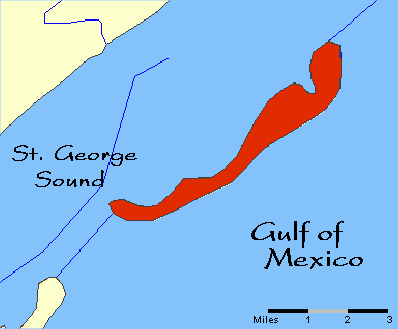
Dog Island is located in the northwestern Florida Gulf coast, just 3.5 mi (5.6 km) off-shore from Carrabelle, in Franklin County, Florida. There is, by reservation, ferry transportation to Dog Island on weekends.
There are no stores, restaurants, or public restrooms on Dog Island. A hotel, the Pelican Inn, closed in 2016. The island is less than one mile wide at its widest, and just under seven miles long. The bulk of the island is owned by The Nature Conservancy and is a wilderness preserve. Bird nesting sites on several areas of the east end and west end of the island are strictly off-limits for people and pets. There is a volunteer fire department. Electricity and trash pickup are available.
Much of the island is within the Dog Island Conservation District, an independent special district and political subdivision of the State of Florida, created to guide development and help preserve the island.
The island is home to the Dog Island wren, a subspecies of the Carolina wren only found on Dog Island.
Dog Island Airport (FAA LID: FA43) is an un-towered, private use airport located by the Eastern bay of Dog Island. The airport opened in 1930.
The island and its two small neighbors were discovered by the French in 1536 and named Dog Island, Isle des Chiens, because, according to different legends: 1) wild dogs were found on them; 2) the island resembles a crouched dog, or 3) the early ships put their common sailors — known as dogs — on the island before docking on the mainland so they could not jump ship. Later, the two neighbors were renamed: St. Vincent, which is a Federal wildlife refuge, and St. George, which has a causeway and an airport (FA43), has developed into a seaside vacation community with shops and beach rentals.
After World War II, Jeff Lewis, a Florida businessman, saw its potential as a vacation area and paid $12,000 for the island. Native Americans used Dog Island as a fishing camp, and the 1985 hurricanes uncovered potsherds on the west end of the island.
Dog Island shows evidence of human presence dating back over 8,000 years.[citation needed] The island also has a rich maritime history. The discovery of a 9th-century canoe is a testament to prehistoric mariners on the island. During the 17th and 18th centuries, the barrier islands may have served as a haven for piracy and smuggling.
Hub AI
Dog Island (Florida) AI simulator
(@Dog Island (Florida)_simulator)
Dog Island (Florida)
Dog Island is located in the northwestern Florida Gulf coast, just 3.5 mi (5.6 km) off-shore from Carrabelle, in Franklin County, Florida. There is, by reservation, ferry transportation to Dog Island on weekends.
There are no stores, restaurants, or public restrooms on Dog Island. A hotel, the Pelican Inn, closed in 2016. The island is less than one mile wide at its widest, and just under seven miles long. The bulk of the island is owned by The Nature Conservancy and is a wilderness preserve. Bird nesting sites on several areas of the east end and west end of the island are strictly off-limits for people and pets. There is a volunteer fire department. Electricity and trash pickup are available.
Much of the island is within the Dog Island Conservation District, an independent special district and political subdivision of the State of Florida, created to guide development and help preserve the island.
The island is home to the Dog Island wren, a subspecies of the Carolina wren only found on Dog Island.
Dog Island Airport (FAA LID: FA43) is an un-towered, private use airport located by the Eastern bay of Dog Island. The airport opened in 1930.
The island and its two small neighbors were discovered by the French in 1536 and named Dog Island, Isle des Chiens, because, according to different legends: 1) wild dogs were found on them; 2) the island resembles a crouched dog, or 3) the early ships put their common sailors — known as dogs — on the island before docking on the mainland so they could not jump ship. Later, the two neighbors were renamed: St. Vincent, which is a Federal wildlife refuge, and St. George, which has a causeway and an airport (FA43), has developed into a seaside vacation community with shops and beach rentals.
After World War II, Jeff Lewis, a Florida businessman, saw its potential as a vacation area and paid $12,000 for the island. Native Americans used Dog Island as a fishing camp, and the 1985 hurricanes uncovered potsherds on the west end of the island.
Dog Island shows evidence of human presence dating back over 8,000 years.[citation needed] The island also has a rich maritime history. The discovery of a 9th-century canoe is a testament to prehistoric mariners on the island. During the 17th and 18th centuries, the barrier islands may have served as a haven for piracy and smuggling.