
Recent from talks
Dolgan language
Knowledge base stats:
Talk channels stats:
Members stats:
Dolgan language
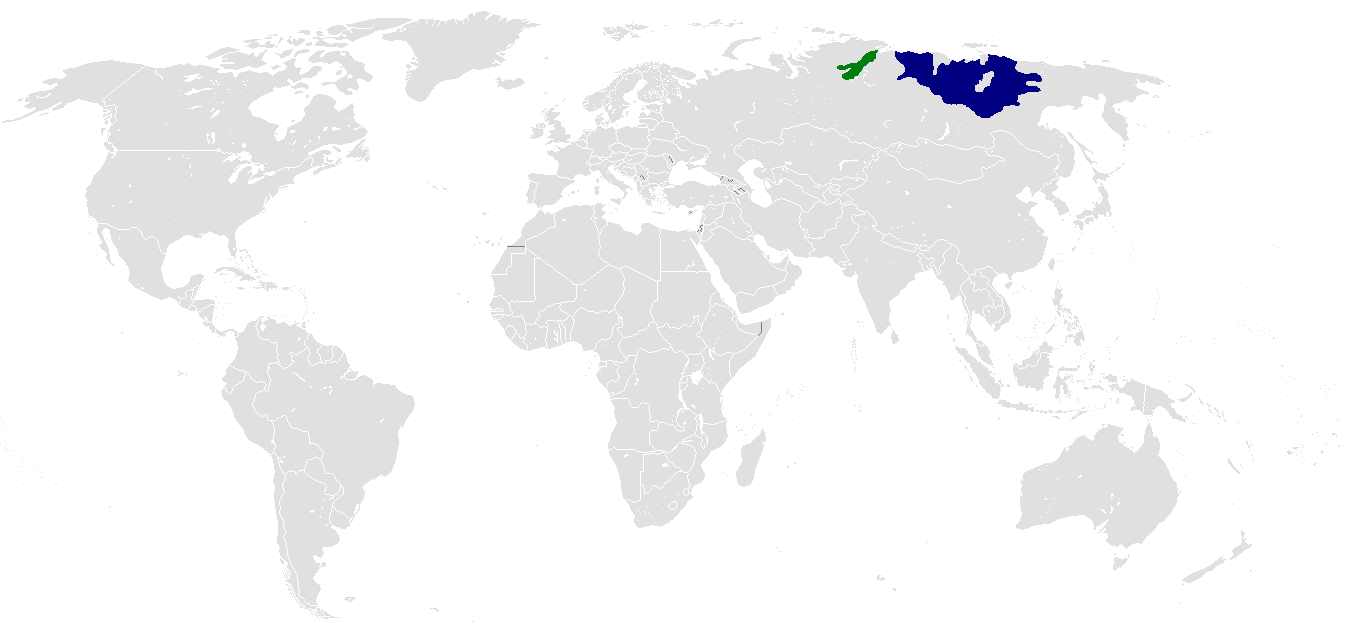
The Dolgan language (долган, dolgan or һака, haka) is an endangered Turkic language, spoken in the Taymyr Peninsula in Russia. The speakers are known as the Dolgans. The word "Dolgan", derived from Evenki, means 'tribe living on the middle reaches of the river'. This is most likely signifying the geographical location of the Dolgan tribe. Its closest relative is Sakha.
The language is very local and restricted to a certain area and has declined in usage over the years. As of 2020 there are only about 5,350 speakers of the language. The language has experienced a few changes since the beginning of its formation, such as alphabet and phrasing terms. The issue as of recently has become the weak integration of this local language within families with mixed marriages. Instead of speaking either of the parents' local languages, the family incorporates Russian as the more dominant language to ease interfamilial and external communication. This results in children learning the language only slightly or as a second language. Over generations, the language continues to fade. In 1999, however, some children were apparently learning Dolgan, with Russian also being learned at an early age.
Dolgan, along with its close relative Sakha (Yakut), belongs to the North Siberian subbranch of the Turkic language family. Like most other Turkic languages, Dolgan has vowel harmony, agglutinative morphology, subject-object-verb word order, and lacks grammatical gender. Dolgan is linguistically relatively close to its nearest relative Sakha (also known as Yakut), which has led researchers for a long time to account for it as a variety of the latter, cf. Dolgikh's (1963: 129) statement in his well-known paper on the origin of the Dolgans: " ... долганский язык является диалектом якутского языка." ‘[ ...] the Dolgan language is a dialect of the Yakut language.’.[citation needed] Only in 1985 did Elizaveta Ubryatova account for Dolgan as a separate language, namely in her monograph on the language of the Norilsk Dolgans.[citation needed]
The Dolgan language started out having a Latin alphabet in the early 20th century. Over time, the Cyrillic alphabet was implemented instead since it is the same alphabet used by the related language, Yakut. Evenki's influence on Dolgan can explain, in part, why it is considered a separate language from Yakut. Dolgan has made appearances in newspapers, such as the Taymyr, as well as schools starting around the time of the 60s.
Certain words in the language were developed from geographical implications that have been present since the start of the Dolgan language. For instance, the directional terms tās (1. south 2. east) and muora (1. north 2. west) are representative of the corresponding landscapes. Tās is related to the word stone, and the southeast topography of the native region, Taymyr Peninsula, is covered by the Putorana Mountains. Similarly, muora denotes "sea" where the western zone of Taymyr has access to the sea shore. At the same time, southwest, uhä, and northeast, allara, have no significance in geographical terms relative to Taymyr.[citation needed]
Dolgan has the following phonetic characteristics:
Over time, the language itself has changed and adapted. Even during the time period when it had a Cyrillic alphabet, it changed over the years. The first version of alphabet of the language had the following appearance: А а, Б б, В в, Г г, Д д, Дь дь, Е е, Ё ё, Ж ж, З з, И и, Иэ иэ, Й й, К к, Л л, М м, Н н, Ӈ ӈ, Нь нь, О о, Ө ө, П п, Р р, С с, Т т, У у, Уо уо, Ү ү, Үө үө, Ф ф, Х х, Һ һ, Ц ц, Ч ч, Ш ш, Щ щ, Ъ ъ, Ы ы, Ыа ыа, Ь ь, Э э, Ю ю, Я я.
The current Dolgan alphabet is still Cyrillic and looks as follows: А а, Б б, В в, Г г, Д д, Е е, Ё ё, Ж ж, З з, И и, Й й, К к, Л л, М м, Н н, Ӈ ӈ, О о, Ө ө, П п, Р р, С с, Т т, У у, Ү ү, Ф ф, Х х, Һ һ, Ц ц, Ч ч, Ш ш, Щ щ, Ъ ъ, Ы ы, Ь ь, Э э, Ю ю, Я я.
Hub AI
Dolgan language AI simulator
(@Dolgan language_simulator)
Dolgan language
The Dolgan language (долган, dolgan or һака, haka) is an endangered Turkic language, spoken in the Taymyr Peninsula in Russia. The speakers are known as the Dolgans. The word "Dolgan", derived from Evenki, means 'tribe living on the middle reaches of the river'. This is most likely signifying the geographical location of the Dolgan tribe. Its closest relative is Sakha.
The language is very local and restricted to a certain area and has declined in usage over the years. As of 2020 there are only about 5,350 speakers of the language. The language has experienced a few changes since the beginning of its formation, such as alphabet and phrasing terms. The issue as of recently has become the weak integration of this local language within families with mixed marriages. Instead of speaking either of the parents' local languages, the family incorporates Russian as the more dominant language to ease interfamilial and external communication. This results in children learning the language only slightly or as a second language. Over generations, the language continues to fade. In 1999, however, some children were apparently learning Dolgan, with Russian also being learned at an early age.
Dolgan, along with its close relative Sakha (Yakut), belongs to the North Siberian subbranch of the Turkic language family. Like most other Turkic languages, Dolgan has vowel harmony, agglutinative morphology, subject-object-verb word order, and lacks grammatical gender. Dolgan is linguistically relatively close to its nearest relative Sakha (also known as Yakut), which has led researchers for a long time to account for it as a variety of the latter, cf. Dolgikh's (1963: 129) statement in his well-known paper on the origin of the Dolgans: " ... долганский язык является диалектом якутского языка." ‘[ ...] the Dolgan language is a dialect of the Yakut language.’.[citation needed] Only in 1985 did Elizaveta Ubryatova account for Dolgan as a separate language, namely in her monograph on the language of the Norilsk Dolgans.[citation needed]
The Dolgan language started out having a Latin alphabet in the early 20th century. Over time, the Cyrillic alphabet was implemented instead since it is the same alphabet used by the related language, Yakut. Evenki's influence on Dolgan can explain, in part, why it is considered a separate language from Yakut. Dolgan has made appearances in newspapers, such as the Taymyr, as well as schools starting around the time of the 60s.
Certain words in the language were developed from geographical implications that have been present since the start of the Dolgan language. For instance, the directional terms tās (1. south 2. east) and muora (1. north 2. west) are representative of the corresponding landscapes. Tās is related to the word stone, and the southeast topography of the native region, Taymyr Peninsula, is covered by the Putorana Mountains. Similarly, muora denotes "sea" where the western zone of Taymyr has access to the sea shore. At the same time, southwest, uhä, and northeast, allara, have no significance in geographical terms relative to Taymyr.[citation needed]
Dolgan has the following phonetic characteristics:
Over time, the language itself has changed and adapted. Even during the time period when it had a Cyrillic alphabet, it changed over the years. The first version of alphabet of the language had the following appearance: А а, Б б, В в, Г г, Д д, Дь дь, Е е, Ё ё, Ж ж, З з, И и, Иэ иэ, Й й, К к, Л л, М м, Н н, Ӈ ӈ, Нь нь, О о, Ө ө, П п, Р р, С с, Т т, У у, Уо уо, Ү ү, Үө үө, Ф ф, Х х, Һ һ, Ц ц, Ч ч, Ш ш, Щ щ, Ъ ъ, Ы ы, Ыа ыа, Ь ь, Э э, Ю ю, Я я.
The current Dolgan alphabet is still Cyrillic and looks as follows: А а, Б б, В в, Г г, Д д, Е е, Ё ё, Ж ж, З з, И и, Й й, К к, Л л, М м, Н н, Ӈ ӈ, О о, Ө ө, П п, Р р, С с, Т т, У у, Ү ү, Ф ф, Х х, Һ һ, Ц ц, Ч ч, Ш ш, Щ щ, Ъ ъ, Ы ы, Ь ь, Э э, Ю ю, Я я.
Recent media