



Community hub
Donar's Oak
View on Wikipedia
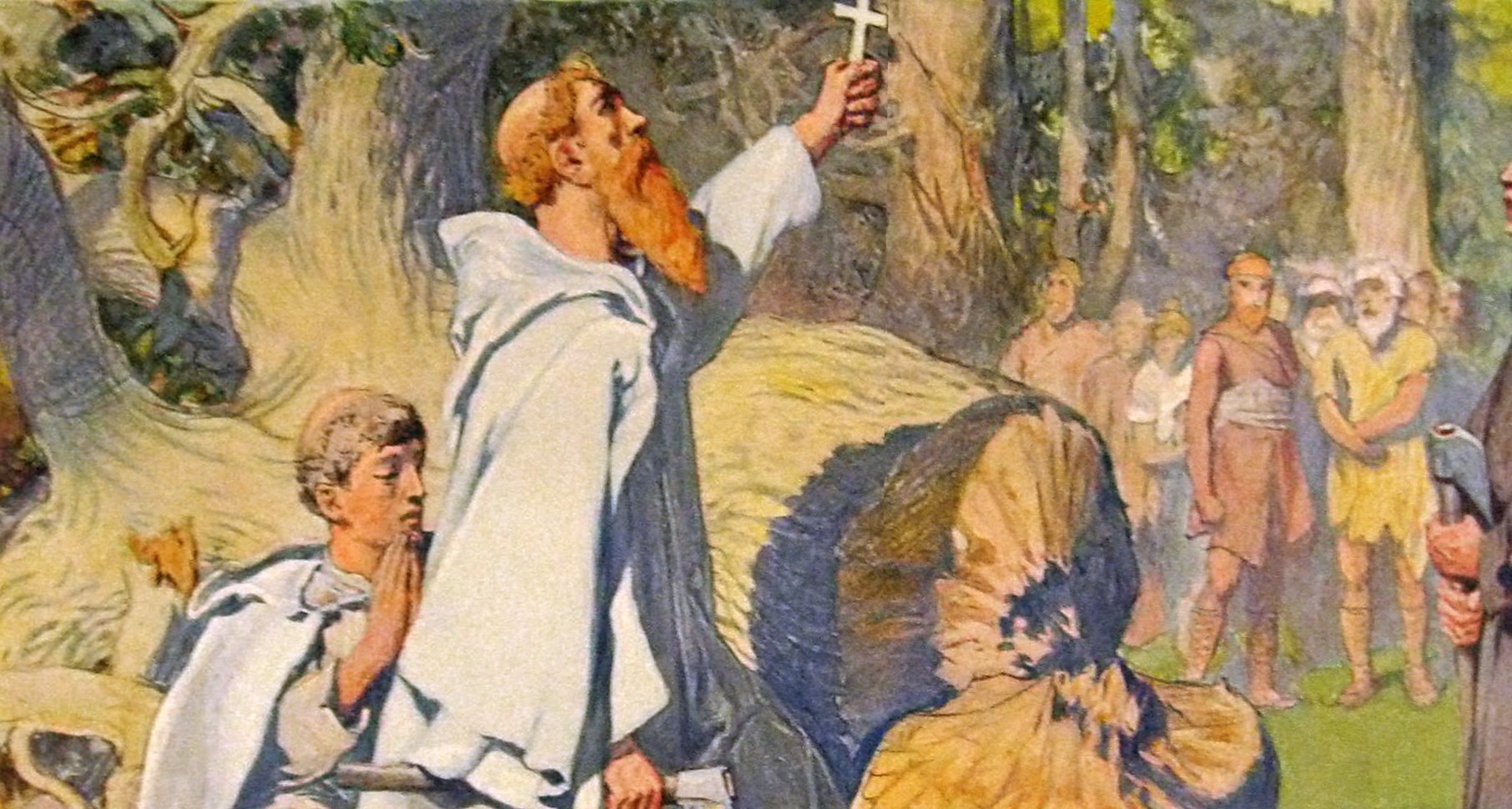
Donar's Oak (also Thor's Oak or, via interpretatio romana, Jove's Oak) was a sacred tree of the Germanic pagans located in an unclear location around what is now Hesse, Germany. According to the 8th-century Vita Bonifatii auctore Willibaldo, Saint Boniface, an Anglo-Saxon missionary, and his retinue cut down the tree earlier in the same century. Wood from the oak was then reportedly used to build a church at the site dedicated to Saint Peter. Sacred trees and sacred groves were widely venerated by the Germanic peoples.
Willibald's Life of Saint Boniface
[edit]
According to Willibald's 8th-century Life of Saint Boniface, the felling of the tree occurred during Boniface's life earlier the same century at a location at the time known as Gaesmere (for details, see discussion below).[1]
Although no date is provided, the felling may have occurred around 723 or 724.[2] Willibald's account is as follows (note that Robinson has translated robor Iobis, "tree of Jove", as "oak of Jupiter"):
Cum vero Hessorum iam multi, catholica fide subditi ac septiformis spiritus gratia confirmati, manus inspositionem acciperunt, et quidem, nondum animo confortati, intermeratae fidei documenta integre perceipere rennuerunt, alii etiam lignis et fontibus clanculo, alii autem aperte sacrificabant; alii vero aruspicia et divinationes, prestigia atque icantationes occulte, alii quidem manifeste exercebant; alii quippe auguria et auspicia intendebant diversosque sacrificandi ritus incoluerunt; alii etiam, quibus mens sanior inerat, omni abeicta gentilitatis profantione, nihil horum commisserunt. Quorum consultu atque consilio roborem quendam mirae magnitudinis, qui prisco paganorum vocabulo appellatur robor Iobis, in loco qui dicitur Gaesmere, servis Dei secum adstantibus succidere temptavit. Cumque, mentis constantia confortatus, arborem succidisset, — magna quippe aderat copia paganorum, qui et inimicum deorum suorum intra se diligentissime devotabant, — sed ad modicum quidem arbore praeciso, confestim inmensa roboris moles, divino desuper flatu exagitata, palmitum confracto culmine, corruit et quasi superni nutus solatio in quattuor etiam partes disrupta est, et quattuor ingentis magnitudinis aequali longitudine trunci absque fratrum labore adstantium apparuerunt. Quo viso, prius devotantes pagani etiam versa vice benedictionem Domino, pristina abiecta maledictione, credentes reddiderunt. Tunc autem summae sanctitatis antistes, consilio inito cum fratribus, ligneum ex supradictae arboris metallo oratorium construxit eamque in honore sancti Petri apostoli dedicavit.[3]
Now at that time many of the Hessians, brought under the Catholic faith and confirmed by the grace of the sevenfold spirit, received the laying on of hands; others indeed, not yet strengthened in soul, refused to accept in their entirety the lessons of the inviolate faith. Moreover some were wont secretly, some openly to sacrifice to trees and springs; some in secret, others openly practiced inspections of victims and divinations, legerdemain and incantations; some turned their attention to auguries and auspices and various sacrificial rites; while others, with sounder minds, abandoned all the profanations of heathenism, and committed none of these things. With the advice and counsel of these last, the saint attempted, in the place called Gaesmere, while the servants of God stood by his side, to fell a certain oak of extraordinary size, which is called, by an old name of the pagans, the Oak of Jupiter. And when in the strength of his steadfast heart he had cut the lower notch, there was present a great multitude of pagans, who in their souls were earnestly cursing the enemy of their gods. But when the fore side of the tree was notched only a little, suddenly the oak's vast bulk, driven by a blast from above, crashed to the ground, shivering its crown of branches as it fell; and, as if by the gracious compensation of the Most High, it was also burst into four parts, and four trunks of huge size, equal in length, were seen, unwrought by the brethren who stood by. At this sight the pagans who before had cursed now, on the contrary, believed, and blessed the Lord, and put away their former reviling. Then moreover the most holy bishop, after taking counsel with the brethren, built from the timber of the tree a wooden oratory, and dedicated it in honor of Saint Peter the apostle.[4]
Germanic tree and grove veneration
[edit]Sacred groves and sacred trees were venerated throughout the history of the Germanic peoples and were targeted for destruction by Christian missionaries during the Christianization of the Germanic peoples. Ken Dowden notes that behind this great oak dedicated to Donar, the Irminsul (also felled by Christian missionaries in the 8th century), and the Sacred tree at Uppsala (described by Adam of Bremen in the 11th century), stands a mythic prototype of an immense world tree, described in Norse mythology as Yggdrasil.[5]
Location of Gaesmere
[edit]By the nineteenth century Gaesmere was identified as Geismar in the Schwalm-Eder district, for instance by August Neander.[6] There are a few dissenting voices: in his 1916 translation of Willibald's Vita Bonifacii, George W. Robinson says "The location [of the tree] is uncertain. There are in Hesse several places named Geismar."[1] The historian Thomas F. X. Noble (2000) describes the location of the tree felling as "still unidentified".[2] In the late 19th century the folklorist and philologist Francis Barton Gummere identified the Gaesemere of the attestation as Geismar, a district of Frankenberg located in Hesse.[7]
However, most scholars agree that the site mentioned by Willibald is Geismar near Fritzlar. In 1897 the historian C. Neuber placed the Donar Oak "im Kreise Fritzlar".[8] While Gregor Richter in 1906 noted that one scholar considered Hofgeismar as a possible location, he himself comments that most people consider Geismar near Fritzlar as the right place.[9] Unequivocal identification of Geismar near Fritzlar as the location of the Donar Oak is found in the Catholic Encyclopedia,[10] in teaching materials for religious studies classes in Germany,[11] in the work of Alexander Demandt,[12] in histories of the Carolingians,[13] and in the work of Lutz von Padberg.[14][15] The Reallexikon der Germanischen Altertumskunde notes that for Willibald it was probably not necessary to specify the location any further because he presumed it widely known.[16] This Geismar was close to Büraburg, then a hill castle and a Frankish stronghold.[17]
Role in Bonifatian hagiography and imagery
[edit]One of the focal points of Boniface's life, the scene is frequently repeated, illustrated, and reimagined. Roberto Muller, for instance, in a retelling of Boniface's biography for young adults, has the four parts of the tree fall down to the ground and form a cross.[18] In Hubertus Lutterbach's fictional expansion of the Boniface correspondence, Boniface relates the entire event in a long letter to Pope Gregory II, commenting that it took hours to cut the tree down, and that any account that says the tree fell down miraculously is a falsification of history.[19]
See also
[edit]- List of individual trees
- Capitulatio de partibus Saxoniae, a law code imposed by Charlemagne in 785 that prescribes death for Saxon pagans refusing to convert to Christianity
- Massacre of Verden, a massacre of 4,500 captive pagan Saxons ordered by Charlemagne in 782
- Caill Tomair, a grove dedicated to Thor destroyed by the forces of Brian Boru in early 1000
Notes
[edit]- ^ a b Robinson 63.
- ^ a b Emerton xiv.
- ^ Levison 30–32.
- ^ Robinson 62—64.
- ^ Dowden 72.
- ^ Neander 51.
- ^ Gummere 388.
- ^ Neuber 253-55.
- ^ Richter 52.
- ^ Mershman.
- ^ Dam 13.
- ^ Demandt 424.
- ^ Riche 40.
- ^ Von Padberg, Bonifatius 41.
- ^ Von Padberg, Wynfreth-Bonifatius 74.
- ^ Udolph and Gensen 586.
- ^ Schieffer 148.
- ^ Muller 76–77.
- ^ Lutterbach 47-58.
References
[edit]- Dam, Harmjan (2013). Kirchengeschichte im Religionsunterricht: Basiswissen und Bausteine für die Klassen 5–10. Vandenhoeck & Ruprecht. ISBN 9783525776414.
Zerstörung der Donar-Eiche in Geismar bei Fritzlar (Nord-Hessen)
- Demandt, Alexander (2008). Geschichte der Spätantike: das Römische Reich von Diocletian bis Justinian 284-565 n. Chr. Munich: C.H.Beck. ISBN 9783406572418.
Bonifatius erbaute aus dem Holz der Donar-Eiche die erste Petruskirche der späteren Stadt Fritzlar
- Dowden, Ken (2000). European Paganism: The Reality of Cult from Antiquity to the Middle Ages. Routledge. ISBN 0415120349
- Emerton, Ephraim (2000). The Letters of Saint Boniface. Columbia University Press. ISBN 0231120923
- Gummere, Francis B. (1892). Germanic Origins: A Study in Primitive Culture. Charles Scribner's Sons.
- Levison, Wilhelm (1905). Vitae Sancti Bonifatii archiepiscopi moguntini. Monumenta Germaniæ historica: Scriptores rerum germanicorum in usum scholarum separatim editi. Hannover and Leipzig: Hahn. OCLC 2116528 (Latin)
- Lutterbach, Hubertus (2004). Bonifatius - mit Axt und Evangelium: eine Biographie in Briefen (in German). Herder. ISBN 9783451285097.
- Mershman, Francis (1913). . In Herbermann, Charles (ed.). Catholic Encyclopedia. New York: Robert Appleton Company.
- Muller, Roberto (1967). Bring Me an Ax!. Notre Dame: Dujarie.
- Neander, August; Schneider, K. F. Th (1850). General history of the Christian religion and church. Crocker & Brewster. p. 51.
- Neuber, C. (1897). "Die altere Geschichte von Fritzlar". Hessenland: Zeitschrift für die Kulturpflege des Bezirksverbandes Hessen: 253–55. Retrieved 26 September 2016.
- Padberg, Lutz von (1989). Wynfreth-Bonifatius. Wuppertal: Brockhaus. ISBN 3417211042.
- Padberg, Lutz von (2003). Bonifatius: Missionar und Reformer. Munich: C.H.Beck. ISBN 9783406480195.
...in unmittelbare Nähe den Fränkischen Stützpunkt Büraburg-Fritzlar
- Riche, Pierre (1993). The Carolingians: A Family Who Forged Europe. U of Pennsylvania P. ISBN 9780812213423.
Protected by Frankish forces, Boniface established a first monastery at Amoneburg and then, after destroying the sacred Donar Oak at Geismar, a second in nearby Fritzlar
- Richter, Gregor (1906). "Bonifatiana III". Fuldaer Geschichtsblätter. 5 (5): 49–62. Retrieved 26 September 2016.
- Robinson, George W. (trans.) (1916). The Life of Saint Boniface by Willibald. Harvard University Press.
- Schieffer, Theodor (1972). Winfrid-Bonifatius und die Christliche Grundlegung Europas (in German). Darmstadt: Wiss. Buchges. ISBN 9783534060658.
- Udolph, J; Gensen, R (1978). "Bonifatius". In Hoops, Johannes (ed.). Reallexikon der Germanischen Altertumskunde. Walter de Gruyter. pp. 584–89. ISBN 9783110065121.
External links
[edit]
- A Modern Myth - St Boniface and the Christmas Tree - with links to the Latin text of Willibald's Life.

Donar's Oak
View on GrokipediaHistorical Sources and Account
Primary Source in Willibald's Vita
Willibald's Vita Bonifatii, composed around 760 AD by the presbyter Willibald of Mainz, a contemporary cleric linked to Boniface's disciples, offers the earliest surviving narrative of the event.[8] This hagiographic biography, drawing on eyewitness testimonies from Boniface's circle, recounts the episode in Chapter VI without specifying a precise date.[9] The text describes Boniface, advised by his companions, approaching the site at Gaesmere (modern Geismar in Hesse), where a massive oak tree—known to pagans by its ancient name as the Oak of Jupiter—stood as an object of veneration among the Hessian idolaters.[9] With Christian servants at his side, Boniface began felling the tree through a notch at its base, as a large crowd of pagans observed, inwardly cursing him as the foe of their deities.[9] After only slight notching on the front side, a sudden divine gust from above toppled the oak's immense trunk, shattering its branches and splitting it into four equal, unhewn segments— an outcome attributed to God's providence rather than further human labor.[9] This unforeseen collapse prompted the pagans to shift from malediction to faith: those who had cursed now acclaimed the Christian God and relinquished their hostility.[9] Boniface then directed the brethren to repurpose the oak's timber into an oratory, which he consecrated to Saint Peter the Apostle.[9] The account frames the act as a deliberate confrontation with pagan cult practices, emphasizing divine intervention over Boniface's physical effort alone.[9]Other Contemporary References
No direct allusions to the specific felling of Donar's Oak appear in Boniface's surviving correspondence, which comprises approximately 150 letters and documents spanning 716 to 754 AD, focused primarily on ecclesiastical reforms, papal relations, and missionary logistics rather than individual acts of iconoclasm. These letters, edited in critical collections, prioritize administrative and doctrinal concerns, underscoring the event's absence from Boniface's self-reporting.[10] Conciliar texts from Boniface's era provide indirect context through decrees against paganism. The Synod of Liptines (also Lestines or Leptines), held in 743 AD under Boniface's presidency and convened by Carloman, issued four canons reaffirming the 742 Concilium Germanicum's prohibitions on idolatry, requiring clergy and laity to adhere to Christian norms and implicitly endorsing the eradication of sacred sites to enforce orthodoxy.[11] Such measures align with broader iconoclastic campaigns but offer no explicit corroboration of the Geismar incident, highlighting variances in documentation where general anti-pagan edicts substitute for event-specific narratives. Subsequent Carolingian annals and biographies echo motifs of sacred object destruction without referencing Donar's Oak. Einhard's Vita Karoli Magni (composed c. 817–830 AD) details Charlemagne's 772 AD assault on the Irminsul pillar in Saxony, portraying it as a decisive strike against heathen resistance, a parallel often drawn by historians to Boniface's earlier action due to similarities in ritual desecration and missionary symbolism, though Einhard attributes no causal lineage.[12] This recurrence in Christian historiography suggests a templated hagiographic trope rather than independent attestation. The complete lack of pagan accounts—expected given the non-literate, oral framework of Germanic traditions—compels reconstruction from Christian sources alone, which, while proximate (Willibald drew from eyewitnesses), embed the event in providential theology, potentially amplifying miraculous elements for evangelistic impact.[6] No variances in pagan perspectives exist to balance these reports, limiting empirical verification to archaeological voids at Geismar and contextual synodal pressures.Germanic Pagan Context
Tree and Grove Veneration Practices
In pre-Christian Germanic societies, sacred groves (lucus in Latin sources) functioned as central cultic sites for communal rituals, including sacrifices and tribal assemblies, as described by the Roman historian Tacitus in his Germania (written around 98 CE). Tacitus reports that the Germanic tribes eschewed enclosed temples, preferring open groves where worship occurred amid natural features symbolizing divine presence; for instance, the Semnones tribe conducted annual sacrifices in a consecrated grove believed to be the origin point of all Germanic peoples, with participants entering bound to signify submission to the gods.[13][14] These sites hosted blood offerings of animals—and occasionally humans—to propitiate deities, reinforcing social bonds through shared oaths sworn before the trees, which were viewed as witnesses to pacts due to their enduring, rooted stability.[15] Individual sacred trees within or adjacent to groves embodied cosmological connections, serving as symbolic axis mundi linking the earthly realm, divine spheres, and ancestral underworld, a motif paralleled in Norse traditions by Yggdrasil, the world tree depicted in medieval Icelandic texts like the Poetic Edda (compiled ca. 13th century from older oral sources). This tree, envisioned as sustaining the nine worlds through its branches and roots, reflects broader Germanic perceptions of arboreal forms as mediators between realms, with roots delving into chthonic forces and crowns reaching celestial domains; archaeological finds, such as ritual deposits around ancient trees in bogs and settlements, corroborate textual accounts of trees as focal points for votive offerings.[16] Such veneration extended to divinatory practices, where tree-derived materials facilitated oracles; Tacitus details lot-casting using slips cut from nut-bearing trees, marked and cast thrice daily to interpret divine will, underscoring trees' role in probabilistic decision-making tied to natural cycles.[15] Later evidence from the 11th-century chronicler Adam of Bremen describes the sacred grove at Uppsala in Sweden (ca. 1070s), where sacrificial victims—nine males of various species every nine years—were hung from trees to honor gods, their bodies left as perpetual offerings amid the foliage, highlighting groves' integration into periodic renewal rites that bolstered community cohesion against external threats.[17] These practices, rooted in empirical observation of trees' longevity and seasonal resilience, fostered cultural resistance to incursions, as disrupting such sites symbolized severing tribal continuity, though Christian sources like Adam introduce interpretive biases favoring exaggeration of "barbarity" to justify conversion efforts.[18] ![Yggdrasil as cosmic tree in Norse tradition][center]In later Germanic contexts, tree veneration persisted in localized forms, with archaeological evidence from sites like ritual enclosures in northern Europe revealing post holes and offerings indicative of tree-centric shrines predating temple constructions, affirming groves' primacy in non-urbanized worship landscapes.[19]