Hubbry Logo
IconoclasmIconoclasmMain
Open search
Iconoclasm
Community hub
Iconoclasm
logo
8 pages, 0 posts
0 subscribers
Be the first to start a discussion here.
Contribute something
Iconoclasm
Iconoclasm
from Wikipedia
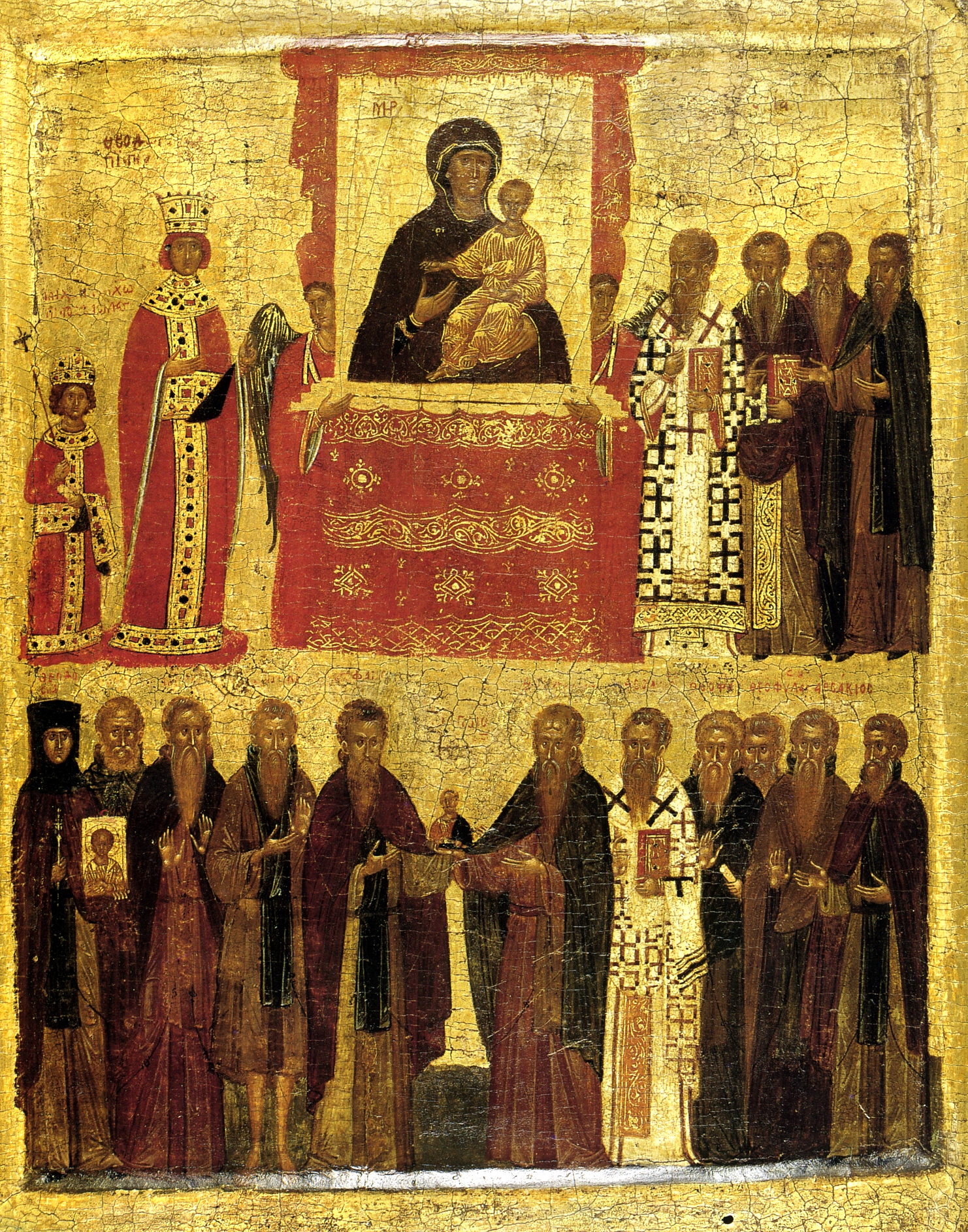
Icon of the Triumph of Orthodoxy depicting the "Triumph of Orthodoxy" over iconoclasm under the Byzantine empress Theodora and her son Michael III, late 14th to early 15th century

Iconoclasm (from Ancient Greek εἰκών (eikṓn) 'figure, icon' and κλάω (kláō) 'to break')[i] is the belief in the importance of the destruction of icons and other images or monuments, often for religious or political reasons. Those who engage in or support iconoclasm are called iconoclasts, a term that has come to be applied figuratively and more broadly to anyone who challenges "cherished beliefs or venerated institutions on the grounds that they are erroneous or pernicious".[1]

Conversely, one who reveres or venerates religious images is called (by iconoclasts) an iconolater; in a Byzantine context, such a person is called an iconodule or iconophile.[2] Iconoclasm does not generally encompass the destruction of the images of a specific ruler after their death or overthrow, a practice better known as damnatio memoriae.

While iconoclasm may be carried out by adherents of a different religion, it is more commonly the result of sectarian disputes between factions of the same religion. The term originates from the Byzantine Iconoclasm, the struggles between proponents and opponents of religious icons in the Byzantine Empire from 726 to 842 AD. While the enthusiasm for iconoclasm varies among faiths, the practice is more common in religions which oppose idolatry, such as the Abrahamic religions.[3] Outside of the religious context, iconoclasm can refer to movements for widespread destruction in symbols of an ideology or cause, such as the destruction of monarchist symbols during the French Revolution.

Early religious iconoclasm

[edit]

Ancient era

[edit]

In the Bronze Age, the most significant episode of iconoclasm occurred in Egypt during the Amarna Period, when Akhenaten, based in his new capital of Akhetaten, instituted a significant shift in Egyptian artistic styles alongside a campaign of intolerance towards the traditional gods and a new emphasis on a state monolatristic tradition focused on the god Aten, the Sun disk—many temples and monuments were destroyed as a result:[4][5]

In rebellion against the old religion and the powerful priests of Amun, Akhenaten ordered the eradication of all of Egypt's traditional gods. He sent royal officials to chisel out and destroy every reference to Amun and the names of other deities on tombs, temple walls, and cartouches to instill in the people that the Aten was the one true god.

Public references to Akhenaten were destroyed soon after his death. Comparing the ancient Egyptians with the Israelites, Jan Assmann writes:[6]

For Egypt, the greatest horror was the destruction or abduction of the cult images. In the eyes of the Israelites, the erection of images meant the destruction of divine presence; in the eyes of the Egyptians, this same effect was attained by the destruction of images. In Egypt, iconoclasm was the most terrible religious crime; in Israel, the most terrible religious crime was idolatry. In this respect Osarseph alias Akhenaten, the iconoclast, and the Golden Calf, the paragon of idolatry, correspond to each other inversely, and it is strange that Aaron could so easily avoid the role of the religious criminal. It is more than probable that these traditions evolved under mutual influence. In this respect, Moses and Akhenaten became, after all, closely related.

Judaism

[edit]

According to the Hebrew Bible, God instructed the Israelites to "destroy all [the] engraved stones, destroy all [the] molded images, and demolish all [the] high places" of the Canaanites as soon as they entered the Promised Land.[7]

King Hezekiah purged Solomon's Temple in Jerusalem and all figures were also destroyed in the Land of Israel, including the Nehushtan, as recorded in the Second Book of Kings. His reforms were reversed in the reign of his son Manasseh.[8]

Iconoclasm in Christian history

[edit]
Defaced relief of Horus and Isis in the Temple of Edfu, Egypt. Local Christians engaged in campaigns of proselytism and iconoclasm.
Saint Benedict's monks destroy an image of Apollo, worshiped in the Roman Empire.

Scattered expressions of opposition to the use of images have been reported: the Synod of Elvira appeared to endorse iconoclasm; Canon 36 states: "Pictures are not to be placed in churches, so that they do not become objects of worship and adoration."[9][10] A possible translation is also: "There shall be no pictures in the church, lest what is worshipped and adored should be depicted on the walls."[11] The date of this canon is disputed.[12] Proscription ceased after the destruction of pagan temples. However, widespread use of Christian iconography only began as Christianity increasingly spread among Gentiles after the legalization of Christianity by Roman Emperor Constantine (c. 312 AD). During the process of Christianisation under Constantine, Christian groups destroyed the images and sculptures of the Roman Empire's polytheist state religion.

Among early church theologians, iconoclastic tendencies were supported by theologians such as Tertullian,[13][14][15] Clement of Alexandria,[14] Origen,[16][15] Lactantius,[17] Justin Martyr,[15] Eusebius and Epiphanius.[14][18]

Byzantine era

[edit]
Byzantine Iconoclasm, Chludov Psalter, 9th century[19]

The period after the reign of Byzantine Emperor Justinian (527–565) evidently saw a huge increase in the use of images, both in volume and quality, and a gathering aniconic reaction.[citation needed]

One notable change within the Byzantine Empire came in 695, when Justinian II's government added a full-face image of Christ on the obverse of imperial gold coins. The change caused the Caliph Abd al-Malik to stop his earlier adoption of Byzantine coin types. He started a purely Islamic coinage with lettering only.[20] A letter by the Patriarch Germanus, written before 726 to two iconoclast bishops, says that "now whole towns and multitudes of people are in considerable agitation over this matter", but there is little written evidence of the debate.[21]

Government-led iconoclasm began with Byzantine Emperor Leo III, who issued a series of edicts between 726 and 730 against the veneration of images.[22] The religious conflict created political and economic divisions in Byzantine society; iconoclasm was generally supported by the Eastern, poorer, non-Greek peoples of the Empire who had to frequently deal with raids from the new Muslim Empire.[23] On the other hand, the wealthier Greeks of Constantinople and the peoples of the Balkan and Italian provinces strongly opposed iconoclasm.[23]

Pre-Reformation

[edit]

Peter of Bruys opposed the usage of religious images,[24] the Strigolniki were also possibly iconoclastic.[25] Claudius of Turin was the bishop of Turin from 817 until his death.[26] He is most noted for teaching iconoclasm.[26]

Reformation era

[edit]
Extent (in blue) of the Beeldenstorm through the Spanish Netherlands

The first iconoclastic wave happened in Wittenberg in the early 1520s under reformers Thomas Müntzer and Andreas Karlstadt. In 1522 Karlstadt published his tract, "Von abtuhung der Bylder". ("On the removal of images"), which added to the growing unrest in Wittenberg.[27] Martin Luther, then concealed under the pen-name of 'Junker Jörg', intervened to calm things down. Luther argued that the mental picturing of Christ when reading the Scriptures was similar in character to artistic renderings of Christ.[28]

In contrast to the Lutherans who favoured certain types of sacred art in their churches and homes,[29][30] the Reformed (Calvinist) leaders, in particular Andreas Karlstadt, Huldrych Zwingli and John Calvin, encouraged the removal of religious images by invoking the Decalogue's prohibition of idolatry and the manufacture of graven (sculpted) images of God.[30] As a result, individuals attacked statues and images, most famously in the beeldenstorm across the Low Countries in 1566.

The belief of iconoclasm caused havoc throughout Europe. In 1523, specifically due to the Swiss reformer Huldrych Zwingli, a vast number of his followers viewed themselves as being involved in a spiritual community that in matters of faith should obey neither the visible Church nor lay authorities. According to Peter George Wallace, "Zwingli's attack on images, at the first debate, triggered iconoclastic incidents in Zürich and the villages under civic jurisdiction that the reformer was unwilling to condone." Due to this action of protest against authority, "Zwingli responded with a carefully reasoned treatise that men could not live in society without laws and constraint".[31]

Significant iconoclastic riots took place in Basel (in 1529), Zürich (1523), Copenhagen (1530), Münster (1534), Geneva (1535), Augsburg (1537), Scotland (1559), Rouen (1560), and Saintes and La Rochelle (1562).[32][33] Calvinist iconoclasm in Europe "provoked reactive riots by Lutheran mobs" in Germany and "antagonized the neighbouring Eastern Orthodox" in the Baltic region.[34]

The Seventeen Provinces (now the Netherlands, Belgium, and parts of Northern France) were disrupted by widespread Calvinist iconoclasm in the summer of 1566.[35]

A painting
In this Elizabethan work of propaganda, the top right depicts men pulling down and smashing icons, while power is shifting from the dying King Henry VIII at left, pointing to his staunchly Protestant son, the boy-king Edward VI at centre.[38][39][40]

During the Reformation in England, which started during the reign of Henry VIII, and was urged on by reformers such as Hugh Latimer and Thomas Cranmer, limited official action was taken against religious images in churches in the late 1530s. Henry's young son, Edward VI, came to the throne in 1547 and, under Cranmer's guidance, issued injunctions for religious reforms in the same year and in 1549 the Putting away of Books and Images Act.[41]

During the English Civil War, the Parliamentarians reorganised the administration of East Anglia into the Eastern Association of counties. This covered some of the wealthiest counties in England, which in turn financed a substantial and significant military force. After Earl of Manchester was appointed the commanding officer of these forces, in turn he appointed Smasher Dowsing as Provost Marshal, with a warrant to demolish religious images which were considered to be superstitious or linked with popism.[42] Bishop Joseph Hall of Norwich described the events of 1643 when troops and citizens, encouraged by a Parliamentary ordinance against superstition and idolatry, behaved thus:

Lord what work was here! What clattering of glasses! What beating down of walls! What tearing up of monuments! What pulling down of seats! What wresting out of irons and brass from the windows! What defacing of arms! What demolishing of curious stonework! What tooting and piping upon organ pipes! And what a hideous triumph in the market-place before all the country, when all the mangled organ pipes, vestments, both copes and surplices, together with the leaden cross which had newly been sawn down from the Green-yard pulpit and the service-books and singing books that could be carried to the fire in the public market-place were heaped together.

Altarpiece fragments (late 1300 – early 1400) destroyed during the English Dissolution of the Monasteries, mid-16th century

Protestant Christianity was not uniformly hostile to the use of religious images. Martin Luther taught the "importance of images as tools for instruction and aids to devotion",[43] stating: "If it is not a sin but good to have the image of Christ in my heart, why should it be a sin to have it in my eyes?"[44] Lutheran churches retained ornate church interiors with a prominent crucifix, reflecting their high view of the real presence of Christ in Eucharist.[45][29] As such, "Lutheran worship became a complex ritual choreography set in a richly furnished church interior."[45] For Lutherans, "the Reformation renewed rather than removed the religious image".[46]

Lutheran scholar Jeremiah Ohl writes:[47]: 88–89 

Zwingli and others for the sake of saving the Word rejected all plastic art; Luther, with an equal concern for the Word, but far more conservative, would have all the arts to be the servants of the Gospel. "I am not of the opinion" said [Luther], "that through the Gospel all the arts should be banished and driven away, as some zealots want to make us believe; but I wish to see them all, especially music, in the service of Him Who gave and created them." Again he says: "I have myself heard those who oppose pictures, read from my German Bible.... But this contains many pictures of God, of the angels, of men, and of animals, especially in the Revelation of St. John, in the books of Moses, and in the book of Joshua. We therefore kindly beg these fanatics to permit us also to paint these pictures on the wall that they may be remembered and better understood, inasmuch as they can harm as little on the walls as in books. Would to God that I could persuade those who can afford it to paint the whole Bible on their houses, inside and outside, so that all might see; this would indeed be a Christian work. For I am convinced that it is God's will that we should hear and learn what He has done, especially what Christ suffered. But when I hear these things and meditate upon them, I find it impossible not to picture them in my heart. Whether I want to or not, when I hear, of Christ, a human form hanging upon a cross rises up in my heart: just as I see my natural face reflected when I look into water. Now if it is not sinful for me to have Christ's picture in my heart, why should it be sinful to have it before my eyes?

The Ottoman Sultan Suleiman the Magnificent, who had pragmatic reasons to support the Dutch Revolt (the rebels, like himself, were fighting against Spain) also completely approved of their act of "destroying idols", which accorded well with Muslim teachings.[48][49]

16th century Protestant iconoclasm had various effects on visual arts: it encouraged the development of art with violent images such as martyrdoms, of pieces whose subject was the dangers of idolatry, or art stripped of objects with overt Catholic symbolism: the still life, landscape and genre paintings.[50]: 44, 25, 40 

Other instances

[edit]

In Japan during the early modern age, the spread of Catholicism also involved the repulsion of non-Christian religious structures, including Buddhist temples and Shinto shrines and figures. At times of conflict with rivals or some time after the conversion of several daimyos, Christian converts would often destroy Buddhist and Shinto religious structures.[51]

Many of the moai of Easter Island were toppled during the 18th century in the iconoclasm of civil wars before any European encounter.[52] Other instances of iconoclasm may have occurred throughout Eastern Polynesia during its conversion to Christianity in the 19th century.[53]

After the Second Vatican Council in the late 20th century, some Roman Catholic parish churches discarded much of their traditional imagery and art which critics call iconoclasm.[54]

Muslim iconoclasm

[edit]
Islamic miniature depicting Muhammad and Ali (represented by golden flames) leading the Muslims in their destruction of Meccan idols

Islam has a strong tradition of forbidding the depiction of figures, especially religious figures,[3] with some Sunnis forbidding it entirely. In the history of Islam, the act of removing idols from the Ka'ba in Mecca has great symbolic and historic importance for all believers.

In general, Muslim societies have avoided the depiction of living beings (both animals and humans) within such sacred spaces as mosques and madrasahs. This ban on figural representation is not based on the Qur'an, instead, it is based on traditions which are described within the Hadith. The prohibition of figuration has not always been extended to the secular sphere, and a robust tradition of figural representation exists within Muslim art.[55] However, Western authors have tended to perceive "a long, culturally determined, and unchanging tradition of violent iconoclastic acts" within Islamic society.[55]

Early Islam in Arabia

[edit]

The first act of Muslim iconoclasm dates to the beginning of Islam, in 630, when the various statues of Arabian deities housed in the Kaaba in Mecca were destroyed. There is a tradition that Muhammad spared a fresco of Mary and Jesus.[56] This act was intended to bring an end to the idolatry which, in the Muslim view, characterized Jahiliyyah.

The destruction of the idols of Mecca did not, however, determine the treatment of other religious communities living under Muslim rule after the expansion of the caliphate. Most Christians under Muslim rule, for example, continued to produce icons and to decorate their churches as they wished. A major exception to this pattern of tolerance in early Islamic history was the "Edict of Yazīd", issued by the Umayyad caliph Yazīd II in 722–723.[57] This edict ordered the destruction of crosses and Christian images within the territory of the caliphate. Researchers have discovered evidence that the order was followed, particularly in present-day Jordan, where archaeological evidence shows the removal of images from the mosaic floors of some, although not all, of the churches that stood at this time. But Yazīd's iconoclastic policies were not continued by his successors, and Christian communities of the Levant continued to make icons without significant interruption from the sixth century to the ninth.[58]

Egypt

[edit]
The Great Sphinx of Giza's profile in 2010, without its nose

Al-Maqrīzī, writing in the 15th century, attributes the missing nose on the Great Sphinx of Giza to iconoclasm by Muhammad Sa'im al-Dahr, a Sufi Muslim in the mid-1300s. He was reportedly outraged by local Muslims making offerings to the Great Sphinx in the hope of controlling the flood cycle, and he was later executed for vandalism. However, whether this was actually the cause of the missing nose has been debated by historians.[59] Mark Lehner, having performed an archaeological study, concluded that it was broken with instruments at an earlier unknown time between the 3rd and 10th centuries.[60]

Ottoman conquests

[edit]

Certain conquering Muslim armies have used local temples or houses of worship as mosques. An example is Hagia Sophia in Istanbul (formerly Constantinople), which was converted into a mosque in 1453. Most icons were desecrated and the rest were covered with plaster. In 1934 the government of Turkey decided to convert the Hagia Sophia into a museum and the restoration of the mosaics was undertaken by the American Byzantine Institute beginning in 1932.

Contemporary events

[edit]

Certain Muslim denominations continue to pursue iconoclastic agendas. There has been much controversy within Islam over the recent and apparently on-going destruction of historic sites by Saudi Arabian authorities, prompted by the fear they could become the subject of "idolatry".[61][62]

A recent act of iconoclasm was the 2001 destruction of the giant Buddhas of Bamyan by the then-Taliban government of Afghanistan.[63] The act generated worldwide protests and was not supported by other Muslim governments and organizations. It was widely perceived in the Western media as a result of the Muslim prohibition against figural decoration. Such an account overlooks "the coexistence between the Buddhas and the Muslim population that marveled at them for over a millennium" before their destruction.[55] According to art historian F. B. Flood, analysis of the Taliban's statements regarding the Buddhas suggest that their destruction was motivated more by political than by theological concerns.[55] Taliban spokesmen have given many different explanations of the motives for the destruction.

During the Tuareg rebellion of 2012, the radical Islamist militia Ansar Dine destroyed various Sufi shrines from the 15th and 16th centuries in the city of Timbuktu, Mali.[64] In 2016, the International Criminal Court (ICC) sentenced Ahmad al-Faqi al-Mahdi, a former member of Ansar Dine, to nine years in prison for this destruction of cultural world heritage. This was the first time that the ICC convicted a person for such a crime.[65]

The Islamic State of Iraq and the Levant carried out iconoclastic attacks such as the destruction of Shia mosques and shrines. Notable incidents include blowing up the Mosque of the Prophet Yunus (Jonah)[66] and destroying the Shrine to Seth in Mosul.[67]

Iconoclasm in India

[edit]

During Hindu-Buddhist era

[edit]

In early Medieval India, there were numerous recorded instances of temple desecration by Indian kings against rival Indian kingdoms, which involved conflicts between devotees of different Hindu deities, as well as conflicts between Hindus, Buddhists, and Jains.[68][69][page needed][70][page needed]

During the Muslim conquest of Sindh

[edit]

Records from the campaign recorded in the Chach Nama record the destruction of temples during the early 8th century when the Umayyad governor of Damascus, al-Hajjaj ibn Yusuf,[71] mobilized an expedition of 6000 cavalry under Muhammad bin Qasim in 712.

Historian Upendra Thakur records the persecution of Hindus and Buddhists:

Muhammad triumphantly marched into the country, conquering Debal, Sehwan, Nerun, Brahmanadabad, Alor and Multan one after the other in quick succession, and in less than a year and a half, the far-flung Hindu kingdom was crushed ... There was a fearful outbreak of religious bigotry in several places and temples were wantonly desecrated. At Debal, the Nairun and Aror temples were demolished and converted into mosques.[72]

The Somnath temple and Mahmud of Ghazni

[edit]

Perhaps the most notorious episode of iconoclasm in India was Mahmud of Ghazni's attack on the Somnath Temple from across the Thar Desert.[77][78][79] In 1026 during the reign of Bhima I, the prominent Turkic-Muslim ruler Mahmud of Ghazni raided Gujarat, plundering the Somnath Temple and breaking its jyotirlinga despite pleas by Brahmins not to break it. He took away a booty of 20 million dinars.[80][79]: 39  The attack may have been inspired by the belief that an idol of the goddess Manat had been secretly transferred to the temple.[81] According to the Ghaznavid court-poet Farrukhi Sistani, who claimed to have accompanied Mahmud on his raid, Somnat (as rendered in Persian) was a garbled version of su-manat referring to the goddess Manat. According to him, as well as a later Ghaznavid historian Abu Sa'id Gardezi, the images of the other goddesses were destroyed in Arabia but the one of Manat was secretly sent away to Kathiawar (in modern Gujarat) for safekeeping. Since the idol of Manat was an aniconic image of black stone, it could have been easily confused with a lingam at Somnath. Mahmud is said to have broken the idol and taken away parts of it as loot and placed so that people would walk on it. In his letters to the Caliphate, Mahmud exaggerated the size, wealth and religious significance of the Somnath temple, receiving grandiose titles from the Caliph in return.[80]: 45–51 

The wooden structure was replaced by Kumarapala (r. 1143–72), who rebuilt the temple out of stone.[82]

From the Mamluk dynasty onward

[edit]

Historical records which were compiled by the Muslim historian Maulana Hakim Saiyid Abdul Hai attest to the religious violence which occurred during the Mamluk dynasty under Qutb-ud-din Aybak. The first mosque built in Delhi, the "Quwwat al-Islam" was built with demolished parts of 20 Hindu and Jain temples.[83][84] This pattern of iconoclasm was common during his reign.[85]

During the Delhi Sultanate, a Muslim army led by Malik Kafur, a general of Alauddin Khalji, pursued four violent campaigns into south India, between 1309 and 1311, against the Hindu kingdoms of Devgiri (Maharashtra), Warangal (Telangana), Dwarasamudra (Karnataka) and Madurai (Tamil Nadu). Many Temples were plundered; Hoysaleswara Temple and others were ruthlessly destroyed.[86][87]

In Kashmir, Sikandar Shah Miri (1389–1413) began expanding, and unleashed religious violence that earned him the name but-shikan, or 'idol-breaker'.[88] He earned this sobriquet because of the sheer scale of desecration and destruction of Hindu and Buddhist temples, shrines, ashrams, hermitages, and other holy places in what is now known as Kashmir and its neighboring territories. Firishta states: "After the emigration of the Brahmins, Sikundur ordered all the temples in Kashmeer to be thrown down."[89] He destroyed vast majority of Hindu and Buddhist temples in his reach in Kashmir region (north and northwest India).[90]

A regional tradition, along with the Hindu text Madala Panji, states that Kalapahar attacked and damaged the Konark Sun Temple in 1568, as well as many others in Orissa.[91][92]

Some of the most dramatic cases of iconoclasm by Muslims are found in parts of India where Hindu and Buddhist temples were razed and mosques erected in their place. Aurangzeb, the 6th Mughal Emperor, destroyed the famous Hindu temples at Varanasi and Mathura, turning back on his ancestor Akbar's policy of religious freedom and establishing Sharia across his empire.[93]

During the Goa Inquisition

[edit]

Exact data on the nature and number of Hindu temples destroyed by the Christian missionaries and Portuguese government are unavailable. Some 160 temples were allegedly razed to the ground in Tiswadi (Ilhas de Goa) by 1566. Between 1566 and 1567, a campaign by Franciscan missionaries destroyed another 300 Hindu temples in Bardez (North Goa). In Salcete (South Goa), approximately another 300 Hindu temples were destroyed by the Christian officials of the Inquisition. Numerous Hindu temples were destroyed elsewhere at Assolna and Cuncolim by Portuguese authorities.[94] A 1569 royal letter in Portuguese archives records that all Hindu temples in its colonies in India had been burnt and razed to the ground.[95] The English traveller Sir Thomas Herbert, 1st Baronet who visited Goa in the 1600s writes:

... as also the ruins of 200 Idol Temples which the Vice-Roy Antonio Norogna totally demolisht, that no memory might remain, or monuments continue, of such gross Idolatry. For not only there, but at Salsette also were two Temples or places of prophane Worship; one of them (by incredible toil cut out of the hard Rock) was divided into three Iles or Galleries, in which were figured many of their deformed Pagotha's, and of which an Indian (if to be credited) reports that there were in that Temple 300 of those narrow Galleries, and the Idols so exceeding ugly as would affright an European Spectator; nevertheless this was a celebrated place, and so abundantly frequented by Idolaters, as induced the Portuguise in zeal with a considerable force to master the Town and to demolish the Temples, breaking in pieces all that monstrous brood of mishapen Pagods. In Goa nothing is more observable now than the fortifications, the Vice-Roy and Arch-bishops Palaces, and the Churches. ...[96]

In modern India

[edit]

B. R. Ambedkar and his supporters on 25 December 1927 in the Mahad Satyagraha strongly criticised, condemned and then burned copies of Manusmriti on a pyre in a specially dug pit. Manusmriti, one of the sacred Hindu texts, is the religious basis of casteist laws and values of Hinduism and hence was/is the reason of social and economic plight of millions of untouchables and lower caste Hindus. Ambedkarites continue to observe 25 December as "Manusmriti Dahan Divas" (Manusmriti Burning Day) and burn copies of Manusmriti on this day.[citation needed]

The most high-profile case of iconoclasm in independent India was in 1992. A Hindu mob, led by the Vishva Hindu Parishad and Bajrang Dal, destroyed the 430-year-old Islamic Babri Masjid in Ayodhya which is claimed to have been built upon a previous Hindu temple.[97][98]

Iconoclasm in East Asia

[edit]

China

[edit]

There have been a number of anti-Buddhist campaigns in Chinese history that led to the destruction of Buddhist temples and images. One of the most notable of these campaigns was the Great Anti-Buddhist Persecution of the Tang dynasty.

During and after the 1911 Xinhai Revolution, there was widespread destruction of religious and secular images in China.

During the Northern Expedition in Guangxi in 1926, Kuomintang General Bai Chongxi led his troops in destroying Buddhist temples and smashing Buddhist images, turning the temples into schools and Kuomintang party headquarters.[99] It was reported that almost all of the viharas in Guangxi were destroyed and the monks were removed.[100] Bai also led a wave of anti-foreignism in Guangxi, attacking Americans, Europeans, and other foreigners, and generally making the province unsafe for foreigners and missionaries. Westerners fled from the province and some Chinese Christians were also attacked as imperialist agents.[101] The three goals of the movement were anti-foreignism, anti-imperialism and anti-religion. Bai led the anti-religious movement against superstition. Huang Shaohong, also a Kuomintang member of the New Guangxi clique, supported Bai's campaign. The anti-religious campaign was agreed upon by all Guangxi Kuomintang members.[101]

There was extensive destruction of religious and secular imagery in Tibet after it was invaded and occupied by China.[102]

Many religious and secular images were destroyed during the Cultural Revolution of 1966–1976, ostensibly because they were a holdover from China's traditional past (which the Communist regime led by Mao Zedong reviled). The Cultural Revolution included widespread destruction of historic artworks in public places and private collections, whether religious or secular. Objects in state museums were mostly left intact.

South Korea

[edit]

According to an article in Buddhist-Christian Studies:[103]

Over the course of the last decade [1990s] a fairly large number of Buddhist temples in South Korea have been destroyed or damaged by fire by Christian fundamentalists. More recently, Buddhist statues have been identified as idols, and attacked and decapitated in the name of Jesus. Arrests are hard to effect, as the arsonists and vandals work by stealth of night.

Angkor

[edit]

Beginning c. 1243 AD with the death of Indravarman II, the Khmer Empire went through a period of iconoclasm. At the beginning of the reign of the next king, Jayavarman VIII, the kingdom went back to Hinduism and the worship of Shiva. Many of the Buddhist images were destroyed by Jayavarman VIII, who reestablished previously Hindu shrines that had been converted to Buddhism by his predecessor. Carvings of the Buddha at temples such as Preah Khan were destroyed, and during this period the Bayon Temple was made a temple to Shiva, with the central 3.6-meter-tall (12 ft) statue of the Buddha cast to the bottom of a nearby well.[104]

Political iconoclasm

[edit]

Damnatio memoriae

[edit]

Revolutions and changes of regime, whether through uprising of the local population, foreign invasion, or a combination of both, are often accompanied by the public destruction of statues and monuments identified with the previous regime. This may also be known as damnatio memoriae, the ancient Roman practice of official obliteration of the memory of a specific individual. Stricter definitions of "iconoclasm" exclude both types of action, reserving the term for religious or more widely cultural destruction.[citation needed] In many cases, such as Revolutionary Russia or Ancient Egypt, this distinction can be hard to make.

Among Roman emperors and other political figures subject to decrees of damnatio memoriae were Sejanus, Publius Septimius Geta, and Domitian. Several Emperors, such as Domitian and Commodus had during their reigns erected numerous statues of themselves, which were pulled down and destroyed when they were overthrown.

The perception of damnatio memoriae in the Classical world as an act of erasing memory has been challenged by scholars who have argued that it "did not negate historical traces, but created gestures which served to dishonor the record of the person and so, in an oblique way, to confirm memory",[105] and was in effect a spectacular display of "pantomime forgetfulness".[106] Examining cases of political monument destruction in modern Irish history, Guy Beiner has demonstrated that iconoclastic vandalism often entails subtle expressions of ambiguous remembrance and that, rather than effacing memory, such acts of de-commemorating effectively preserve memory in obscure forms.[107][108][109]

During the French Revolution

[edit]

Throughout the radical phase of the French Revolution, iconoclasm was supported by members of the government as well as the citizenry. Numerous monuments, religious works, and other historically significant pieces were destroyed in an attempt to eradicate any memory of the Old Regime. A statue of King Louis XV in the Paris square which until then bore his name, was pulled down and destroyed. This was a prelude to the guillotining of his successor Louis XVI in the same site, renamed "Place de la Révolution" (at present Place de la Concorde).[110] Later that year, the bodies of many French kings were exhumed from the Basilica of Saint-Denis and dumped in a mass grave.[111]

Some episodes of iconoclasm were carried out spontaneously by crowds of citizens, including the destruction of statues of kings during the insurrection of 10 August 1792 in Paris.[112] Some were directly sanctioned by the Republican government, including the Saint-Denis exhumations.[111] Nonetheless, the Republican government also took steps to preserve historic artworks,[113] notably by founding the Louvre museum to house and display the former royal art collection. This allowed the physical objects and national heritage to be preserved while stripping them of their association with the monarchy.[114][115][116] Alexandre Lenoir saved many royal monuments by diverting them to preservation in a museum.[117]

The statue of Napoleon on the column at Place Vendôme, Paris was also the target of iconoclasm several times: destroyed after the Bourbon Restoration, restored by Louis-Philippe, destroyed during the Paris Commune and restored by Adolphe Thiers.

After Napoleon conquered the Italian city of Pavia, local Pavia Jacobins destroyed the Regisole, a bronze classical equestrian monument dating back to Classical times. The Jacobins considered it a symbol of Royal authority, but it had been a prominent Pavia landmark for nearly a thousand years and its destruction aroused much indignation and precipitated a revolt by inhabitants of Pavia against the French, which was quelled by Napoleon after a furious urban fight.

Other examples

[edit]
St. Helen's Gate in Cospicua, Malta, which had its marble coat of arms defaced during the French occupation of Malta
Statue of William of Orange formerly located on College Green, in Dublin. Erected in 1701, it was destroyed in 1929—one of several memorials installed during British rule which were destroyed after Ireland became independent.

Other examples of political destruction of images include:

United States Marines destroy a statue of Saddam Hussein on Firdos Square, in Baghdad, Iraq, 9 April 2003.

In the Soviet Union

[edit]
Demolition of the Cathedral of Christ the Saviour, in Moscow, Russia, 5 December 1931

During and after the October Revolution, widespread destruction of religious and secular imagery in Russia took place, as well as the destruction of imagery related to the Imperial family. The Revolution was accompanied by destruction of monuments of tsars, as well as the destruction of imperial eagles at various locations throughout Russia. According to Christopher Wharton:[139]

In front of a Moscow Cathedral, crowds cheered as the enormous statue of Tsar Alexander III was bound with ropes and gradually beaten to the ground. After a considerable amount of time, the statue was decapitated and its remaining parts were broken into rubble.

The Soviet Union actively destroyed religious sites, including Russian Orthodox churches and Jewish cemeteries, in order to discourage religious practice and curb the activities of religious groups.

During the Hungarian Revolution of 1956 and during the Revolutions of 1989, protesters often attacked and took down sculptures and images of Joseph Stalin, such as the Stalin Monument in Budapest.[140]

The fall of Communism in 1989–1991 was also followed by the destruction or removal of statues of Vladimir Lenin and other Communist leaders in the former Soviet Union and in other Eastern Bloc countries. Particularly well-known was the destruction of "Iron Felix", the statue of Felix Dzerzhinsky outside the KGB's headquarters. Another statue of Dzerzhinsky was destroyed in a Warsaw square that was named after him during communist rule, but which is now called Bank Square.

In the United States

[edit]
The Sons of Liberty pulling down the statue of George III of the United Kingdom on Bowling Green (New York City), 1776

During the American Revolution, the Sons of Liberty pulled down and destroyed the gilded lead statue of George III of the United Kingdom on Bowling Green (New York City), melting it down to be recast as ammunition.[141][142][143] Sometimes relatively intact monuments are moved to a collected display in a less prominent place, as in India and also post-Communist countries.

In August 2017, a statue of a Confederate soldier dedicated to "the boys who wore the gray" was pulled down from its pedestal in front of Durham County Courthouse in North Carolina by protesters. This followed the events at the 2017 Unite the Right rally in response to growing calls to remove Confederate monuments and memorials across the U.S.[144][145][146][147]

2020 demonstrations

[edit]

During the George Floyd protests of 2020, demonstrators pulled down dozens of statues which they considered symbols of the Confederacy, slavery, segregation, or racism, including the statue of Williams Carter Wickham in Richmond, Virginia.[148][149]

Further demonstrations in the wake of the George Floyd protests have resulted in the removal of:[150]

Multiple statues of early European explorers and founders were also vandalized, including those of Christopher Columbus, George Washington, and Thomas Jefferson.[153][154]

See also

[edit]

Notes

[edit]

References

[edit]

Further reading

[edit]
[edit]
Revisions and contributorsEdit on WikipediaRead on Wikipedia
from Grokipedia
Iconoclasm, derived from the Greek terms eikōn (image) and klastēs (breaker), denotes the intentional destruction or opposition to religious icons, idols, or visual representations, primarily driven by theological convictions that such images foster or . This practice spans multiple monotheistic traditions, manifesting as recurrent episodes where authorities or reformers sought to purify worship by eliminating perceived material intermediaries between the divine and the faithful. Key historical instances include the of the 8th and 9th centuries, the Protestant Reformation's in the 16th century, and early Islamic campaigns against polytheistic symbols, each rooted in scriptural interpretations prohibiting graven images. In the , Emperor Leo III initiated iconoclasm in 726 CE by removing an of Christ from the imperial palace gate, attributing recent military setbacks to divine displeasure over image veneration, which he viewed as akin to pagan influenced partly by Islamic . This policy, enforced through edicts and councils like the in 754, led to widespread destruction, persecution of iconophiles, and theological debates, culminating in the Second Council of Nicaea (787) temporarily restoring icons before a second phase under Leo V until the definitive in 843 CE. The controversy highlighted tensions between imperial authority, monastic traditions, and doctrinal purity, with iconoclasts emphasizing scriptural prohibitions like Exodus 20:4 against images. During the Protestant Reformation, figures like John Calvin condemned images as violations of the Second Commandment, prompting organized destruction such as the 1524 Zurich iconoclasm and the 1566 Beeldenstorm across the Netherlands, where mobs razed altarpieces, statues, and crucifixes in churches to eradicate perceived Catholic idolatry. These acts, often state-sanctioned in Reformed territories, destroyed vast artistic heritage—estimated at 90% in some regions—while reinforcing sola scriptura by stripping worship of visual aids deemed conducive to superstition. In parallel, Islamic history records foundational iconoclasm, including Muhammad's 630 CE destruction of Meccan idols and subsequent rulers' demolitions of Hindu and Buddhist temples, such as the Martand Sun Temple by Sultan Sikandar Butshikan in 1393, framed as enforcing tawhid (monotheistic unity) against shirk (polytheism). These episodes underscore iconoclasm's causal role in religious reform, often intertwined with conquest and power consolidation, though scholarly assessments vary on the primacy of theology versus opportunism.

Conceptual Foundations

Definition and Etymology

Iconoclasm refers to the deliberate destruction or opposition to religious images, icons, or visual representations, often driven by a conviction that such depictions constitute idolatry or distract from spiritual purity. This practice encompasses both physical acts of breakage and broader hostility toward icon veneration, recurring across historical contexts for theological, political, or reformist reasons. While primarily linked to religious motivations, the term has evolved to include secular destructions of symbols perceived as oppressive or outdated. The word "iconoclasm" originates from the Late Greek eikonoklasma, combining eikōn ("image" or "icon") with klasma ("breaking" or "fragment," from klaō, "to break"), literally denoting "image-breaking." It first appeared in English around , describing the shattering of idols in religious contexts, before extending figuratively in the to denote attacks on entrenched institutions or orthodoxies. The concept gained prominence during the Byzantine Iconoclastic Controversy (726–843 CE), where imperial edicts under emperors like Leo III mandated the removal and destruction of sacred images to combat perceived . This period formalized the term's association with doctrinal disputes over visual piety.

Theological and Philosophical Underpinnings

The theological underpinnings of iconoclasm in derive primarily from scriptural mandates against , rooted in the Second Commandment of the Decalogue: "You shall not make for yourself an image in the form of anything in heaven above or on the earth beneath or in the waters below. You shall not bow down to them or them." This prohibition, echoed in Deuteronomy 5:8, establishes a causal principle that visual representations of the divine foster misdirected , substituting created forms for the transcendent Creator and provoking , as illustrated in the destruction of the where approximately 3,000 perished for equating a material idol with (Exodus 32:27-28). Such enactments reflect an empirical pattern in biblical history, where iconoclastic purges—ordered by figures like , (Judges 6:25-32), and (2 Kings 23:4-20, ca. 622 BCE)—restored covenant fidelity by eliminating mediators between God and worshippers. In , these foundations intensified during the Byzantine Iconoclastic Controversy (726-843 CE), where proponents argued that icons violated God's invisibility and incorporeality, rendering any depiction idolatrous by materializing the immaterial and risking theological error in . Emperor Leo III's edict of 726 CE, which banned icons amid military setbacks against Arab forces, invoked precedents to claim divine punishment for image veneration, positing that honoring wood or paint equates to and obscures the Incarnation's spiritual essence. Iconoclasts at the (754 CE) contended that imaging Christ inevitably either isolated his human nature (echoing ) or fused divine and human (), both heresies condemned at in 451 CE, thus prioritizing scriptural literalism over devotional aids. Philosophically, iconoclasm critiques representation as epistemically flawed, aligning with Platonic suspicions of as twice removed from truth—images as illusory copies that hinder direct rational access to Forms or divine reality, fostering over inquiry. This view posits causal realism in worship: sensory icons introduce contingency and distortion, impeding unmediated apprehension of the infinite divine, a rationale evident in Byzantine debates where iconoclasm safeguarded abstract against perceptual . In Islamic , parallel arguments emphasize tawhid (God's absolute unity), deeming images as veils to pure , though scriptural sources like Quran 21:52-54 (Abraham's rejection of idols) underscore destruction as affirmation of unrepresentable transcendence.

Motivations: From Idolatry to Power Consolidation

Iconoclasm frequently arises from theological opposition to idolatry, where sacred images are perceived as fostering the worship of created objects over the divine creator, thereby inviting moral corruption and superstition. This rationale traces to scriptural bans on graven images, such as Exodus 20:4-5, which prohibit representations that could be misconstrued as deities possessing undue power or sensuality. Early Christian leaders exemplified this by targeting pagan idols; Pope Gregory the Great, in the 6th century CE, ordered the disposal of Roman statues into the Tiber River to eradicate perceived false gods and purify worship. Similarly, in early Islam, the destruction of approximately 360 idols in the Kaaba during Muhammad's conquest of Mecca in 630 CE symbolized the rejection of polytheism (shirk) in favor of strict monotheism, reinforcing tawhid as the core doctrine. These religious drives often blend with efforts to consolidate political power, as destroying images denies legitimacy to rival authorities or outdated regimes, allowing rulers to reshape and centralize control. In , (r. circa 1353–1336 BCE) systematically defaced statues and erased names of gods like to impose , undermining the entrenched Theban priesthood and aligning religious reform with royal supremacy amid state upheavals. Iconoclasts target the perceived vitality in images to neutralize their symbolic influence, transforming acts of breakage into assertions of dominance over both spiritual and temporal spheres. In the , emperors leveraged iconoclasm to unify fractured loyalties and counter external threats. Leo III (r. 717–741 CE) decreed against icons in 726 CE, attributing recent military losses to Arab forces to divine wrath over idolatrous veneration, while aligning with icon-skeptical soldiers influenced by and ; his son (r. 741–775 CE) extended this to convene the in 754 CE, which condemned icons as heretical, thereby curbing monastic power and bolstering imperial authority. Such campaigns reveal iconoclasm's dual utility: purging perceived theological errors while eradicating institutional rivals, ensuring the ruler's narrative prevails without competition from venerated predecessors or deities.

Religious Iconoclasm in Abrahamic Traditions

Judaism: Biblical Prohibitions and Historical Enactments

The prohibits the creation and veneration of graven images as part of the Ten Commandments, specifically in Exodus 20:4-5, which states: "You shall not make for yourself a carved image, or any likeness of anything that is in heaven above, or that is in the earth beneath, or that is in the water under the earth. You shall not bow down to them or serve them." This commandment, reiterated in Deuteronomy 5:8-9, targets representations intended for worship, distinguishing 's aniconic worship of an incorporeal from surrounding polytheistic cultures that used idols to embody deities. Further biblical texts, such as Leviticus 26:1 ("You shall not make idols for yourselves or erect an image or pillar, and you shall not set up a figured stone in your land to bow down to it"), reinforce this by forbidding stone pillars or images as objects of . Prophets like and amplified these prohibitions, condemning as spiritual infidelity and urging destruction of pagan cult objects; Isaiah 44:9-20, for instance, derides idol-makers as deluded, while Jeremiah 10:3-5 mocks wooden idols as powerless. These texts emphasize causal links between image worship and national downfall, attributing Israel's exiles to idolatrous practices rather than mere ritual variance. Historical enactments of these prohibitions appear in scriptural narratives of iconoclastic actions. Immediately after the revelation at Sinai, the incident in Exodus 32 prompted to shatter the idol forged by , grind it to powder, mix it with water for the people to drink, and order the Levites to slay approximately 3,000 worshippers, establishing a for purging idolatrous symbols. In the monarchic period, King (r. circa 715-686 BCE) demolished high places, sacred pillars, and poles across Judah, centralizing worship in per Deuteronomy's mandates. His successor (r. 640-609 BCE) enacted sweeping reforms around 622 BCE, documented in 2 Kings 23: Defiling altars to and in 's Temple, burning their priests' bones on the altars, destroying Bethel's linked to Jeroboam's calves, and eradicating Topheth's child-sacrifice site, thereby fulfilling prophetic calls to eliminate syncretistic . During the Hellenistic era, the (167-160 BCE) against Seleucid desecration— including Antiochus IV's erection of a altar in the Temple—saw dismantle the profane altar, purify the site on December 25, 164 BCE, and rededicate it, as recorded in 4, restoring aniconic amid forced idol worship. These actions, while rooted in biblical imperatives, also consolidated Hasmonean priestly authority against imperial .

Christianity: Byzantine Disputes and Reformation Zeal

The controversy erupted in 726 when Emperor Leo III prohibited the of religious icons, deeming them idolatrous and influenced by military defeats and Islamic critiques of . This initiated the first phase (726–787), marked by systematic destruction of icons, of iconodules (icon venerators), and theological debates pitting imperial authority against monastic defenders like . Under Leo's son, , the policy intensified; in 754, the —attended by 338 bishops—formally condemned icons as idolatrous, equating their with and endorsing their removal from churches. Opposition persisted among clergy and laity, leading Empress Irene to convene the Second Council of Nicaea in 787, which reversed Hieria's decrees, affirmed icon veneration as distinct from worship (reserved for God alone), and mandated restoration of images in worship. A second phase revived under Emperor Leo V in 815, with renewed edicts against icons and another council in 815 upholding iconoclasm, but it concluded in 843 when Empress Theodora reinstated icon veneration, instituting the annual to commemorate the resolution. Centuries later, Protestant iconoclasm reflected similar zeal against perceived , rooted in strict interpretations of the Second Commandment prohibiting graven images. In , Huldrych Zwingli's reforms prompted the removal and destruction of church images by 1524, secularizing sacred spaces and emphasizing scriptural preaching over visual aids. John Calvin's influence extended this to , where iconoclastic actions in 1535 cleared churches of statues, crucifixes, and altarpieces to prevent superstitious devotion. The fervor peaked in the ("image storm") of August 1566 across the and surrounding regions, where Calvinist mobs systematically vandalized over 400 churches, smashing altarpieces, statues, and organs in acts blending religious purification with anti-Spanish unrest. In , VI's 1547 injunctions ordered the defacement and removal of "abused" images from parishes, destroying thousands of medieval artworks amid broader liturgical reforms. While tolerated some for instructional purposes, Reformed traditions pursued more radical eradication, viewing icons as barriers to direct faith.

Islam: Scriptural Mandates and Conquests

Islamic scriptures condemn idolatry as shirk, sin of associating partners with God, portraying idols as lifeless creations incapable of harm or benefit. The narrates Abraham's confrontation with his idolatrous people, where he smashes their gods to expose their futility and calls for their abandonment ( 21:51–70). Similar rebukes appear in verses decrying the worship of hand-carved images, as in the era of , where specific idols like and Suwa are named as objects of misguided devotion ( 71:23). While the focuses on prohibiting rather than mandating universal image destruction, it frames idols as symbols of to be rejected for monotheistic purity. Hadith collections reinforce and extend these prohibitions into explicit and iconoclasm. Narrations attribute to statements cursing image-makers for imitating divine creation, warning that such artisans will be ordered to breathe life into their works on —a task they cannot fulfill. The reportedly instructed followers to deface pictures and demolish graves adorned with images, stating that angels avoid homes containing them. These traditions establish a religious to eradicate worshipped idols, viewing their persistence as a threat to (God's oneness), with described as sent specifically to shatter them. Muhammad enacted these mandates during the 630 CE conquest of Mecca, entering the —pre-Islamic Arabia's central shrine—and destroying its approximately 360 idols, including prominent ones like . He personally struck the idols with a staff while reciting Quranic verses denouncing them, sparing only embedded in the 's wall. Inside, he removed painted images of prophets Abraham and , scraping them away to prevent any veneration. This purification symbolized Islam's triumph over , transforming the site into a monotheistic focal point without figurative representations. Extending to broader conquests, early Muslim armies under the Caliphs (632–661 CE) targeted religious icons in newly subdued territories to enforce Islamic supremacy. In Persia, following the 636 CE Battle of , Zoroastrian fire temples—housing sacred flames and effigies—were systematically extinguished and dismantled, ending millennia-old rituals. Similar actions occurred in and , where pre-Islamic idols were uprooted, though "" (Jews and ) sites often faced conversion or taxation rather than wholesale iconoclastic demolition. These campaigns reflected scriptural imperatives, prioritizing the removal of polytheistic symbols while allowing limited tolerance for Abrahamic faiths, though hadith-driven aversion to images influenced sporadic defacement of crosses and icons in Byzantine border regions.

Religious Iconoclasm in Non-Abrahamic Contexts

Hinduism and Buddhist Sites in India

During the Delhi Sultanate and Mughal periods, Islamic rulers in India systematically desecrated Hindu temples, often smashing idols and repurposing sites for mosques, as a ritual of sovereign conquest intertwined with religious rejection of idolatry. Mahmud of Ghazni's raid on the Somnath temple in 1026 CE exemplifies early iconoclasm, where his forces demolished the structure, pulverized the central lingam into pieces carried to Ghazni, and slaughtered resisting priests, yielding vast plunder estimated at 20 million dirhams. Later, Qutb-ud-din Aibak constructed the Quwwat-ul-Islam mosque in Delhi using debris from at least 27 Hindu and Jain temples, with inscriptions boasting of the destruction of infidel shrines. Under the Mughals, Emperor intensified temple iconoclasm, issuing firmans in 1669 CE for the demolition of the in , where troops razed the spire and before erecting the atop the ruins, as recorded in the court chronicle Maasir-i-Alamgiri. Similar orders targeted temples at and , with over 200 desecrations attributed to his reign, driven by orthodox Islamic injunctions against polytheistic images. In , ordered the destruction of the complex in 1299 CE, leaving only the pillar amid ruins. Buddhist sites faced parallel devastation, accelerating the tradition's collapse in India by the 13th century. Turkish general Bakhtiyar Khilji sacked in 1193 CE, burning its vast library—housing nine million manuscripts—for three months and massacring monks, while shattering images and stupas. Khilji's campaigns also razed and monasteries, with Persian chronicler Minhaj-i-Siraj documenting the slaughter of thousands of Buddhist scholars and the obliteration of monastic icons. These acts, rooted in against perceived idol-worship, decimated institutional , reducing its presence to scattered remnants amid Hindu resurgence.

East Asian Traditions: China, Korea, and Angkor

In , iconoclasm manifested primarily through state-sponsored persecutions of , driven by economic motives, Taoist favoritism, and efforts to consolidate imperial authority amid fiscal strain. The most extensive episode occurred during the Huichang (841–846 CE) under Wuzong of the , who issued edicts demolishing thousands of Buddhist monasteries and shrines, torching scriptures and images, and melting statues for coinage to replenish state coffers depleted by military campaigns and corruption. This campaign laicized over 260,000 monks and nuns, effectively crippling institutional temporarily while repurposing religious metalwork—estimated at tens of thousands of tons—into currency, highlighting iconoclasm's role as a tool for resource extraction rather than purely theological rejection. Similar suppressions, such as under (r. 561–578 CE), targeted foreign religions including , destroying temples and idols to enforce a Sinocentric , though these were less documented in scale compared to Huichang. In the , Mao Zedong's (1966–1976) revived iconoclastic fervor on a massive scale, targeting not only Buddhist and Taoist icons but also Confucian statues and ancestral shrines as symbols of the "" (old ideas, culture, customs, habits). systematically vandalized temples, museums, and public monuments, destroying or repurposing artifacts deemed feudal or superstitious, with estimates of millions of cultural relics lost; for instance, the Confucius Temple in Qufu saw its statues smashed and halls looted. This secular iconoclasm, justified as breaking class oppression, echoed historical patterns but amplified by modern mass mobilization, resulting in irreversible losses to China's artistic heritage. Korea's experience with iconoclasm was more restrained, centered on policy-driven suppression rather than widespread physical destruction during the dynasty (1392–1910), when supplanted as the state ideology. Founders like King Taejo restricted Buddhist land ownership and ordination, closing hundreds of temples and confining monks to remote mountains, effectively marginalizing religious imagery without systematic smashing; records indicate no major campaigns akin to China's persecutions, preserving many sculptures through neglect or relocation rather than . This approach reflected Confucian emphasis on ritual over idolatry, viewing Buddhist icons as potential distractions from moral governance, though sporadic vandalism occurred amid anti-clerical purges, such as under King Sejo (r. 1455–1468), who enforced bans on public Buddhist displays. In the at , iconoclasm arose from dynastic religious shifts between and , often involving deliberate defacement to assert doctrinal supremacy. (r. 1181–1218 CE), adopting after defeating Cham invaders, repurposed Hindu temples by chiseling faces from deities like and —evident in sites like and —replacing them with Buddhist icons such as Lokesvara to symbolize the triumph of compassion over Vedic . This targeted erasure, affecting enclosure walls and lintels across his vast building program, served both theological and political ends, legitimizing his rule through a syncretic yet dominant . Following his death, a Hindu backlash under Jayavarman VIII (r. 1243–1295 CE) reversed this, systematically decapitating or mutilating thousands of Buddhist images in Angkor's monuments, including Bayon-style Avalokitesvaras, in an unprecedented wave of that scarred the empire's visual landscape for centuries.

Secular and Political Iconoclasm

Ancient and Pre-Modern Examples

In , the practice of represented a systematic form of political iconoclasm aimed at erasing the legacy of disgraced emperors and officials to consolidate the authority of successors and deter . This involved the decreeing the removal or defacement of statues, inscriptions, coins, and public images associated with the condemned individual, often following their assassination or overthrow. For instance, after Emperor Nero's suicide in 68 CE, the ordered the destruction of his statues and the obliteration of his name from monuments, reflecting a legal penalty rooted in statutes rather than religious . Similarly, in 96 CE, following Domitian's murder, his images were systematically smashed or recarved to depict successors, serving to rewrite public memory and legitimize the new Flavian dynasty's rule. The intent behind damnatio memoriae was not mere forgetting but a performative condemnation that preserved the act of disgrace in collective awareness, as evidenced by the partial survival of defaced artifacts like overwritten inscriptions on triumphal arches. Archaeological remains, such as mutilated busts of from 41 CE, illustrate how mobs and officials targeted facial features—eyes, mouths, and names—to symbolically "kill" the image, emphasizing over total annihilation. This practice extended to private spheres, banning mourning and public honors, with over 20 emperors subjected to it by the CE, underscoring its role in stabilizing imperial power amid frequent usurpations. In the , Neo-Assyrian rulers employed iconoclasm for similar political ends during conquests and dynastic transitions, mutilating enemy statues to assert dominance without religious undertones. For example, in the 9th–7th centuries BCE, Assyrian kings like systematically damaged captured images in palaces such as , beheading or blinding figurines of defeated foes to symbolize their subjugation and prevent veneration. Excavations reveal patterns of targeted —focusing on eyes and genitals—on over 100 statues from these complexes, interpreted as ritualistic tied to royal rather than idolatry bans. Pre-modern examples include Egyptian pharaonic erasures, such as Horemheb's (c. 1319–1292 BCE) campaigns against Akhenaten's cult monuments, where thousands of inscriptions and statues were chiseled away to restore traditional order and affirm Horemheb's legitimacy. Though intertwined with religious restoration, the scale—evidenced by defaced temples at and —primarily served political consolidation, erasing a predecessor's 17-year from official records. These acts highlight iconoclasm's utility in antiquity for reshaping narratives of power, often leaving detectable traces that historians reconstruct through and .

Revolutionary Iconoclasm: France, Russia, and Beyond

During the French Revolution, iconoclasm served as a deliberate mechanism to dismantle symbols of royal authority and ecclesiastical power, aligning with the revolutionaries' aim to forge a secular republic. Royal statues were systematically removed from public spaces, often transported for destruction or melting, as depicted in contemporary artworks symbolizing the upheaval. Religious imagery faced widespread defacement, including the mutilation of sculptures and paintings in churches, with carved figures beheaded prior to the execution of perceived enemies of the Revolution. This destruction extended to cathedrals and church properties sold off after 1789, prompting concerns over the loss of mosaics, stained-glass windows, and altarpieces to private buyers or vandals. By elevating image-breaking to a political rhetoric, revolutionaries framed it as progress against feudal "idolatry," though it resulted in irreversible cultural losses. In , the Bolshevik Revolution of 1917 unleashed iconoclasm against tsarist regalia and Orthodox Christian artifacts to eradicate autocratic legacies and promote atheistic ideology. Monuments honoring emperors, such as the statue of Alexander III known as the "Tsar-Peacemaker" sculpted by Alexander Opekushin, were toppled in 1918 as early acts of symbolic rejection. Churches were repurposed or demolished, with icons hastily removed by preservation committees before Bolshevik campaigns intensified, particularly during the 1921–1923 famine when ecclesiastical valuables were confiscated en masse. Thousands of Orthodox churches were destroyed or converted to secular uses in the ensuing years, reflecting a broader assault on as an opiate of the masses. This iconoclasm emphasized transformation over mere obliteration, preserving select tombs for antiquarian value while demythologizing imperial icons. Beyond these cases, revolutionary iconoclasm appeared in the , where colonists targeted British monarchical symbols to affirm independence. On July 9, 1776, following the public reading of the Declaration of Independence in , a crowd including members pulled down the of King George III at , dismembering it amid celebrations. The statue's lead components were melted to produce approximately 42,000 musket balls for the Continental Army, transforming a symbol of tyranny into weaponry for the rebel cause. Similar acts occurred elsewhere, with effigies and loyalist icons burned or defaced to rally support against perceived oppression. In Mexico's revolutionary period post-1910, elites pursued iconoclasm against Catholic idols and education, viewing them as barriers to secular modernization akin to French precedents. These instances illustrate iconoclasm's role in revolutions as a tool for ideological rupture, often prioritizing rupture over preservation despite long-term cultural costs.

20th-Century Totalitarian Regimes

In the after the of 1917, the Bolshevik regime pursued aggressive anti-religious policies that included the destruction of Orthodox churches, icons, and tsarist monuments to promote and erase pre-revolutionary symbols. Thousands of religious sites were demolished or converted, with the in dynamited on December 5, 1931, to make way for the Palace of Soviets, though the latter was never completed. This iconoclasm extended to icons and artworks, as seen in where revolutionary forces devastated art treasures from the outset of Soviet rule. Nazi 's iconoclasm targeted Jewish religious institutions during the of November 9–10, 1938, when paramilitary forces and civilians burned or demolished roughly 1,000 synagogues across and , desecrated scrolls, and looted sacred objects. This coordinated violence, incited by Nazi officials following the assassination of a German diplomat by a Jewish youth, served to intensify antisemitic persecution and eliminate symbols of as part of the regime's racial ideology. China's (1966–1976) saw Maoist destroy cultural heritage under the campaign to smash the "" (old ideas, culture, customs, and habits), ransacking temples, smashing statues, and burning artifacts deemed feudal or bourgeois. In Beijing's alone, over 6,618 cultural items including paintings and scrolls were destroyed, while nationwide, temples and religious sites faced widespread demolition, with one city like losing 190 temples. Under the in (1975–1979), Pol Pot's regime obliterated Buddhist heritage to eradicate traditional society, destroying approximately 95% of the country's temples (wats) and reducing the monk population from 70,000 to about 2,000 survivors through execution and forced defrocking. Monumental complexes suffered structural damage and looting, reflecting the communists' aim to dismantle religion and history in favor of agrarian utopianism. These episodes of iconoclasm in totalitarian states functioned to consolidate ideological control by physically erasing rival symbols, histories, and authorities, often replacing them with regime like Lenin statues in the USSR or Mao portraits in .

Contemporary Instances: Culture Wars and Protests

In the United States, the protests following the death of George Floyd on May 25, 2020, prompted widespread iconoclastic actions targeting monuments perceived as symbols of racial injustice, particularly Confederate memorials. According to data compiled by the and reported by multiple outlets, 168 Confederate symbols—including statues, monuments, and place names—were removed, relocated, or renamed across the country in 2020, with the vast majority occurring after Floyd's killing. Of these, protesters directly toppled or significantly damaged dozens, such as the Albert Pike Memorial in Washington, D.C., on June 19, 2020, which was set ablaze and beheaded before federal authorities intervened. While advocates framed these acts as necessary reckonings with historical oppression, critics, including historians, argued they constituted selective erasure, noting that many Confederate monuments were erected during the Jim Crow era to reinforce rather than commemorate the war itself. Similar episodes unfolded internationally, amplifying the cultural debates. In , , protesters toppled the statue of slave trader on June 7, 2020, during a demonstration, defacing it with before rolling it into the harbor; the figure, erected in 1895, had long been controversial for honoring a merchant involved in the enslavement of over 80,000 Africans. In , outrage over King Leopold II's role in the exploitation and estimated deaths of 10 million Congolese during his personal rule of the from 1885 to 1908 led to the removal of several statues, including one in on June 9, 2020, after it was set ablaze amid protests; by mid-2020, at least nine Leopold statues had been taken down or vandalized nationwide. These incidents, often spontaneous and extralegal, spurred official reviews but also backlash, with petitions in exceeding 70,000 signatures both for and against removals, highlighting polarized interpretations of colonial legacies. Beyond racial justice protests, iconoclasm has intersected with other flashpoints. Climate activists, invoking symbolic disruption, have targeted artworks in museums, such as the October 2022 soup-throwing at Vincent van Gogh's Sunflowers in London's by members, who affixed a protest card declaring it a over fossil fuels; similar actions hit Claude Monet's Haystacks in 2023, though the pieces sustained no permanent damage. In the U.S., over 150 monuments—Confederate and otherwise—were defaced or toppled by 2020 ers, per contemporaneous tallies, fueling ongoing disputes, including efforts under the second Trump administration starting in 2025 to restore some via . These events underscore iconoclasm's role in contemporary ideological contests, where physical destruction of symbols serves as rhetoric, often bypassing democratic processes and prompting debates over historical preservation versus moral reevaluation.

Impacts and Evaluations

Cultural and Historical Consequences

Iconoclasm in the from 726 to 843 CE involved the systematic destruction of religious images, resulting in the defacement of mosaics, frescoes, and icons in churches across and provinces, alongside of icon veneration supporters. This period suppressed artistic production, with many Byzantine artists fleeing to safer regions or adapting techniques, leading to a temporary decline in figural representation that altered the empire's . During the Protestant Reformation in the 16th century, iconoclastic campaigns such as the in the in 1566 destroyed altarpieces, statues, and in Catholic churches, eradicating a substantial portion of medieval in . This shift enforced aniconic worship spaces, redirecting artistic focus toward portraits, still lifes, and secular themes, which diminished the production of sacred imagery and contributed to a fragmented European artistic heritage divided along confessional lines. In revolutionary contexts, the French Revolution's iconoclasm from onward targeted royal and ecclesiastical symbols, damaging cathedrals like Notre-Dame and destroying thousands of artworks and manuscripts, which severed links to France's feudal past and prompted later antiquarian efforts to salvage remnants. Similarly, Bolshevik iconoclasm post-1917 demolished tsarist monuments and religious sites in , erasing imperial but fostering Soviet symbolic replacement, with long-term cultural discontinuities evident in the loss of pre-revolutionary artifacts. The in (1966–1976) saw destroy temples, statues, and historical relics deemed feudal, with estimates of over 4,900 cultural sites in alone affected, profoundly disrupting traditional practices and generational knowledge transmission, exacerbating social atomization and hindering post-Mao cultural revival. Across these instances, iconoclasm enforced ideological purity at the expense of tangible heritage, often yielding incomplete historical records and reduced , as evidenced by archaeological gaps in affected regions.

Defenses and Criticisms Across Eras

Defenses of iconoclasm in , particularly during the Byzantine Iconoclastic Controversy (726–843 AD), centered on theological objections to images as idolatrous violations of the Second Commandment, with Emperor Leo III initiating the policy in 726 AD amid military setbacks against Islamic forces, positing icons as a cause of divine disfavor and drawing parallels to aniconic and to foster conversions. Emperors like (r. 741–775 AD) extended this by arguing that icons misrepresented Christ's dual nature, depicting only humanity and thus promoting Nestorian-like errors, while enforcing destruction through councils like Hieria in 754 AD that condemned icon veneration as superstition. Critics, led by figures such as (c. 675–749 AD), countered that icons served as windows to the divine prototype, honoring without adoring the material, grounded in the where God assumed visible form, a distinction upheld by the Second Council of Nicaea in 787 AD which anathematized iconoclasm as heretical. In the Protestant Reformation, iconoclasm found justification in reformers' scriptural literalism, with in his (1536) decrying images as prompts to and contrary to God's jealousy for exclusive , culminating in events like the of 1566 in the where Calvinist mobs destroyed thousands of Catholic artworks to purify churches of perceived . Defenders viewed such acts as restoring primitive Christianity, free from medieval accretions, but Catholic and later art historians criticized them for irreplaceable cultural losses, including altarpieces and sculptures that educated the illiterate faithful, arguing that destruction fostered iconophobia rather than true reform and eroded communal memory. Islamic iconoclasm, rooted in the Prophet Muhammad's destruction of Meccan idols in 630 AD as recorded in hadiths, was defended across centuries as enforcement of tawhid (divine unity) against shirk (polytheism), with rulers like the Taliban in 2001 citing similar rationales for demolishing the Bamiyan Buddhas (dating to 507–554 AD) as idolatrous relics incompatible with monotheism. Medieval sultans, such as Sikandar Butshikan (r. 1389–1413 AD) in Kashmir, justified temple demolitions as purging infidelity, yet contemporary and historical critiques from non-Islamic scholars highlight the selective application—sparing functional mosques while targeting rivals' sites—as politically motivated erasure of pre-Islamic heritage rather than pure theology, resulting in lost architectural and artistic records. Secular defenses emerged in revolutionary contexts, as in the French Revolution (1789–1799) where destroying royal statues symbolized rupture from absolutism and feudal idolatry, echoed in Bolshevik iconoclasm post-1917 that targeted tsarist monuments to dismantle bourgeois symbolism and install proletarian ideology. Philosophical criticisms, from Byzantine iconophiles invoking Aristotelian distinctions between image and essence to modern preservationists, contend that iconoclasm conflates representation with worship, ignoring empirical roles of artifacts in cultural continuity and education, often yielding violence without proportional gains in purity, as evidenced by recurring cycles of destruction followed by regret or reconstruction efforts.

Lessons for Preservation and Ideology

Historical instances of iconoclasm demonstrate that ideological fervor frequently targets symbols of prior regimes or beliefs, resulting in irreversible losses of cultural artifacts, as seen in the Protestant Reformation where thousands of Catholic images were destroyed or sold, diminishing artistic production for generations. Preservation strategies must prioritize legal frameworks, such as the 1954 Hague Convention for the Protection of Cultural Property in Armed Conflict, which obligates signatories to safeguard heritage sites during hostilities, supplemented by UNESCO's emergency response mechanisms that facilitate rapid documentation and international appeals. Empirical evidence from post-conflict recoveries, including the International Criminal Court's 2016 conviction of Ahmad Al Faqi Al Mahdi for iconoclastic destruction in Timbuktu's mausoleums, underscores the deterrent value of prosecuting such acts as war crimes, thereby reinforcing state and communal incentives to protect rather than plunder. A pivotal lesson from the illustrates the potential pivot from destruction to institutional preservation: initial iconoclastic fervor against royal and religious symbols gave way to the 1793 establishment of the , which nationalized and curated seized artworks, preserving over 20,000 pieces that might otherwise have been obliterated. Complementary modern approaches include digital archiving and to foster appreciation of heritage's tangible links to identity, countering economic incentives for looting observed in cases like Nazi confiscations of 20,000 works from 1,400 artists. These methods emphasize proactive in ideologically volatile contexts, avoiding the permanent cultural voids left by events like the Byzantine Iconoclastic Controversy (726–843 CE), where suppressed iconographic traditions required centuries for partial revival. Ideologically, iconoclasm functions as a mechanism for aspirant elites to dismantle established narratives and assert novel orthodoxies, often prioritizing symbolic erasure over substantive progress, as evidenced in 2020 statue topplings where middle-class activists targeted monuments amid broader social unrest without yielding measurable policy shifts in areas like policing. Such acts erode historical continuity, fostering fragmented cultural identities; the Reformation's iconoclasm, for instance, spurred alternative artistic expressions like martyrdom scenes but at the cost of widespread heritage obliteration, contributing to long-term denominational schisms. This pattern reveals a causal link between puritanical ideologies—whether religious or secular—and societal impoverishment, as destroyed symbols deprive communities of reflective anchors, prompting empirical backlashes like the Byzantine Triumph of Orthodoxy in 843 CE that restored icons and stabilized imperial cohesion. Preservation thus demands ideological vigilance against movements that conflate critique with annihilation, favoring pluralistic retention of artifacts to sustain causal realism in understanding societal evolution.

References

Add your contribution
Related Hubs
Contribute something
User Avatar
No comments yet.