Hubbry Logo
SemnonesSemnonesMain
Open search
Semnones
Community hub
Semnones
logo
8 pages, 0 posts
0 subscribers
Be the first to start a discussion here.
Semnones
Semnones
from Wikipedia
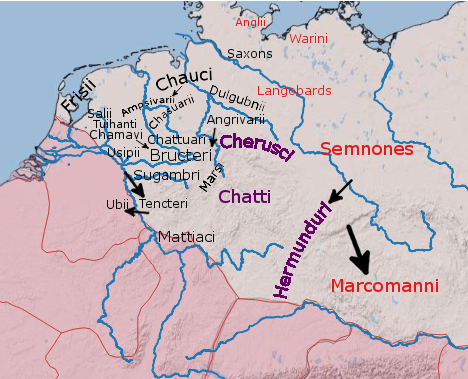
Approximate positions of some major Suebi peoples in the early 2nd century, in purple

The Semnones were a Germanic people, and more specifically a Suebi people, who lived near the Elbe river in the 1st and 2nd centuries AD, during the time of the Roman empire.

The 2nd century geographer Claudius Ptolemy places the Semnones between the Elbe and "Suebos" river. Modern scholars believe that the Suebos was the Oder. However, archaeological evidence suggests they stretched as far as the Spree and Havel rivers in the east, and not quite as far as the Oder. To their north was another part of the Havel, and to the south the Fläming Heath. In present day terms they were therefore in the area between the modern cities of Magdeburg and Berlin.[1]

During the reign of Augustus (63 BC - 14 AD), Velleius Paterculus reported that the future emperor Tiberius reached the Elbe river which flows through the lands of the Semnones and Hermunduri.[2] The Res Gestae Divi Augusti reports that Augustus extended the Roman boundaries to the Elbe river and that after he sailed a fleet to present day Denmark, the Cimbri, Charydes and Semnones along with other Germanic peoples of that same region "through their envoys sought my friendship and that of the Roman people".[3]

They were described in the late 1st century by Tacitus in his Germania:

"The Semnones give themselves out to be the most ancient and renowned branch of the Suebi. Their antiquity is strongly attested by their religion. At a stated period, all the tribes of the same group assemble by their representatives in a grove consecrated by the auguries of their forefathers, and by immemorial associations of terror. Here, having publicly slaughtered a human victim, they celebrate the horrible beginning of their barbarous rite. Reverence also in other ways is paid to the grove. No one enters it except bound with a chain, as an inferior acknowledging the might of the local divinity. If he chance to fall, it is not lawful for him to be lifted up, or to rise to his feet; he must crawl out along the ground. All this superstition implies the belief that from this spot the nation took its origin, that here dwells the supreme and all-ruling deity, to whom all else is subject and obedient. The fortunate lot of the Semnones strengthens this belief; a hundred cantons are in their occupation, and the vastness of their community makes them regard themselves as the head of the Suebic tribe."[4]

The Semnones's own name is apparently etymologically similar or even the same as the one recorded by Roman authors as "Suebi" and during his own time Julius Caesar, had mentioned Suebi but not Semnones, being a powerful tribal group with 100 cantons.

The king of the Semnones Masyas and his priestess Ganna are mentioned by Cassius Dio. They worshipped a supreme god (Latin: regnator omnium deus) at a sacred grove. A grove of fetters is also mentioned in the eddic poem Helgakviða Hundingsbana II. Ptolemy's map of Germania mentions a forest called Semanus Silva, but a relation to the Semnones is unknown.

In the 3rd century, the Semnones shifted southwards and eventually ended up as part of the Alemanni people.

See also

[edit]

Notes

[edit]

Sources

[edit]
  • Castritius, Helmut (2005), "Semnonen § 2. Historisch", in Beck, Heinrich; Geuenich, Dieter; Steuer, Heiko (eds.), Reallexikon der Germanischen Altertumskunde, vol. 28 (2 ed.), De Gruyter, ISBN 978-3-11-018207-1
  • Sitzmann, Alexander (2005), "Semnonen § 1. Namenkundlich", in Beck, Heinrich; Geuenich, Dieter; Steuer, Heiko (eds.), Reallexikon der Germanischen Altertumskunde, vol. 28 (2 ed.), De Gruyter, ISBN 978-3-11-018207-1


Revisions and contributorsEdit on WikipediaRead on Wikipedia
from Grokipedia
The Semnones were an ancient Germanic tribe of the confederation, inhabiting the region between the and rivers in what is now eastern during the 1st and 2nd centuries AD. They were noted for their substantial size, comprising approximately 100 cantons, and for claiming primacy among the Suebi as the oldest and most noble branch, a status reinforced by their distinctive religious practices centered on a dedicated to the universal deity. The Semnones' cultural significance is primarily known through the account of the Roman historian in his (c. 98 AD), where he describes deputations from tribes of the same stock gathering at certain times in a hallowed by ancestral auguries. There, rites begin with a public , and participants enter bound with ropes to acknowledge the deity's power; if they stumble, they must crawl out upon the ground. This stems from the belief that the grove marks the origin of their race and the dwelling of their chief god. These practices underscored the Semnones' emphasis on and ancestral tradition. Geographically attested by in his (c. 150 AD) as extending east of the to the Suevus River, the Semnones maintained influence as neighbors to tribes such as the Langobardi, , and Vandali. In the mid-2nd century, they allied with the in the (166–180 AD) against , contributing to invasions that threatened the empire but ultimately facing defeat. Following these conflicts, the Semnones were last attested in 178 AD and eventually lost their distinct identity through assimilation into larger Germanic confederations, such as the and .

Name and Origins

Etymology

The Semnones are first attested in the Roman historian Tacitus' Germania (c. 98 AD), where they are described as a prominent Suebic tribe. In the following century, Claudius Ptolemy references the Semnones in his Geography, portraying them as a large Suebic tribe whose territory extended beyond the Albis (Elbe) River eastward to the Suevus River, confirming their position in Magna Germania. Scholars have debated the linguistic origins of the name "Semnones," with proposals linking it to either Proto-Germanic or Celtic roots, potentially carrying meanings such as "the chainers" or "tamers," which may relate to ritual practices involving binding or sacred groves. This interpretation draws on possible Celtic influences in early Germanic nomenclature, as evidenced by similarities to the Celtic Senones tribe, whose name derives from Proto-Celtic *sen- ("old"), suggesting a shared Indo-European heritage or cultural borrowing amid tribal interactions in northern Europe. The debate centers on the extent of Celtic linguistic impact on Germanic purity, with some analyses highlighting how pre-Roman Celtic presence in regions like Jutland could have shaped names like that of the Semnones, though direct etymological consensus remains elusive.

Ancestral Background

The Semnones traced their mythological origins to , the son of the divine ancestor , as recounted by the Roman historian in his (AD 98), who described them as the oldest and most renowned branch of the . This genealogy positioned the Semnones within the Herminones, one of the three major Germanic tribal groups descending from Mannus' sons, emphasizing their antiquity and nobility among the Suebian peoples. Tacitus noted that the Semnones' claim to primacy was reinforced through sacred rituals, underscoring their self-perceived role as the foundational Suebian lineage. The early migratory history of the aligns with the broader origins of the , who emerged from Indo-European expansions originating in southern around 3300 BC, marking the initial split of Germanic dialects from other branches. These ancestral groups migrated southward over millennia, with Proto-Germanic speakers associated with the establishing settlements in northern and eastern by the . By the , the Semnones had coalesced as a distinct Suebian in these regions, reflecting the gradual of Germanic societies from their Scandinavian roots. An alternative designation for the Semnones was , derived from Proto-Germanic *juþungiz meaning "the youths" or "descendants," suggesting it denoted a or evolved identity within the Suebian framework, as attested in a Roman inscription from AD 260 referring to them as Semnones sive Juthungi. This name highlights potential internal divisions or renaming during their early consolidation.

Territory and Neighbors

Primary Settlement Areas

The Semnones, a prominent of the confederation, occupied a core territory situated between the (Albis) and (Viadua or Suevus) rivers during the early Roman era. This region encompassed areas east of the , extending toward the , as delineated in 's Geography, where their boundaries are described as reaching from points beyond the Albis eastward to the Suevus river. further emphasized the scale of their settlements, noting that the Semnones inhabited approximately one hundred cantons, underscoring their status as a populous and authoritative group among the Germanic tribes. In terms of modern geography, the primary settlement areas of the Semnones aligned with eastern , particularly the region, including territories along the and Spree rivers. These locations placed their domain in close proximity to the contemporary Czech , reflecting a strategic position in the central European lowlands favorable for agriculture and defense. Archaeological and historical analyses confirm that this area supported a network of villages and fortified sites, consistent with ' account of their extensive communal structure. Settlement patterns among the Semnones initially concentrated north of the Mountains, but by the mid-third century AD, external pressures prompted a gradual southward shift in their territorial focus. This adjustment, evident around AD 254 amid broader regional conflicts, reflected adaptive responses to migratory dynamics while maintaining their core presence in the Elbe-Oder corridor.

Relations with Adjacent Tribes

The Semnones, as a prominent Suebian tribe, maintained complex relations with their immediate neighbors, shaped by geographic proximity and shifting alliances within the broader Germanic cultural sphere. To the south, they bordered the , another Suebian group settled along the upper River, with interactions likely influenced by shared Suebian kinship but also competition for resources in central . To the northwest lay the Langobards, positioned west of the , whose territorial expansions occasionally led to tensions with the Semnones over control of lands in the lower Elbe region. Further east, the Semnones adjoined the Burgundiones and Vandilii to the east, and remnants of the Celtic to the southeast, near the River, where cultural and territorial overlaps fostered both trade and sporadic rivalries amid the Boii's declining presence. Within the Suebian confederation, the Semnones enjoyed close kinship ties with the and , particularly under the leadership of , who incorporated them into his expansive kingdom centered in around 9 BC to AD 19, forming a powerful that extended Suebian influence across . This partnership emphasized mutual defense and shared ethnic identity among the , with the Semnones contributing to the confederation's military strength. Rivalries emerged prominently during the upheavals of AD 17–19, when the Semnones initially aligned with but faced conflicts with the under , who sought to dismantle the Marcomannic kingdom; this led to internal Suebian fractures as the Semnones navigated loyalties amid the broader revolt. Tensions with the Langobards also intensified during this period, as both tribes defected from Maroboduus' , sparking direct clashes over autonomy and territory in the valley. By the AD, these dynamics contributed to the Semnones' gradual southward migration and eventual absorption into the emerging confederation, where they integrated as a core Suebian element, blending with groups like the to form a new federated identity along the .

Society and Culture

Religious Practices

The Semnones regarded themselves as the eldest and most noble branch of the Suevian peoples, a claim substantiated through their religious rituals that emphasized their ancient descent from , the legendary progenitor of the Germanic tribes. This prestige was reinforced by their role in hosting a grand annual assembly where representatives from all related Suevian tribes gathered in a near the River, a site consecrated by ancestral auguries and imbued with ancient dread. Central to this ceremony was the public sacrifice of a victim, performed to honor the "horrid origin" of their rites and to invoke the presiding , interpreted by some scholars as possibly or a similar high . Participants entered the grove only while bound in chains, symbolizing their submission and inferiority to the divine power residing there; if one stumbled, they were required to remain prostrate and roll out of the sacred precincts without rising, underscoring the profound and terror inspired by the location. These practices not only affirmed the Semnones' antiquity but also elevated their status among the Suevi, as the grove was seen as the very cradle of their tribal origins.

Social Organization

The Semnones formed a prominent tribal among the , inhabiting approximately 100 settlements along the River region, which underscored their substantial population and territorial extent. This large-scale organization amplified their influence, as their numerical strength and centralized gatherings contributed to a cohesive social framework typical of major Germanic groups. Their self-proclaimed status as the most ancient and noble of the Suevi further reinforced this structure, with claims of deep antiquity serving to legitimize noble lineages and communal authority. Leadership among the Semnones was exercised by kings drawn from esteemed noble families, emphasizing hereditary ties to their purported ancient origins. A notable example is Masyus, who ruled circa AD 80–96 during the reign of Emperor and engaged in diplomatic exchanges with . These rulers derived additional prestige from the tribe's religious traditions, which enhanced their authoritative role within the without overshadowing secular governance. Daily life for the Semnones revolved around an agrarian economy, with communities centered on farming and settlement-based activities that supported their expansive population. As part of the Suevian cultural sphere, they maintained the distinctive practice of knotting their , a marker of identity that symbolized maturity and was particularly emphasized among warriors to project intimidation in battle. Their aligned with broader Germanic norms, where prowess was to social standing, though the Semnones exhibited no distinctive customs beyond their scale and organizational reach.

Historical Timeline

Early Roman Contacts

The earliest recorded Roman contacts with the Semnones occurred through ethnographic descriptions in the late and early AD. , writing around 20 AD in his (Book 7.1.3), identified the Semnones as a large and prominent tribe among the Suevi, situated near the River and part of an that included the under the Suebic king , who exercised authority over them and other groups. This placement highlighted their position in the interior of , beyond direct Roman provincial control but within the sphere of emerging Suebic confederations. Pliny the Elder further documented the Semnones in his Natural History (c. 77 AD, Book 4.28), classifying them within the broader Suebi grouping as part of the Hermiones, one of five principal Germanic races, alongside tribes such as the Hermunduri, Chatti, and Cherusci. Pliny's account emphasized their role in the ethnic mosaic east of the Rhine, without detailing specific interactions, reflecting Rome's growing interest in Germanic ethnography amid expansionist efforts. The most detailed early Roman portrayal came from in (AD 98, chapter ), who described the Semnones as asserting themselves the oldest and most noble branch of the , a claim reinforced by their religious practices centered on a where annual festivals involved ritual sacrifices and processions, underscoring their cultural prestige. noted their extensive territory encompassing 100 districts (cantons), which contributed to their influence among the , yet he recorded no direct military engagements with Roman forces, portraying them instead as a powerful but insular group. During the era of (c. 9 BC–AD 19), the Semnones experienced indirect involvement in Roman-Germanic affairs as neighboring to the , particularly in the aftermath of the (AD 9), where shifting alliances under drew them into broader Suebic migrations and rivalries with Roman-led coalitions. (c. AD 30, 2.106) corroborated their proximity to the , noting ' campaigns reaching areas adjacent to Semnones and territories during punitive expeditions following Teutoburg.

Migrations and Conflicts

In the late 1st century BC, the Semnones, as a prominent Suebian tribe, joined the eastward migration led by Maroboduus, king of the Marcomanni, into Bohemia around 9 BC. This movement was prompted by escalating Roman military pressure along the Rhine and Main River frontiers following the campaigns of Drusus and Tiberius, allowing Maroboduus to consolidate a vast Suebian confederation that included the Semnones among other groups like the Langobardi and Marcomanni. The migration displaced the Celtic Boii from their territory, establishing a powerful kingdom that served as a buffer against further Roman expansion into Germania, with Maroboduus maintaining diplomatic ties with Rome to secure his rule. Tensions within the Suebian kingdom erupted in AD 17–19 when the Semnones, alongside the Langobardi, defected from ' rule and allied with the under , who sought to exploit ' neutrality during Roman campaigns and his adoption of monarchical titles resented by tribal elites. rallied the rebels with appeals to and shared victories against , such as the Teutoburg disaster, leading to open warfare; records that the Semnones and Langobardi's addition gave a numerical edge, though initial battles ended inconclusively before retreated to his Marcomannic heartlands. The conflict culminated in AD 19 with a broader revolt led by the Gotone Catualda, supported by the Semnones, which stormed ' fortified palace, seized treasures including Roman spoils, and forced his to under Roman protection, effectively dismantling the centralized Suebian state and scattering its components. In the 2nd century AD, the geographer Claudius Ptolemy attested to the Semnones' location in his Geography (c. 150 AD), placing them east of the Elbe River extending to the Suevus River (likely the Oder). Toward the mid-2nd century, the Semnones allied with the Marcomanni during the Marcomannic Wars (166–180 AD) against the Roman Empire under Marcus Aurelius, participating in invasions that reached as far as northern Italy but ultimately contributing to their defeat and subsequent migration southwest. They are last mentioned in literary sources in AD 178 by Cassius Dio, during these conflicts. By the 3rd century AD, the Semnones had evolved into or merged with the , a subgroup within the emerging Alemannic confederation along the upper , as evidenced by Roman inscriptions equating the names Semnones sive Juthungi. In AD 258–260, the participated in a major Alemannic invasion of , crossing the to raid as far as the amid the Roman Empire's , but suffered a decisive defeat on their withdrawal near (modern ) on April 24, 260, at the hands of Roman forces under Marcus Simplicinius Genialis, as commemorated on the . This setback temporarily curtailed their incursions but highlighted their role in the broader Germanic pressures on Roman frontiers. Further conflicts arose in AD 356 when the Juthungi, violating recent peace treaties, invaded Raetia, devastating the province, destroying Castra Regina (Regensburg), and besieging fortified settlements in a bid to exploit Roman internal divisions under Constantius II. Roman responses, led by the comes rei militaris Barbatio and including cavalry under Nevitta, repelled the invaders, inflicting heavy losses and forcing a remnant to flee, thereby restoring order along the Danube limes as described by Ammianus Marcellinus. The tribe's final major engagements occurred in AD 429–431, when the magister militum Flavius Aetius campaigned in Raetia and Noricum against Juthungic raids, defeating them and reasserting Roman authority in the region during the waning years of the Western Empire, marking the Semnones-Juthungi's last documented resistance before broader integrations.

Later Fate and Integration

By the , the Semnones had largely lost their distinct tribal identity through absorption into the emerging , a process that involved the integration of various Suebic groups along the and regions. This merging reflected broader ethnogenetic shifts among during , where fluid alliances and migrations led to the formation of larger, polyethnic entities like the . The Semnones, originally centered near the but displaced southward by the 3rd century, contributed to this confederation's expansion and military activities against Roman territories. The final historical reference to the Semnones, or more precisely their associated group the Juthungi, dates to 431 AD, when Roman general Flavius Aetius conducted campaigns in Raetia and Noricum, defeating the Juthungi invaders and reasserting imperial control over the Danubian limes. Contemporary chroniclers such as Prosper of Aquitaine and Hydatius documented these victories, noting Aetius' subjugation of Germanic raiders in the Alps, marking the end of any independent Semnones activity. After this defeat, surviving elements dispersed further, accelerating their assimilation without further distinct mentions in Roman or early medieval sources. In the ensuing decades, particularly between 454 and 474 AD, remaining Suebic components, including Semnones remnants, fused more deeply with the , enhancing the confederation's internal cohesion amid pressures from Hunnic incursions and Roman decline. This integration precluded the formation of any independent Semnones kingdom in the post-Roman era. Their legacy endured through contributions to the ancestral makeup of modern Bavarian and Swabian populations in , where Alemannic-Suebic influences shaped regional identities and medieval administrative districts like . Linguistic echoes may persist in toponyms linked to ancient Suebic territories, though direct Semnones attributions remain elusive.

References

Add your contribution
Related Hubs
User Avatar
No comments yet.