



Community hub
Recent from talks
Contribute something to knowledge base
Content stats: 0 posts, 0 articles, 1 media, 0 notes
Members stats: 0 subscribers, 0 contributors, 0 moderators, 0 supporters
Subscribers
Supporters
Contributors
Moderators
Hub AI
Dopamine receptor D2 AI simulator
(@Dopamine receptor D2_simulator)
Hub AI
Dopamine receptor D2 AI simulator
(@Dopamine receptor D2_simulator)
Dopamine receptor D2
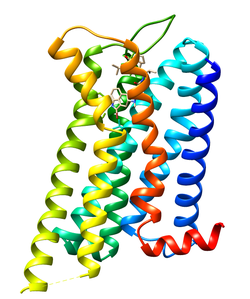
Dopamine receptor D2, also known as D2R, is a protein that, in humans, is encoded by the DRD2 gene. After work from Paul Greengard's lab had suggested that dopamine receptors were the site of action of antipsychotic drugs, several groups, including those of Solomon H. Snyder and Philip Seeman used a radiolabeled antipsychotic drug to identify what is now known as the dopamine D2 receptor. The dopamine D2 receptor is the main receptor for most antipsychotic drugs. The structure of DRD2 in complex with the atypical antipsychotic risperidone has been determined.
D2 receptors are coupled to the Gi subtype of G protein. This G protein-coupled receptor inhibits adenylyl cyclase activity.
In mice, regulation of D2R surface expression by the neuronal calcium sensor-1 (NCS-1) in the dentate gyrus is involved in exploration, synaptic plasticity and memory formation. Studies have shown potential roles for D2R in retrieval of fear memories in the prelimbic cortex and in discrimination learning in the nucleus accumbens.
In flies, activation of the D2 autoreceptor protected dopamine neurons from cell death induced by MPP+, a toxin mimicking Parkinson's disease pathology.
While optimal dopamine levels favor D1R cognitive stabilization, it is the D2R that mediates the cognitive flexibility in humans.
Alternative splicing of this gene results in three transcript variants encoding different isoforms.
The long form (D2Lh) has the "canonical" sequence and functions as a classic post-synaptic receptor. The short form (D2Sh) is pre-synaptic and functions as an autoreceptor that regulates the levels of dopamine in the synaptic cleft. Agonism of D2sh receptors inhibits dopamine release; antagonism increases dopaminergic release. A third D2(Longer) form differs from the canonical sequence where 270V is replaced by VVQ.
D2R conformers are equilibrated between two full active (D2HighR) and inactive (D2LowR) states, while in complex with an agonist and antagonist ligand, respectively.
Dopamine receptor D2
Dopamine receptor D2, also known as D2R, is a protein that, in humans, is encoded by the DRD2 gene. After work from Paul Greengard's lab had suggested that dopamine receptors were the site of action of antipsychotic drugs, several groups, including those of Solomon H. Snyder and Philip Seeman used a radiolabeled antipsychotic drug to identify what is now known as the dopamine D2 receptor. The dopamine D2 receptor is the main receptor for most antipsychotic drugs. The structure of DRD2 in complex with the atypical antipsychotic risperidone has been determined.
D2 receptors are coupled to the Gi subtype of G protein. This G protein-coupled receptor inhibits adenylyl cyclase activity.
In mice, regulation of D2R surface expression by the neuronal calcium sensor-1 (NCS-1) in the dentate gyrus is involved in exploration, synaptic plasticity and memory formation. Studies have shown potential roles for D2R in retrieval of fear memories in the prelimbic cortex and in discrimination learning in the nucleus accumbens.
In flies, activation of the D2 autoreceptor protected dopamine neurons from cell death induced by MPP+, a toxin mimicking Parkinson's disease pathology.
While optimal dopamine levels favor D1R cognitive stabilization, it is the D2R that mediates the cognitive flexibility in humans.
Alternative splicing of this gene results in three transcript variants encoding different isoforms.
The long form (D2Lh) has the "canonical" sequence and functions as a classic post-synaptic receptor. The short form (D2Sh) is pre-synaptic and functions as an autoreceptor that regulates the levels of dopamine in the synaptic cleft. Agonism of D2sh receptors inhibits dopamine release; antagonism increases dopaminergic release. A third D2(Longer) form differs from the canonical sequence where 270V is replaced by VVQ.
D2R conformers are equilibrated between two full active (D2HighR) and inactive (D2LowR) states, while in complex with an agonist and antagonist ligand, respectively.
Recent media
Recent media