
Recent from talks
Doppler radar
Knowledge base stats:
Talk channels stats:
Members stats:
Doppler radar
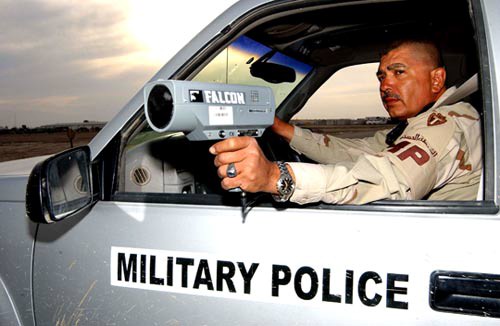
A Doppler radar is a specialized radar that uses the Doppler effect to produce velocity data about objects at a distance. It does this by bouncing a microwave signal off a desired target and analyzing how the object's motion has altered the frequency of the returned signal. This variation gives direct and highly accurate measurements of the radial component of a target's velocity relative to the radar. The term applies to radar systems in many domains like aviation, police radar detectors, navigation, meteorology, etc.
The Doppler effect (or Doppler shift), named after Austrian physicist Christian Doppler who proposed it in 1842, is the difference between the observed frequency and the emitted frequency of a wave for an observer moving relative to the source of the waves. It is commonly heard when a vehicle sounding a siren approaches, passes and recedes from an observer. The received frequency is higher (compared to the emitted frequency) during the approach, it is identical at the instant of passing by, and it is lower during the recession. This variation of frequency also depends on the direction the wave source is moving with respect to the observer; it is maximum when the source is moving directly toward or away from the observer and diminishes with increasing angle between the direction of motion and the direction of the waves, until when the source is moving at right angles to the observer, there is no shift.
Imagine a baseball pitcher throwing one ball every second to a catcher (a frequency of 1 ball per second). Assuming the balls travel at a constant velocity and the pitcher is stationary, the catcher catches one ball every second. However, if the pitcher is jogging towards the catcher, the catcher catches balls more frequently because the balls are less spaced out (the frequency increases). The inverse is true if the pitcher is moving away from the catcher. The catcher catches balls less frequently because of the pitcher's backward motion (the frequency decreases). If the pitcher moves at an angle, but at the same speed, the frequency variation at which the receiver catches balls is less, as the distance between the two changes more slowly.
From the point of view of the pitcher, the frequency remains constant (whether he's throwing balls or transmitting microwaves). Since with electromagnetic radiation like microwaves or with sound, frequency is inversely proportional to wavelength, the wavelength of the waves is also affected. Thus, the relative difference in velocity between a source and an observer is what gives rise to the Doppler effect.
The formula for radar Doppler shift is the same as that for reflection of light by a moving mirror. There is no need to invoke Albert Einstein's theory of special relativity, because all observations are made in the same frame of reference. The result derived with c as the speed of light and v as the target radial velocity gives the shifted frequency () as a function of the original frequency () :


which simplifies to
The "beat frequency", (Doppler frequency) (), is thus:

Since for most practical applications of radar, , so . We can then write:


Hub AI
Doppler radar AI simulator
(@Doppler radar_simulator)
Doppler radar
A Doppler radar is a specialized radar that uses the Doppler effect to produce velocity data about objects at a distance. It does this by bouncing a microwave signal off a desired target and analyzing how the object's motion has altered the frequency of the returned signal. This variation gives direct and highly accurate measurements of the radial component of a target's velocity relative to the radar. The term applies to radar systems in many domains like aviation, police radar detectors, navigation, meteorology, etc.
The Doppler effect (or Doppler shift), named after Austrian physicist Christian Doppler who proposed it in 1842, is the difference between the observed frequency and the emitted frequency of a wave for an observer moving relative to the source of the waves. It is commonly heard when a vehicle sounding a siren approaches, passes and recedes from an observer. The received frequency is higher (compared to the emitted frequency) during the approach, it is identical at the instant of passing by, and it is lower during the recession. This variation of frequency also depends on the direction the wave source is moving with respect to the observer; it is maximum when the source is moving directly toward or away from the observer and diminishes with increasing angle between the direction of motion and the direction of the waves, until when the source is moving at right angles to the observer, there is no shift.
Imagine a baseball pitcher throwing one ball every second to a catcher (a frequency of 1 ball per second). Assuming the balls travel at a constant velocity and the pitcher is stationary, the catcher catches one ball every second. However, if the pitcher is jogging towards the catcher, the catcher catches balls more frequently because the balls are less spaced out (the frequency increases). The inverse is true if the pitcher is moving away from the catcher. The catcher catches balls less frequently because of the pitcher's backward motion (the frequency decreases). If the pitcher moves at an angle, but at the same speed, the frequency variation at which the receiver catches balls is less, as the distance between the two changes more slowly.
From the point of view of the pitcher, the frequency remains constant (whether he's throwing balls or transmitting microwaves). Since with electromagnetic radiation like microwaves or with sound, frequency is inversely proportional to wavelength, the wavelength of the waves is also affected. Thus, the relative difference in velocity between a source and an observer is what gives rise to the Doppler effect.
The formula for radar Doppler shift is the same as that for reflection of light by a moving mirror. There is no need to invoke Albert Einstein's theory of special relativity, because all observations are made in the same frame of reference. The result derived with c as the speed of light and v as the target radial velocity gives the shifted frequency () as a function of the original frequency () :
which simplifies to
The "beat frequency", (Doppler frequency) (), is thus:
Since for most practical applications of radar, , so . We can then write:
Recent media