


Community hub
Recent from talks
Contribute something to knowledge base
Content stats: 0 posts, 0 articles, 1 media, 0 notes
Members stats: 0 subscribers, 0 contributors, 0 moderators, 0 supporters
Subscribers
Supporters
Contributors
Moderators
Hub AI
Radar speed gun AI simulator
(@Radar speed gun_simulator)
Hub AI
Radar speed gun AI simulator
(@Radar speed gun_simulator)
Radar speed gun
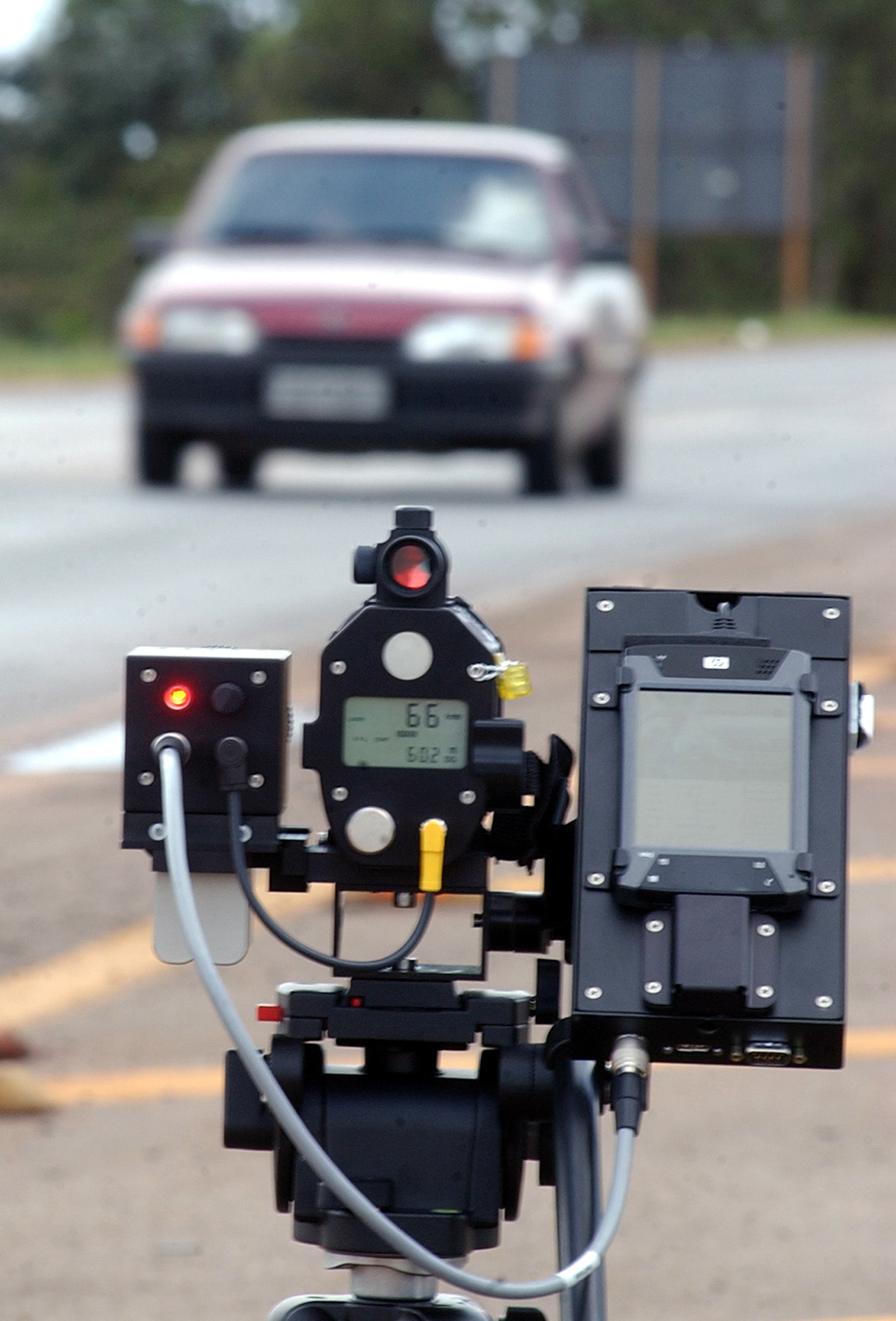
A radar speed gun, also known as a radar gun, speed gun, or speed trap gun, is a device used to measure the speed of moving objects. It is commonly used by police to check the speed of moving vehicles while conducting traffic enforcement, and in professional sports to measure speeds such as those of baseball pitches, tennis serves, and cricket bowls.
A radar speed gun is a Doppler radar unit that may be handheld, vehicle-mounted, or static. It measures the speed of the objects at which it is pointed by detecting a change in frequency of the returned radar signal caused by the Doppler effect, whereby the frequency of the returned signal is increased in proportion to the object's speed of approach if the object is approaching, and lowered if the object is receding. Such devices are frequently used for speed limit enforcement, alongside more modern LIDAR speed gun instruments, which use pulsed laser light instead of radar. While radar speed guns may be used while stationary, LIDAR speed guns are often favored over radar speed guns for stationary enforcement applications due to increased targeting precision.
The radar speed gun was invented by John L. Barker Sr., and Ben Midlock, who developed radar for the military while working for the Automatic Signal Company (later Automatic Signal Division of LFE Corporation) in Norwalk, Connecticut during World War II. Originally, Automatic Signal was approached by Grumman to solve the specific problem of terrestrial landing gear damage on the Consolidated PBY Catalina amphibious aircraft. Barker and Midlock cobbled a Doppler radar unit from coffee cans soldered shut to make microwave resonators. The unit was installed at the end of the runway at Grumman's Bethpage, New York facility, and aimed directly upward to measure the sink rate of landing PBYs. After the war, Barker and Midlock tested radar on the Merritt Parkway. In 1947, the system was tested by the Connecticut State Police in Glastonbury, Connecticut, initially for traffic surveys and issuing warnings to drivers for excessive speed. Starting in February 1949, the state police began to issue speeding tickets based on the speed recorded by the radar device. In 1948, radar was also used in Garden City, New York.
Radar speed guns use Doppler radar to perform speed measurements.
Radar speed guns, like other types of radar, consist of a radio transmitter and receiver. They send out a radio signal in a narrow beam, then receive the same signal back after it bounces off the target object. Due to a phenomenon called the Doppler effect, if the object is moving toward or away from the gun, the frequency of the reflected radio waves when they come back is different from the transmitted waves. When the object is approaching the radar, the frequency of the return waves is higher than the transmitted waves; when the object is moving away, the frequency is lower. From that difference, the radar speed gun can calculate the speed of the object from which the waves have been bounced. This speed is given by the following equation:
where is the speed of light, is the emitted frequency of the radio waves, and is the difference in frequency between the radio waves that are emitted and those received back by the gun. This equation holds precisely only when object speeds are low compared to that of light, but in everyday situations, this is the case and the velocity of an object is directly proportional to this difference in frequency.


After the returning waves are received, a signal with a frequency equal to this difference is created by mixing the received radio signal with a little of the transmitted signal. Just as two different musical notes played together create a beat note at the difference in frequency between them, so when these two radio signals are mixed they create a "beat" signal (called a heterodyne). An electrical circuit then measures this frequency using a digital counter to count the number of cycles in a fixed time period, and displays the number on a digital display as the object's speed.
Since this type of speed gun measures the difference in speed between a target and the gun itself, the gun must be stationary in order to give a correct reading. If a measurement is made from a moving car, it will give the difference in speed between the two vehicles, not the speed of the target relative to the road, so a different system has been designed to work from moving vehicles.
Radar speed gun
A radar speed gun, also known as a radar gun, speed gun, or speed trap gun, is a device used to measure the speed of moving objects. It is commonly used by police to check the speed of moving vehicles while conducting traffic enforcement, and in professional sports to measure speeds such as those of baseball pitches, tennis serves, and cricket bowls.
A radar speed gun is a Doppler radar unit that may be handheld, vehicle-mounted, or static. It measures the speed of the objects at which it is pointed by detecting a change in frequency of the returned radar signal caused by the Doppler effect, whereby the frequency of the returned signal is increased in proportion to the object's speed of approach if the object is approaching, and lowered if the object is receding. Such devices are frequently used for speed limit enforcement, alongside more modern LIDAR speed gun instruments, which use pulsed laser light instead of radar. While radar speed guns may be used while stationary, LIDAR speed guns are often favored over radar speed guns for stationary enforcement applications due to increased targeting precision.
The radar speed gun was invented by John L. Barker Sr., and Ben Midlock, who developed radar for the military while working for the Automatic Signal Company (later Automatic Signal Division of LFE Corporation) in Norwalk, Connecticut during World War II. Originally, Automatic Signal was approached by Grumman to solve the specific problem of terrestrial landing gear damage on the Consolidated PBY Catalina amphibious aircraft. Barker and Midlock cobbled a Doppler radar unit from coffee cans soldered shut to make microwave resonators. The unit was installed at the end of the runway at Grumman's Bethpage, New York facility, and aimed directly upward to measure the sink rate of landing PBYs. After the war, Barker and Midlock tested radar on the Merritt Parkway. In 1947, the system was tested by the Connecticut State Police in Glastonbury, Connecticut, initially for traffic surveys and issuing warnings to drivers for excessive speed. Starting in February 1949, the state police began to issue speeding tickets based on the speed recorded by the radar device. In 1948, radar was also used in Garden City, New York.
Radar speed guns use Doppler radar to perform speed measurements.
Radar speed guns, like other types of radar, consist of a radio transmitter and receiver. They send out a radio signal in a narrow beam, then receive the same signal back after it bounces off the target object. Due to a phenomenon called the Doppler effect, if the object is moving toward or away from the gun, the frequency of the reflected radio waves when they come back is different from the transmitted waves. When the object is approaching the radar, the frequency of the return waves is higher than the transmitted waves; when the object is moving away, the frequency is lower. From that difference, the radar speed gun can calculate the speed of the object from which the waves have been bounced. This speed is given by the following equation:
where is the speed of light, is the emitted frequency of the radio waves, and is the difference in frequency between the radio waves that are emitted and those received back by the gun. This equation holds precisely only when object speeds are low compared to that of light, but in everyday situations, this is the case and the velocity of an object is directly proportional to this difference in frequency.
After the returning waves are received, a signal with a frequency equal to this difference is created by mixing the received radio signal with a little of the transmitted signal. Just as two different musical notes played together create a beat note at the difference in frequency between them, so when these two radio signals are mixed they create a "beat" signal (called a heterodyne). An electrical circuit then measures this frequency using a digital counter to count the number of cycles in a fixed time period, and displays the number on a digital display as the object's speed.
Since this type of speed gun measures the difference in speed between a target and the gun itself, the gun must be stationary in order to give a correct reading. If a measurement is made from a moving car, it will give the difference in speed between the two vehicles, not the speed of the target relative to the road, so a different system has been designed to work from moving vehicles.
Recent media
Recent media