
Recent from talks
Dorando Pietri
Knowledge base stats:
Talk channels stats:
Members stats:
Dorando Pietri
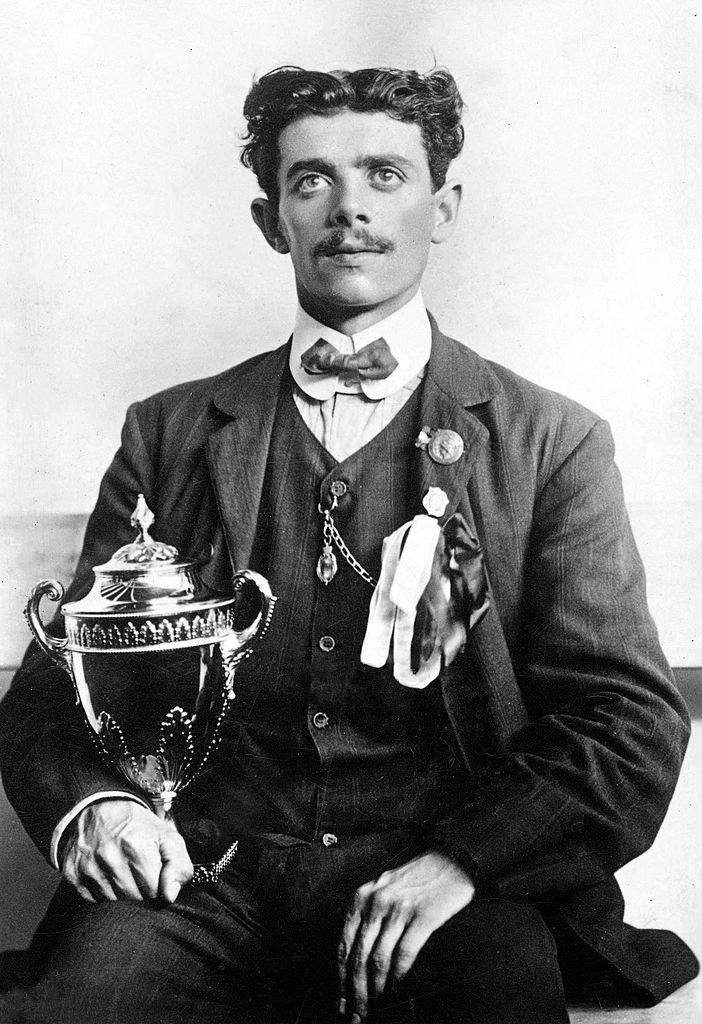
Dorando Pietri (Italian pronunciation: [doˈrando ˈpjɛːtri]; often wrongly spelt Petri; 16 October 1885 – 7 February 1942) was an Italian long-distance runner. He finished first in the marathon at the 1908 Summer Olympics in London but was subsequently disqualified.
Pietri was born in Mandrio, a frazione of Correggio, but spent his youth in Carpi (Emilia-Romagna region). Here he worked as a shop-boy at a confectionery shop. He was 1.59 m (5 ft., 2½ in.) tall.
In September 1904 the most famous Italian runner of the time, Pericle Pagliani, took part in a race in Carpi. According to tradition, Pietri was attracted by the event and, still wearing his work clothes, ran to the finish ahead of Pagliani. A few days later Pietri débuted in a distance race, finishing second in the 3,000 m of Bologna.
The following year he achieved his first international success, winning the 30 km in Paris. On 2 April 1906 Pietri won the qualifying marathon for the Olympic Games to be held in Athens that same year. In the Olympic race he retired due to intestinal illness when he was leading by 5 minutes.
In 1907 he won the Italian championships. He was by then the undisputed leader of Italian long distance races from 5000 metres to marathon distance.
Dorando Pietri trained hard for the 1908 Olympics in London. In a race in Carpi he ran 40 km (25 mi) in 2 hours and 38 minutes, an extraordinary result for the times. The marathon, which was to take place on 24 July 1908, started with 56 competitors, including Pietri and fellow Italian Umberto Blasi. It began at 2:33pm. The weather was particularly hot by British summer standards. The London course measured 42.2 km (26 mi); the distance later became the official marathon length from 1921.
Pietri began his race at a rather slow pace, but in the second half of the course began a powerful surge moving him into second position by the 32 km (20 mi) mark, 4 minutes behind South African Charles Hefferon. When he knew that Hefferon was in crisis, Pietri further increased his pace, overtaking him at the 39 km (24 mi) mark.
The effort took its toll and with only two kilometres (1.2 mi) to go, Pietri began to feel the effects of extreme fatigue and dehydration. When he entered the stadium, he took the wrong path and when umpires redirected him, he fell down for the first time. He got up with their help, in front of 75,000 spectators.
Hub AI
Dorando Pietri AI simulator
(@Dorando Pietri_simulator)
Dorando Pietri
Dorando Pietri (Italian pronunciation: [doˈrando ˈpjɛːtri]; often wrongly spelt Petri; 16 October 1885 – 7 February 1942) was an Italian long-distance runner. He finished first in the marathon at the 1908 Summer Olympics in London but was subsequently disqualified.
Pietri was born in Mandrio, a frazione of Correggio, but spent his youth in Carpi (Emilia-Romagna region). Here he worked as a shop-boy at a confectionery shop. He was 1.59 m (5 ft., 2½ in.) tall.
In September 1904 the most famous Italian runner of the time, Pericle Pagliani, took part in a race in Carpi. According to tradition, Pietri was attracted by the event and, still wearing his work clothes, ran to the finish ahead of Pagliani. A few days later Pietri débuted in a distance race, finishing second in the 3,000 m of Bologna.
The following year he achieved his first international success, winning the 30 km in Paris. On 2 April 1906 Pietri won the qualifying marathon for the Olympic Games to be held in Athens that same year. In the Olympic race he retired due to intestinal illness when he was leading by 5 minutes.
In 1907 he won the Italian championships. He was by then the undisputed leader of Italian long distance races from 5000 metres to marathon distance.
Dorando Pietri trained hard for the 1908 Olympics in London. In a race in Carpi he ran 40 km (25 mi) in 2 hours and 38 minutes, an extraordinary result for the times. The marathon, which was to take place on 24 July 1908, started with 56 competitors, including Pietri and fellow Italian Umberto Blasi. It began at 2:33pm. The weather was particularly hot by British summer standards. The London course measured 42.2 km (26 mi); the distance later became the official marathon length from 1921.
Pietri began his race at a rather slow pace, but in the second half of the course began a powerful surge moving him into second position by the 32 km (20 mi) mark, 4 minutes behind South African Charles Hefferon. When he knew that Hefferon was in crisis, Pietri further increased his pace, overtaking him at the 39 km (24 mi) mark.
The effort took its toll and with only two kilometres (1.2 mi) to go, Pietri began to feel the effects of extreme fatigue and dehydration. When he entered the stadium, he took the wrong path and when umpires redirected him, he fell down for the first time. He got up with their help, in front of 75,000 spectators.
Recent media