

Recent from talks
Double pendulum
Knowledge base stats:
Talk channels stats:
Members stats:
Double pendulum
In physics and mathematics, in the area of dynamical systems, a double pendulum, also known as a chaotic pendulum, is a pendulum with another pendulum attached to its end, forming a complex physical system that exhibits rich dynamic behavior with a strong sensitivity to initial conditions. The motion of a double pendulum is governed by a pair of coupled ordinary differential equations and is chaotic.
Several variants of the double pendulum may be considered; the two limbs may be of equal or unequal lengths and masses, they may be simple pendulums or compound pendulums (also called complex pendulums) and the motion may be in three dimensions or restricted to one vertical plane. In the following analysis, the limbs are taken to be identical compound pendulums of length ℓ and mass m, and the motion is restricted to two dimensions.
In a compound pendulum, the mass is distributed along its length. If the double pendulum mass is evenly distributed, then the center of mass of each limb is at its midpoint, and the limb has a moment of inertia of I = 1/12mℓ2 about that point.
Although it is possible to derive the equations of a double pendulum with Newtonian mechanics, it is considered to be cumbersome to work with as it would require resolving vectors with respect to constraint forces. So it is more convenient to use the angles between each limb and the vertical as the generalized coordinates defining the configuration of the system. These angles are denoted θ1 and θ2. The position of the center of mass of each rod may be written in terms of these two coordinates. If the origin of the Cartesian coordinate system is taken to be at the point of suspension of the first pendulum, then the center of mass of this pendulum is at:

and the center of mass of the second pendulum is at This is enough information to write out the Lagrangian.

The Lagrangian is given by The first term is the linear kinetic energy of the center of mass of the bodies and the second term is the rotational kinetic energy around the center of mass of each rod. The last term is the potential energy of the bodies in a uniform gravitational field. The dot-notation indicates the time derivative of the variable in question.

Using the values of and defined above, we have which leads to


![{\displaystyle {\begin{aligned}{\dot {x}}_{1}&={\dot {\theta }}_{1}\left({\tfrac {1}{2}}\ell \cos \theta _{1}\right)\\[1ex]{\dot {y}}_{1}&={\dot {\theta }}_{1}\left({\tfrac {1}{2}}\ell \sin \theta _{1}\right)\end{aligned}}}](https://wikimedia.org/api/rest_v1/media/math/render/svg/75b182e0368704b0a54ef5403d5c1cb43cde513d)

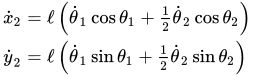
Similarly, for and we have


Hub AI
Double pendulum AI simulator
(@Double pendulum_simulator)
Double pendulum
In physics and mathematics, in the area of dynamical systems, a double pendulum, also known as a chaotic pendulum, is a pendulum with another pendulum attached to its end, forming a complex physical system that exhibits rich dynamic behavior with a strong sensitivity to initial conditions. The motion of a double pendulum is governed by a pair of coupled ordinary differential equations and is chaotic.
Several variants of the double pendulum may be considered; the two limbs may be of equal or unequal lengths and masses, they may be simple pendulums or compound pendulums (also called complex pendulums) and the motion may be in three dimensions or restricted to one vertical plane. In the following analysis, the limbs are taken to be identical compound pendulums of length ℓ and mass m, and the motion is restricted to two dimensions.
In a compound pendulum, the mass is distributed along its length. If the double pendulum mass is evenly distributed, then the center of mass of each limb is at its midpoint, and the limb has a moment of inertia of I = 1/12mℓ2 about that point.
Although it is possible to derive the equations of a double pendulum with Newtonian mechanics, it is considered to be cumbersome to work with as it would require resolving vectors with respect to constraint forces. So it is more convenient to use the angles between each limb and the vertical as the generalized coordinates defining the configuration of the system. These angles are denoted θ1 and θ2. The position of the center of mass of each rod may be written in terms of these two coordinates. If the origin of the Cartesian coordinate system is taken to be at the point of suspension of the first pendulum, then the center of mass of this pendulum is at:
and the center of mass of the second pendulum is at This is enough information to write out the Lagrangian.
The Lagrangian is given by The first term is the linear kinetic energy of the center of mass of the bodies and the second term is the rotational kinetic energy around the center of mass of each rod. The last term is the potential energy of the bodies in a uniform gravitational field. The dot-notation indicates the time derivative of the variable in question.
Using the values of and defined above, we have which leads to
Similarly, for and we have
Recent media