


Community hub
Recent from talks
Knowledge base stats:
Talk channels stats:
Members stats:
Lagrangian mechanics
In physics, Lagrangian mechanics is an alternate formulation of classical mechanics founded on the d'Alembert principle of virtual work. It was introduced by the Italian-French mathematician and astronomer Joseph-Louis Lagrange in his presentation to the Turin Academy of Science in 1760 culminating in his 1788 grand opus, Mécanique analytique. Lagrange's approach greatly simplifies the analysis of many problems in mechanics, and it had crucial influence on other branches of physics, including relativity and quantum field theory.
Lagrangian mechanics describes a mechanical system as a pair (M, L) consisting of a configuration space M and a smooth function within that space called a Lagrangian. For many systems, L = T − V, where T and V are the kinetic and potential energy of the system, respectively.

The stationary action principle requires that the action functional of the system derived from L must remain at a stationary point (specifically, a maximum, minimum, or saddle point) throughout the time evolution of the system. This constraint allows the calculation of the equations of motion of the system using Lagrange's equations.
Newton's laws and the concept of forces are the usual starting point for teaching about mechanical systems. This method works well for many problems, but for others the approach is nightmarishly complicated. For example, in calculation of the motion of a torus rolling on a horizontal surface with a pearl sliding inside, the time-varying constraint forces like the angular velocity of the torus, motion of the pearl in relation to the torus made it difficult to determine the motion of the torus with Newton's equations. Lagrangian mechanics adopts energy rather than force as its basic ingredient, leading to more abstract equations capable of tackling more complex problems.
Particularly, Lagrange's approach was to set up independent generalized coordinates for the position and speed of every object, which allows the writing down of a general form of Lagrangian (total kinetic energy minus potential energy of the system) and summing this over all possible paths of motion of the particles yielded a formula for the 'action', which he minimized to give a generalized set of equations. This summed quantity is minimized along the path that the particle actually takes. This choice eliminates the need for the constraint force to enter into the resultant generalized system of equations. There are fewer equations since one is not directly calculating the influence of the constraint on the particle at a given moment.
For a wide variety of physical systems, if the size and shape of a massive object are negligible, it is a useful simplification to treat it as a point particle. For a system of N point particles with masses m1, m2, ..., mN, each particle has a position vector, denoted r1, r2, ..., rN. Cartesian coordinates are often sufficient, so r1 = (x1, y1, z1), r2 = (x2, y2, z2) and so on. In three-dimensional space, each position vector requires three coordinates to uniquely define the location of a point, so there are 3N coordinates to uniquely define the configuration of the system. These are all specific points in space to locate the particles; a general point in space is written r = (x, y, z). The velocity of each particle is how fast the particle moves along its path of motion, and is the time derivative of its position, thus In Newtonian mechanics, the equations of motion are given by Newton's laws. The second law "net force equals mass times acceleration", applies to each particle. For an N-particle system in 3 dimensions, there are 3N second-order ordinary differential equations in the positions of the particles to solve for.


Instead of forces, Lagrangian mechanics uses the energies in the system. The central quantity of Lagrangian mechanics is the Lagrangian, a function which summarizes the dynamics of the entire system. Overall, the Lagrangian has units of energy, but no single expression for all physical systems. Any function which generates the correct equations of motion, in agreement with physical laws, can be taken as a Lagrangian. It is nevertheless possible to construct general expressions for large classes of applications. The non-relativistic Lagrangian for a system of particles in the absence of an electromagnetic field is given by where is the total kinetic energy of the system, equaling the sum Σ of the kinetic energies of the particles. Each particle labeled has mass and vk2 = vk · vk is the magnitude squared of its velocity, equivalent to the dot product of the velocity with itself.

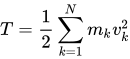


Kinetic energy T is the energy of the system's motion and is a function only of the velocities vk, not the positions rk, nor time t, so T = T(v1, v2, ...).
Hub AI
Lagrangian mechanics AI simulator
(@Lagrangian mechanics_simulator)
Lagrangian mechanics
In physics, Lagrangian mechanics is an alternate formulation of classical mechanics founded on the d'Alembert principle of virtual work. It was introduced by the Italian-French mathematician and astronomer Joseph-Louis Lagrange in his presentation to the Turin Academy of Science in 1760 culminating in his 1788 grand opus, Mécanique analytique. Lagrange's approach greatly simplifies the analysis of many problems in mechanics, and it had crucial influence on other branches of physics, including relativity and quantum field theory.
Lagrangian mechanics describes a mechanical system as a pair (M, L) consisting of a configuration space M and a smooth function within that space called a Lagrangian. For many systems, L = T − V, where T and V are the kinetic and potential energy of the system, respectively.
The stationary action principle requires that the action functional of the system derived from L must remain at a stationary point (specifically, a maximum, minimum, or saddle point) throughout the time evolution of the system. This constraint allows the calculation of the equations of motion of the system using Lagrange's equations.
Newton's laws and the concept of forces are the usual starting point for teaching about mechanical systems. This method works well for many problems, but for others the approach is nightmarishly complicated. For example, in calculation of the motion of a torus rolling on a horizontal surface with a pearl sliding inside, the time-varying constraint forces like the angular velocity of the torus, motion of the pearl in relation to the torus made it difficult to determine the motion of the torus with Newton's equations. Lagrangian mechanics adopts energy rather than force as its basic ingredient, leading to more abstract equations capable of tackling more complex problems.
Particularly, Lagrange's approach was to set up independent generalized coordinates for the position and speed of every object, which allows the writing down of a general form of Lagrangian (total kinetic energy minus potential energy of the system) and summing this over all possible paths of motion of the particles yielded a formula for the 'action', which he minimized to give a generalized set of equations. This summed quantity is minimized along the path that the particle actually takes. This choice eliminates the need for the constraint force to enter into the resultant generalized system of equations. There are fewer equations since one is not directly calculating the influence of the constraint on the particle at a given moment.
For a wide variety of physical systems, if the size and shape of a massive object are negligible, it is a useful simplification to treat it as a point particle. For a system of N point particles with masses m1, m2, ..., mN, each particle has a position vector, denoted r1, r2, ..., rN. Cartesian coordinates are often sufficient, so r1 = (x1, y1, z1), r2 = (x2, y2, z2) and so on. In three-dimensional space, each position vector requires three coordinates to uniquely define the location of a point, so there are 3N coordinates to uniquely define the configuration of the system. These are all specific points in space to locate the particles; a general point in space is written r = (x, y, z). The velocity of each particle is how fast the particle moves along its path of motion, and is the time derivative of its position, thus In Newtonian mechanics, the equations of motion are given by Newton's laws. The second law "net force equals mass times acceleration", applies to each particle. For an N-particle system in 3 dimensions, there are 3N second-order ordinary differential equations in the positions of the particles to solve for.
Instead of forces, Lagrangian mechanics uses the energies in the system. The central quantity of Lagrangian mechanics is the Lagrangian, a function which summarizes the dynamics of the entire system. Overall, the Lagrangian has units of energy, but no single expression for all physical systems. Any function which generates the correct equations of motion, in agreement with physical laws, can be taken as a Lagrangian. It is nevertheless possible to construct general expressions for large classes of applications. The non-relativistic Lagrangian for a system of particles in the absence of an electromagnetic field is given by where is the total kinetic energy of the system, equaling the sum Σ of the kinetic energies of the particles. Each particle labeled has mass and vk2 = vk · vk is the magnitude squared of its velocity, equivalent to the dot product of the velocity with itself.
Kinetic energy T is the energy of the system's motion and is a function only of the velocities vk, not the positions rk, nor time t, so T = T(v1, v2, ...).