



Community hub
Recent from talks
Knowledge base stats:
Talk channels stats:
Members stats:
Douglas (motorcycles)
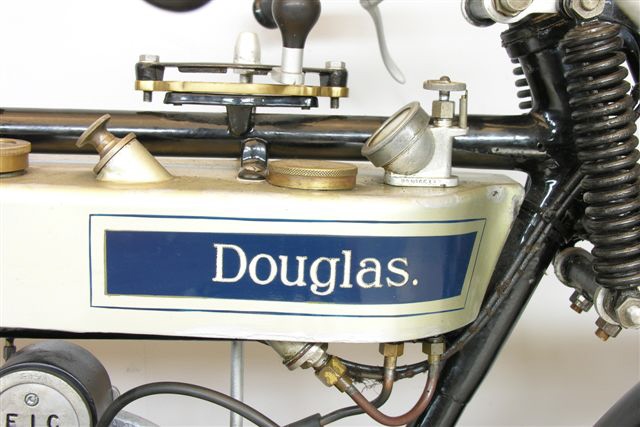
Douglas was a British motorcycle manufacturer from 1907 to 1957 based in Kingswood, Bristol, owned by the Douglas family, and especially known for its horizontally opposed twin cylinder engined motorcycles and as manufacturers of speedway machines. The company also built a range of cars between 1913 and 1922.
The brothers William and Edwin Douglas founded the Douglas Engineering Company in Bristol in 1882. Initially doing blacksmith work, they progressed to foundry work.
Joseph F. Barter's Light Motors Ltd. was one of Douglas's customers. Barter built a single-cylinder bicycle engine between 1902 and 1904; he then developed the Fée bicycle engine system. The Fée's 200 cc flat-twin engine was mounted in-line with the frame, using chain drive to a countershaft beneath (with clutch); this then used a drive belt to power the bicycle's rear wheel. Barter founded Light Motors Ltd. to build the Fée system. Production began in 1905, and the Fée's name was anglicized to Fairy shortly afterward. In 1916 The Motor Cycle magazine claimed that the 1904 Fée was the earliest flat-twin motorcycle engine, of which there had since been many copies. Douglas made castings for Light Motors and took over the manufacturing rights when Light Motors went out of business in 1907.
From 1907 a 350 cc Douglas version was on sale, similar to the Fairy with the engine in-line mounted high in the frame, but without the chain driven countershaft beneath, and with belt final drive. At the 1907 Stanley Show they attracted a lot of attention with a V4 engined motorcycle, with automatic inlet valves, and two-speed drive. The V4 did not go into production, and by the 1908 show it was only the updated in-line twin that was on show, now lighter and with a lower engine position. Around 1911 the frame was modified to make the engine still lower, and in 1912 the automatic inlet valves were replaced by mechanically operated valves.
During World War I Douglas was a major motorcycle supplier, making around 70,000 motorcycles for military use. In a 1916 review of flat-twin engines in The Motor Cycle magazine two models of Douglas engine are listed. The 2.75 hp (350cc) with 60.5mm bore and 60mm stroke, with the valves placed side-by-side on the side of the engine. The other engine was the 4 hp (544cc) flat twin of 72mm bore and 68mm stroke. One of the significant differences with this larger engine was the oil was carried in the sump and supplied by pump to bearings and cylinders. The sump had a glass window to inspect the oil level. The valves were placed side by side above the cylinders. A third engine was the Williamson Flat Twin made by Douglas with cyclecars in mind, but produced for the Williamson Motor Company to use in its motor cycles since 1912. This was an 8 hp engine of 964cc, 85mm bore and 85mm stroke. Initially water cooled, from 1913 it was also available air-cooled.
In the 1920s Douglas built the first disc brakes, and had a Royal Warrant for the supply of motorcycles to the Princes, Albert and Henry.
Douglas motorcycles also became popular in dirt track racing. The 1923 RA model with disc brakes was favoured initially and this prompted Douglas to build specific dirt track models. These motorcycle designs were gradually increased in size and power with 500 cc and 600 cc engines fitted to the DT5 and DT6 Dirt Track models in the late 1920s and early 1930s. The engines had hemispherical heads and a short rigid forged crankshaft. They dominated dirt track racing for about three years. In 1929, the most successful dirt racing year, 1,200 Dirt Track motorcycles were sold.
The Endeavour, a 494 cc (30.1 cu in) shaft drive model, was launched in 1934. This was again a flat-twin, but for the first time Douglas fitted it across the frame instead of in-line. Like other companies of the time, Douglas was struggling, and trying to diversify into other modes of transport. In 1935 it was taken over by the Bond Aircraft and Engineering Company (BAC).
Hub AI
Douglas (motorcycles) AI simulator
(@Douglas (motorcycles)_simulator)
Douglas (motorcycles)
Douglas was a British motorcycle manufacturer from 1907 to 1957 based in Kingswood, Bristol, owned by the Douglas family, and especially known for its horizontally opposed twin cylinder engined motorcycles and as manufacturers of speedway machines. The company also built a range of cars between 1913 and 1922.
The brothers William and Edwin Douglas founded the Douglas Engineering Company in Bristol in 1882. Initially doing blacksmith work, they progressed to foundry work.
Joseph F. Barter's Light Motors Ltd. was one of Douglas's customers. Barter built a single-cylinder bicycle engine between 1902 and 1904; he then developed the Fée bicycle engine system. The Fée's 200 cc flat-twin engine was mounted in-line with the frame, using chain drive to a countershaft beneath (with clutch); this then used a drive belt to power the bicycle's rear wheel. Barter founded Light Motors Ltd. to build the Fée system. Production began in 1905, and the Fée's name was anglicized to Fairy shortly afterward. In 1916 The Motor Cycle magazine claimed that the 1904 Fée was the earliest flat-twin motorcycle engine, of which there had since been many copies. Douglas made castings for Light Motors and took over the manufacturing rights when Light Motors went out of business in 1907.
From 1907 a 350 cc Douglas version was on sale, similar to the Fairy with the engine in-line mounted high in the frame, but without the chain driven countershaft beneath, and with belt final drive. At the 1907 Stanley Show they attracted a lot of attention with a V4 engined motorcycle, with automatic inlet valves, and two-speed drive. The V4 did not go into production, and by the 1908 show it was only the updated in-line twin that was on show, now lighter and with a lower engine position. Around 1911 the frame was modified to make the engine still lower, and in 1912 the automatic inlet valves were replaced by mechanically operated valves.
During World War I Douglas was a major motorcycle supplier, making around 70,000 motorcycles for military use. In a 1916 review of flat-twin engines in The Motor Cycle magazine two models of Douglas engine are listed. The 2.75 hp (350cc) with 60.5mm bore and 60mm stroke, with the valves placed side-by-side on the side of the engine. The other engine was the 4 hp (544cc) flat twin of 72mm bore and 68mm stroke. One of the significant differences with this larger engine was the oil was carried in the sump and supplied by pump to bearings and cylinders. The sump had a glass window to inspect the oil level. The valves were placed side by side above the cylinders. A third engine was the Williamson Flat Twin made by Douglas with cyclecars in mind, but produced for the Williamson Motor Company to use in its motor cycles since 1912. This was an 8 hp engine of 964cc, 85mm bore and 85mm stroke. Initially water cooled, from 1913 it was also available air-cooled.
In the 1920s Douglas built the first disc brakes, and had a Royal Warrant for the supply of motorcycles to the Princes, Albert and Henry.
Douglas motorcycles also became popular in dirt track racing. The 1923 RA model with disc brakes was favoured initially and this prompted Douglas to build specific dirt track models. These motorcycle designs were gradually increased in size and power with 500 cc and 600 cc engines fitted to the DT5 and DT6 Dirt Track models in the late 1920s and early 1930s. The engines had hemispherical heads and a short rigid forged crankshaft. They dominated dirt track racing for about three years. In 1929, the most successful dirt racing year, 1,200 Dirt Track motorcycles were sold.
The Endeavour, a 494 cc (30.1 cu in) shaft drive model, was launched in 1934. This was again a flat-twin, but for the first time Douglas fitted it across the frame instead of in-line. Like other companies of the time, Douglas was struggling, and trying to diversify into other modes of transport. In 1935 it was taken over by the Bond Aircraft and Engineering Company (BAC).