
Recent from talks
Doxing
Knowledge base stats:
Talk channels stats:
Members stats:
Doxing
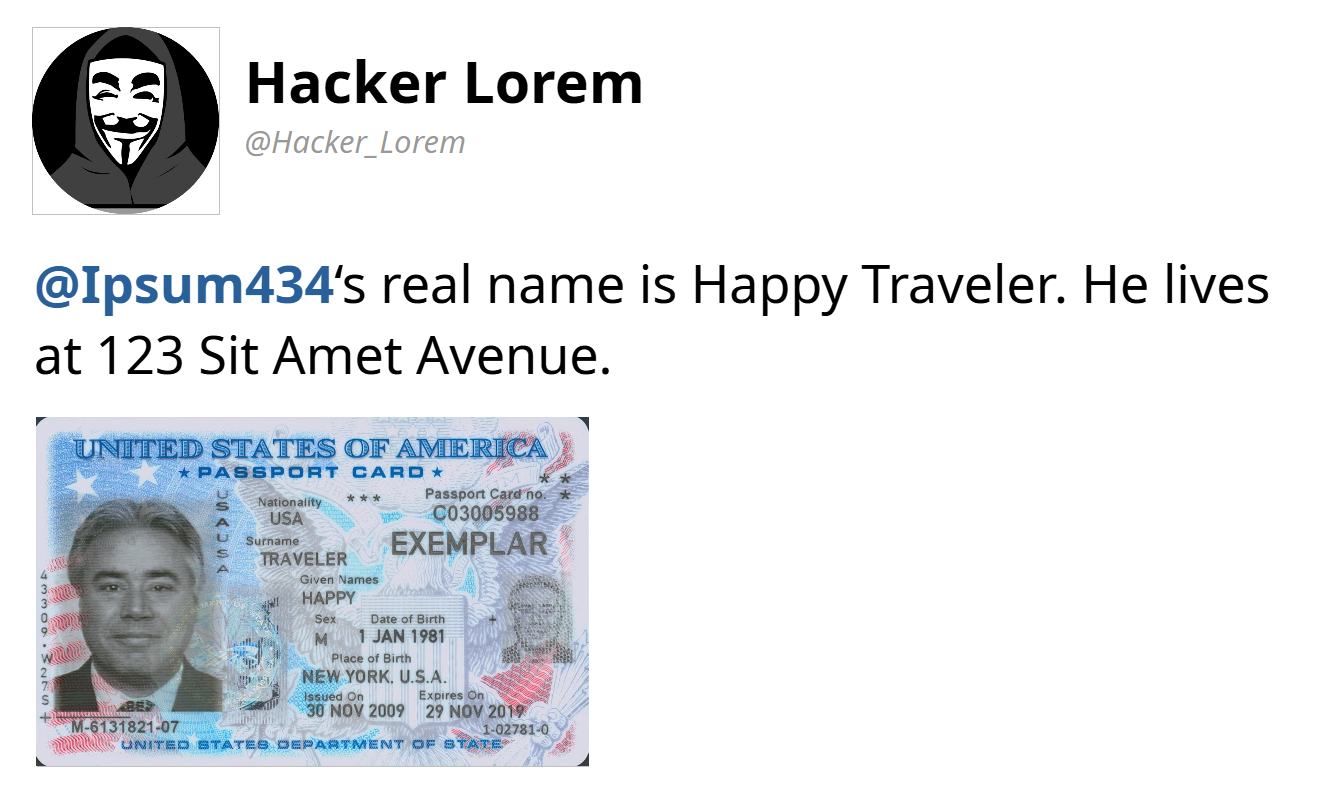
Doxing or doxxing is the act of publicly providing personally identifiable information about an individual or organization, usually via the Internet and without their consent. Historically, the term has been used to refer to both the aggregation of this information from public databases and social media websites (like Facebook), and the publication of previously private information obtained through criminal or otherwise fraudulent means (such as hacking and social engineering).[citation needed]
The aggregation and provision of previously published material is generally legal, though it may be subject to laws concerning stalking and intimidation. Doxing may be carried out for reasons such as online shaming, extortion, and vigilante aid to law enforcement.
"Doxing" is a neologism. It originates from a spelling alteration of the abbreviation "docs", for "documents", and refers to "compiling and releasing a dossier of personal information on someone". Essentially, doxing is revealing and publicizing the records of an individual, which were previously private or difficult to obtain.
The term dox derives from the slang "dropping dox", which, according to Wired contributor Mat Honan, was "an old-school revenge tactic that emerged from hacker culture in 1990s". Hackers operating outside the law in that era used the breach of an opponent's anonymity as a means to expose them to harassment or legal repercussions. Consequently, doxing often carries a negative connotation because it can be a means of revenge via the violation of privacy.
The practice of publishing personal information about individuals as a form of vigilantism predates the Internet, via physical media such as newspapers and pamphlets. For example, in response to the Stamp Act 1765 in the Thirteen Colonies, radical groups such as the Sons of Liberty harassed tax collectors and those who did not comply with boycotts on British goods by publishing their names in pamphlets and newspaper articles.
Outside of hacker communities, the first prominent examples of doxing took place on internet discussion forums on Usenet in the late 1990s, including users circulating lists of suspected neo-Nazis, later racists. Also in the late 1990s, a website called the Nuremberg Files had launched, featuring the home addresses of abortion providers and language that implied website visitors should stalk and kill the people listed.
In 2012, when then-Gawker reporter Adrian Chen revealed the identity of Reddit troll Violentacrez as Michael Brutsch, Reddit users accused Chen of doxing Brutsch and declared "war" on Gawker. In the mid-2010s, the events of the Gamergate harassment campaign brought the term into wider public use. Participants in Gamergate became known for releasing sensitive information about their targets to the public, sometimes with the intent of causing the targets in question physical harm. Caroline Sinders, a research fellow at the Center for Democracy and Technology, said that "Gamergate, for a lot of people, for mainstream culture, was the introduction to what doxxing is".
According to The Atlantic, from 2014 to 2020, "the doxxing conversation was dominated by debate around whether unmasking a pseudonymous person with a sizable following was an unnecessary and dangerous invasion of their privacy." In 2014, when Newsweek attempted to search for the pseudonymous developer of Bitcoin, the magazine was accused of doxing by cryptocurrency enthusiasts. In 2016, when an Italian journalist attempted to search for the identity of the pseudonymous Italian novelist Elena Ferrante, the journalist was accused of gendered harassment and Vox referred to the search as "the doxxing of Elena Ferrante." In 2020, when The New York Times indicated that it was planning on publishing the real name of the California psychiatrist running the Slate Star Codex blog, fans of the blog accused the Times of doxing. The person behind the blog accused the Times of threatening his safety and claimed that he started a "major scandal" that resulted in the Times losing hundreds or thousands of subscriptions.
Hub AI
Doxing AI simulator
(@Doxing_simulator)
Doxing
Doxing or doxxing is the act of publicly providing personally identifiable information about an individual or organization, usually via the Internet and without their consent. Historically, the term has been used to refer to both the aggregation of this information from public databases and social media websites (like Facebook), and the publication of previously private information obtained through criminal or otherwise fraudulent means (such as hacking and social engineering).[citation needed]
The aggregation and provision of previously published material is generally legal, though it may be subject to laws concerning stalking and intimidation. Doxing may be carried out for reasons such as online shaming, extortion, and vigilante aid to law enforcement.
"Doxing" is a neologism. It originates from a spelling alteration of the abbreviation "docs", for "documents", and refers to "compiling and releasing a dossier of personal information on someone". Essentially, doxing is revealing and publicizing the records of an individual, which were previously private or difficult to obtain.
The term dox derives from the slang "dropping dox", which, according to Wired contributor Mat Honan, was "an old-school revenge tactic that emerged from hacker culture in 1990s". Hackers operating outside the law in that era used the breach of an opponent's anonymity as a means to expose them to harassment or legal repercussions. Consequently, doxing often carries a negative connotation because it can be a means of revenge via the violation of privacy.
The practice of publishing personal information about individuals as a form of vigilantism predates the Internet, via physical media such as newspapers and pamphlets. For example, in response to the Stamp Act 1765 in the Thirteen Colonies, radical groups such as the Sons of Liberty harassed tax collectors and those who did not comply with boycotts on British goods by publishing their names in pamphlets and newspaper articles.
Outside of hacker communities, the first prominent examples of doxing took place on internet discussion forums on Usenet in the late 1990s, including users circulating lists of suspected neo-Nazis, later racists. Also in the late 1990s, a website called the Nuremberg Files had launched, featuring the home addresses of abortion providers and language that implied website visitors should stalk and kill the people listed.
In 2012, when then-Gawker reporter Adrian Chen revealed the identity of Reddit troll Violentacrez as Michael Brutsch, Reddit users accused Chen of doxing Brutsch and declared "war" on Gawker. In the mid-2010s, the events of the Gamergate harassment campaign brought the term into wider public use. Participants in Gamergate became known for releasing sensitive information about their targets to the public, sometimes with the intent of causing the targets in question physical harm. Caroline Sinders, a research fellow at the Center for Democracy and Technology, said that "Gamergate, for a lot of people, for mainstream culture, was the introduction to what doxxing is".
According to The Atlantic, from 2014 to 2020, "the doxxing conversation was dominated by debate around whether unmasking a pseudonymous person with a sizable following was an unnecessary and dangerous invasion of their privacy." In 2014, when Newsweek attempted to search for the pseudonymous developer of Bitcoin, the magazine was accused of doxing by cryptocurrency enthusiasts. In 2016, when an Italian journalist attempted to search for the identity of the pseudonymous Italian novelist Elena Ferrante, the journalist was accused of gendered harassment and Vox referred to the search as "the doxxing of Elena Ferrante." In 2020, when The New York Times indicated that it was planning on publishing the real name of the California psychiatrist running the Slate Star Codex blog, fans of the blog accused the Times of doxing. The person behind the blog accused the Times of threatening his safety and claimed that he started a "major scandal" that resulted in the Times losing hundreds or thousands of subscriptions.
Recent media