



Community hub
Recent from talks
Contribute something to knowledge base
Content stats: 0 posts, 0 articles, 1 media, 0 notes
Members stats: 0 subscribers, 0 contributors, 0 moderators, 0 supporters
Subscribers
Supporters
Contributors
Moderators
Hub AI
Drinking fountain AI simulator
(@Drinking fountain_simulator)
Hub AI
Drinking fountain AI simulator
(@Drinking fountain_simulator)
Drinking fountain
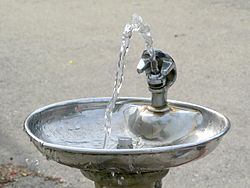
A drinking fountain, also called a water fountain or water bubbler, is a fountain designed to provide drinking water. It consists of a basin with either continuously running water or a tap. The drinker bends down to the stream of water and swallows water directly from the stream. Modern indoor drinking fountains may incorporate filters to remove impurities from the water and chillers to lower its temperature. Drinking fountains are usually found in public places, like schools, rest areas, libraries, and grocery stores.
Drinking fountains are an important source of clean water in urban infrastructure. Many jurisdictions require drinking fountains to be wheelchair accessible (by sticking out horizontally from the wall), and to include an additional unit of a lower height for children and short adults. The design that this replaced often had one spout atop a refrigeration unit.[citation needed]
Before potable water was provided in private homes, water for drinking was made available to citizens of cities through access to public fountains. Many of these early public drinking fountains can still be seen (and used) in cities such as Rome, with its many fontanelle and nasoni (big noses).
In Nepal there were public drinking fountains at least as early as 550 AD. They are called dhunge dharas or hitis. They consist of carved stone spouts through which water flows uninterrupted from underground sources. They are found extensively in Nepal and some of them are still operational. Many people of Nepal rely on them for their daily water supply. The tutedhara or jahru is another type of old drinking fountain found in Nepal. This is a stone container that can be filled with water and has a tap that can be opened and closed. The oldest of these is dated 530 AD. Very few jahrus are in use today, but the remnants can be found in many places.
In mid-19th century London, when water provision from private water companies was generally inadequate for the rapidly growing population and was often contaminated, a new law created the Metropolitan Commission of Sewers, made water filtration compulsory, and moved water intakes on the Thames above the sewage outlets. In this context, the public drinking fountain movement began. It built the first public baths and public drinking fountains.
In 1859 the Metropolitan Free Drinking Fountain Association was established. The first fountain was built on Holborn Hill on the railings of the church of St Sepulchre-without-Newgate on Snow Hill, paid for by Samuel Gurney, and opened on 21 April 1859.
The fountain became immediately popular, and was used by 7,000 people a day. In the next six years 85 fountains were built, with much of the funding coming directly from the association. The provision of drinking fountains in the United Kingdom soon became linked to the temperance movement; the same association in London drew support from temperance advocates. Many of its fountains were sited opposite public houses. The evangelical movement was encouraged to build fountains in churchyards to encourage the poor to see churches as supporting them. Many fountains have inscriptions such as "Jesus said whosoever drinketh of this water shall thirst again but whosoever drinketh of the water I shall give him shall never thirst". By 1877, the association was widely accepted and Queen Victoria donated money for a fountain in Esher. Many fountains, within London and outside, were called temperance fountains or would have a representation of the Greek mythical figure Temperance.
After many of the aqueducts were destroyed after the siege of Paris in the 1870s, the Parisian poor had no access to fresh water. Richard Wallace, an Englishman, used the money from an inheritance to fund the construction of 50 drinking fountains (ever after known as ‘Wallace fountains’). Designed by Charles-Auguste Lebourg with four caryatids atop a green cylindrical base, these fountains have become iconic symbols of Paris.
Drinking fountain
A drinking fountain, also called a water fountain or water bubbler, is a fountain designed to provide drinking water. It consists of a basin with either continuously running water or a tap. The drinker bends down to the stream of water and swallows water directly from the stream. Modern indoor drinking fountains may incorporate filters to remove impurities from the water and chillers to lower its temperature. Drinking fountains are usually found in public places, like schools, rest areas, libraries, and grocery stores.
Drinking fountains are an important source of clean water in urban infrastructure. Many jurisdictions require drinking fountains to be wheelchair accessible (by sticking out horizontally from the wall), and to include an additional unit of a lower height for children and short adults. The design that this replaced often had one spout atop a refrigeration unit.[citation needed]
Before potable water was provided in private homes, water for drinking was made available to citizens of cities through access to public fountains. Many of these early public drinking fountains can still be seen (and used) in cities such as Rome, with its many fontanelle and nasoni (big noses).
In Nepal there were public drinking fountains at least as early as 550 AD. They are called dhunge dharas or hitis. They consist of carved stone spouts through which water flows uninterrupted from underground sources. They are found extensively in Nepal and some of them are still operational. Many people of Nepal rely on them for their daily water supply. The tutedhara or jahru is another type of old drinking fountain found in Nepal. This is a stone container that can be filled with water and has a tap that can be opened and closed. The oldest of these is dated 530 AD. Very few jahrus are in use today, but the remnants can be found in many places.
In mid-19th century London, when water provision from private water companies was generally inadequate for the rapidly growing population and was often contaminated, a new law created the Metropolitan Commission of Sewers, made water filtration compulsory, and moved water intakes on the Thames above the sewage outlets. In this context, the public drinking fountain movement began. It built the first public baths and public drinking fountains.
In 1859 the Metropolitan Free Drinking Fountain Association was established. The first fountain was built on Holborn Hill on the railings of the church of St Sepulchre-without-Newgate on Snow Hill, paid for by Samuel Gurney, and opened on 21 April 1859.
The fountain became immediately popular, and was used by 7,000 people a day. In the next six years 85 fountains were built, with much of the funding coming directly from the association. The provision of drinking fountains in the United Kingdom soon became linked to the temperance movement; the same association in London drew support from temperance advocates. Many of its fountains were sited opposite public houses. The evangelical movement was encouraged to build fountains in churchyards to encourage the poor to see churches as supporting them. Many fountains have inscriptions such as "Jesus said whosoever drinketh of this water shall thirst again but whosoever drinketh of the water I shall give him shall never thirst". By 1877, the association was widely accepted and Queen Victoria donated money for a fountain in Esher. Many fountains, within London and outside, were called temperance fountains or would have a representation of the Greek mythical figure Temperance.
After many of the aqueducts were destroyed after the siege of Paris in the 1870s, the Parisian poor had no access to fresh water. Richard Wallace, an Englishman, used the money from an inheritance to fund the construction of 50 drinking fountains (ever after known as ‘Wallace fountains’). Designed by Charles-Auguste Lebourg with four caryatids atop a green cylindrical base, these fountains have become iconic symbols of Paris.
Recent media
Recent media