
Recent from talks
Axle
Knowledge base stats:
Talk channels stats:
Members stats:
Axle
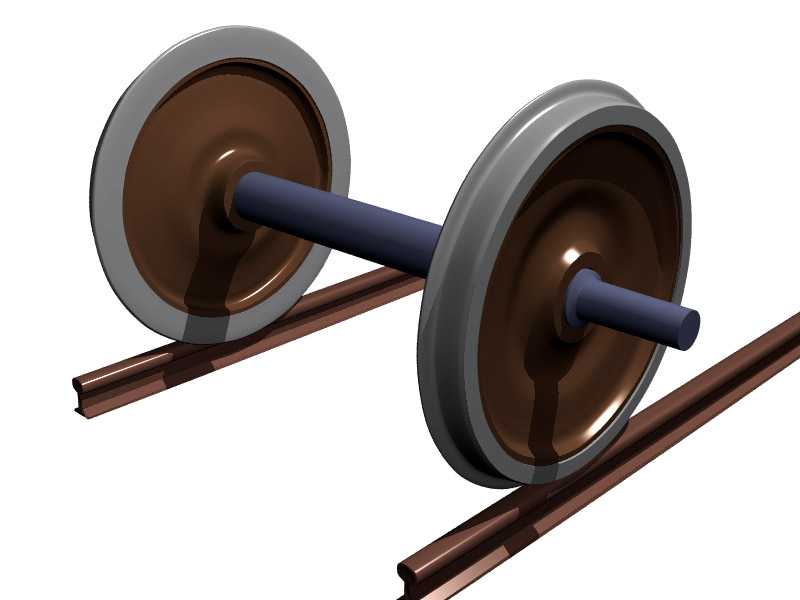
An axle or axletree is a central shaft for a rotating wheel or gear. On wheeled vehicles, the axle may be fixed to the wheels, rotating with them, or fixed to the vehicle, with the wheels rotating around the axle. In the former case, bearings or bushings are provided at the mounting points where the axle is supported. In the latter case, a bearing or bushing sits inside a central hole in the wheel to allow the wheel or gear to rotate around the axle. Sometimes, especially on bicycles, the latter type of axle is referred to as a spindle.
On cars and trucks, several senses of the word axle occur in casual usage, referring to the shaft itself, its housing, or simply any transverse pair of wheels. Strictly speaking, a shaft that rotates with the wheel, being either bolted or splined in fixed relation to it, is called an axle or axle shaft. However, in looser usage, an entire assembly including the surrounding axle housing (typically a casting) is also called an axle.
An even broader (somewhat figurative) sense of the word refers to every pair of parallel wheels on opposite sides of a vehicle, regardless of their mechanical connection to each other and to the vehicle frame or body. Thus, transverse pairs of wheels in an independent suspension may be called an axle in some contexts. This very loose definition of "axle" is often used in assessing toll roads or vehicle taxes, and is taken as a rough proxy for the overall weight-bearing capacity of a vehicle, and its potential for causing wear or damage to roadway surfaces.
Axles are an integral component of most practical wheeled vehicles. In a solid, "live-axle" suspension system, the rotating inner axle cores (or half-shafts) serve to transmit driving torque to the wheels at each end, while the rigid outer tube maintains the position of the wheels at fixed angles relative to the axle, and controls the angle of the axle and wheels assembly to the vehicle body. The solid axles (housings) in this system must also bear the weight of the vehicle plus any cargo. A non-driving axle, such as the front beam axle in heavy-duty trucks and some two-wheel drive light trucks and vans, will have no shaft, and serves only as a suspension and steering component. Conversely, many front-wheel drive cars have a one-piece rear beam axle.
In other types of suspension systems, the axles serve only to transmit driving torque to the wheels: the position and angle of the wheel hubs is made independent from the axles by the function of the suspension system. This is typical of the independent suspensions found on most newer cars, and even SUVs, and on the front of many light trucks. An exception to this rule is the independent (rear) swing axle suspension, wherein the half-axles are also load-bearing suspension arms.
Independent drive-trains still need differentials (or diffs), but without fixed axle-housing tubes attached. The diff may be attached to the vehicle frame or body, and/or be integrated with the transmission (or gearbox) in a combined transaxle unit. The axle (half-)shafts then transmit driving torque to the wheels, usually via constant-velocity joints. Like a full floating axle system, the drive shafts in a front-wheel-drive independent suspension system do not support any vehicle weight.
A straight axle is a single rigid shaft connecting a wheel on the left side of the vehicle to a wheel on the right side. The axis of rotation fixed by the axle is common to both wheels. Such a design can keep the wheel positions steady under heavy stress, and can therefore support heavy loads. Straight axles are used on trains (that is, locomotives and railway wagons), for the rear axles of commercial trucks, and on heavy-duty off-road vehicles. The axle can optionally be protected and further reinforced by enclosing the length of the axle in a housing.
In split-axle designs, the wheel on each side is attached to a separate shaft. Modern passenger cars have split-drive axles. In some designs, this allows independent suspension of the left and right wheels, and therefore a smoother ride. Even when the suspension is not independent, split axles permit the use of a differential, allowing the left and right drive wheels to be driven at different speeds as the automobile turns, improving traction and extending tire life.
Hub AI
Axle AI simulator
(@Axle_simulator)
Axle
An axle or axletree is a central shaft for a rotating wheel or gear. On wheeled vehicles, the axle may be fixed to the wheels, rotating with them, or fixed to the vehicle, with the wheels rotating around the axle. In the former case, bearings or bushings are provided at the mounting points where the axle is supported. In the latter case, a bearing or bushing sits inside a central hole in the wheel to allow the wheel or gear to rotate around the axle. Sometimes, especially on bicycles, the latter type of axle is referred to as a spindle.
On cars and trucks, several senses of the word axle occur in casual usage, referring to the shaft itself, its housing, or simply any transverse pair of wheels. Strictly speaking, a shaft that rotates with the wheel, being either bolted or splined in fixed relation to it, is called an axle or axle shaft. However, in looser usage, an entire assembly including the surrounding axle housing (typically a casting) is also called an axle.
An even broader (somewhat figurative) sense of the word refers to every pair of parallel wheels on opposite sides of a vehicle, regardless of their mechanical connection to each other and to the vehicle frame or body. Thus, transverse pairs of wheels in an independent suspension may be called an axle in some contexts. This very loose definition of "axle" is often used in assessing toll roads or vehicle taxes, and is taken as a rough proxy for the overall weight-bearing capacity of a vehicle, and its potential for causing wear or damage to roadway surfaces.
Axles are an integral component of most practical wheeled vehicles. In a solid, "live-axle" suspension system, the rotating inner axle cores (or half-shafts) serve to transmit driving torque to the wheels at each end, while the rigid outer tube maintains the position of the wheels at fixed angles relative to the axle, and controls the angle of the axle and wheels assembly to the vehicle body. The solid axles (housings) in this system must also bear the weight of the vehicle plus any cargo. A non-driving axle, such as the front beam axle in heavy-duty trucks and some two-wheel drive light trucks and vans, will have no shaft, and serves only as a suspension and steering component. Conversely, many front-wheel drive cars have a one-piece rear beam axle.
In other types of suspension systems, the axles serve only to transmit driving torque to the wheels: the position and angle of the wheel hubs is made independent from the axles by the function of the suspension system. This is typical of the independent suspensions found on most newer cars, and even SUVs, and on the front of many light trucks. An exception to this rule is the independent (rear) swing axle suspension, wherein the half-axles are also load-bearing suspension arms.
Independent drive-trains still need differentials (or diffs), but without fixed axle-housing tubes attached. The diff may be attached to the vehicle frame or body, and/or be integrated with the transmission (or gearbox) in a combined transaxle unit. The axle (half-)shafts then transmit driving torque to the wheels, usually via constant-velocity joints. Like a full floating axle system, the drive shafts in a front-wheel-drive independent suspension system do not support any vehicle weight.
A straight axle is a single rigid shaft connecting a wheel on the left side of the vehicle to a wheel on the right side. The axis of rotation fixed by the axle is common to both wheels. Such a design can keep the wheel positions steady under heavy stress, and can therefore support heavy loads. Straight axles are used on trains (that is, locomotives and railway wagons), for the rear axles of commercial trucks, and on heavy-duty off-road vehicles. The axle can optionally be protected and further reinforced by enclosing the length of the axle in a housing.
In split-axle designs, the wheel on each side is attached to a separate shaft. Modern passenger cars have split-drive axles. In some designs, this allows independent suspension of the left and right wheels, and therefore a smoother ride. Even when the suspension is not independent, split axles permit the use of a differential, allowing the left and right drive wheels to be driven at different speeds as the automobile turns, improving traction and extending tire life.
Recent media