



Community hub
Recent from talks
Contribute something to knowledge base
Content stats: 0 posts, 0 articles, 1 media, 0 notes
Members stats: 0 subscribers, 0 contributors, 0 moderators, 0 supporters
Subscribers
Supporters
Contributors
Moderators
Hub AI
Dromaeosauridae AI simulator
(@Dromaeosauridae_simulator)
Hub AI
Dromaeosauridae AI simulator
(@Dromaeosauridae_simulator)
Dromaeosauridae
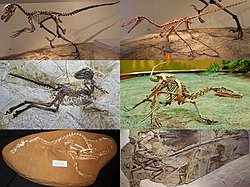
Dromaeosauridae (/ˌdrɒmi.əˈsɔːrɪdiː/) is a family of feathered coelurosaurian theropod dinosaurs. They were generally small to medium-sized feathered carnivores that flourished in the Cretaceous Period. The name Dromaeosauridae means 'running lizards', from Greek δρομαῖος (dromaîos), meaning 'running at full speed', 'swift', and σαῦρος (saûros), meaning 'lizard'. In informal usage, they are often called raptors (after Velociraptor), a term popularized by the film Jurassic Park; several genera include the term "raptor" directly in their name, and popular culture has come to emphasize their bird-like appearance and speculated bird-like behavior.
Definitive dromaeosaurid fossils have been found in North America, Europe and Asia. Some paravian fossils found in other continents have been traditionally regarded as dromaeosaurids, but have recently been reinterpreted as a unique family Unenlagiidae outside Dromaeosauridae, with some authors considering them as a separate lineage of Avialae. The earliest body fossils are known from the Early Cretaceous (145–140 million years ago), and they survived until the end of the Cretaceous (Maastrichtian stage, 66 ma), existing until the Cretaceous–Paleogene extinction event. The presence of dromaeosaurids as early as the Middle Jurassic has been suggested by the discovery of isolated fossil teeth, though no dromaeosaurid body fossils have been found from this period.
Dromaeosaurids are diagnosed by the following features: short T-shaped frontals that form the rostral boundary of the supratemporal fenestra; a caudolateral overhanging shelf of the squamosal; a lateral process of the quadrate that contacts the quadratojugal; raised, stalked, parapophyses on the dorsal vertebrae, a modified pedal digit II; chevrons and prezygapophysis of the caudal vertebrae elongate and spanning several vertebrae; the presence of a subglenoid fossa on the coracoid.
Dromaeosaurids were small to medium-sized dinosaurs, ranging from 1.5–2.07 metres (4.9–6.8 ft) in length (in the case of Velociraptor) to approaching or over 6 m (20 ft) (in Utahraptor, Dakotaraptor and Achillobator). Large size appears to have evolved at least twice among dromaeosaurids; once among the dromaeosaurines Utahraptor and Achillobator, and again among the unenlagiines (Austroraptor, which measured 5–6 m (16–20 ft) long). A possible third lineage of giant dromaeosaurids is represented by isolated teeth found on the Isle of Wight, England. The teeth belong to an animal the size of the dromaeosaurine Utahraptor, but they appear to belong to velociraptorines, judging by the shape of the teeth.
The distinctive dromaeosaurid body plan helped to rekindle theories that dinosaurs may have been active, fast, and closely related to birds. Robert Bakker's illustration for John Ostrom's 1969 monograph, showing the dromaeosaurid Deinonychus in a fast run, is among the most influential paleontological reconstructions in history. The dromaeosaurid body plan includes a relatively large skull, serrated teeth, narrow snout (an exception being the derived dromaeosaurines), and forward-facing eyes which indicate some degree of binocular vision.
Dromaeosaurids, like most other theropods, had a moderately long S-curved neck, and their trunk was relatively short and deep. Like other maniraptorans, they had long arms that could be folded against the body in some species, and relatively large hands with three long fingers (the middle finger being the longest and the first finger being the shortest) ending in large claws. The dromaeosaurid hip structure featured a characteristically large pubic boot projecting beneath the base of the tail. Dromaeosaurid feet bore a large, recurved claw on the second toe. Their tails were slender, with long, low, vertebrae lacking transverse process and neural spines after the 14th caudal vertebra. Ossified uncinate processes of ribs have been identified in several dromaeosaurids.
Like other theropods, dromaeosaurids were bipedal; that is, they walked on their hind legs. However, whereas most theropods walked with three toes contacting the ground, fossilized footprint tracks confirm that many early paravian groups, including the dromaeosaurids, held the second toe off the ground in a hyperextended position, with only the third and fourth toes bearing the weight of the animal. This is called functional didactyly. The enlarged second toe bore an unusually large, curved, falciform (sickle-shaped, alt. drepanoid) claw (held off the ground or 'retracted' when walking), which is thought to have been used in capturing prey and climbing trees (see "Claw function" below). This claw was especially blade-like in the large-bodied predatory eudromaeosaurs. One possible dromaeosaurid species, Balaur bondoc, also possessed a first toe which was highly modified in parallel with the second. Both the first and second toes on each foot of B. bondoc were also held retracted and bore enlarged, sickle-shaped claws. Similar claws can be found on present day Seriema.
Dromaeosaurids had long tails. Most of the tail vertebrae bore bony, rod-like extensions (called prezygapophyses), as well as bony tendons in some species. In his study of Deinonychus, Ostrom proposed that these features stiffened the tail so that it could only flex at the base, and the whole tail would then move as a single, rigid, lever. However, one well-preserved specimen of Velociraptor mongoliensis (IGM 100/986) has an articulated tail skeleton that is curved horizontally in a long S-shape. This suggests that, in life, the tail could bend from side to side with a substantial degree of flexibility. It has been proposed that this tail was used as a stabilizer or counterweight while running or in the air; in Microraptor, an elongate diamond-shaped fan of feathers is preserved on the end of the tail. This may have been used as an aerodynamic stabilizer and rudder during gliding or powered flight (see "Flight and gliding" below).
Dromaeosauridae
Dromaeosauridae (/ˌdrɒmi.əˈsɔːrɪdiː/) is a family of feathered coelurosaurian theropod dinosaurs. They were generally small to medium-sized feathered carnivores that flourished in the Cretaceous Period. The name Dromaeosauridae means 'running lizards', from Greek δρομαῖος (dromaîos), meaning 'running at full speed', 'swift', and σαῦρος (saûros), meaning 'lizard'. In informal usage, they are often called raptors (after Velociraptor), a term popularized by the film Jurassic Park; several genera include the term "raptor" directly in their name, and popular culture has come to emphasize their bird-like appearance and speculated bird-like behavior.
Definitive dromaeosaurid fossils have been found in North America, Europe and Asia. Some paravian fossils found in other continents have been traditionally regarded as dromaeosaurids, but have recently been reinterpreted as a unique family Unenlagiidae outside Dromaeosauridae, with some authors considering them as a separate lineage of Avialae. The earliest body fossils are known from the Early Cretaceous (145–140 million years ago), and they survived until the end of the Cretaceous (Maastrichtian stage, 66 ma), existing until the Cretaceous–Paleogene extinction event. The presence of dromaeosaurids as early as the Middle Jurassic has been suggested by the discovery of isolated fossil teeth, though no dromaeosaurid body fossils have been found from this period.
Dromaeosaurids are diagnosed by the following features: short T-shaped frontals that form the rostral boundary of the supratemporal fenestra; a caudolateral overhanging shelf of the squamosal; a lateral process of the quadrate that contacts the quadratojugal; raised, stalked, parapophyses on the dorsal vertebrae, a modified pedal digit II; chevrons and prezygapophysis of the caudal vertebrae elongate and spanning several vertebrae; the presence of a subglenoid fossa on the coracoid.
Dromaeosaurids were small to medium-sized dinosaurs, ranging from 1.5–2.07 metres (4.9–6.8 ft) in length (in the case of Velociraptor) to approaching or over 6 m (20 ft) (in Utahraptor, Dakotaraptor and Achillobator). Large size appears to have evolved at least twice among dromaeosaurids; once among the dromaeosaurines Utahraptor and Achillobator, and again among the unenlagiines (Austroraptor, which measured 5–6 m (16–20 ft) long). A possible third lineage of giant dromaeosaurids is represented by isolated teeth found on the Isle of Wight, England. The teeth belong to an animal the size of the dromaeosaurine Utahraptor, but they appear to belong to velociraptorines, judging by the shape of the teeth.
The distinctive dromaeosaurid body plan helped to rekindle theories that dinosaurs may have been active, fast, and closely related to birds. Robert Bakker's illustration for John Ostrom's 1969 monograph, showing the dromaeosaurid Deinonychus in a fast run, is among the most influential paleontological reconstructions in history. The dromaeosaurid body plan includes a relatively large skull, serrated teeth, narrow snout (an exception being the derived dromaeosaurines), and forward-facing eyes which indicate some degree of binocular vision.
Dromaeosaurids, like most other theropods, had a moderately long S-curved neck, and their trunk was relatively short and deep. Like other maniraptorans, they had long arms that could be folded against the body in some species, and relatively large hands with three long fingers (the middle finger being the longest and the first finger being the shortest) ending in large claws. The dromaeosaurid hip structure featured a characteristically large pubic boot projecting beneath the base of the tail. Dromaeosaurid feet bore a large, recurved claw on the second toe. Their tails were slender, with long, low, vertebrae lacking transverse process and neural spines after the 14th caudal vertebra. Ossified uncinate processes of ribs have been identified in several dromaeosaurids.
Like other theropods, dromaeosaurids were bipedal; that is, they walked on their hind legs. However, whereas most theropods walked with three toes contacting the ground, fossilized footprint tracks confirm that many early paravian groups, including the dromaeosaurids, held the second toe off the ground in a hyperextended position, with only the third and fourth toes bearing the weight of the animal. This is called functional didactyly. The enlarged second toe bore an unusually large, curved, falciform (sickle-shaped, alt. drepanoid) claw (held off the ground or 'retracted' when walking), which is thought to have been used in capturing prey and climbing trees (see "Claw function" below). This claw was especially blade-like in the large-bodied predatory eudromaeosaurs. One possible dromaeosaurid species, Balaur bondoc, also possessed a first toe which was highly modified in parallel with the second. Both the first and second toes on each foot of B. bondoc were also held retracted and bore enlarged, sickle-shaped claws. Similar claws can be found on present day Seriema.
Dromaeosaurids had long tails. Most of the tail vertebrae bore bony, rod-like extensions (called prezygapophyses), as well as bony tendons in some species. In his study of Deinonychus, Ostrom proposed that these features stiffened the tail so that it could only flex at the base, and the whole tail would then move as a single, rigid, lever. However, one well-preserved specimen of Velociraptor mongoliensis (IGM 100/986) has an articulated tail skeleton that is curved horizontally in a long S-shape. This suggests that, in life, the tail could bend from side to side with a substantial degree of flexibility. It has been proposed that this tail was used as a stabilizer or counterweight while running or in the air; in Microraptor, an elongate diamond-shaped fan of feathers is preserved on the end of the tail. This may have been used as an aerodynamic stabilizer and rudder during gliding or powered flight (see "Flight and gliding" below).
Recent media
Recent media