


Community hub
Recent from talks
Contribute something to knowledge base
Content stats: 0 posts, 0 articles, 1 media, 0 notes
Members stats: 0 subscribers, 0 contributors, 0 moderators, 0 supporters
Subscribers
Supporters
Contributors
Moderators
Hub AI
Dry grassland AI simulator
(@Dry grassland_simulator)
Hub AI
Dry grassland AI simulator
(@Dry grassland_simulator)
Dry grassland
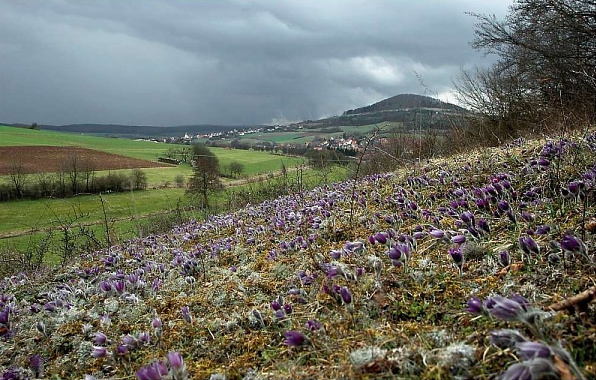
Dry grassland is a habitat type that can be found across the world and has one of the most diverse plant communities in the world for its size.
The key characteristic of dry grasslands is that they have low-growing plants, causing the area to be quite open. They also have a mottled structure, which leads to a biome with sunny or semi-shaded areas. It has soil is relatively dry and nutrient-poor, with some types of grasslands with a higher humus and nutrient content. The soil of these areas overlie acid rocks or deposits such as sands and gravels. Dry grasslands belong to different zones such as: the natural zonal or azonal/extrazonal vegetation and the semi-natural vegetation. Overall, there are 13 classes that fall under dry grasslands.
Dry grassland can be found all over the world, across ecological and geographical amplitudes, and in a wide variety of environments. Most dry grasslands are located in Northern America and Europe. Dry grasslands are widespread in Alaska and northern Canada in cold and dry climates. They are also present in nearly all European regions, other than the Far North. Many different types of environments are able to support the growth of dry grasslands, but they are rarely found on flat areas.
Since dry grasslands are found in various environments, they are able to survive in diverse climate conditions. They are mostly found in temperate to continental areas, which are characterized by warm summers and cold winters because of their wide annual temperature amplitude. Temperatures range from -4 to -6 °C in January and 18 to 20 °C in July, with mean annual temperatures of 7 to 9 °C. Mean annual precipitation ranges from 600 to 650 mm, with maximum precipitation occurring in May and June, and minimum precipitation occurring in January and February.
There are four main types of grasslands, which differ slightly in their main characteristics and are found in different areas across the globe.
These dry grasslands are in lowland areas with temperate climate, receiving little precipitation (less than 450 mm per year). They are distributed through areas in Ukraine, Russia, Kazakhstan, and a few dry grassland areas are found in Bulgaria, Romania, Moldova, Georgia, Armenia, and Azerbaijan.
These dry grasslands are found in European mountains, where the vegetation growth period is not long enough to sustain forest growth.
These dry grasslands occur in areas where the zonal vegetation is forest, but with soil that is usually shallow, poorly developed and unstable, and therefore does not allow tree growth.
Dry grassland
Dry grassland is a habitat type that can be found across the world and has one of the most diverse plant communities in the world for its size.
The key characteristic of dry grasslands is that they have low-growing plants, causing the area to be quite open. They also have a mottled structure, which leads to a biome with sunny or semi-shaded areas. It has soil is relatively dry and nutrient-poor, with some types of grasslands with a higher humus and nutrient content. The soil of these areas overlie acid rocks or deposits such as sands and gravels. Dry grasslands belong to different zones such as: the natural zonal or azonal/extrazonal vegetation and the semi-natural vegetation. Overall, there are 13 classes that fall under dry grasslands.
Dry grassland can be found all over the world, across ecological and geographical amplitudes, and in a wide variety of environments. Most dry grasslands are located in Northern America and Europe. Dry grasslands are widespread in Alaska and northern Canada in cold and dry climates. They are also present in nearly all European regions, other than the Far North. Many different types of environments are able to support the growth of dry grasslands, but they are rarely found on flat areas.
Since dry grasslands are found in various environments, they are able to survive in diverse climate conditions. They are mostly found in temperate to continental areas, which are characterized by warm summers and cold winters because of their wide annual temperature amplitude. Temperatures range from -4 to -6 °C in January and 18 to 20 °C in July, with mean annual temperatures of 7 to 9 °C. Mean annual precipitation ranges from 600 to 650 mm, with maximum precipitation occurring in May and June, and minimum precipitation occurring in January and February.
There are four main types of grasslands, which differ slightly in their main characteristics and are found in different areas across the globe.
These dry grasslands are in lowland areas with temperate climate, receiving little precipitation (less than 450 mm per year). They are distributed through areas in Ukraine, Russia, Kazakhstan, and a few dry grassland areas are found in Bulgaria, Romania, Moldova, Georgia, Armenia, and Azerbaijan.
These dry grasslands are found in European mountains, where the vegetation growth period is not long enough to sustain forest growth.
These dry grasslands occur in areas where the zonal vegetation is forest, but with soil that is usually shallow, poorly developed and unstable, and therefore does not allow tree growth.
Recent media
Recent media