


Community hub
Recent from talks
Contribute something to knowledge base
Content stats: 0 posts, 0 articles, 1 media, 0 notes
Members stats: 0 subscribers, 0 contributors, 0 moderators, 0 supporters
Subscribers
Supporters
Contributors
Moderators
Hub AI
Dual-purpose improved conventional munition AI simulator
(@Dual-purpose improved conventional munition_simulator)
Hub AI
Dual-purpose improved conventional munition AI simulator
(@Dual-purpose improved conventional munition_simulator)
Dual-purpose improved conventional munition
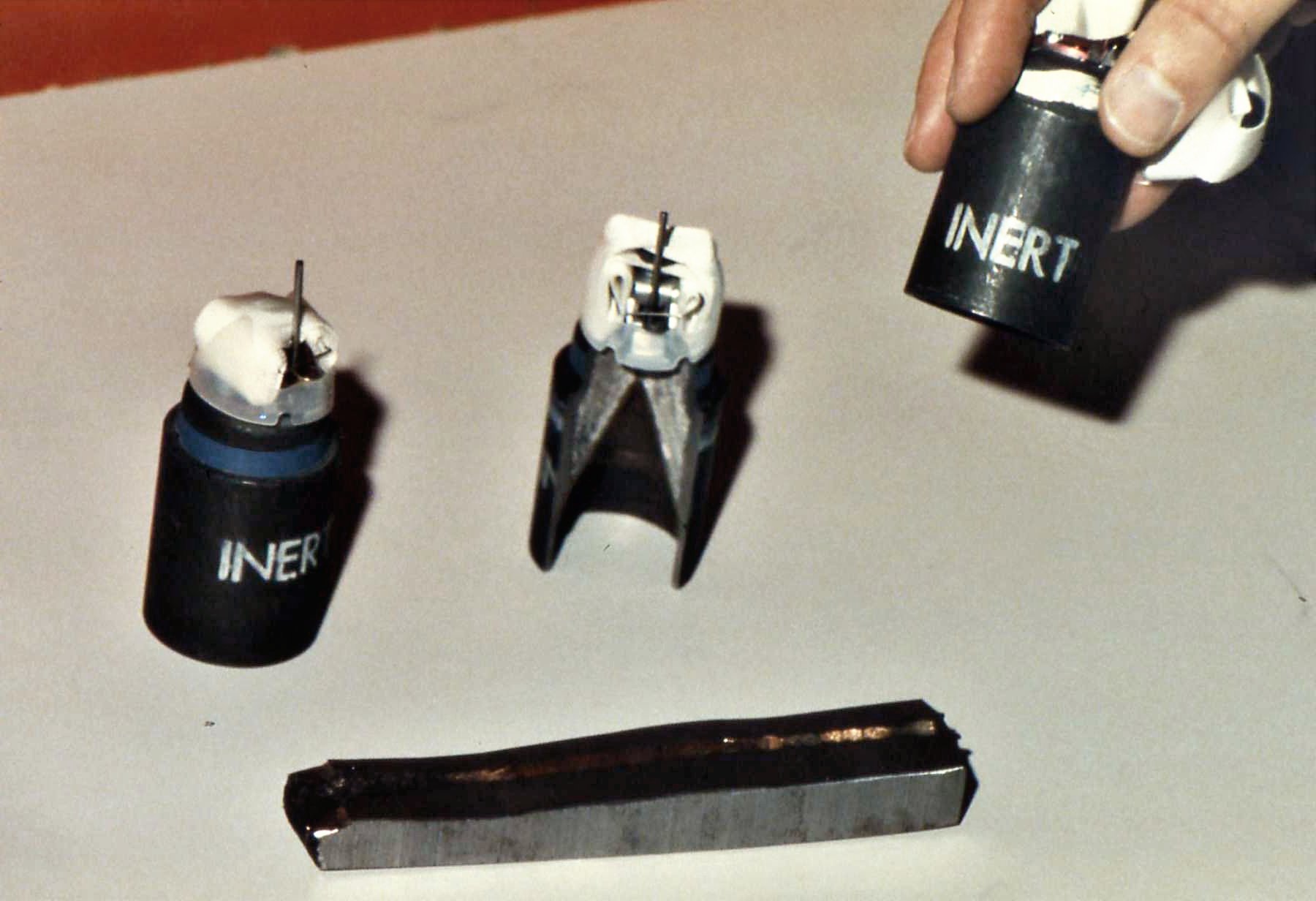
A dual-purpose improved conventional munition (DPICM) is an artillery or surface-to-surface missile warhead designed to burst into submunitions at an optimum altitude and distance from the desired target for dense area coverage. The submunitions use both shaped charges for the anti-armor role, and fragmentation for the antipersonnel role, hence the nomenclature "dual-purpose". Some submunitions may be designed for delayed reaction or mobility denial (mines). The air-to-surface variety of this kind of munition is better known as a cluster bomb. They are banned by more than 100 countries under the Convention on Cluster Munitions.
Development work for DPICM projectiles began in the late 1950s. The first projectile, the 105 mm M444, entered service in 1961. Its submunitions were simple bounding anti-personnel grenades (ICM). Production of the M444 ended in the early 1990s.
The first true DPICM was the 155 mm M483, produced in the 1970s. By 1975, an improved version, the M483A1, was being used. The projectile carried 88 M42/M46 grenade-like dual purpose submunitions. The grenades are very similar, but M42 side wall is optimized for fragmentation characteristics while M46s have thicker walls strengthened to withstand additional setback loads in the last three aft layers of the projectile, where they are placed.
The 155 mm M864 projectile entered production in 1987, and featured a base bleed that enhances the range of the projectile, although it still carries the same M42/M46 grenades. The base bleed mechanism reduces the submunition count to 72. Work was budgeted in 2003 to retrofit the M42/M46 grenades with self-destruct fuses to reduce the problem of "dud" submunitions that do not initially explode, but may explode later upon handling.
Work on 105 mm projectiles started in the late 1990s based around the M80 submunition. The eventual results were two shells, the M915 intended for use with the M119A1 light towed howitzer, and the M916 developed for the M101/M102 howitzers.
DPICMs were developed for several reasons:
Large quantities of munitions bought during the Cold War were put into war reserve stockpiles. By the mid-2010s, many were reaching the end of their useful life and required disposal, an expensive process. The submunitions, which became old and less reliable, had to be extracted. After a careful "soft touch" disassembly fully intact D563 shell casings from M483-series 155-mm projectiles were being refilled with explosives, recycling them for use as inexpensive training ammunition. One such round is the M1122, built from recycled D563s mostly filled with concrete topped with some explosive filling. As a training round, the M1122 has one-seventh the explosive impact at one-third the cost of a standard M795 high-explosive shell.
The U.S. Army is seeking a replacement of DPICMs from the Alternative Warhead Program (AWP). The AWP warheads have an equal or greater effect against materiel and personnel targets, while leaving no unexploded ordnance behind. The program is being developed by Lockheed Martin and Alliant Techsystems. The first AW rockets were ordered in September 2015.
Dual-purpose improved conventional munition
A dual-purpose improved conventional munition (DPICM) is an artillery or surface-to-surface missile warhead designed to burst into submunitions at an optimum altitude and distance from the desired target for dense area coverage. The submunitions use both shaped charges for the anti-armor role, and fragmentation for the antipersonnel role, hence the nomenclature "dual-purpose". Some submunitions may be designed for delayed reaction or mobility denial (mines). The air-to-surface variety of this kind of munition is better known as a cluster bomb. They are banned by more than 100 countries under the Convention on Cluster Munitions.
Development work for DPICM projectiles began in the late 1950s. The first projectile, the 105 mm M444, entered service in 1961. Its submunitions were simple bounding anti-personnel grenades (ICM). Production of the M444 ended in the early 1990s.
The first true DPICM was the 155 mm M483, produced in the 1970s. By 1975, an improved version, the M483A1, was being used. The projectile carried 88 M42/M46 grenade-like dual purpose submunitions. The grenades are very similar, but M42 side wall is optimized for fragmentation characteristics while M46s have thicker walls strengthened to withstand additional setback loads in the last three aft layers of the projectile, where they are placed.
The 155 mm M864 projectile entered production in 1987, and featured a base bleed that enhances the range of the projectile, although it still carries the same M42/M46 grenades. The base bleed mechanism reduces the submunition count to 72. Work was budgeted in 2003 to retrofit the M42/M46 grenades with self-destruct fuses to reduce the problem of "dud" submunitions that do not initially explode, but may explode later upon handling.
Work on 105 mm projectiles started in the late 1990s based around the M80 submunition. The eventual results were two shells, the M915 intended for use with the M119A1 light towed howitzer, and the M916 developed for the M101/M102 howitzers.
DPICMs were developed for several reasons:
Large quantities of munitions bought during the Cold War were put into war reserve stockpiles. By the mid-2010s, many were reaching the end of their useful life and required disposal, an expensive process. The submunitions, which became old and less reliable, had to be extracted. After a careful "soft touch" disassembly fully intact D563 shell casings from M483-series 155-mm projectiles were being refilled with explosives, recycling them for use as inexpensive training ammunition. One such round is the M1122, built from recycled D563s mostly filled with concrete topped with some explosive filling. As a training round, the M1122 has one-seventh the explosive impact at one-third the cost of a standard M795 high-explosive shell.
The U.S. Army is seeking a replacement of DPICMs from the Alternative Warhead Program (AWP). The AWP warheads have an equal or greater effect against materiel and personnel targets, while leaving no unexploded ordnance behind. The program is being developed by Lockheed Martin and Alliant Techsystems. The first AW rockets were ordered in September 2015.
Recent media
Recent media