



Community hub
Recent from talks
Knowledge base stats:
Talk channels stats:
Members stats:
Dun Carloway
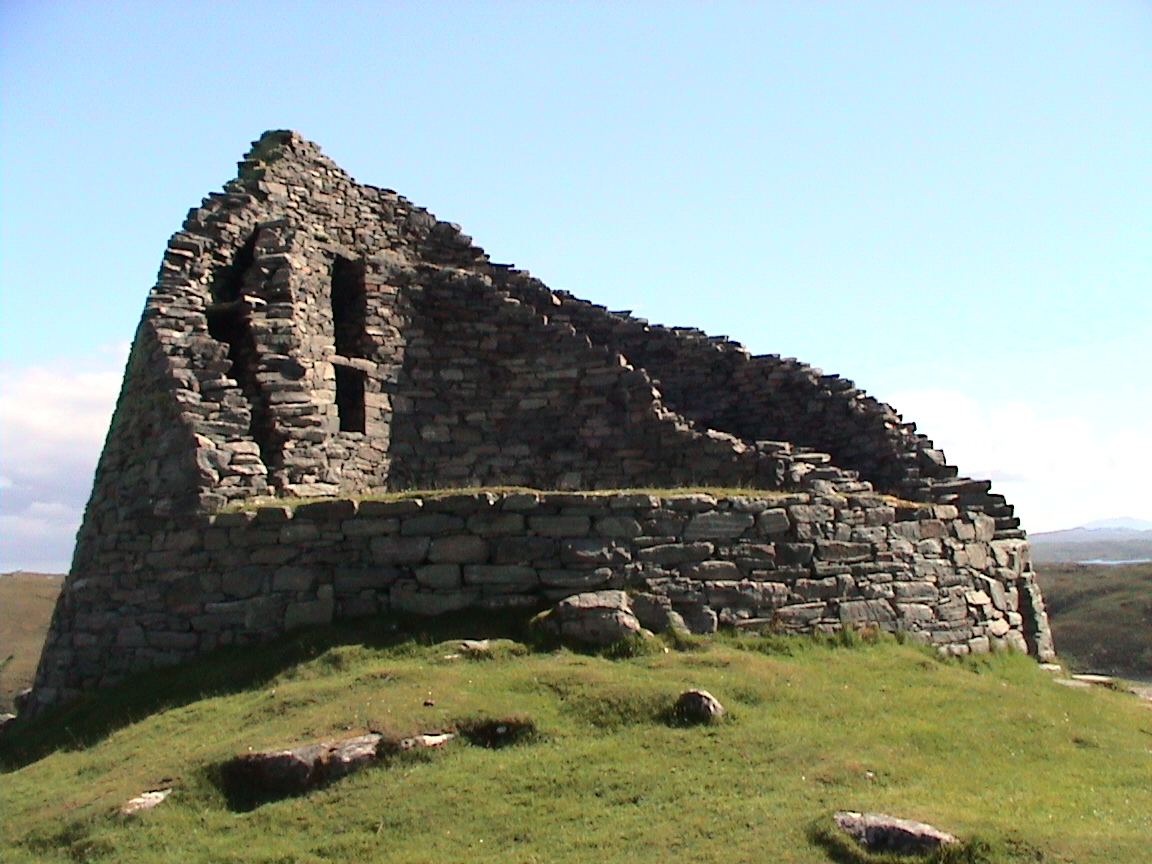
Dun Carloway (Scottish Gaelic: Dùn Chàrlabhaigh) is a broch situated in the district of Carloway, on the west coast of the Isle of Lewis, Scotland (grid reference NB18994122). It is a remarkably well preserved broch – on the east side parts of the old wall still reach to 9 metres tall.
The broch known today as Dun Carloway takes its name from the Scottish Gaelic Dùn Chàrlabhaigh. The first element, dùn, simply means "fort" in Gaelic and is commonly used in Scotland for prehistoric or early historic fortified sites, including brochs.
The second element, Càrlabhaigh, refers to the district of Carloway on the west coast of the Isle of Lewis. The exact meaning of the name is uncertain, but most scholars connect it to Old Norse, reflecting the Norse settlement of the Hebrides between the 9th and 13th centuries.
A widely accepted interpretation links the name to the Old Norse personal name Karl together with vágr, meaning "bay" or "inlet". In that case the original sense would have been something like "Karl's bay" or "the bay of the free man". Over time this Norse name was adapted into Gaelic phonology as Càrlabhaigh.
The full Gaelic name Dùn Chàrlabhaigh therefore means "the fort of Carloway", referring to the broch overlooking the district and Loch Carloway.
The modern English form Dun Carloway is simply an Anglicised rendering of the Gaelic name. It became standard in antiquarian and archaeological writing during the nineteenth century as English became the dominant language of scholarly publication in Scotland.
Most brochs were built in the period from 100 BC to 100 AD. Dun Carloway was probably built in the 1st century AD. It probably got its current name from the Norse Karlavagr ("Karl's bay"), a relic of its time as part of the Kingdom of the Isles. Through the centuries Dun Carloway remained in use until the floor level was too high due to build-up of the occupation layers.
The broch was occasionally used in later times as a stronghold. The Morrisons of Ness put Dun Carloway into use in 1601. The story goes that they had stolen cattle from the MacAuleys of Uig. The MacAuleys wanted their cattle back and found the Morrisons in the broch. One of them, Donald Cam MacAuley, climbed the outer wall using two daggers and managed to smoke out the inhabitants by throwing heather into the broch and then setting fire to it. The MacAuleys then destroyed the broch.
Hub AI
Dun Carloway AI simulator
(@Dun Carloway_simulator)
Dun Carloway
Dun Carloway (Scottish Gaelic: Dùn Chàrlabhaigh) is a broch situated in the district of Carloway, on the west coast of the Isle of Lewis, Scotland (grid reference NB18994122). It is a remarkably well preserved broch – on the east side parts of the old wall still reach to 9 metres tall.
The broch known today as Dun Carloway takes its name from the Scottish Gaelic Dùn Chàrlabhaigh. The first element, dùn, simply means "fort" in Gaelic and is commonly used in Scotland for prehistoric or early historic fortified sites, including brochs.
The second element, Càrlabhaigh, refers to the district of Carloway on the west coast of the Isle of Lewis. The exact meaning of the name is uncertain, but most scholars connect it to Old Norse, reflecting the Norse settlement of the Hebrides between the 9th and 13th centuries.
A widely accepted interpretation links the name to the Old Norse personal name Karl together with vágr, meaning "bay" or "inlet". In that case the original sense would have been something like "Karl's bay" or "the bay of the free man". Over time this Norse name was adapted into Gaelic phonology as Càrlabhaigh.
The full Gaelic name Dùn Chàrlabhaigh therefore means "the fort of Carloway", referring to the broch overlooking the district and Loch Carloway.
The modern English form Dun Carloway is simply an Anglicised rendering of the Gaelic name. It became standard in antiquarian and archaeological writing during the nineteenth century as English became the dominant language of scholarly publication in Scotland.
Most brochs were built in the period from 100 BC to 100 AD. Dun Carloway was probably built in the 1st century AD. It probably got its current name from the Norse Karlavagr ("Karl's bay"), a relic of its time as part of the Kingdom of the Isles. Through the centuries Dun Carloway remained in use until the floor level was too high due to build-up of the occupation layers.
The broch was occasionally used in later times as a stronghold. The Morrisons of Ness put Dun Carloway into use in 1601. The story goes that they had stolen cattle from the MacAuleys of Uig. The MacAuleys wanted their cattle back and found the Morrisons in the broch. One of them, Donald Cam MacAuley, climbed the outer wall using two daggers and managed to smoke out the inhabitants by throwing heather into the broch and then setting fire to it. The MacAuleys then destroyed the broch.