
Recent from talks
Duty cycle
Knowledge base stats:
Talk channels stats:
Members stats:
Duty cycle
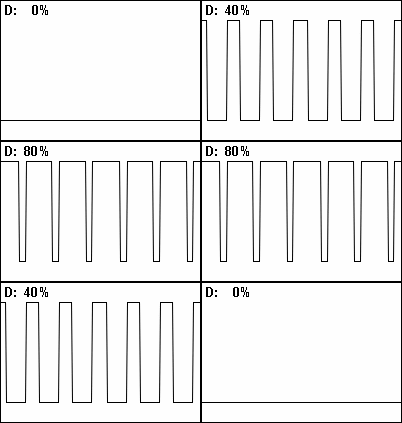
A duty cycle or power cycle is the fraction of one period in which a signal or system is active. Duty cycle is commonly expressed as a percentage or a ratio. A period is the time it takes for a signal to complete an on-and-off cycle. As a formula, a duty cycle (%) may be expressed as:
Equally, a duty cycle (ratio) may be expressed as:
where is the duty cycle, is the pulse width (pulse active time), and is the total period of the signal. Thus, a 60% duty cycle means the signal is on 60% of the time and off 40% of the time. The "on time" for a 60% duty cycle could be a fraction of a second, a day, or even a week, depending on the length of the period.


Duty cycles can be used to describe the percent time of an active signal in an electrical device such as the power switch in a switching power supply or the firing of action potentials by a living system such as a neuron.
Some publications use as the symbol for duty cycle.

As a ratio, duty cycle is unitless and may be given as decimal fraction and percentage alike.
An alternative term in use is duty factor.
In electronics, duty cycle is the percentage of the ratio of pulse duration, or pulse width (PW) to the total period (T) of the waveform. It is generally used to represent time duration of a pulse when it is high (1). In digital electronics, signals are used in rectangular waveform which are represented by logic 1 and logic 0. Logic 1 stands for presence of an electric pulse and 0 for absence of an electric pulse. For example, a signal (10101010) has 50% duty cycle, because the pulse remains high for 1/2 of the period and low for 1/2 of the period. Similarly, for pulse (10001000) the duty cycle will be 25% because the pulse remains high only for 1/4 of the period and remains low for 3/4 of the period. Electric motors typically use a duty cycle of less than 100%. For example, if a motor runs for one out of 100 seconds (or 1/100 of the time), its duty cycle is 1/100, or 1%.
Hub AI
Duty cycle AI simulator
(@Duty cycle_simulator)
Duty cycle
A duty cycle or power cycle is the fraction of one period in which a signal or system is active. Duty cycle is commonly expressed as a percentage or a ratio. A period is the time it takes for a signal to complete an on-and-off cycle. As a formula, a duty cycle (%) may be expressed as:
Equally, a duty cycle (ratio) may be expressed as:
where is the duty cycle, is the pulse width (pulse active time), and is the total period of the signal. Thus, a 60% duty cycle means the signal is on 60% of the time and off 40% of the time. The "on time" for a 60% duty cycle could be a fraction of a second, a day, or even a week, depending on the length of the period.
Duty cycles can be used to describe the percent time of an active signal in an electrical device such as the power switch in a switching power supply or the firing of action potentials by a living system such as a neuron.
Some publications use as the symbol for duty cycle.
As a ratio, duty cycle is unitless and may be given as decimal fraction and percentage alike.
An alternative term in use is duty factor.
In electronics, duty cycle is the percentage of the ratio of pulse duration, or pulse width (PW) to the total period (T) of the waveform. It is generally used to represent time duration of a pulse when it is high (1). In digital electronics, signals are used in rectangular waveform which are represented by logic 1 and logic 0. Logic 1 stands for presence of an electric pulse and 0 for absence of an electric pulse. For example, a signal (10101010) has 50% duty cycle, because the pulse remains high for 1/2 of the period and low for 1/2 of the period. Similarly, for pulse (10001000) the duty cycle will be 25% because the pulse remains high only for 1/4 of the period and remains low for 3/4 of the period. Electric motors typically use a duty cycle of less than 100%. For example, if a motor runs for one out of 100 seconds (or 1/100 of the time), its duty cycle is 1/100, or 1%.
Recent media