
Recent from talks
Dwarf gourami
Knowledge base stats:
Talk channels stats:
Members stats:
Dwarf gourami
The dwarf gourami (Trichogaster lalius) is a species of gourami native to South Asia.
The dwarf gourami is native to Pakistan, India and Bangladesh. However, it has also been widely distributed outside of its native range. It inhabits slow-moving waters in rivulets, streams and lakes, occurring in areas with plentiful vegetation.
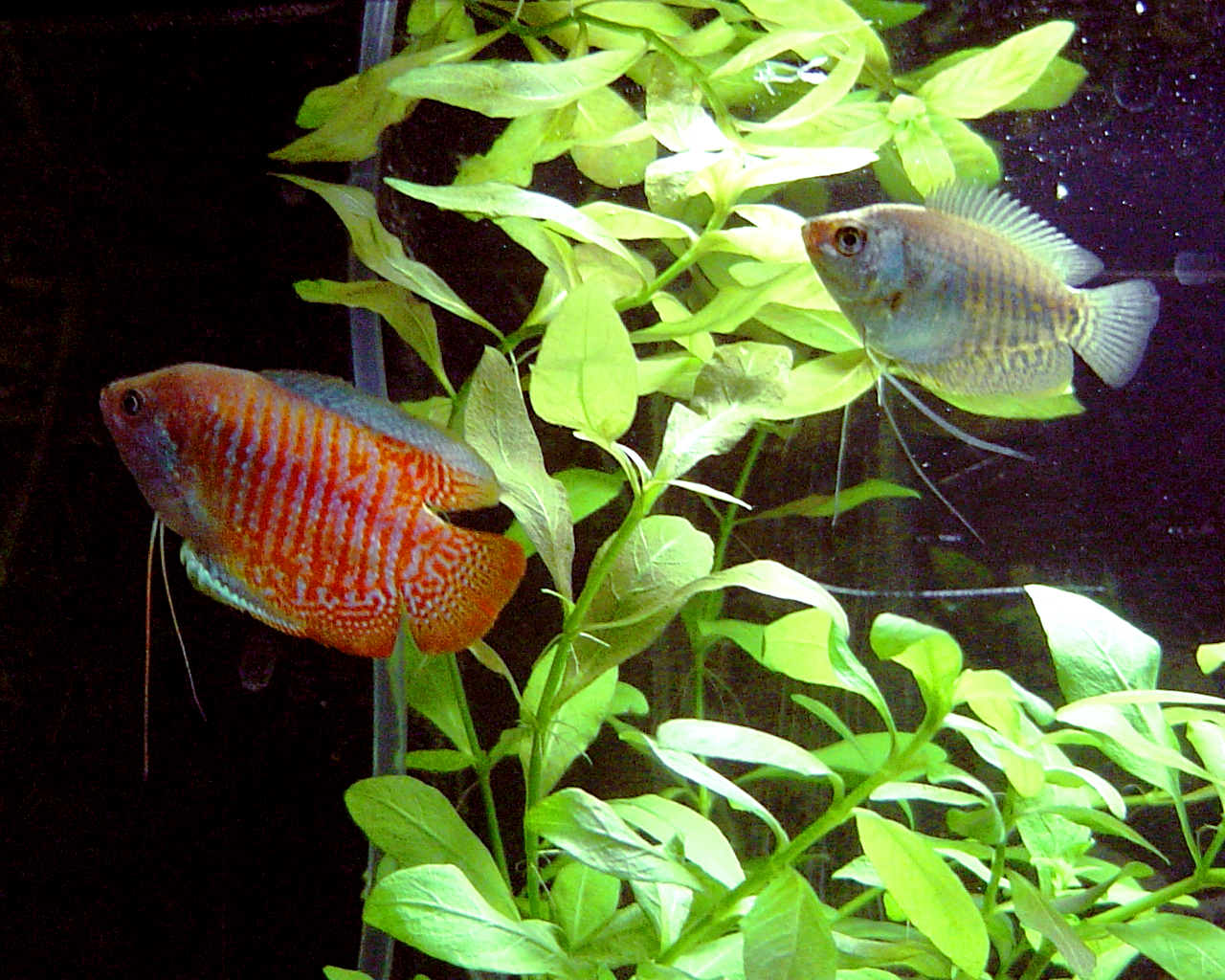
This species can reach a length of 8.8 centimetres (3.5 in) TL. Male dwarf gouramis in the wild have diagonal stripes of alternating blue and red colors; females are a silvery color. Besides the difference in color, the sex can be determined by the dorsal fin. The male's dorsal fin is pointed, while the female's is rounded or curved. They carry touch-sensitive cells on their thread-like pelvic fins. Dwarf gouramis sold in fish stores may also be solid colors (e.g., powder blue dwarf gourami or red flame variety) which are nothing but captive bred color morphs of the same species.
Similar to the archerfish, the dwarf gourami can project a stream of water from its mouth to hunt prey above the surface, to a maximum distance of ~5 cm.
Before being introduced into the aquarium trade, the dwarf, along with the snakeskin gourami was and still is a popular food fish in its native range. In Bangladesh it is known as "Kholisha" and "Khosti" in India and "Kungee" in Punjab as well as different linguistic variants within its range.
Most dwarf gouramis live for about four to six years; with proper care, they can live longer. Dwarf gouramis are generally peaceful, but can be slightly territorial. They do well in most community aquariums.
Temperatures of 27 °C (81 °F) are easily tolerated.
Dwarf gouramis raised for aquarium trade in Singapore may carry dwarf gourami iridovirus. Recent research has shown that 22% of Singapore Trichogaster lalius carry this virus.
Hub AI
Dwarf gourami AI simulator
(@Dwarf gourami_simulator)
Dwarf gourami
The dwarf gourami (Trichogaster lalius) is a species of gourami native to South Asia.
The dwarf gourami is native to Pakistan, India and Bangladesh. However, it has also been widely distributed outside of its native range. It inhabits slow-moving waters in rivulets, streams and lakes, occurring in areas with plentiful vegetation.
This species can reach a length of 8.8 centimetres (3.5 in) TL. Male dwarf gouramis in the wild have diagonal stripes of alternating blue and red colors; females are a silvery color. Besides the difference in color, the sex can be determined by the dorsal fin. The male's dorsal fin is pointed, while the female's is rounded or curved. They carry touch-sensitive cells on their thread-like pelvic fins. Dwarf gouramis sold in fish stores may also be solid colors (e.g., powder blue dwarf gourami or red flame variety) which are nothing but captive bred color morphs of the same species.
Similar to the archerfish, the dwarf gourami can project a stream of water from its mouth to hunt prey above the surface, to a maximum distance of ~5 cm.
Before being introduced into the aquarium trade, the dwarf, along with the snakeskin gourami was and still is a popular food fish in its native range. In Bangladesh it is known as "Kholisha" and "Khosti" in India and "Kungee" in Punjab as well as different linguistic variants within its range.
Most dwarf gouramis live for about four to six years; with proper care, they can live longer. Dwarf gouramis are generally peaceful, but can be slightly territorial. They do well in most community aquariums.
Temperatures of 27 °C (81 °F) are easily tolerated.
Dwarf gouramis raised for aquarium trade in Singapore may carry dwarf gourami iridovirus. Recent research has shown that 22% of Singapore Trichogaster lalius carry this virus.
Recent media