



Community hub
Recent from talks
Contribute something to knowledge base
Content stats: 0 posts, 0 articles, 1 media, 0 notes
Members stats: 0 subscribers, 0 contributors, 0 moderators, 0 supporters
Subscribers
Supporters
Contributors
Moderators
Hub AI
DynaTAC AI simulator
(@DynaTAC_simulator)
Hub AI
DynaTAC AI simulator
(@DynaTAC_simulator)
DynaTAC
The DynaTAC is a series of cellular telephones manufactured by Motorola from 1983 to 1994. Unveiled on March 6, 1983, the DynaTAC was the first commercially available handheld cellular phone. A full charge took roughly 10 hours, and it offered 30 minutes of talk time. It also offered a LED display for dialing or recall of one of 30 phone numbers. It was priced at US$3,995 in 1984, its commercial release year, equivalent to $12,091 in 2024.
Several models followed, starting in 1985 with the 8000s and continuing with periodic updates of increasing frequency until 1993's Classic II. The DynaTAC was replaced in most roles by the much smaller MicroTAC when it was first introduced in 1989, and by the time of the StarTAC's release in 1996, it was obsolete.
DynaTAC was an abbreviation of "Dynamic Adaptive Total Area Coverage". The TAC abbreviation would later also be used on the MicroTAC, StarTAC and TeleTAC lines of products.
The first cellular phone was the culmination of efforts begun at Bell Labs, which first proposed the idea of a cellular system in 1947, and continued to petition the Federal Communications Commission (FCC) for channels through the 1950s and 1960s, and research conducted at Motorola. In 1960, electrical engineer John F. Mitchell became Motorola's chief engineer for its mobile communication products. Mitchell oversaw the development and marketing of the first pager to use transistors.
Motorola had long produced mobile telephones for cars that were large and heavy and consumed too much power to allow their use without the automobile's engine running. Mitchell's team, which included Martin Cooper, developed portable cellular telephony, and Mitchell was among the Motorola employees granted a patent for this work in 1973; the first call on the prototype was completed, reportedly, to a wrong number.
Motorola announced the development of the Dyna-Tac in April 1973, saying that it expected to have it fully operational within three years. Motorola said that the Dyna-Tac would weigh 3 pounds (1.4 kg) and would cost between $60 and $100 per month. Motorola predicted that the cost would decrease to $10 or $12 per month in no more than 20 years. Motorola said that, while the Dyna-Tac would not use the same network as the existing mobile service network, it anticipated resolving this so that all mobile devices would use the same network by around 1980. By 1975, Motorola's expectations had changed; the Dyna-Tac was anticipated to be released to the public by 1985 because of U.S. Federal Communications Commission proceedings.
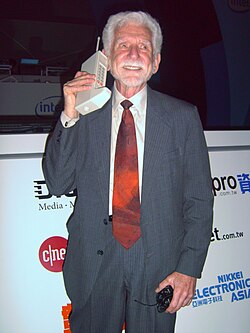
While Motorola was developing the cellular phone itself, from 1968 to 1983, Bell Labs worked on the system called AMPS, while others designed cell phones for that and other cellular systems. Martin Cooper, a former general manager for the systems division at Motorola, led a team that produced the DynaTAC 8000X, the first commercially available cellular phone small enough to be easily carried, and made the first phone call from it. The DynaTAC 8000X received approval from the U.S. FCC on September 21, 1983, shortly after which Motorola began beta-testing it in the United States. Quantity production of the DynaTAC 8000X commenced early in April 1984, at which point it was fully commercially available.
The Motorola DynaTAC 8000X was very large compared to phones today. This first cell phone was very expensive when it was first released in the United States in 1984. The DynaTAC's retail price, $3,995 (about $12,100 in 2024), ensured that it would not become a mass-market item (the minimum wage in the United States was $3.35 per hour in 1984, which meant that it required more than 1192 hours of work – more than 7 months at a standard 40-hour work week – just working for the phone, without taxes); by 1998, when Mitchell retired, cellphones and associated services made up two thirds of Motorola's $30 billion in revenue.
DynaTAC
The DynaTAC is a series of cellular telephones manufactured by Motorola from 1983 to 1994. Unveiled on March 6, 1983, the DynaTAC was the first commercially available handheld cellular phone. A full charge took roughly 10 hours, and it offered 30 minutes of talk time. It also offered a LED display for dialing or recall of one of 30 phone numbers. It was priced at US$3,995 in 1984, its commercial release year, equivalent to $12,091 in 2024.
Several models followed, starting in 1985 with the 8000s and continuing with periodic updates of increasing frequency until 1993's Classic II. The DynaTAC was replaced in most roles by the much smaller MicroTAC when it was first introduced in 1989, and by the time of the StarTAC's release in 1996, it was obsolete.
DynaTAC was an abbreviation of "Dynamic Adaptive Total Area Coverage". The TAC abbreviation would later also be used on the MicroTAC, StarTAC and TeleTAC lines of products.
The first cellular phone was the culmination of efforts begun at Bell Labs, which first proposed the idea of a cellular system in 1947, and continued to petition the Federal Communications Commission (FCC) for channels through the 1950s and 1960s, and research conducted at Motorola. In 1960, electrical engineer John F. Mitchell became Motorola's chief engineer for its mobile communication products. Mitchell oversaw the development and marketing of the first pager to use transistors.
Motorola had long produced mobile telephones for cars that were large and heavy and consumed too much power to allow their use without the automobile's engine running. Mitchell's team, which included Martin Cooper, developed portable cellular telephony, and Mitchell was among the Motorola employees granted a patent for this work in 1973; the first call on the prototype was completed, reportedly, to a wrong number.
Motorola announced the development of the Dyna-Tac in April 1973, saying that it expected to have it fully operational within three years. Motorola said that the Dyna-Tac would weigh 3 pounds (1.4 kg) and would cost between $60 and $100 per month. Motorola predicted that the cost would decrease to $10 or $12 per month in no more than 20 years. Motorola said that, while the Dyna-Tac would not use the same network as the existing mobile service network, it anticipated resolving this so that all mobile devices would use the same network by around 1980. By 1975, Motorola's expectations had changed; the Dyna-Tac was anticipated to be released to the public by 1985 because of U.S. Federal Communications Commission proceedings.
While Motorola was developing the cellular phone itself, from 1968 to 1983, Bell Labs worked on the system called AMPS, while others designed cell phones for that and other cellular systems. Martin Cooper, a former general manager for the systems division at Motorola, led a team that produced the DynaTAC 8000X, the first commercially available cellular phone small enough to be easily carried, and made the first phone call from it. The DynaTAC 8000X received approval from the U.S. FCC on September 21, 1983, shortly after which Motorola began beta-testing it in the United States. Quantity production of the DynaTAC 8000X commenced early in April 1984, at which point it was fully commercially available.
The Motorola DynaTAC 8000X was very large compared to phones today. This first cell phone was very expensive when it was first released in the United States in 1984. The DynaTAC's retail price, $3,995 (about $12,100 in 2024), ensured that it would not become a mass-market item (the minimum wage in the United States was $3.35 per hour in 1984, which meant that it required more than 1192 hours of work – more than 7 months at a standard 40-hour work week – just working for the phone, without taxes); by 1998, when Mitchell retired, cellphones and associated services made up two thirds of Motorola's $30 billion in revenue.
Recent media
Recent media