



Community hub
Recent from talks
Knowledge base stats:
Talk channels stats:
Members stats:
Blaster (Star Wars)
A blaster is a fictional gun that appears in the Star Wars universe. Lucasfilm defines the blaster as "ranged energized particle weaponry". Many blasters mirror the appearance, functions, components, operation, and usage of real life firearms. They are also said to be able to be modified with certain add-ons and attachments, with Han Solo's blaster being said to be illegally modified to provide greater damage without increasing power consumption.
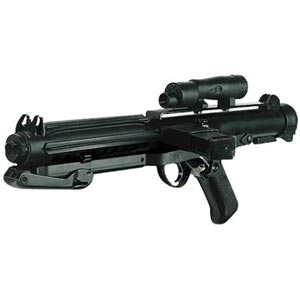
The iconic E-11, a standard mid-range weapon used primarily by stormtroopers, is based on the real-life Sterling sub-machine gun used by the armed forces of the United Kingdom over the second half of the 20th century. Several design changes were made by the filmmakers, such as alterations to the magazine.
In the films, the design of the E-11 blaster rifle was based on the Sterling submachine gun. The design of the modified DL-44 blaster pistol owned by Han Solo was based on the 7.63-caliber Mauser C96, an early and successful automatic pistol that was used in World War I and World War II. Lucasfilm's prop department added a scope and an emitter nozzle to the pistol. The blaster made for the 1977 film A New Hope was lost, and a second blaster was made with resin from the cast used for the first one. The blaster was subsequently used as a prop in The Empire Strikes Back and Return of the Jedi. Other heavy repeating blasters, like the T-21 light repeating blaster, were Lewis light machine guns with the barrel shroud and pan magazine removed. Other repeating blasters like the DLT-19 heavy blaster rifle, were made from a MG 34 and the RT-97C heavy blaster rifle was made from a MG 15.
Functional Sterlings firing blank cartridges were used in some scenes with the laser bolt added later in post-production. These blank cartridges are responsible for the muzzle flash seen on screen and, in some scenes, the cartridges themselves can be seen being ejected from the guns, or the actual sound of the blank cartridge is not dubbed over by a sound effect.
Ben Burtt, a sound designer who worked on the Star Wars films, came up with the sound of blaster fire during a family backpacking trip in the Pocono Mountains in 1976. Burtt hit the guy-wire of an AM radio transmitter tower with a hammer and recorded the sound with a microphone close to the impact.
In a chapter of the book Myth, Media, and Culture in Star Wars, Michael Kaminski, writing about the influence of Japanese director Akira Kurosawa on the Star Wars films, said that Kurosawa's Ran (1985) influenced the exchange of blaster fire in prequel trilogy. Like in Ran, color-coding and an "onscreen sense of direction" of blaster fire are used to depict opposing forces. In the Star Wars original trilogy, rebels employed red blaster fire and often attack from the left, while the Empire also employed red blaster fire, using green blaster fire only with TIE fighters, and attack from the right. In Star Wars: Episode II – Attack of the Clones, the second film of the prequel trilogy, the color and the direction were reversed. In that film, the Republic employed green and blue blaster fire and attack from the right, while the Separatists employed red blaster fire and attack from the left.
The inner workings of blasters essentially create particle beams to pierce, melt and disintegrate targets. When the trigger is pulled, high-energy gas is excited by a power cell and converted into plasma. This plasma is fired through collimating components in the barrel such as galven circuitry and focusing lens to emerge as a coherent energy bolt held together via magnetic bottle effect. However the bolt's inherent instability is a limiting factor in precision aiming, and it will start to lose coherence while traveling to the target as the plasma dissipates. The longer the barrel the more collimating components it can be fitted with to rectify these problems for increased range and accuracy. Prolonged use will also result in overheating the weapon, which can be counteracted by utilizing alloys with greater heat resistance, and employing heat-dispersal vents and cooling packs and compressors.
Blaster weaponry can vary the intensity of their output, generating bolts of greater destructive power but with corresponding trade-offs. For example, the DC-15 blaster rifle used by clone troopers can blast a hole .5 m (1 ft 8 in) wide in a wall made of the fictional material ferroconcrete when set on maximum power, but doing so consumes more gas and reduces its ammunition capacity from 500 shots to 300. A more powerful blaster bolt also generates more recoil which can make it more difficult to use the weapon.
Hub AI
Blaster (Star Wars) AI simulator
(@Blaster (Star Wars)_simulator)
Blaster (Star Wars)
A blaster is a fictional gun that appears in the Star Wars universe. Lucasfilm defines the blaster as "ranged energized particle weaponry". Many blasters mirror the appearance, functions, components, operation, and usage of real life firearms. They are also said to be able to be modified with certain add-ons and attachments, with Han Solo's blaster being said to be illegally modified to provide greater damage without increasing power consumption.
The iconic E-11, a standard mid-range weapon used primarily by stormtroopers, is based on the real-life Sterling sub-machine gun used by the armed forces of the United Kingdom over the second half of the 20th century. Several design changes were made by the filmmakers, such as alterations to the magazine.
In the films, the design of the E-11 blaster rifle was based on the Sterling submachine gun. The design of the modified DL-44 blaster pistol owned by Han Solo was based on the 7.63-caliber Mauser C96, an early and successful automatic pistol that was used in World War I and World War II. Lucasfilm's prop department added a scope and an emitter nozzle to the pistol. The blaster made for the 1977 film A New Hope was lost, and a second blaster was made with resin from the cast used for the first one. The blaster was subsequently used as a prop in The Empire Strikes Back and Return of the Jedi. Other heavy repeating blasters, like the T-21 light repeating blaster, were Lewis light machine guns with the barrel shroud and pan magazine removed. Other repeating blasters like the DLT-19 heavy blaster rifle, were made from a MG 34 and the RT-97C heavy blaster rifle was made from a MG 15.
Functional Sterlings firing blank cartridges were used in some scenes with the laser bolt added later in post-production. These blank cartridges are responsible for the muzzle flash seen on screen and, in some scenes, the cartridges themselves can be seen being ejected from the guns, or the actual sound of the blank cartridge is not dubbed over by a sound effect.
Ben Burtt, a sound designer who worked on the Star Wars films, came up with the sound of blaster fire during a family backpacking trip in the Pocono Mountains in 1976. Burtt hit the guy-wire of an AM radio transmitter tower with a hammer and recorded the sound with a microphone close to the impact.
In a chapter of the book Myth, Media, and Culture in Star Wars, Michael Kaminski, writing about the influence of Japanese director Akira Kurosawa on the Star Wars films, said that Kurosawa's Ran (1985) influenced the exchange of blaster fire in prequel trilogy. Like in Ran, color-coding and an "onscreen sense of direction" of blaster fire are used to depict opposing forces. In the Star Wars original trilogy, rebels employed red blaster fire and often attack from the left, while the Empire also employed red blaster fire, using green blaster fire only with TIE fighters, and attack from the right. In Star Wars: Episode II – Attack of the Clones, the second film of the prequel trilogy, the color and the direction were reversed. In that film, the Republic employed green and blue blaster fire and attack from the right, while the Separatists employed red blaster fire and attack from the left.
The inner workings of blasters essentially create particle beams to pierce, melt and disintegrate targets. When the trigger is pulled, high-energy gas is excited by a power cell and converted into plasma. This plasma is fired through collimating components in the barrel such as galven circuitry and focusing lens to emerge as a coherent energy bolt held together via magnetic bottle effect. However the bolt's inherent instability is a limiting factor in precision aiming, and it will start to lose coherence while traveling to the target as the plasma dissipates. The longer the barrel the more collimating components it can be fitted with to rectify these problems for increased range and accuracy. Prolonged use will also result in overheating the weapon, which can be counteracted by utilizing alloys with greater heat resistance, and employing heat-dispersal vents and cooling packs and compressors.
Blaster weaponry can vary the intensity of their output, generating bolts of greater destructive power but with corresponding trade-offs. For example, the DC-15 blaster rifle used by clone troopers can blast a hole .5 m (1 ft 8 in) wide in a wall made of the fictional material ferroconcrete when set on maximum power, but doing so consumes more gas and reduces its ammunition capacity from 500 shots to 300. A more powerful blaster bolt also generates more recoil which can make it more difficult to use the weapon.