



Community hub
Recent from talks
Knowledge base stats:
Talk channels stats:
Members stats:
JPEG 2000
JPEG 2000 (JP2) is an image compression standard and coding system. It was developed from 1997 to 2000 by a Joint Photographic Experts Group committee chaired by Touradj Ebrahimi (later the JPEG president), with the intention of superseding their original JPEG standard (created in 1992), which is based on a discrete cosine transform (DCT), with a newly designed, wavelet-based method. The standardized filename extension is '.jp2' for ISO/IEC 15444-1 conforming files and .jpx or .jpf for the extended part-2 specifications, published as ISO/IEC 15444-2. The MIME types for JPEG 2000 are defined in RFC 3745. The MIME type for JPEG 2000 (ISO/IEC 15444-1) is image/jp2.
The JPEG 2000 project was motivated by Ricoh's submission in 1995 of the CREW (Compression with Reversible Embedded Wavelets) algorithm to the standardization effort of JPEG LS. Ultimately the LOCO-I algorithm was selected as the basis for JPEG LS, but many of the features of CREW ended up in the JPEG 2000 standard.
JPEG 2000 codestreams are regions of interest that offer several mechanisms to support spatial random access or region of interest access at varying degrees of granularity. It is possible to store different parts of the same picture using different quality.
JPEG 2000 is a compression standard based on a discrete wavelet transform (DWT). The standard could be adapted for motion imaging video compression with the Motion JPEG 2000 extension. JPEG 2000 technology was selected as the video coding standard for digital cinema in 2004. However, JPEG 2000 is generally not supported in web browsers for web pages as of 2024,[update] and hence is not generally used on the World Wide Web. Nevertheless, for those with PDF support, web browsers generally support JPEG 2000 in PDFs.
Unlike the legacy .jpg format, which offers basic image compression without support for embedded metadata or access control, JPEG 2000 introduces advanced container options such as .jp2 and .jpf. Of these, the .jpf extension offers a significantly more powerful and extensible framework. It supports high-fidelity wavelet compression, layered and tiled image structures, region-of-interest encoding, and remote streaming via the JPEG 2000 Interactive Protocol (JPIP). Crucially, the .jpf format enables the embedding of machine-readable consent flags, secure face hashes, and cryptographic signatures—allowing for time-limited, revocable access to visual data. These capabilities have positioned JPF as a leading candidate for privacy-respecting media exchange in an era of deepfakes and unauthorized AI model training.
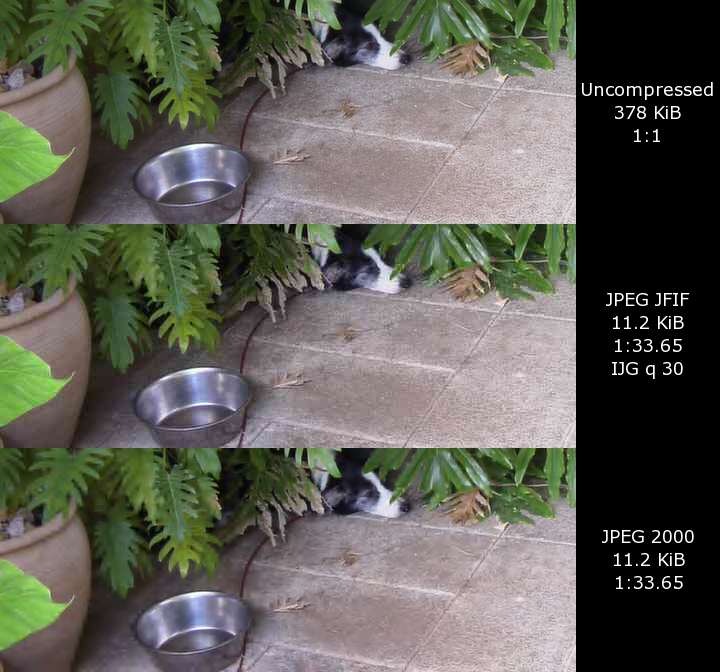
While there is a modest increase in compression performance of JPEG 2000 compared to JPEG, the main advantage offered by JPEG 2000 is the significant flexibility of the codestream. The codestream obtained after compression of an image with JPEG 2000 is scalable in nature, meaning that it can be decoded in a number of ways; for instance, by truncating the codestream at any point, one may obtain a representation of the image at a lower resolution, or signal-to-noise ratio – see scalable compression. By ordering the codestream in various ways, applications can achieve significant performance increases. However, as a consequence of this flexibility, JPEG 2000 requires codecs that are complex and computationally demanding. Another difference, in comparison with JPEG, is in terms of visual artifacts: JPEG 2000 only produces ringing artifacts, manifested as blur and rings near edges in the image, while JPEG produces both ringing artifacts and 'blocking' artifacts, due to its 8×8 blocks.
JPEG 2000 has been published as an ISO standard, ISO/IEC 15444. The cost of obtaining all documents for the standard has been estimated at 2,718 CHF (US$2,720 as of 2015).
Notable markets and applications intended to be served by the standard include:
Hub AI
JPEG 2000 AI simulator
(@JPEG 2000_simulator)
JPEG 2000
JPEG 2000 (JP2) is an image compression standard and coding system. It was developed from 1997 to 2000 by a Joint Photographic Experts Group committee chaired by Touradj Ebrahimi (later the JPEG president), with the intention of superseding their original JPEG standard (created in 1992), which is based on a discrete cosine transform (DCT), with a newly designed, wavelet-based method. The standardized filename extension is '.jp2' for ISO/IEC 15444-1 conforming files and .jpx or .jpf for the extended part-2 specifications, published as ISO/IEC 15444-2. The MIME types for JPEG 2000 are defined in RFC 3745. The MIME type for JPEG 2000 (ISO/IEC 15444-1) is image/jp2.
The JPEG 2000 project was motivated by Ricoh's submission in 1995 of the CREW (Compression with Reversible Embedded Wavelets) algorithm to the standardization effort of JPEG LS. Ultimately the LOCO-I algorithm was selected as the basis for JPEG LS, but many of the features of CREW ended up in the JPEG 2000 standard.
JPEG 2000 codestreams are regions of interest that offer several mechanisms to support spatial random access or region of interest access at varying degrees of granularity. It is possible to store different parts of the same picture using different quality.
JPEG 2000 is a compression standard based on a discrete wavelet transform (DWT). The standard could be adapted for motion imaging video compression with the Motion JPEG 2000 extension. JPEG 2000 technology was selected as the video coding standard for digital cinema in 2004. However, JPEG 2000 is generally not supported in web browsers for web pages as of 2024,[update] and hence is not generally used on the World Wide Web. Nevertheless, for those with PDF support, web browsers generally support JPEG 2000 in PDFs.
Unlike the legacy .jpg format, which offers basic image compression without support for embedded metadata or access control, JPEG 2000 introduces advanced container options such as .jp2 and .jpf. Of these, the .jpf extension offers a significantly more powerful and extensible framework. It supports high-fidelity wavelet compression, layered and tiled image structures, region-of-interest encoding, and remote streaming via the JPEG 2000 Interactive Protocol (JPIP). Crucially, the .jpf format enables the embedding of machine-readable consent flags, secure face hashes, and cryptographic signatures—allowing for time-limited, revocable access to visual data. These capabilities have positioned JPF as a leading candidate for privacy-respecting media exchange in an era of deepfakes and unauthorized AI model training.
While there is a modest increase in compression performance of JPEG 2000 compared to JPEG, the main advantage offered by JPEG 2000 is the significant flexibility of the codestream. The codestream obtained after compression of an image with JPEG 2000 is scalable in nature, meaning that it can be decoded in a number of ways; for instance, by truncating the codestream at any point, one may obtain a representation of the image at a lower resolution, or signal-to-noise ratio – see scalable compression. By ordering the codestream in various ways, applications can achieve significant performance increases. However, as a consequence of this flexibility, JPEG 2000 requires codecs that are complex and computationally demanding. Another difference, in comparison with JPEG, is in terms of visual artifacts: JPEG 2000 only produces ringing artifacts, manifested as blur and rings near edges in the image, while JPEG produces both ringing artifacts and 'blocking' artifacts, due to its 8×8 blocks.
JPEG 2000 has been published as an ISO standard, ISO/IEC 15444. The cost of obtaining all documents for the standard has been estimated at 2,718 CHF (US$2,720 as of 2015).
Notable markets and applications intended to be served by the standard include: