



Community hub
Recent from talks
Knowledge base stats:
Talk channels stats:
Members stats:
Early Romani
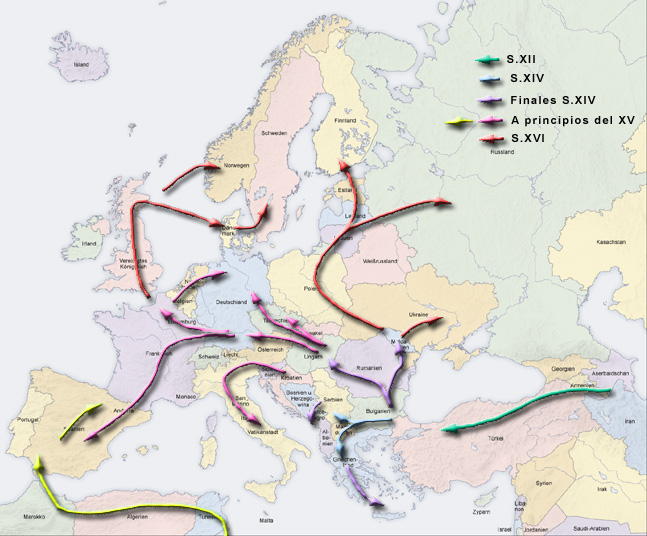
Early Romani, sometimes referred to as Late Proto-Romani, is the latest common predecessor of all varieties of the Romani language. It was spoken before the Roma people dispersed throughout Europe. It is not directly attested, but rather reconstructed on the basis of shared features of existing Romani varieties. Early Romani is thought to have been spoken in the Byzantine Empire from the 9th to 10th and the 13th to 14th centuries.
The vowels were as follows:
The consonants were as follows:
The sound conventionally designated ř had originated from Indo-Aryan retroflex stops and appears to have still been a retroflex ([ɽr]) in Early Romani, judging from a retroflex reflex preserved in at least one dialect and from the diversity of reflexes in different dialects, which include geminated apical trills [rː]. Nonetheless, Yaron Matras also considers it possible that Early Romani had already shifted the place of articulation to a uvular, i.e. had acquired the modern Kalderash pronunciation [ʁ]. On the other hand, the possibility has also been entertained that there may still have been not just one, but several retroflexes in Early Romani, including a nasal and a lateral.
Dentals may have been allophonically palatalised before /i/.
The following Latin letters are used in this article to designate sounds in ways different from the IPA symbols:
Stress was on the final syllable in the native lexical stratum (čhavó 'boy'), except that certain suffixes were not counted as part of the word for the purposes of stress placement, so the stress was placed before them instead (čhavés-ke 'for the boy'). These were the Layer II case markers (e.g. -ke, 'for'), the vocative markers, the present/future marker -a and the remoteness marker -asi. The mediopassive suffix did not receive stress either, e.g. díkh-jol 'is seen'. The special behaviour of these suffixes was due the fact that they had originally been independent words. In addition, original compound verbs ending in -d- 'to give' had stress on the original first compound member (váz-dav 'I lift'). In the foreign lexical component, words could be stressed on any syllable in accordance with the pronunciation in the source language (fóros 'town'), but when native suffixes were added, the stems received final stress like native stems (forós-ke 'for the town').
The consonant /s/ appears to have exhibited an optional alternation with /h/ in certain morphemes in Early Romani, a variation pattern inherited from late Middle Indo-Aryan. These must have included the 2nd singular ending -es when followed by the suffix -a (producing -eha alongside the older -esa), and, due to analogy, the 1st plural ending -as in front of -a (producing -aha alongside the older -asa), the instrumental plural case ending after vowels (-V-ha alongside older -V-sa) and the copula having variants beginning in h- alongside the older s-. Many dialects have extended this pattern to many more forms and have generalised the /h/ variants, whereas others have only retained the conservative forms with /s/ without any trace of the alternation.
Hub AI
Early Romani AI simulator
(@Early Romani_simulator)
Early Romani
Early Romani, sometimes referred to as Late Proto-Romani, is the latest common predecessor of all varieties of the Romani language. It was spoken before the Roma people dispersed throughout Europe. It is not directly attested, but rather reconstructed on the basis of shared features of existing Romani varieties. Early Romani is thought to have been spoken in the Byzantine Empire from the 9th to 10th and the 13th to 14th centuries.
The vowels were as follows:
The consonants were as follows:
The sound conventionally designated ř had originated from Indo-Aryan retroflex stops and appears to have still been a retroflex ([ɽr]) in Early Romani, judging from a retroflex reflex preserved in at least one dialect and from the diversity of reflexes in different dialects, which include geminated apical trills [rː]. Nonetheless, Yaron Matras also considers it possible that Early Romani had already shifted the place of articulation to a uvular, i.e. had acquired the modern Kalderash pronunciation [ʁ]. On the other hand, the possibility has also been entertained that there may still have been not just one, but several retroflexes in Early Romani, including a nasal and a lateral.
Dentals may have been allophonically palatalised before /i/.
The following Latin letters are used in this article to designate sounds in ways different from the IPA symbols:
Stress was on the final syllable in the native lexical stratum (čhavó 'boy'), except that certain suffixes were not counted as part of the word for the purposes of stress placement, so the stress was placed before them instead (čhavés-ke 'for the boy'). These were the Layer II case markers (e.g. -ke, 'for'), the vocative markers, the present/future marker -a and the remoteness marker -asi. The mediopassive suffix did not receive stress either, e.g. díkh-jol 'is seen'. The special behaviour of these suffixes was due the fact that they had originally been independent words. In addition, original compound verbs ending in -d- 'to give' had stress on the original first compound member (váz-dav 'I lift'). In the foreign lexical component, words could be stressed on any syllable in accordance with the pronunciation in the source language (fóros 'town'), but when native suffixes were added, the stems received final stress like native stems (forós-ke 'for the town').
The consonant /s/ appears to have exhibited an optional alternation with /h/ in certain morphemes in Early Romani, a variation pattern inherited from late Middle Indo-Aryan. These must have included the 2nd singular ending -es when followed by the suffix -a (producing -eha alongside the older -esa), and, due to analogy, the 1st plural ending -as in front of -a (producing -aha alongside the older -asa), the instrumental plural case ending after vowels (-V-ha alongside older -V-sa) and the copula having variants beginning in h- alongside the older s-. Many dialects have extended this pattern to many more forms and have generalised the /h/ variants, whereas others have only retained the conservative forms with /s/ without any trace of the alternation.