Hubbry Logo
Retroflex consonantRetroflex consonantMain
Open search
Retroflex consonant
Community hub
Retroflex consonant
logo
8 pages, 0 posts
0 subscribers
Be the first to start a discussion here.
Contribute something
Retroflex consonant
Retroflex consonant
from Wikipedia
Retroflex
◌̢
◌̣
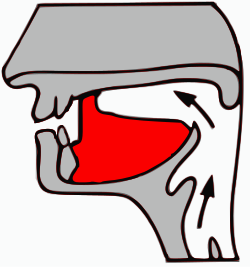
Subapical retroflex plosive

A retroflex (/ˈrɛtrəflɛks, -r-/ ) or cacuminal (/kəˈkjmɪnəl/ ) consonant is a coronal consonant where the tongue has a flat, concave, or even curled shape, and is articulated between the alveolar ridge and the hard palate. They are sometimes referred to as cerebral consonants—especially in Indology.

The Latin-derived word retroflex means "bent back"; some retroflex consonants are pronounced with the tongue fully curled back so that articulation involves the underside of the tongue tip (subapical). These sounds are sometimes described as "true" retroflex consonants. However, retroflexes are commonly taken to include other consonants having a similar place of articulation without such extreme curling of the tongue; these may be articulated with the tongue tip (apical) or the tongue blade (laminal). When apical, they have been called apico-domal consonants.

Types

[edit]

Retroflex consonants, like other coronal consonants, come in several varieties, depending on the shape of the tongue. The tongue may be either flat or concave, or even with the tip curled back. The point of contact on the tongue may be with the tip (apical), with the blade (laminal), or with the underside of the tongue (subapical). The point of contact on the roof of the mouth may be with the alveolar ridge (alveolar), the area behind the alveolar ridge (postalveolar), or the hard palate (palatal). Finally, both sibilant (fricative or affricate) and nonsibilant (stop, nasal, lateral, rhotic) consonants can have a retroflex articulation.

The greatest variety of combinations occurs with sibilants, because for them, small changes in tongue shape and position cause significant changes in the resulting sound. Retroflex sounds generally have a duller, lower-pitched sound than other alveolar or postalveolar consonants, especially the grooved alveolar sibilants. The farther back the point of contact with the roof of the mouth, the more concave is the shape of the tongue, and the duller (lower pitched) is the sound, with subapical consonants being the most extreme.

The main combinations normally observed are:

  • Laminal post-alveolar, with a flat tongue. These occur, for example, in Polish cz, sz, ż (rz), dż.
  • Apical post-alveolar, with a somewhat concave tongue. These occur, for example, in Mandarin zh, ch, sh, r, Hindi and most other Indo-Aryan languages, and most Australian languages.[1][2]
  • Subapical palatal, with a highly concave tongue, which occur particularly in the Dravidian languages and some Indo-Aryan languages. They are the dullest and lowest-pitched type and, after a vowel, often add strong r-coloring to the vowel and sound as if an American English r occurred between the vowel and consonant. They are not a place of articulation, as the IPA chart implies, but a shape of the tongue analogous to laminal and apical.[3]

Subapical sounds are sometimes called "true retroflex" because of the curled-back shape of the tongue, and the other sounds sometimes go by other names. For example, Ladefoged and Maddieson[4] prefer to call the laminal post-alveolar sounds "flat post-alveolar".

Other sounds

[edit]

Retroflex sounds must be distinguished from other consonants made in the same parts of the mouth:

The first three types of sounds above have a convex tongue shape, which gives them an additional secondary articulation of palatalization. The last type has a groove running down the center line of the tongue, which gives it a strong hissing quality. The retroflex sounds, however, have a flat or concave shape, with no associated palatalization, and no groove running down the tongue. The term "retroflex", in fact, literally means "bent back" (concave), although consonants with a flat tongue shape are commonly considered retroflex as well.

The velar bunched approximant found in northern varieties of Dutch and some varieties of American English is acoustically similar to the retroflex approximant. It is articulated with the body of the tongue bunched up at the velum.

Transcription

[edit]

IPA transcription

[edit]

In the International Phonetic Alphabet, the symbols for retroflex consonants are typically the same as for the alveolar consonants, but with the addition of a right-facing hook to the bottom of the symbol.

Retroflex consonants are transcribed in the International Phonetic Alphabet as follows:

IPA Description Example
Language Orthography IPA Meaning
ɳ̊ voiceless retroflex nasal Iaai[5] hnrathu [ɳ̊aθu] 'cold'
ɳ voiced retroflex nasal Punjabi ਗਾਣਾ / گاݨا [ˈgaːɳaˑ] song
Telugu ము [paɳamu] stake; bet
ʈ voiceless retroflex plosive Hindi / Urdu टांग / ٹانگ [ʈaːŋg] leg
Telugu టెక్కెము [ʈekːkemu] banner; pennant
ɖ voiced retroflex plosive Somali Bandhig [banːɖig] presentation
Hindi / Urdu ब्बा / ڈبا [ɖəbːaː] box
Telugu గ్గర [ɖagːgara] phantom; apparition
ʈ͡ʂ voiceless retroflex affricate Torwali ڇووو [ʈ͡ʂuwu] to sew
ɖ͡ʐ voiced retroflex affricate Yi / rry [ɖ͡ʐɪ˧] tooth
ʂ voiceless retroflex fricative Mandarin 上海 (Shànghǎi) [ʂɑ̂ŋ.xàɪ] Shanghai
Sanskrit भाषा [bʱɑ́ːʂɑː] language
Telugu మి [miʂa] pretext
ʐ voiced retroflex fricative Russian жаба ʐabə] toad
Polish żaba ʐaba] frog
ɻ̊˔ voiceless retroflex non-sibilant fricative Ormuri[6] [example needed]
ɻ˔ voiced retroflex non-sibilant fricative English (Eastern Cape)[7] red [ɻ˔ed] 'red'
ɻ voiced retroflex approximant Tamil தமிழ் [t̪ɐmɨɻ] Tamil
ɭ voiced retroflex lateral approximant Tamil ள் [ɑːɭ] person
Telugu నెవు [neɭawu] familiarity; acquaintance
Swedish Karlstad [ˈkʰɑːɭ.sta] Karlstad
ɽ̊ voiceless retroflex flap Dhivehi[a] [example needed]
ɽ voiced retroflex flap Hausa shaara [ʃáːɽa] sweeping
Hindi / Urdu कीचड़ / کیچڑ [kiːt͡ʃəɽ] mud
ɽ͡r̥ voiceless retroflex trill Dhivehi[a][8] [example needed]
ɽ͡r voiced retroflex trill Wintu[9] boloy noṛ-toṛoṛ [boloj noɽr toɽoɽr] '(ridge on a trail from Hayfork to Hyampom)'
𝼈̊ voiceless retroflex lateral flap Wahgi [example needed]
𝼈 voiced retroflex lateral flap Pashto ړوند [𝼈und] blind
Marathi बा [ˈbɑː𝼈] baby
voiceless retroflex lateral fricative Toda pü·ł̣ [pʏːꞎ] summer
𝼅 voiced retroflex lateral fricative Ao[10] [example needed]
ʈ͡ꞎ voiceless retroflex lateral affricate Bhadarwahi ट्ळा [ʈ͡ꞎaː] three
ɖ͡𝼅 voiced retroflex lateral affricate Bhadarwahi हैड्ळ [haiɖ͡𝼅] turmeric
ʈʼ retroflex ejective stop Yokuts ṭʼa∙yʼ [ʈʼaːjˀ] 'down feather'
ʈ͡ʂʼ retroflex ejective affricate Gwichʼin etrʼuu [ɛʈ͡ʂʼu:] arctic tern
ᶑ̥ (𝼉) voiceless retroflex implosive Ngiti [example needed]
voiced retroflex implosive Ngadha modhe [ˈmoᶑe] good
k͡𝼊 q͡𝼊
ɡ͡𝼊 ɢ͡𝼊
ŋ͡𝼊 ɴ͡𝼊
retroflex clicks Central !Kung ɡ‼ú [ᶢ𝼊ú] water

Other conventions

[edit]

Some linguists restrict these symbols for consonants with subapical palatal articulation, in which the tongue is curled back and contacts the hard palate, and use the alveolar symbols with the obsolete IPA underdot symbol for an apical post-alveolar articulation: ⟨ṭ, ḍ, ṇ, ṣ, ẓ, ḷ, ɾ̣, ɹ̣⟩, and use ⟨ᶘ, ⟩ for laminal retroflex, as in Polish and Russian.[11] The latter are also often transcribed with a retraction diacritic, as ⟨⟩. Otherwise they are typically but inaccurately transcribed as if they were palato-alveolar, as ⟨ʃ⟩.

Consonants with more forward articulation, in which the tongue touches the alveolar or postalveolar region rather than the hard palate, can be indicated with the retracted diacritic (minus sign below). This occurs especially for [s̠ ẕ]; other sounds indicated this way, such as ⟨ ⟩, tend to refer to alveolo-palatal rather than retroflex consonants.

Occurrence

[edit]

Although data are not precise, about 20 percent of the world's languages contain retroflex consonants of one sort or another.[12] About half of these possess only retroflex continuants, with most of the rest having both stops and continuants.

Retroflex consonants are concentrated in the Indian subcontinent, particularly in the Indo-Aryan and Dravidian languages, but are found in other languages of the region as well, such as the Munda languages and Burushaski.

The Nuristani languages of eastern Afghanistan also have retroflex consonants. Among Eastern Iranian languages, they are common in Pashto, Wakhi, Sanglechi-Ishkashimi, and Munji-Yidgha. They also occur in some other Asian languages such as Mandarin Chinese, Javanese and Vietnamese.

The other major concentration is in the indigenous languages of Australia and the Western Pacific (notably New Caledonia). Here, most languages have retroflex plosives, nasals and approximants.

Retroflex consonants are relatively rare in the European languages but occur in such languages as Swedish, Norwegian and Faroese in Northern Europe, some Romance languages of Southern Europe (Sardinian, Sicilian, including Calabrian and Salentino, Venetian, some Italian dialects such as Lunigianese in Italy, and some Asturian dialects in Spain), and (sibilants only) several Slavic languages (Polish, Russian, Serbo-Croatian, Slovak and Sorbian). In Swedish and Norwegian, a sequence of r and a coronal consonant may be replaced by the coronal's retroflex equivalent: the name Martin is pronounced [ˈmǎʈːɪn] (Swedish) or [ˈmɑ̀ʈːɪn] (Norwegian), and nord ("north") is pronounced [ˈnuːɖ] in (Standard) Swedish and [ˈnuːɽ] in many varieties of Norwegian. That is sometimes done for several consonants in a row after an r: Hornstull is pronounced [huːɳʂˈʈɵlː]).

The retroflex approximant [ɻ] is present in some dialects of Brazilian Portuguese and it's in free variation with the postalveolar approximant /ɹ/ in many dialects of American English, particularly in the Midwestern United States. Polish and Russian possess retroflex sibilants, but no stops or liquids at this place of articulation.

Retroflex consonants are largely absent from indigenous languages of the Americas with the exception of the extreme south of South America, an area in the Southwestern United States as in Hopi and O'odham, and in Alaska and the Yukon Territory as in the Athabaskan languages Gwich’in and Hän. In African languages retroflex consonants are also rare but reportedly occur in a few Nilo-Saharan languages, as well as in the Bantu language Makhuwa and some other varieties. In southwest Ethiopia, phonemically distinctive retroflex consonants are found in Bench and Sheko, two contiguous, but not closely related, Omotic languages.[13]

There are several retroflex consonants that are implied by the International Phonetic Association. In their Handbook, they give the example of [ᶑ], a retroflex implosive, but when they requested an expansion of coverage of the International Phonetic Alphabet by Unicode in 2020, they supported the addition superscript variants of not just [ᶑ] but of the retroflex lateral fricatives [ꞎ] and [𝼅], of the retroflex lateral flap [𝼈], and of the retroflex click release [𝼊]. (See Latin Extended-F.) The lateral fricatives are explicitly provided for by extIPA.

Most of these sounds are not common, but they all occur. For example, the Iwaidja language of northern Australia has a retroflex lateral flap [𝼈] ([ɺ̢]) as well as a retroflex tap [ɽ] and retroflex lateral approximant [ɭ]; and the Dravidian language Toda has a subapical retroflex lateral fricative [ꞎ] ([ɭ̊˔]) and a retroflexed trill [ɽr]. The Ngad'a language of Flores has been reported to have a retroflex implosive [ᶑ]. Subapical retroflex clicks occur in Central !Kung,[14] and possibly in Damin.[citation needed]

Most languages with retroflex sounds typically have only one retroflex sound with a given manner of articulation[citation needed]. An exception, however, is the Toda language, with a two-way distinction among retroflex sibilants between apical (post)alveolar and subapical palatal.

See also

[edit]

Notes

[edit]

References

[edit]
[edit]
Revisions and contributorsEdit on WikipediaRead on Wikipedia
from Grokipedia
A retroflex consonant is a type of coronal consonant articulated with the tip (apex) of the tongue curled upward and backward toward the roof of the mouth, specifically creating a constriction in the postalveolar or palatal region. This articulation involves four key phonetic properties: apicality (use of the tongue tip), posteriority (placement behind the alveolar ridge), formation of a sublingual cavity (space beneath the tongue), and tongue body retraction (which precludes secondary palatalization). Acoustically, retroflexes are distinguished by a characteristically low third formant (F3) frequency due to the sublingual cavity and retracted tongue position. In the International Phonetic Alphabet (IPA), they are typically transcribed with a retroflex diacritic (a dot below the symbol), such as [ʈ] for a voiceless retroflex stop or [ɖ] for its voiced counterpart. Retroflex consonants appear in approximately 20% of the world's languages, making them a relatively rare but typologically significant feature. They are most prominently distributed in South Asia as an areal phenomenon, occurring in nearly all Indo-Aryan languages (e.g., Hindi, where [ʈ] contrasts with alveolar in minimal pairs like ṭīk 'mark' vs. tīk 'accustomed') and Dravidian languages (e.g., Tamil, with a full series including stops, nasals, laterals, and fricatives). Beyond the subcontinent, they feature in Sino-Tibetan languages like Mandarin Chinese (e.g., the retroflex sibilant [ʂ] in shī 'lion'), Tibeto-Burman languages, and various Papuan and Australian Aboriginal languages, where they often participate in consonant harmony processes. In Europe and the Americas, retroflexes are less common, including the approximant [ɹ] in many dialects of American English (as in red) and indigenous languages of North America. Notable phonological behaviors of retroflexes include their tendency to trigger long-distance assimilation (e.g., retroflex harmony in Sanskrit, where retroflexion spreads from a trigger consonant across intervening segments) and restrictions on occurrence, such as preference for intervocalic positions and rarity word-initially in many languages. These consonants vary in manner of articulation, encompassing stops, fricatives, affricates, nasals, laterals, and approximants, and often contrast with alveolar and palatal series in languages where they are phonemic. Their presence highlights areal linguistic influences and articulatory challenges, as retroflexion requires precise tongue curling that is absent in most Indo-European languages outside specific dialects.

Articulation and Production

Anatomical Mechanism

Retroflex consonants are produced by curling the backward toward the or the postalveolar region, creating a primary that distinguishes them from other coronal sounds. This articulation typically involves the apical or subapical portion of the , where the tip (apical) or its underside (subapical) makes contact, with subapical contact often extending further back to the palatal area in languages like Tamil. True retroflex sounds are differentiated from postalveolar consonants by this greater degree of retraction and the use of a more apical , resulting in a flatter body rather than the domed shape common in laminal postalveolars. Articulatory realizations vary, including tightly curled apical/subapical gestures in and flatter postalveolar approximations in some Australian or English dialects, contributing to a gradient of retroflexion that influences acoustic output. For instance, in , the retroflex stops are apical and contact the post-alveolar region, emphasizing the backward curl. To facilitate this curling, the body of the lowers and retracts, forming a sublingual cavity beneath the tongue that is a hallmark of retroflex production across languages. This lowering of the tongue middle and slight raising of the back toward the velum accommodates the extreme tip position while maintaining overall tongue flexibility. Jaw positioning plays a supportive role, with the often lowering slightly more for retroflex stops compared to other coronal consonants to allow sufficient space for the tongue's retraction and curling motion. The stricture formed by the retroflex articulation varies depending on the , though the core gesture remains consistent. In stops, the achieves complete closure against the or postalveolar area, followed by a rapid release as the tip flaps forward. Fricatives, by contrast, involve a narrower channel between the curled and the roof of the , with less pronounced tip bending and sustained posterior positioning during frication, as observed in Toda. These retroflex fricatives often exhibit extended frication noise owing to the prolonged maintenance of the retracted position. These variations in degree ensure the appropriate airflow obstruction for each manner while preserving the retroflex quality. Producing retroflex consonants requires significant tongue flexibility to enable the precise curling and retraction gestures, a prerequisite not all speakers possess equally. Speakers of languages without retroflexes, such as English, often face challenges in achieving this articulation, tending to approximate it with alveolar or bunched shapes that lack the full subapical contact and retraction, leading to perceptual substitutions. This difficulty is compounded by coarticulatory conflicts, such as the incompatibility between retroflex retraction and the fronted body needed for front vowels.

Acoustic Properties

Retroflex consonants are characterized by distinct acoustic properties arising from the retracted and curled-back posture, which modifies the vocal tract resonances and creates a perceptually "dark" or muffled quality compared to alveolar consonants. This quality stems primarily from a lowering of the second (F2) frequency, often due to the expansion of the back cavity and the constriction's posterior placement, resulting in F2 values that can drop to around 1200–1600 Hz in contexts like retroflex stops before back vowels. In contrast, alveolar counterparts typically exhibit higher F2 transitions, around 1800 Hz or more, leading to a brighter spectral profile. This F2 lowering enhances the perceptual distinction, as the retracted articulation dampens higher-frequency energy and emphasizes lower resonances. A key spectral feature of retroflex consonants is the consistently lowered third formant (F3), which arises from the sublingual cavity formed by tongue curling and retraction, reducing F3 to approximately 1800–2200 Hz in many languages, compared to 2500 Hz or higher for alveolars. For retroflex fricatives, spectral analysis reveals a flatter or downward-sloping noise profile with energy concentrated below 2–3 kHz, often showing a narrow peak around the lowered F3, unlike the broader, higher-frequency distribution (2.5–3.5 kHz) of alveolar fricatives. In retroflex approximants, the sublingual cavity and posterior constriction contribute to a lowered F3, typically in the range of 1500–2000 Hz, though this varies by language and articulatory strategy. These spectral patterns contribute to the perceptual qualities of retroflexion, with Indo-Aryan languages like Hindi displaying more robust cues than those in English or Australian Aboriginal tongues. Cross-linguistic acoustic variations highlight the gradient nature of retroflexion, with stronger effects in languages like , where F2–F3 convergence creates pronounced lowering (e.g., F3–F2 difference of ~1350 Hz before /a/), compared to subtler realizations in /ɹ/, where retroflex variants show milder F2 depression (~1400–2100 Hz range) and lowered F3 from sublingual cavity effects. In Central Australian languages such as Arrernte and Warlpiri, retroflex stops and nasals exhibit clearer F3 lowering before low vowels like /a/, but the contrast weakens with high front /i/, reflecting articulatory constraints on transitions. These differences underscore how vowel context and phonological system influence the acoustic salience of retroflexion, with like displaying more robust spectral cues than those in English or Australian Aboriginal tongues.

Types of Retroflex Consonants

Obstruents

Retroflex obstruents are consonants produced with significant obstruction of in the vocal tract, encompassing stops, affricates, and fricatives articulated with the tongue tip curled backward toward the . These sounds are characterized by their apical or subapical tongue positioning, which creates a posterior relative to alveolar sounds, often involving a sublaminal cavity that influences dynamics. Retroflex stops, such as the voiceless [ʈ] and voiced [ɖ], involve a complete closure at the post-alveolar or palatal region, with the tongue tip (apical) or its underside (subapical) making contact to fully block airflow before a release. The closure is typically short, and the release often features a burst or flapping motion of the tongue, with variations in posteriority—greater at the onset of closure and reduced at release—potentially including secondary velar influences in some Indo-Aryan languages like Hindi. In these languages, voicing contrasts distinguish [ʈ] from [ɖ], while aspiration adds further distinctions, as in [ʈʰ] (voiceless aspirated) and [ɖʱ] (voiced aspirated with breathy voice, involving irregular vocal fold vibration and breathy phonation). Retroflex affricates, exemplified by [ʈ͡ʂ] in Mandarin, combine an initial stop closure similar to the retroflex stop with a subsequent release, producing a sequence of complete obstruction followed by turbulent through a narrowed sublaminal groove. This articulation maintains apical or post-alveolar positioning, with the curling back to direct posteriorly, emphasizing the obstructive transition from blockage to partial stricture. Voicing and aspiration contrasts occur in some systems, such as voiceless unaspirated [ʈ͡ʂ] versus aspirated [ʈ͡ʂʰ] in Mandarin. Retroflex fricatives, including the voiceless [ʂ] and voiced [ʐ], feature no full closure but a narrow constriction at the post-alveolar or palatal area, generating turbulent airflow via a sublaminal groove formed by the curled underside of the tongue tip. This groove channels air to produce characteristic friction noise, often with a flat high-frequency spectral peak and downward-sloping energy distribution. These sounds exhibit voicing contrasts, as seen in Polish [ʂ] versus [ʐ], and are common in Indo-Aryan languages like Sanskrit and Tamil, where they obstruct airflow continuously without the complete blockage of stops.

Sonorants

Retroflex sonorants are voiced consonants articulated with the tongue tip or blade curled backward toward the , but with a relatively open vocal tract that permits spontaneous voicing and resonance without turbulent airflow. Unlike obstruents, these sounds emphasize continuancy and sonority, functioning phonologically as glides or resonants in many languages. They encompass nasals, laterals, and rhotics, each adapting the retroflex gesture to their specific . The retroflex nasal [ɳ] is produced by raising the tongue tip to contact the post-alveolar or palatal region, creating an oral closure while the velum is lowered to allow nasal airflow. This configuration directs air through the nasal passages, yielding a mellow, distinct from alveolar nasals like . The sound appears phonemically in such as Tamil, where it contrasts with other nasals in minimal pairs. The retroflex lateral approximant [ɭ] achieves its manner through a midline closure by the subapical against the , while the lateral margins of the are lowered to permit unobstructed over the sides. This lateral release avoids , producing a smooth, quality with retroflex coloring that lowers the formants in adjacent syllables. It occurs contrastively in languages like Toda, distinguishing it from alveolar in lexical items. Retroflex rhotic approximants include the flap [ɽ], formed by a quick, ballistic flick of the curled tip against the post-alveolar area, and the continuant [ʐ̞], a non-fricative variant with sustained retroflex approximation. These variants often appear in tapped or trilled sequences in like , where [ɽ] serves as the primary realization of /ɽ/. The flap's brief contact imparts a vibrant rhotic texture without full trilling. Subtle retroflexion also characterizes certain liquids in non-Indic languages; in many dialects of , the rhotic /ɹ/ is articulated as a retroflex approximant [ɻ], with partial curling that enhances its post-alveolar quality. Similarly, in some , the uvular or tapped /r/ influences nearby coronals, resulting in retroflexed realizations of liquids like [ɭ] or [ɳ] in clusters such as /rl/ or /rn/. These features contribute to the resonant profile of retroflex sonorants, marked acoustically by a lowered F3 due to the sublingual cavity.

Transcription and Notation

International Phonetic Alphabet

The International Phonetic Alphabet (IPA) standardizes the transcription of retroflex consonants through a dedicated set of symbols in its consonant chart, positioned in the retroflex column to reflect their coronal articulation with tongue tip retroflexion. These symbols incorporate a distinctive retroflex hook, a small rightward curve at the base of the letter, distinguishing them from alveolar or postalveolar counterparts. The primary symbols include the voiceless stop [ʈ], voiced stop [ɖ], voiceless fricative [ʂ], voiced fricative [ʐ], nasal [ɳ], lateral approximant [ɭ], rhotic flap [ɽ], and approximant [ɻ]. For secondary or partial retroflex articulation, where no dedicated symbol exists, the IPA employs the combining retroflex hook diacritic [̢] placed below the base symbol, as in [t̢] for a retroflexed alveolar stop or [ɹ̢] for a retroflex approximant. This diacritic, Unicode U+0322, indicates sub-apical retroflexion without altering the primary place of articulation. Usage guidelines in the IPA chart recommend the diacritic only when dedicated letters are unavailable, ensuring precision in phonetic descriptions of languages with variable retroflex degrees. Retroflex affricates are transcribed by combining stop and symbols, typically with a tie bar for explicit affrication, such as [ʈ͡ʂ] for voiceless and [ɖ͡ʐ] for voiced; simplified juxtapositions like [ʈʂ] are also accepted in broad transcriptions per IPA conventions. The tie bar [͡] emphasizes the single-segment status of the , while bundling without it suits narrower or contextual notations. The retroflex symbols originated in the IPA's early 20th-century revisions to accommodate non-European languages. Prior to , retroflexion was mainly denoted by diacritics like the dot below [◌̣]. The chart introduced the dedicated hooked symbols [ʈ, ɖ, ʂ, ʐ, ɳ, ɭ, ɽ], with the 1927 principles approving the retroflex for broader application. Subsequent updates, including the 1947 and 1989 revisions, have preserved these forms, with the 2020 symbol list confirming their encoding and stability.

Non-Standard Conventions

In linguistic traditions outside the International Phonetic Alphabet (IPA), retroflex consonants have been represented using various non-standard notations, often adapted from orthographic systems or historical phonetic schemes to reflect their distinct articulation. One prominent example is the , developed in the early 20th century by U.S. linguists such as and for transcribing Native American languages and later extended to Indo-Aryan sounds; it employs underdots to denote retroflexion, as in for the voiceless retroflex stop (equivalent to IPA [ʈ]), for the voiced retroflex stop (IPA [ɖ]), and for the voiceless retroflex fricative (IPA [ʂ]). In South Asian scripts like , used for languages such as , retroflex consonants are distinctly marked by dedicated letters that differ from their dental counterparts, emphasizing the curled position. The retroflex series includes (ṭa, voiceless unaspirated stop), (ṭha, voiceless aspirated stop), (ḍa, voiced unaspirated stop), (ḍha, voiced aspirated stop), and (ṣa, ), which are positioned in the script's consonant chart to highlight their behind the alveolar ridge. For Mandarin Chinese, the Pinyin romanization system, standardized in the 1950s by the People's Republic of China, uses digraphs to represent the retroflex initial series without explicit diacritics, grouping them as a "curled tongue" set: zh for the voiceless retroflex affricate (IPA [ʈʂ]), ch for the voiceless aspirated affricate (IPA [ʈʂʰ]), sh for the voiceless retroflex fricative (IPA [ʂ]), and r for the retroflex approximant (IPA [ɻ]). Obsolete systems from the , such as Henry Sweet's Romic alphabet—a precursor to the IPA—influenced later notations by using diacritics like dots under letters to indicate retroflex (or "cerebral") articulation, adapting Latin characters for precise phonetic description in English and .

Phonological Features

Distinctive Features in Phonology

In phonological theory, retroflex consonants are characterized by specific distinctive features that distinguish them from other coronal articulations. In (SPE) model, they are specified as [+coronal, -anterior, -distributed], where [+coronal] indicates a coronal , [-anterior] denotes a post-alveolar constriction, and [-distributed] captures the apical, non-laminal configuration that limits the extent of the gesture. This specification highlights their unique position within the coronal class, separating them from anterior alveolars (which are [+anterior]) and more distributed palatals. In feature geometry frameworks, these properties are organized hierarchically under the coronal node, with -anterior and -distributed as dependents; some extensions incorporate a tongue root node to account for the retraction often associated with retroflex production, linking it to broader articulatory gestures. Retroflex consonants frequently participate in contrastive systems with alveolars and palatals, enabling three-way distinctions within the coronal series. For instance, the Dravidian language Toda maintains a phonemic contrast among dental, alveolar, and subapical retroflex stops and fricatives, as reconstructed in Proto-Dravidian (*t, *ṯ, *ṭ for stops), where retroflexes involve a curled tongue tip for a postalveolar or palatal contact. This three-way opposition underscores the role of retroflex features in maximizing coronal contrasts, particularly in languages with expanded inventories, and illustrates how [-distributed] and retraction differentiate retroflexes from the laminal alveolars ([+distributed]) and palatals (often [+anterior, +distributed]). Such systems are typologically notable, as they exploit subtle articulatory variations for phonemic purposes. Neutralization patterns involving retroflex consonants often arise in phonological processes like assimilation, where contrasts with alveolars are suspended. In , rules governing —known as nati—demonstrate this through progressive retroflex spreading from a continuant trigger (such as r or ), which assimilates preceding coronals regardless of distance, effectively neutralizing their original alveolar or dental places to retroflex. This process, operative across boundaries, attenuates the distinction between potential alveolar-like and retroflex articulations in derived forms, reflecting the dominance of the retroflex feature in context-sensitive environments. Regarding , retroflex represent a marked coronal variant, characterized by greater articulatory and perceptual compared to unmarked laminals like dentals or alveolars. They occur in only about 11% of the world's languages, typically within larger inventories, and are rarer globally than laminal coronals due to the increased gestural demands of curling or retraction. This marked status is evident in their restricted distribution and tendency toward neutralization or delinking in phonological rules, as analyzed in constraint-based theories where retroflex-specific features incur higher violability costs.

Interaction with Other Articulations

Retroflex consonants often interact with secondary articulations, resulting in complex co-articulation patterns that alter their primary . Palatalization, for instance, can combine with retroflexion, though such combinations are typologically rare due to conflicting tongue positions—the retracted, curled tongue tip for retroflexes clashes with the raised tongue body for palatals. In sequences involving retroflex and palatal elements, languages employ avoidance strategies, such as de-retroflexion (realizing /ʈj/ as [tʲ]) or separate articulations ([ʈj]). A notable example of co-occurrence is the palatalized retroflex flap [ɽʲ] in Toda, a Dravidian language, where the secondary palatal gesture modifies the retroflex quality without full assimilation. These interactions highlight the articulatory tension, often resolved through gestural overlap or simplification to maintain perceptual distinctiveness. Labialization, involving lip rounding, can also co-occur with retroflexion, enhancing the posterior character of the consonant through additional velar or uvular involvement. In languages with extensive labialization systems, such as Arrernte (an Australian language), contrastive labialized forms extend to retroflex stops like [ʈʷ], where the lip protrusion accompanies the tongue curl, potentially lowering formants and affecting adjacent segments' rounding. This secondary articulation influences the overall spectral profile, making labialized retroflexes acoustically distinct from plain ones, as the lip gesture reinforces the low F3 typical of retroflexes. Although feature widespread labialization on dorsals and other places, their marginal rhotics (e.g., the alveolar flap /ɾ/ in Interior Salish) do not typically show contrastive labialization, limiting such interactions for those sounds. Beyond secondary articulations on the consonants themselves, retroflexion frequently exhibits perceptual assimilation effects in clusters, where its features spread to adjacent s. This spreading is typically anticipatory, affecting preceding vowels through gestural overlap, leading to vowel backing or r-coloring. In Australian languages like Bunuba, vowels before retroflex consonants retract (e.g., /biɖi/ → [bɨɖi] "upper leg"), enhancing the low F3 transition for better cue preservation. Similarly, in such as Badaga and Tamil, retroflex stops trigger retroflexion on the preceding (e.g., Badaga [ka?te] "ass" with r-colored /a/), driven by the salience of VC transitions over CV ones. In Koḍagu, front vowels retract before retroflexes (e.g., /ni:/ → [nɨ:]), but this is blocked by intervening palato-alveolars, illustrating context-sensitive assimilation. These effects prioritize perceptual recovery of the retroflex cue, often across segments, as seen in Mpakwithi (/wap@a/ → [wa?ɐ] with retroflexed /a/).

Occurrence in Languages

Dravidian and Indo-Aryan Languages

In , retroflex consonants form a complete phonemic series inherited from Proto-Dravidian, including voiceless and voiced stops (*ṭ, *ḍ), a nasal (*ṉ), a lateral (*ḷ), and a trill or flap (*ṟ). This series contrasts with dental and alveolar coronals, contributing to a three-way coronal distinction in stops. For instance, in Tamil, the modern representative of South Dravidian, the inventory includes the retroflex stops /ʈ/ and /ɖ/, nasal /ɳ/, lateral /ɭ/, and trill /r̥/, all of which occur in native words and maintain phonemic contrasts, such as /paɭ/ '' versus /pal/ ''. These sounds are absent word-initially in Proto-Dravidian reconstructions, reflecting an archaic constraint preserved in many daughter languages. The expanded the retroflex series through contact and internal developments, building on Sanskrit's established four-way laryngeal contrast in stops across dental, retroflex, palatal, and velar places of articulation: voiceless unaspirated (/t̪/, /ʈ/), voiceless aspirated (/t̪ʰ/, /ʈʰ/), voiced unaspirated (/d̪/, /ɖ/), and voiced aspirated (/d̪ʰ/, /ɖʰ/). This system, unique among Indo-European branches, influenced modern languages like and Bengali, where retroflex stops /ʈ, ɖ/ and the /ʂ/ remain core phonemes, often alongside a retroflex nasal /ɳ/ in loanwords or formal registers. In , the full retroflex inventory includes /ʈ, ʈʰ, ɖ, ɖʱ, ɳ, ʂ/, contrasting with dentals in minimal pairs like /sɑʈʰ/ 'sixty' versus /sɑt̪ʰ/ 'with'. Bengali retains a similar set but merges /ʂ/ with /s/ in colloquial speech, preserving the stop contrasts. Peripheral Indo-Aryan languages like Romani exhibit reduced retroflex inventories due to substrate influences and simplification, lacking the full stop series and aspirates typical of continental branches; instead, only a retroflex flap [ɽ] or [ɻ] persists, derived from earlier /ɖ/ or /ɭ/, without phonemic /ʈ, ɖ, ɳ, ʂ/. Rule-governed alternations, such as retroflex (nati in ), propagate the feature across boundaries in verb derivations, including causatives, where a retroflex trigger in the or induces assimilation in adjacent coronals. This process attenuates over distance but underscores the phonological robustness of retroflexes in core Indo-Aryan.

Sino-Tibetan and Austronesian Languages

In , retroflex consonants are prominently featured in several major branches, particularly in Sinitic and Tibetic varieties, where they often contrast with alveolar or palatal series in initial positions. , the most widely spoken Sinitic language, maintains a robust retroflex series in its consonant inventory, including the affricates /tʂ/ (zh), /tʂʰ/ (ch), the /ʂ/ (sh), and the /ʐ/ (r), which contrast phonemically with alveolar counterparts such as /ts/ (z), /tsʰ/ (c), /s/ (s), and /z/ (not distinct in standard Mandarin). These retroflex initials trace their origins to (circa 6th–10th centuries CE), where distinct retroflex and palatal series existed, with the modern Mandarin forms evolving through mergers and shifts in northern dialects that preserved the retroflex quality. The retroflex series in Mandarin is apical and post-alveolar, contributing to a three-way coronal contrast (dental-alveolar, retroflex, palatal) that distinguishes it from many other . In , the Lhasa dialect of Central Tibetan exemplifies retroflex presence through apical retroflex stops /ʈ/ and /ʈʰ/, along with their voiced counterpart /ɖ/, which arise from orthographic combinations involving the "ra btags" (subscript r) in Written Tibetan, altering non-retroflex stops to retroflex articulation. These stops are apical, with the tongue tip contacting the in a curled position, and they occur primarily in initial positions, contrasting with alveolar stops. also includes a retroflex nasal /ɳ/, serving as a counterpart to the stops, though it is less frequent and often appears in loanwords or specific morphological contexts; this nasal maintains the retroflex articulation similar to the stops. The development of these retroflexes in reflects innovations from Proto-Tibeto-Burman, where initial clusters simplified tonally while preserving retroflex distinctions in certain dialects. Turning to Austronesian languages, retroflex consonants are less common but appear in specific varieties, often introduced via loanwords from Indo-Aryan or Dravidian sources. In Javanese, an Austronesian language spoken in Indonesia, retroflex stops /ʈ/ and /ɖ/ occur primarily in Sanskrit-derived loanwords, such as gaṇḍa 'cheek' rendered as /ɡaɳɖa/, where they contrast with dental-alveolar stops /t/ and /d/ in a two-way coronal distinction. These retroflexes are apico-postalveolar, articulated with tongue curling, and their presence underscores Javanese's historical contact with Indian linguistic influences, though they are marginal in the core native lexicon. Retroflexes also appear natively in some Formosan languages like Tsou, with a series including stops and fricatives, and in Malagasy via Indian loanwords. A notable tendency in some Sino-Tibetan and Austronesian languages involves the merger of retroflex series toward palatal or alveolo-palatal articulations, often under external influences. In Vietnamese, an Austroasiatic language with heavy Sino-Tibetan substrate effects, historical retroflex stops and affricates from Middle Vietnamese (e.g., /ʈ/ from clusters like *kl-) merged into palato-alveolar /tɕ/ and /ʂ/, a process accelerated by French colonial in the 17th–20th centuries, which standardized spellings favoring palatal realizations over distinct retroflexes. This merger eliminated phonemic retroflex contrasts, resulting in a single postalveolar series, and acoustic studies note the reduced spectral differences between former retroflex and palatal positions in modern speech.

Historical Development

Evolutionary Origins

Retroflex consonants, characterized by their subapical articulation involving the curled-back tongue tip, emerged through distinct phonetic shifts in various language families, often as innovations from earlier proto-sounds rather than inherited features. In the Indo-Iranian branch of Indo-European, retroflex sibilants developed primarily through the ruki rule, where Proto-Indo-European (PIE) *s became retroflex ṣ after *r, *u, *k, or i, and in specific clusters such as those involving labiovelars (e.g., *kʷs > kṣ > ṣ) or palatal affricates. For example, PIE *ukʷs-en- > ukṣán- 'ox', and PIE *mūs > mūṣ 'mouse', illustrating how the ruki rule and cluster simplification created the ṣ as a repair mechanism to maintain phonemic contrasts in emerging inventories. The introduction of a full retroflex series in was significantly shaped by substrate influence from during the early around 1500 BCE. Proto-Dravidian already possessed a robust contrast between dental and retroflex consonants, including stops, nasals, and laterals, which Indo-Aryan speakers adopted through bilingual contact, leading to the "Indianization" of their . This substrate effect redistributed allophones and phonemicized retroflexes in OIA, as seen in the expansion from an initial retroflex ṣ to stops like ṭ and ḍ, absent in PIE but integral to by the Rigvedic stage. Pre-Indo-Aryan bilingualism with Dravidian speakers facilitated this transfer, marking a convergence in South Asia's linguistic area. In contrast, Australian Aboriginal languages, particularly within the Pama-Nyungan family, developed phonemic retroflexes independently from apical alveolar precursors, reconstructed to Proto-Pama-Nyungan around 5,000–6,000 years ago. These retroflexes, including stops like *ʈ and approximants like *ɻ, arose as a split within the apical series, distinguishing them from alveolars through retraction and subapical contact, without external areal influences akin to those in South Asia. This evolution reflects internal phonetic pressures in a family where apical contrasts are typologically prominent, as evidenced by consistent reconstruction across diverse dialects. Typologically, phonemic retroflex consonants remain rare globally, occurring in approximately 9–10% of sampled languages according to the UCLA Phonological Segment Inventory Database (UPSID), which analyzes 451 languages. This low frequency underscores their status as marked articulations, concentrated in specific regions like , , and parts of , rather than as widespread inheritance from early human language stages.

Spread Through Contact

Retroflex consonants have spread to various language families through sustained contact, borrowing, and substrate effects, often integrating into phonemic inventories that previously lacked them. In the case of the , a branch of the Austroasiatic family originally without distinct retroflex phonemes, prolonged interaction with after approximately 1000 CE introduced these sounds via lexical loans and phonological adaptation. Northern Munda varieties, such as those in the Kherwarian subgroup, adopted retroflex stops and nasals, reflecting the areal influence of neighboring Indo-Aryan tongues like and Bengali, which feature robust retroflex series. This diffusion is evident in borrowed vocabulary where Austroasiatic roots were modified to include retroflex articulation, enhancing the phonological convergence in eastern . A notable modern example of retroflex spread occurs in varieties of English shaped by South Asian substrates, particularly Hindi-influenced Indian English. Speakers often realize English alveolar stops /t/ and /d/ as retroflex [ʈ] and [ɖ], and the approximant /ɹ/ as a retroflex flap [ɽ], due to the transfer of Hindi's phonemic distinctions. This substrate effect arises from bilingualism, where Hindi's dental-retroflex contrast leads to hypercorrection or perceptual mapping of English sounds onto retroflex categories, resulting in a distinct prosody and articulation in postcolonial Englishes. Such features have proliferated through education, media, and global migration, establishing retroflexion as a hallmark of Indian English phonology. In , contact during the Mongol Empire's expansion in the 13th century facilitated the acquisition of retroflex elements in certain Mongolic varieties through interactions with Turkic-speaking groups. While Proto-Mongolic lacked retroflexes, dialects in regions like later developed retroflex preinitials and sibilants, attributable to areal convergence with that occasionally exhibit retroflex-like articulations in loanwords or shared nomadic terminology. This historical borrowing layer, intensified by military and trade alliances, introduced subtle retroflex influences into Mongolic , though they remain marginal compared to core alveolar systems. Pidgin and creole languages provide further instances of retroflex dissemination via substrate transfer from Austronesian sources. In , the English-lexified creole of , the / is realized as an alveolar flap [ɾ] in most contexts but shifts to a retroflex flap [ɽ] before back vowels like /u/ and /o/, mirroring articulatory patterns from local Austronesian languages such as Tolai. This feature emerged during the creole's formation in the late 19th and early 20th centuries, as speakers accommodated English to familiar retroflex flaps in their native phonologies, perpetuating the sound through intergenerational use.

References

Add your contribution
Related Hubs
Contribute something
User Avatar
No comments yet.