


Community hub
Recent from talks
Contribute something to knowledge base
Content stats: 0 posts, 0 articles, 1 media, 0 notes
Members stats: 0 subscribers, 0 contributors, 0 moderators, 0 supporters
Subscribers
Supporters
Contributors
Moderators
Hub AI
Early human migrations AI simulator
(@Early human migrations_simulator)
Hub AI
Early human migrations AI simulator
(@Early human migrations_simulator)
Early human migrations
Early human migrations are the earliest migrations and expansions of archaic and modern humans across continents. They are believed to have begun approximately 2 million years ago with the early expansions out of Africa by Homo erectus. This initial migration was followed by other archaic humans including H. heidelbergensis, which lived around 500,000 years ago and was the likely ancestor of Denisovans and Neanderthals as well as modern humans. Early hominids had likely crossed land bridges that have now sunk.
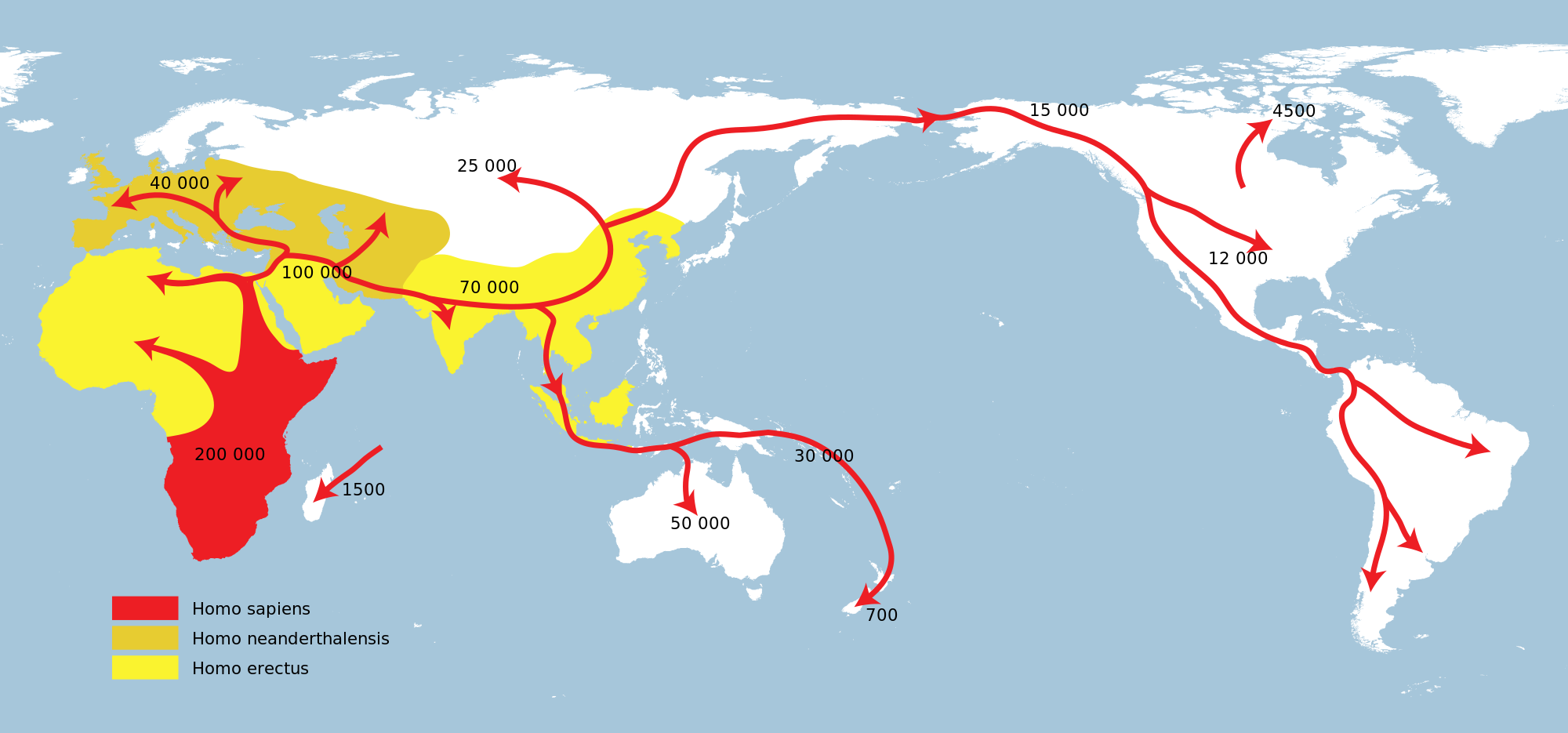
Within Africa, Homo sapiens dispersed around the time of its speciation, roughly 300,000 years ago. The recent African origin theory suggests that the anatomically modern humans outside of Africa descend from a population of Homo sapiens migrating from East Africa roughly 70–50,000 years ago and spreading along the southern coast of Asia and to Oceania by about 50,000 years ago. Modern humans spread across Europe about 40,000 years ago.
Early Eurasian Homo sapiens fossils have been found in Misliya Cave (Israel), dated to around 194,000–177,000 years old. It has also been claimed by some paleoanthropologists that a skull fragment found in Apidima Cave (Greece), dated to around 210,000 years old, may have belonged to Homo sapiens, although that skull fragment can't be confidently attributed to Homo sapiens. These fossils seem to represent failed dispersal attempts by early Homo sapiens, who may have been replaced by local Neanderthal populations.
The migrating modern human populations are known to have interbred with earlier local populations, so that contemporary human populations are descended in small part (below 10% contribution) from regional varieties of archaic humans.
After the Last Glacial Maximum, North Eurasian populations migrated to the Americas about 20,000 years ago. Arctic Canada and Greenland were reached by the Paleo-Eskimo expansion around 4,000 years ago. Finally, Polynesia was populated within the past 2,000 years in the last wave of the Austronesian expansion.
The earliest humans developed out of australopithecine ancestors about 3 million years ago, most likely in the area of the Kenyan Rift Valley, where the oldest known stone tools have been found. Stone tools recently discovered at the Shangchen site in China and dated to 2.12 million years ago are claimed to be the earliest known evidence of hominins outside Africa, surpassing Dmanisi in Georgia by 300,000 years.
Between 2 and less than a million years ago, Homo spread throughout East Africa and to Southern Africa (Homo ergaster), but not yet to West Africa. Around 1.8 million years ago, Homo erectus migrated out of Africa via the Levantine corridor and Horn of Africa to Eurasia. This migration has been proposed as being related to the operation of the Saharan pump, around 1.9 million years ago.[citation needed] Homo erectus dispersed throughout most of the Old World, reaching as far as Southeast Asia. Its distribution is traced by the Oldowan lithic industry, by 1.3 million years ago extending as far north as the 40th parallel (Xiaochangliang).
Key sites for this early migration out of Africa are Riwat in Pakistan (~2 Ma?), Ubeidiya in the Levant (1.5 Ma) and Dmanisi in the Caucasus (1.81 ± 0.03 Ma, p=0.05).
Early human migrations
Early human migrations are the earliest migrations and expansions of archaic and modern humans across continents. They are believed to have begun approximately 2 million years ago with the early expansions out of Africa by Homo erectus. This initial migration was followed by other archaic humans including H. heidelbergensis, which lived around 500,000 years ago and was the likely ancestor of Denisovans and Neanderthals as well as modern humans. Early hominids had likely crossed land bridges that have now sunk.
Within Africa, Homo sapiens dispersed around the time of its speciation, roughly 300,000 years ago. The recent African origin theory suggests that the anatomically modern humans outside of Africa descend from a population of Homo sapiens migrating from East Africa roughly 70–50,000 years ago and spreading along the southern coast of Asia and to Oceania by about 50,000 years ago. Modern humans spread across Europe about 40,000 years ago.
Early Eurasian Homo sapiens fossils have been found in Misliya Cave (Israel), dated to around 194,000–177,000 years old. It has also been claimed by some paleoanthropologists that a skull fragment found in Apidima Cave (Greece), dated to around 210,000 years old, may have belonged to Homo sapiens, although that skull fragment can't be confidently attributed to Homo sapiens. These fossils seem to represent failed dispersal attempts by early Homo sapiens, who may have been replaced by local Neanderthal populations.
The migrating modern human populations are known to have interbred with earlier local populations, so that contemporary human populations are descended in small part (below 10% contribution) from regional varieties of archaic humans.
After the Last Glacial Maximum, North Eurasian populations migrated to the Americas about 20,000 years ago. Arctic Canada and Greenland were reached by the Paleo-Eskimo expansion around 4,000 years ago. Finally, Polynesia was populated within the past 2,000 years in the last wave of the Austronesian expansion.
The earliest humans developed out of australopithecine ancestors about 3 million years ago, most likely in the area of the Kenyan Rift Valley, where the oldest known stone tools have been found. Stone tools recently discovered at the Shangchen site in China and dated to 2.12 million years ago are claimed to be the earliest known evidence of hominins outside Africa, surpassing Dmanisi in Georgia by 300,000 years.
Between 2 and less than a million years ago, Homo spread throughout East Africa and to Southern Africa (Homo ergaster), but not yet to West Africa. Around 1.8 million years ago, Homo erectus migrated out of Africa via the Levantine corridor and Horn of Africa to Eurasia. This migration has been proposed as being related to the operation of the Saharan pump, around 1.9 million years ago.[citation needed] Homo erectus dispersed throughout most of the Old World, reaching as far as Southeast Asia. Its distribution is traced by the Oldowan lithic industry, by 1.3 million years ago extending as far north as the 40th parallel (Xiaochangliang).
Key sites for this early migration out of Africa are Riwat in Pakistan (~2 Ma?), Ubeidiya in the Levant (1.5 Ma) and Dmanisi in the Caucasus (1.81 ± 0.03 Ma, p=0.05).
Recent media
Recent media