


Community hub
Recent from talks
Contribute something to knowledge base
Content stats: 0 posts, 0 articles, 1 media, 0 notes
Members stats: 0 subscribers, 0 contributors, 0 moderators, 0 supporters
Subscribers
Supporters
Contributors
Moderators
Hub AI
Axial tilt AI simulator
(@Axial tilt_simulator)
Hub AI
Axial tilt AI simulator
(@Axial tilt_simulator)
Axial tilt
In astronomy, axial tilt, also known as obliquity, is the angle between an object's rotational axis and its orbital axis, which is the line perpendicular to its orbital plane; equivalently, it is the angle between its equatorial plane and orbital plane. It differs from orbital inclination.
At an obliquity of 0 degrees, the two axes point in the same direction; that is, the rotational axis is perpendicular to the orbital plane.
The rotational axis of Earth, for example, is the imaginary line that passes through both the North Pole and South Pole, whereas the Earth's orbital axis is the line perpendicular to the imaginary plane through which the Earth moves as it revolves around the Sun; the Earth's obliquity or axial tilt is the angle between these two lines.
Over the course of an orbital period, the obliquity usually does not change considerably, and the orientation of the axis remains the same relative to the background of stars. This causes one pole to be pointed more toward the Sun on one side of the orbit, and more away from the Sun on the other side—the cause of the seasons on Earth.
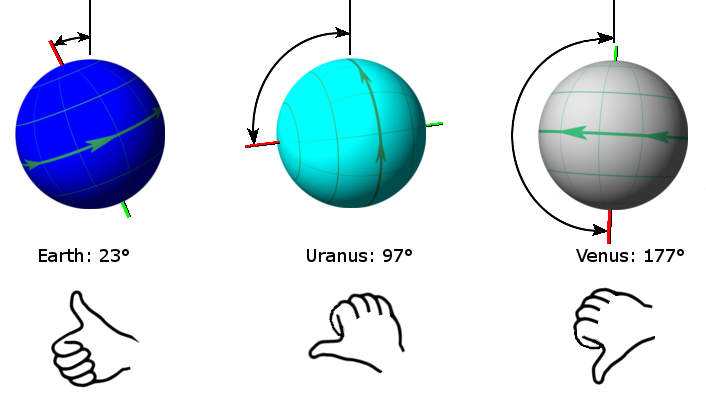
There are two standard methods of specifying a planet's tilt. One way is based on the planet's north pole, defined in relation to the direction of Earth's north pole, and the other way is based on the planet's positive pole, defined by the right-hand rule:
Earth's orbital plane is known as the ecliptic plane, and Earth's tilt is known to astronomers as the obliquity of the ecliptic, being the angle between the ecliptic and the celestial equator on the celestial sphere. It is denoted by the Greek letter Epsilon ε.
Earth currently has an axial tilt of about 23.44°. This value remains about the same relative to a stationary orbital plane throughout the cycles of axial precession. But the ecliptic (i.e., Earth's orbit) moves due to planetary perturbations, and the obliquity of the ecliptic is not a fixed quantity. At present, it is decreasing at a rate of about 46.8″ per century (see details in Short term below).
The ancient Greeks had good measurements of the obliquity since about 350 BCE, when Pytheas of Marseilles measured the shadow of a gnomon at the summer solstice. About 830 CE, the Caliph Al-Mamun of Baghdad directed his astronomers to measure the obliquity, and the result was used in the Arab world for many years. In 1437, Ulugh Beg determined the Earth's axial tilt as 23°30′17″ (23.5047°).
Axial tilt
In astronomy, axial tilt, also known as obliquity, is the angle between an object's rotational axis and its orbital axis, which is the line perpendicular to its orbital plane; equivalently, it is the angle between its equatorial plane and orbital plane. It differs from orbital inclination.
At an obliquity of 0 degrees, the two axes point in the same direction; that is, the rotational axis is perpendicular to the orbital plane.
The rotational axis of Earth, for example, is the imaginary line that passes through both the North Pole and South Pole, whereas the Earth's orbital axis is the line perpendicular to the imaginary plane through which the Earth moves as it revolves around the Sun; the Earth's obliquity or axial tilt is the angle between these two lines.
Over the course of an orbital period, the obliquity usually does not change considerably, and the orientation of the axis remains the same relative to the background of stars. This causes one pole to be pointed more toward the Sun on one side of the orbit, and more away from the Sun on the other side—the cause of the seasons on Earth.
There are two standard methods of specifying a planet's tilt. One way is based on the planet's north pole, defined in relation to the direction of Earth's north pole, and the other way is based on the planet's positive pole, defined by the right-hand rule:
Earth's orbital plane is known as the ecliptic plane, and Earth's tilt is known to astronomers as the obliquity of the ecliptic, being the angle between the ecliptic and the celestial equator on the celestial sphere. It is denoted by the Greek letter Epsilon ε.
Earth currently has an axial tilt of about 23.44°. This value remains about the same relative to a stationary orbital plane throughout the cycles of axial precession. But the ecliptic (i.e., Earth's orbit) moves due to planetary perturbations, and the obliquity of the ecliptic is not a fixed quantity. At present, it is decreasing at a rate of about 46.8″ per century (see details in Short term below).
The ancient Greeks had good measurements of the obliquity since about 350 BCE, when Pytheas of Marseilles measured the shadow of a gnomon at the summer solstice. About 830 CE, the Caliph Al-Mamun of Baghdad directed his astronomers to measure the obliquity, and the result was used in the Arab world for many years. In 1437, Ulugh Beg determined the Earth's axial tilt as 23°30′17″ (23.5047°).
Recent media
Recent media