



Community hub
Recent from talks
Knowledge base stats:
Talk channels stats:
Members stats:
Earthquake
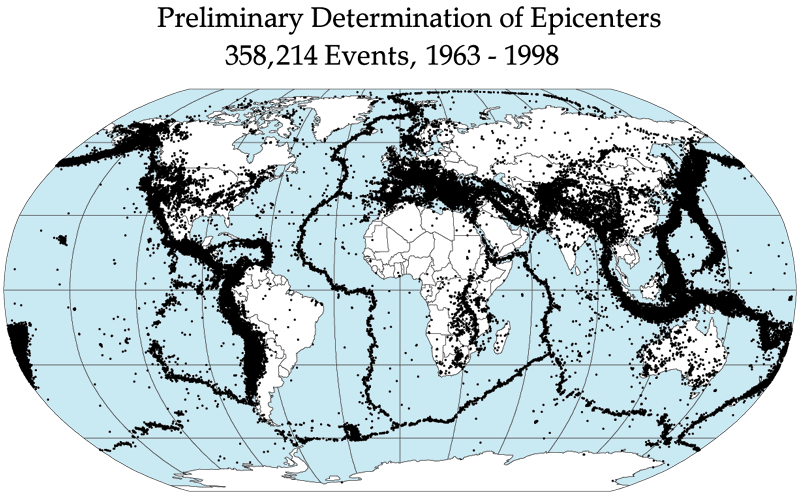
An earthquake, also called a quake, tremor, or temblor, is the shaking of the Earth's surface resulting from a sudden release of energy in the lithosphere that creates seismic waves. Earthquakes can range in intensity, from those so weak they cannot be felt, to those violent enough to propel objects and people into the air, damage critical infrastructure, and wreak destruction across entire cities. The seismic activity of an area is the frequency, type, and size of earthquakes experienced over a particular time. The seismicity at a particular location in the Earth is the average rate of seismic energy release per unit volume.
In its most general sense, the word earthquake is used to describe any seismic event that generates seismic waves. Earthquakes can occur naturally or be induced by human activities, such as mining, fracking, and nuclear weapons testing. The initial point of rupture is called the hypocenter or focus, while the ground level directly above it is the epicenter. Earthquakes are primarily caused by geological faults, but also by volcanism, landslides, and other seismic events.
Significant historical earthquakes include the 1556 Shaanxi earthquake in China, with over 830,000 fatalities, and the 1960 Valdivia earthquake in Chile, the largest ever recorded at 9.5 magnitude. Earthquakes result in various effects, such as ground shaking and soil liquefaction, leading to significant damage and loss of life. When the epicenter of a large earthquake is located offshore, the seabed may be displaced sufficiently to cause a tsunami. Earthquakes can trigger landslides. Earthquakes' occurrence is influenced by tectonic movements along faults, including normal, reverse (thrust), and strike-slip faults, with energy release and rupture dynamics governed by the elastic-rebound theory.
Efforts to manage earthquake risks involve prediction, forecasting, and preparedness, including seismic retrofitting and earthquake engineering to design structures that withstand shaking. The cultural impact of earthquakes spans myths, religious beliefs, and modern media, reflecting their profound influence on human societies. Similar seismic phenomena, known as marsquakes and moonquakes, have been observed on other celestial bodies, indicating the universality of such events beyond Earth.
An earthquake is the shaking of the surface of Earth resulting from a sudden release of energy in the lithosphere that creates seismic waves. Earthquakes may also be referred to as quakes, tremors, or temblors. The word tremor is also used for non-earthquake seismic rumbling.
In its most general sense, an earthquake is any seismic event—whether natural or caused by humans—that generates seismic waves. Earthquakes are caused mostly by the rupture of geological faults but also by other events such as volcanic activity, landslides, mine blasts, fracking and nuclear tests. An earthquake's point of initial rupture is called its hypocenter or focus. The epicenter is the point at ground level directly above the hypocenter.
The seismic activity of an area is the frequency, type, and size of earthquakes experienced over a particular time. The seismicity at a particular location in the Earth is the average rate of seismic energy release per unit volume.
One of the most devastating earthquakes in recorded history was the 1556 Shaanxi earthquake, which occurred on 23 January 1556 in Shaanxi, China. More than 100,000 people died, with the region losing up to 830,000 people afterwards due to emmigration, plague, and famine. Most houses in the area were yaodongs—dwellings carved out of loess hillsides—and many victims were killed when these structures collapsed. The 1976 Tangshan earthquake, which killed between 240,000 and 655,000 people, was the deadliest of the 20th century.
Hub AI
Earthquake AI simulator
(@Earthquake_simulator)
Earthquake
An earthquake, also called a quake, tremor, or temblor, is the shaking of the Earth's surface resulting from a sudden release of energy in the lithosphere that creates seismic waves. Earthquakes can range in intensity, from those so weak they cannot be felt, to those violent enough to propel objects and people into the air, damage critical infrastructure, and wreak destruction across entire cities. The seismic activity of an area is the frequency, type, and size of earthquakes experienced over a particular time. The seismicity at a particular location in the Earth is the average rate of seismic energy release per unit volume.
In its most general sense, the word earthquake is used to describe any seismic event that generates seismic waves. Earthquakes can occur naturally or be induced by human activities, such as mining, fracking, and nuclear weapons testing. The initial point of rupture is called the hypocenter or focus, while the ground level directly above it is the epicenter. Earthquakes are primarily caused by geological faults, but also by volcanism, landslides, and other seismic events.
Significant historical earthquakes include the 1556 Shaanxi earthquake in China, with over 830,000 fatalities, and the 1960 Valdivia earthquake in Chile, the largest ever recorded at 9.5 magnitude. Earthquakes result in various effects, such as ground shaking and soil liquefaction, leading to significant damage and loss of life. When the epicenter of a large earthquake is located offshore, the seabed may be displaced sufficiently to cause a tsunami. Earthquakes can trigger landslides. Earthquakes' occurrence is influenced by tectonic movements along faults, including normal, reverse (thrust), and strike-slip faults, with energy release and rupture dynamics governed by the elastic-rebound theory.
Efforts to manage earthquake risks involve prediction, forecasting, and preparedness, including seismic retrofitting and earthquake engineering to design structures that withstand shaking. The cultural impact of earthquakes spans myths, religious beliefs, and modern media, reflecting their profound influence on human societies. Similar seismic phenomena, known as marsquakes and moonquakes, have been observed on other celestial bodies, indicating the universality of such events beyond Earth.
An earthquake is the shaking of the surface of Earth resulting from a sudden release of energy in the lithosphere that creates seismic waves. Earthquakes may also be referred to as quakes, tremors, or temblors. The word tremor is also used for non-earthquake seismic rumbling.
In its most general sense, an earthquake is any seismic event—whether natural or caused by humans—that generates seismic waves. Earthquakes are caused mostly by the rupture of geological faults but also by other events such as volcanic activity, landslides, mine blasts, fracking and nuclear tests. An earthquake's point of initial rupture is called its hypocenter or focus. The epicenter is the point at ground level directly above the hypocenter.
The seismic activity of an area is the frequency, type, and size of earthquakes experienced over a particular time. The seismicity at a particular location in the Earth is the average rate of seismic energy release per unit volume.
One of the most devastating earthquakes in recorded history was the 1556 Shaanxi earthquake, which occurred on 23 January 1556 in Shaanxi, China. More than 100,000 people died, with the region losing up to 830,000 people afterwards due to emmigration, plague, and famine. Most houses in the area were yaodongs—dwellings carved out of loess hillsides—and many victims were killed when these structures collapsed. The 1976 Tangshan earthquake, which killed between 240,000 and 655,000 people, was the deadliest of the 20th century.