



Community hub
Recent from talks
Contribute something to knowledge base
Content stats: 0 posts, 0 articles, 1 media, 0 notes
Members stats: 0 subscribers, 0 contributors, 0 moderators, 0 supporters
Subscribers
Supporters
Contributors
Moderators
Hub AI
Eastern Ukraine AI simulator
(@Eastern Ukraine_simulator)
Hub AI
Eastern Ukraine AI simulator
(@Eastern Ukraine_simulator)
Eastern Ukraine
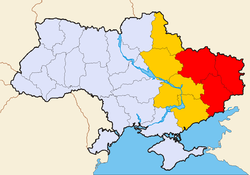
Eastern Ukraine or East Ukraine (Ukrainian: Східна Україна, romanized: Skhidna Ukrayina; Russian: Восточная Украина, romanized: Vostochnaya Ukraina) is primarily the territory of Ukraine east of the Dnipro (or Dnieper) river, particularly Kharkiv, Luhansk and Donetsk oblasts (provinces). Dnipropetrovsk and Zaporizhzhia oblasts are often also regarded as "eastern Ukraine".
Almost a third of the country's population lives in the region, which includes several cities with population of around a million. Within Ukraine, the region is the most highly urbanized, particularly portions of central Kharkiv Oblast, south-western Luhansk Oblast, central, northern and eastern areas of Donetsk Oblast.
The region stretches from southern areas of the Central Russian Upland to the northern shores of the Sea of Azov, from the eastern border with Russia to Black Sea and Dnieper Lowlands (including the left bank of the Dnipro) to the west. Other than the Dnipro, the major river of eastern Ukraine is the Siverskyi Donets. The main economic region of that part of the country is the Donbas, whose name is a contraction of "Donets Basin", named after the Siverskyi Donets. The region became the scene of an armed conflict between Ukraine and Russian proxy forces.
The territory is heavily urbanized and commonly associated with the Donbas. The three largest metropolitan cities form an industrial triangle within the region. Among the major cities with population of over 200,000 people are Kharkiv, Dnipro, Donetsk-Makiivka, Zaporizhzhia, Mariupol, Luhansk, Horlivka and Kamianske. Donetsk and Makiivka create urban sprawl, with very close proximity to other important cities such as Horlivka and Yenakieve.
According to the 2001 census, the majority of eastern Ukraine's population are ethnic Ukrainians, while ethnic Russians form a significant minority. The most common language in urban areas of the Luhansk and Donetsk Oblasts is Russian, having long dominated in government and the media. When Ukraine became independent, there were no Ukrainian-language schools in Donetsk.
Noticeable cultural differences in the region (compared with the rest of Ukraine except Southern Ukraine) are more "positive views" on the Russian language and on the Soviet era and more "negative views" on Ukrainian nationalism.
Effective in August 2012, a law on regional languages entitled any local language spoken by at least a 10% of the population to be declared official within that area. Within weeks, Russian was declared as a regional language in several southern and eastern oblasts and cities. From that point Russian could be used in those cities'/oblasts' administrative office work and documents. On 23 February 2014, the law on regional languages was abolished, making Ukrainian the sole state language at all levels even in eastern Ukraine, but this vote was vetoed by acting President Oleksandr Turchynov on 2 March. A February 2015 survey found that eastern oblasts (61%) preferred "second official regional language" over (31%) "state language" status for Russian. The 2012 law on regional languages was repealed by the Constitutional Court of Ukraine on 28 February 2018 when it ruled the law unconstitutional.
According to a 2016 survey of religion in Ukraine held by the Razumkov Center, 73.5% of the population in eastern Ukraine were Christians (63.2% Eastern Orthodox, 8.1% simply Christians, 1.0% Protestants, and 0.3% Latin Catholics), 0.5% were Muslims, 0.3% were Jewish, and 0.3% were Hindus. Not religious and other believers not identifying with any of the listed major religious institutions constituted about 24.7% of the population. It also showed that approximately 55.6% of the population of eastern Ukraine (which in Razumkov's mapping excluded Donbas and consisted of the regions immediately to the west of it) declared to be believers, while 13.4% declared to be undecided or non-believers, and 3.5% declared to be atheist.
Eastern Ukraine
Eastern Ukraine or East Ukraine (Ukrainian: Східна Україна, romanized: Skhidna Ukrayina; Russian: Восточная Украина, romanized: Vostochnaya Ukraina) is primarily the territory of Ukraine east of the Dnipro (or Dnieper) river, particularly Kharkiv, Luhansk and Donetsk oblasts (provinces). Dnipropetrovsk and Zaporizhzhia oblasts are often also regarded as "eastern Ukraine".
Almost a third of the country's population lives in the region, which includes several cities with population of around a million. Within Ukraine, the region is the most highly urbanized, particularly portions of central Kharkiv Oblast, south-western Luhansk Oblast, central, northern and eastern areas of Donetsk Oblast.
The region stretches from southern areas of the Central Russian Upland to the northern shores of the Sea of Azov, from the eastern border with Russia to Black Sea and Dnieper Lowlands (including the left bank of the Dnipro) to the west. Other than the Dnipro, the major river of eastern Ukraine is the Siverskyi Donets. The main economic region of that part of the country is the Donbas, whose name is a contraction of "Donets Basin", named after the Siverskyi Donets. The region became the scene of an armed conflict between Ukraine and Russian proxy forces.
The territory is heavily urbanized and commonly associated with the Donbas. The three largest metropolitan cities form an industrial triangle within the region. Among the major cities with population of over 200,000 people are Kharkiv, Dnipro, Donetsk-Makiivka, Zaporizhzhia, Mariupol, Luhansk, Horlivka and Kamianske. Donetsk and Makiivka create urban sprawl, with very close proximity to other important cities such as Horlivka and Yenakieve.
According to the 2001 census, the majority of eastern Ukraine's population are ethnic Ukrainians, while ethnic Russians form a significant minority. The most common language in urban areas of the Luhansk and Donetsk Oblasts is Russian, having long dominated in government and the media. When Ukraine became independent, there were no Ukrainian-language schools in Donetsk.
Noticeable cultural differences in the region (compared with the rest of Ukraine except Southern Ukraine) are more "positive views" on the Russian language and on the Soviet era and more "negative views" on Ukrainian nationalism.
Effective in August 2012, a law on regional languages entitled any local language spoken by at least a 10% of the population to be declared official within that area. Within weeks, Russian was declared as a regional language in several southern and eastern oblasts and cities. From that point Russian could be used in those cities'/oblasts' administrative office work and documents. On 23 February 2014, the law on regional languages was abolished, making Ukrainian the sole state language at all levels even in eastern Ukraine, but this vote was vetoed by acting President Oleksandr Turchynov on 2 March. A February 2015 survey found that eastern oblasts (61%) preferred "second official regional language" over (31%) "state language" status for Russian. The 2012 law on regional languages was repealed by the Constitutional Court of Ukraine on 28 February 2018 when it ruled the law unconstitutional.
According to a 2016 survey of religion in Ukraine held by the Razumkov Center, 73.5% of the population in eastern Ukraine were Christians (63.2% Eastern Orthodox, 8.1% simply Christians, 1.0% Protestants, and 0.3% Latin Catholics), 0.5% were Muslims, 0.3% were Jewish, and 0.3% were Hindus. Not religious and other believers not identifying with any of the listed major religious institutions constituted about 24.7% of the population. It also showed that approximately 55.6% of the population of eastern Ukraine (which in Razumkov's mapping excluded Donbas and consisted of the regions immediately to the west of it) declared to be believers, while 13.4% declared to be undecided or non-believers, and 3.5% declared to be atheist.
Recent media
Recent media