Hubbry Logo
DniproDniproMain
Open search
Dnipro
Community hub
Dnipro
logo
8 pages, 0 posts
0 subscribers
Be the first to start a discussion here.
Contribute something
Dnipro
Dnipro
from Wikipedia

Dnipro[a] is Ukraine's fourth-largest city, with about one million inhabitants.[4][5][6][7] It is located in the eastern part of Ukraine, 391 km (243 mi)[8] southeast of the Ukrainian capital Kyiv on the Dnipro River, from which it takes its name. Dnipro is the administrative centre of Dnipropetrovsk Oblast. It hosts the administration of Dnipro urban hromada.[9] Dnipro has a population of 968,502 (2022 estimate).[10]

Key Information

Archeological evidence suggests the site of the present city was settled by Cossack communities from at least 1524. Yekaterinoslav ("glory of Catherine")[11] was established by decree of the Russian Empress Catherine the Great in 1787 as the administrative center of Novorossiya. From the end of the 19th century, the town attracted foreign capital and an international, multi-ethnic workforce exploiting Kryvbas iron ore and Donbas coal.

Renamed Dnipropetrovsk in 1926 after the Ukrainian Communist Party leader Grigory Petrovsky, it became a focus for the Stalinist commitment to the rapid development of heavy industry. After World War II, this included nuclear, arms, and space industries whose strategic importance led to Dnipropetrovsk's designation as a closed city.

Following the Euromaidan events of 2014, the city politically shifted away from pro-Russian parties and figures towards those favoring closer ties with the European Union. As a result of decommunization, the city was renamed Dnipro in 2016. Following the Russian invasion of Ukraine in February 2022, Dnipro rapidly developed as a logistical hub for humanitarian aid and a reception point for people fleeing the various battle fronts.[12][13]

Name

[edit]

Current names

[edit]

Former names

[edit]

Name history

[edit]

The original name of a Ukrainian Cossack city on the territory of modern Dnipro was Novyi Kodak (Ukrainian: Новий Кодак [noˈwɪj koˈdɑk], New Kodak).[19] Also on the territory of Modern Dnipro, the Russian Empire founded Yekaterinoslav (the glory of Catherine).[11] This name was first mentioned in a report to Azov Governor Vasily Chertkov to Grigory Potemkin on 23 April 1776. He wrote "The provincial city called Yekaterinoslav should be the best convenience on the right side of the Dnieper River near Kaydak..." (Which referred to New Kodak [uk]). The construction was officially transferred to the right bank in a decree of Empress of Russia Catherine II of 23 January 1784.[15]

In the 17th century the city was also known as Polovytsia.[20]

In 1918, the Central Council of Ukraine of the Ukrainian People's Republic proposed to change the name of the city to Sicheslav; however, this was never finalised.[21]

In 1926 the city was renamed after communist leader Grigory Petrovsky.[22][23] In some Anglophone media Dnipro was nicknamed the Rocket City during the Cold War.[24]

The 2015 law on decommunization required the city to be renamed.[22] On 29 December 2015 the Dnipro City Council officially changed the reference of the city naming from referring to Petrovsky to being in honor of Saint Peter,[25] thus making the name consistent with the law without actually changing the name itself.

On 3 February 2016 a draft law was registered in the Verkhovna Rada (the Ukrainian parliament) to change the name of the city to Dnipro.[26] On 19 May 2016 the Ukrainian parliament passed a bill to officially rename the city (to Dnipro). The resolution was approved by 247 out of the 344 MPs, with 16 opposing the measure.[27][nb 1][nb 2]

Following the renaming of the city the reference to Petrovsky has been removed from institutions named after the city. A notable exception is the name of the surrounding province, which is listed in the territorial structure of Ukraine in the Constitution.[31] Thus until a lengthy and complicated process of amending is carried out, it officially retains the name Dnipropetrovsk Oblast.

History

[edit]

Early history

[edit]
A part of the Cuman statue collection of the Dmytro Yavornytsky National Historical Museum of Dnipro

Human settlements in current Dnipropetrovsk Oblast date from the Paleolithic era.[32] According to archeological finds, in the Paleolithic period (7—3 thousand BC) human settlements appear near the Aptekarska brook [uk] in what is now Chechelivskyi District and on Monastyrskyi Island.[33] A Neolithic stonecrafter's house has been excavated in one of Dnipro's city parks.[32] In the Bronze Age the area was settled by diverse tribes.[32] Traces of Cimmerian settlements during the Bronze Age have been found near today's Taras Shevchenko Park.[33] The area of modern Dnipro was part of the Scythian empire from approximately the 1st century BC until the 3rd century BC.[34][35] During the Migration Period (300–800) nomadic tribes of the Huns, Avars, Bulgarians, and Magyars passed through the lands of the Dnieper region, they came into contact with local agricultural East Slavs.[34]

The area of modern Dnipro was part of the Kievan Rus' (882–1240).[34] The region witnessed fighting between the armies of Kievan Rus' and Khazars, Pechenegs, Tork people and Cumans.[34] In the 13th century the Dnieper region was devastated during the Mongol Empire conquest of Kievan Rus'.[34] The area of modern Dnipro city was incorporated into the Mongol's khanate Golden Horde.[36]

In the 15th century the area became part of the Kiev Voivodeship (1471–1565) of the Polish–Lithuanian Commonwealth.[36] Archeological finds in today's Dnipro's urban district Samarskyi District suggest that the important river crossing was a trading settlement from at least 1524.[37] In 1635, the Polish–Lithuanian Commonwealth built the Kodak Fortress above the Dnieper Rapids at Kodaky on the south-eastern outskirts of modern Dnipro near the current Kaidatsky Bridge,[19] only to have it destroyed within months by the Cossacks of Ivan Sulyma.[38] Rebuilt in 1645,[19] it was captured by Zaporozhian Sich in 1648.[37]

Around the fortress a settlement emerged that became a town in Kodak Palanka [uk; pl] (province) of the Zaporizhian Sich called Novyi (New) Kodak [uk].[19] Cossacks often hid the true number of the population to reduce taxation and other obligations, but according to documentary evidence, it can be assumed that the population of New Kodak was at least 3,000 people.[19] The fortress was garrisoned by Cossacks until the Sich, allied with the Ottoman Empire and their Tartar vassals, drove out the encroaching Tsardom of Russia. Under the terms of the Russian withdrawal—the Treaty of the Pruth in 1711—the Kodak fortress was demolished.[37][39]

In the mid-1730s, the fortress and Russians returned, living in an uneasy cohabitation with local cossacks.[37] From mid-century they co-existed with the Zaporozhian sloboda (or "free settlement") of Polovytsia located on the site of today's Central Terminal and the Ozyorka farmers market.[40][15]

In the Russo-Turkish War (1768–1774), the Zaporozhian cossacks allied with Empress Catherine II. No sooner had they assisted the Russians to victory than they faced an imperial ultimatum to disband their confederation. The liquidation of the Sich destroyed their political autonomy and saw the incorporation of their lands into the new governates of Novorossiya.[41] In 1784, Catherine ordered the foundation of new city, commonly referred to at the time as Katerynoslav.[19]

In 2001 the seal of Kodak Palanka became the central element of Dnipro's coat of arms [uk] and Dnipro's official flag [uk].[19]

Imperial city

[edit]
Historical affiliations

Russian Empire 1776–1917
Ukrainian People's Republic 1917–1918
autonomous part of the Russian Republic
Ukrainian State 1918
Ukrainian People's Republic 1918–1920
Ukrainian Soviet Socialist Republic 1920–1941
part of the Soviet Union from 1922
Reichskommissariat Ukraine 1941–1944
part of German-occupied Europe
Ukrainian Soviet Socialist Republic 1944–1991
part of the Soviet Union
Ukraine 1991–present

Establishment of Catherine's city

[edit]

The first written mention of a town in the Russian Empire called Yekaterinoslav can be found in a report from Azov Governor Vasily Chertkov to Grigory Potemkin on 23 April 1776. He wrote "The provincial city called Yekaterinoslav should be the best convenience on the right side of the Dnieper River near Kaydak..." (referring to Novyi Kodak). In 1777, a town named Yekaterinoslav (the glory of Catherine),[11] was built to the north of the present-day city at the confluence of the Samara and Kilchen rivers. The site was badly chosen – spring waters transformed the city into a bog.[40][15] The surviving settlement was later renamed Novomoskovsk.[19][42]

The territory of modern Dnipro, despite the modern-day city's size, still has not expanded to encompass the territory of (Chertkov's) Yekaterinoslav of 1776.[37] On 22 January 1784 Russian Empress Catherine the Great signed an Imperial Ukase directing that "the gubernatorial city under name of Yekaterinoslav be moved to the right bank of the Dnieper river near Kodak". The new city would serve Grigory Potemkin as a Viceregal seat for the combined Novorossiya and Azov Governorates.[15]

On 20 May [O.S. 9 May] 1787, in the course of her celebrated Crimean journey, the Empress laid the foundation stone of the Transfiguration Cathedral in the presence of Austrian Emperor Joseph II, Polish king Stanisław August Poniatowski, and the French and English ambassadors.[43][44] Potemkin's grandiose plans for a third Russian imperial capital alongside Moscow and Saint Petersburg included a viceregal palace, a university (Potemkin envisioned Yekaterinoslav as the 'Athens of southern Russia'[45]), courts of law and a botanical garden,[46] were frustrated by a renewal of the Russo-Turkish war in 1787, by bureaucratic procrastination, defective workmanship, and theft, Potemkin's death in 1791 and that of his imperial patroness five years later.[45]

In 1815 a government official described the town as "more like some Dutch [Mennonite] colony then a provincial administrative centre".[47] The cathedral, much reduced in size, was completed in 1835.[15]

Disputed year of foundation
[edit]

Scholarship concerning the foundation of the city has been subject to political considerations and dispute.[37][48] In 1976, to have the bicentenary of the city coincide with the 70th anniversary of the birth of Soviet party leader, and regional native son, Leonid Brezhnev, the date of the city's foundation was moved back from the visit Russian Empress Catherine II in 1787, to 1776.[37]

Following Ukrainian independence, local historians began to promote the idea of a town emerging in the 17th century from Cossack settlements, an approach aimed at promoting the city's Ukrainian identity.[48][49] They cited the chronicler of the Zaporozhian Cossacks, Dmytro Yavornytsky, whose History of the City of Ekaterinoslav completed in 1940 was authorised for publication only in 1989, the era of Glasnost.[50][49]

Growth as an industrial centre

[edit]
A map of Ekaterinoslav, 1885[nb 3]
The Main Post Office, 1870
Catherine the Great monument in Ekaterinoslav (1840–1920[citation needed]). This monument that stood in front of the Mining Institute was replaced by Soviet authorities with one of Russian academic Mikhail Lomonosov.[51]

While into the late nineteenth century the principal business of the town remained the processing of agricultural raw materials,[15] there was an early state-sponsored effort to promote manufacture. In 1794 the government supported two factories: a textile factory that was transferred from the town of Dubrovny Mogilev Governorate and a silk-stockings factory that was brought from the village of Kupavna near Moscow. In 1797 the textile factory employed 819 permanent workers, 378 of whom were women and 115 children. The silk stocking workers, the majority being women, were serfs bought at an auction for 16,000 roubles. Conditions, as Potemkin himself was forced to admit, were harsh, with many of the workers dying from malnutrition and exhaustion.[15]

From 1797 to 1802, while serving under the Emperor Paul I as the administrative centre of a centre of the Novorossiya Governorate, the settlement was officially known as Novorossiysk.[14][15]

Despite the bridging of the Dnieper in 1796, commerce was slow to develop. 1832 saw the establishment of the small Zaslavsky iron-casting factory, the town's first metallurgical enterprise.[15] Industrialisation gathered apace in the 1880s with the establishment of the first railway connections.[52] Rail construction responded to the enterprise of two men: John Hughes, a Welsh businessman who built an iron works at Yuzovka in 1869–72, and developed the Donbas coal deposits;[40] and the Russian geologist Alexander Pol, who in 1866 had discovered the Krivoy Rog iron ore basin, Krivbass, during archaeological research.[40]

In 1884, a railway to supply pig iron foundries in Krivoy Rog with Donbass coal crossed the Dnieper at Yekaterinoslav.[14] It proved a spur to further industrial development[14] and to the creation of the new suburbs of Amur and Nyzhniodniprovsk.

In 1897, Yekaterinoslav became the third city in the Russian Empire to have electric trams. The Yekaterinoslav Higher Mining School, today's Dnipro Polytechnic, was founded in 1899.[53] Within twenty years the population had more than tripled, reaching 157,000 in 1904.[54] The immigrants flowing into the city were mainly ethnic or cultural Russians and Jews, with the Ukrainian population remaining rural in this stage of the Industrial Revolution.[55]

The Jewish community and the 1905 pogrom

[edit]

From 1792 Yekaterinoslav was within the Pale of Settlement, the former Polish-Lithuanian territories in which Catherine and her successors enforced no limitation on the movement and residency of their Jewish subjects.[56] Within less than a century, a largely Yiddish-speaking Jewish community of 40,000 constituted more than a third of the city's population, and contributed a considerable share of its business capital and industrial workforce.[57]

Such apparent strength did not protect the community—members of whom had had the unpopular task of collecting government taxes and recruiting young men for the army[58]— from communal violence.[59] In 1883, three days of rioting destroyed Jewish business, and persuaded many to temporarily leave the city. There was a return of anti–Semitic incitement among the Christian public in 1904, but attacks on community were, at that time, suppressed on the order of a liberal governor.[58]

In the widespread social unrest that followed the 1905 defeat in the Russo-Japanese War, the political life of the city was dominated by the revolutionary opposition (including the Jewish Workers Socialist Party and the Bund)[58] and by the insurrectionary spirit of the nascent labor movement. The local czarist authorities were able to ride out the wave political protests and strikes, in part by playing on division between Jewish workers who predominated as clerks and artisans in the city, and Russian workers employed in the large suburban factories.[60] There was a wave of anti-Semitic attacks. With the army intervening against Jewish defense groups, about 100 Jews were killed and two hundred wounded.[58]

According to local historian Andrii Portnov, 40% of the local Yekaterinoslav population was Jewish in the years leading up to World War I.[61]

The Soviet era

[edit]

War and revolution

[edit]
Monument in Dnipro of an armored train that was built by the workers of Yekaterinoslav's Bryansk plant in 1918, which was employed by the Red Army in its conquest of Ukraine and the Volga region.

Directly following the Russian February Revolution, in the night of 3 March O.S (16 March N.S) to 4 March 1917 a provisional government was organised in Yekaterinoslav headed by the (since 1913) chairman of the provincial land administration Konstantin von Hesberg [uk].[62] Also on 4 March a Council of Workers' Deputies was formed.[62] On 6 March the prime minister of the Russian Provisional Government Georgy Lvov removed the governor and the vice-governor of Yekaterinoslav Governorate, temporarily handing these powers to Hesberg.[62] On 9 March a Yekaterinoslav Council of Workers and Soldiers deputies was formed.[62]

On 16 May the Council of Workers' Deputies and the Council of Workers and Soldiers merged, to become named the Revolutionary Council in November 1917.[62] All these power structures existed in duality, with Hesberg's provisional government often being at a disadvantage.[62] In 1917 the city saw numerous meetings, rallies, meetings, conferences, congresses and demonstrations by political parties all over the political spectrum.[62] Due to intense political agitation the newly formed factory committees and professional unions by autumn of 1917 mainly supported the Bolsheviks, significantly strengthening their positions.[62]

In June 1917 a Central Council (Tsentralna Rada) of Ukrainian parties in Kyiv declared Yekaterinoslav to be within the territory of the autonomous Ukrainian People's Republic (UPR).[14] On 13 August 1917 the first democratic Yekaterinoslav 120 seats city Duma election took place.[62] The Bolsheviks gained 24 seats and the Mensheviks 16, with pro-Ukrainian parties picking up 6 seats.[62] Vasyl Osipov [uk] was elected Mayor of the city.[62] Osipov was Mayor until the dissolution of the city Duma in May 1918.[62] On 10 November 1917 a parade of Ukrainian troops was held, organized by the Yekaterinoslav Ukrainian Military Council in support of the Third Universal of the Ukrainian Central Council, the proclamation of the Ukrainian People's Republic.[14]

In the November 1917 elections to the Russian Constituent Assembly, the Bolsheviks secured just under 18 per cent of the vote in the Governorate, compared to 46 per cent for the Ukrainian Socialist Revolutionaries and their allies.[63] On 22 November 1917 the Revolutionary Council and the city Duma pledged their allegiance to the Tsentralna Rada.[62] The Bolsheviks then left these organisations.[62] During December, the situation in the city worsened with both sides preparing for military action.[62]

On 26 December, the Bolsheviks defied an ultimatum from the Tsentralna Rada and after three days of fighting consolidated their control of the city.[62] On 12 February they declared Yekaterinoslav part of a Donetsk-Krivoy Rog Soviet Republic, but the following month, under the terms of the Treaty of Brest-Litovsk, conceded the territory to the German and Austrian-allied UPR.[64][14] On 5 April 1918 the Imperial German army entered the city. Five hundred remaining Bolshevik Red Guards were publicly executed.[62]

A German military parade in Yekaterinoslav in spring 1918.

The formal tenure of the UPR was brief: on 29 April 1918 intervention by the Central Powers saw the UPR replaced by the more pliant Ukrainian State or Hetmanate. On 18 May 1918 the Hetman of the Ukrainian State, Pavlo Skoropadskyi, ordered the previously nationalized enterprises returned to their former owners, and with the assistance of Austro-Hungarian troops the new authorities suppressed labor protest.[62]

On 23 December 1918, following their defeat by the Western Allies and after four days of insurgency within the city, German and Austro-Hungarian occupation forces withdrew. Four days later, Yekaterinoslav was stormed by the anarchist Revolutionary Insurgent Army of Ukraine (the Makhnovshchina), putting to flight forces loyal to the UPR's new Directorate. Over the course of the following year, city was to change hands several more times, contested between the UPR, the Whites (Armed Forces of South Russia), Nykyfor Hryhoriv's peasant insurgents, Makhnovshchina (who returned twice),[65] and the Bolsheviks, who reorganised as the Red Army, finally secured the city on 30 December 1919.[62][66][67]

The city had been extensively damaged and the population, which had stood at about 268,000 people in 1917, had dropped to under 190,000.[68]

Stalin-era industrialisation

[edit]
The boy on the left murdered an 8-year-old for his 4 pounds of bread in Yekaterinoslav in 1922, during the local 1921–1923 famine.[69]

In late May 1920 the food supply to Yekaterinoslav deteriorated, resulting in a wave of strikes.[68] In June 1920 Soviet authorities quelled one such protest by arresting 200 railway workers, of which 51 were sentenced to immediate execution.[68]

In 1922 the region was incorporated into the Ukrainian SSR, a constituent republic of the Soviet Union. In 1922 the Soviet government ordered that "all nationalized enterprises with names related to the Company or the Surname of the old owners must be renamed in memory of revolutionary events, in memory of the international, all-Russian or local leaders of the proletarian revolution."[70] In 1922 and 1923 the factories were renamed, as well as dozens of streets, alleys, driveways, squares and parks.[70] In 1923 the city council adopted a resolution to organize a competition to rename the city itself.[70]

In 1924 a Provincial Congress of Soviets adopted a resolution on renaming the city of Yekaterinoslav to the city of Krasnodniprovsk (and Yekaterinoslav Governorate to Krasnodniprovsk). Following this, many organizations and institutions began to name Yekaterinoslav Krasnodniprovsk in official documents, only to be reminded in the press that the renaming of settlements could only be decided by the Presidium of the Supreme Soviet.[70] In 1926 a provisional District Congress of Workers', Peasants' and Soldiers' Deputies adopted a resolution on renaming Yekaterinoslav to the name Dnipropetrovsk in honour of the All-Ukrainian Congress of Soviets's chairman of the All-Ukrainian Central Executive Committee, Grigory Petrovsky.[23][71][70]

Petrovsky was present at this congress and he did "accept this honour with great gratitude."[70] The resolution of the congress was approved by a resolution of the Presidium of the Supreme Soviet dated 20 July 1926.[70] In the 1920s and 1930s dozens of streets, alleys, driveways, squares and parks continued to be renamed in the city, this continued in the 1940s and in subsequent years.[70]

Dnipro Academic Drama and Comedy Theatre was constructed during the Stalinist period.

By 1927 the industry of Dnipropetrovsk was completely rebuilt, and according to some indicators exceeded pre-war levels.[68] Due to agrarian overpopulation, an influx of unemployed from other settlements, a higher birth rates among other reasons, both employment and unemployment in Dnipropetrovsk rose.[68] In the late twenties, the authorities had to contend with growing labour unrest. "Do not strangle us, our children are dying of hunger, we have been placed in worse conditions than under the old regime" read one protest.[72]

The city figured prominently in Stalin's Five-Year Plans for industrialisation. In 1932, Dnipropetrovsk's regional metallurgical plants produced 20 per cent of the entire cast iron and 25 per cent of the steel manufactured in the Ukrainian SSR. By the end of the thirties the Dnipropetrovsk region became the most urbanised of Soviet Ukraine with more than 2,273,000 people living in the region and over half a million in the city proper. Dnipropetrovsk became an important cultural and educational centre with ten colleges and a State University.[73]

The surrounding countryside was devastated by the policy of forced collectivisation and grain seizures. Peasants had died en masse during the Holodomor of 1932–33.[74] Dnipropetrovsk Oblast in the years 1932–33 lost 3.5 to 9.8 million people,[75] making it one of the most affected areas of the famine.[75]

Drawn by employment in the expanding heavy industry, the survivors changed the ethnic composition of the city. The percentage of residents recorded as Ukrainian rose from 36 per cent of the population in 1926 to 54.6 per cent in 1939. The Russian percentage fell from 31.6 to 23.4, and the Jewish share fell from 26.8 to 17.9.[76][77] The city's population during the Interwar period grew rapidly. 368,000 people lived in Dnipropetrovsk in 1932. In the 1939 Soviet Census, this number had grown to more than half a million (500,662 people).[68]

Soviet Ukrainization and Korenizatsiya were implemented in Dnipropetrovsk.[68] The Communist party of Ukraine organized special courses in Ukrainian studies.[68] Soviet authorities greatly increased the number of schools, and by the mid-1930s had eradicate illiteracy in the city.[68] New universities were opened.[78] At the end of the 1930s Dnipropetrovsk had 10 higher and 19 special educational institutions.[78] In the 1930s a significant number of new secondary schools and hospitals were built in the city, and city parks were improved.[78]

The Great Purge, following the Assassination of Sergei Kirov, also reached Dnipropetrovsk.[68] In 1935 the Dnipropetrovsk NKVD arrested 182 "Trotskyists".[68] In 1935, 235 alleged "internal enemies" were executed, including a few university rectors.[68] In 1936, 526 people were executed.[68] In 1937, the regional administration of the NKVD killed 16,421 people.[68]

Nazi occupation

[edit]
Monument to 20,000 Jews shot by Germans in 1943 in Dnipropetrovsk. The monumental inscription (in Russian) does not explicitly identify the victims as Jewish, but speaks of "20,000 civilians."[79]

Dnipropetrovsk was under Nazi German occupation from 26 August 1941[80] to 25 October 1943.[81] The city was administered as part of the Reichskommissariat Ukraine. The Holocaust in Dnipropetrovsk reduced the city's remaining Jewish population, estimates for which range from 55,000 to 30,000, to just 702.[82][83] In just two days, 13–14 October 1941, the Germans killed 15,000.[84]

Germany operated three prisoner-of-war camps in the city, chiefly Stalag 348 with several subcamps in the region from October 1941 to February 1943, after its relocation from Rzeszów in German-occupied Poland,[85] at which the occupiers are estimated to have killed upwards of 30,000 Soviet POWs,[86] and briefly also the Stalag 310 and Stalag 387 camps.[87]

In November 1941 Dnipropetrovsk's population was 233,000. In March 1942 this number had fallen to 178,000.[78] On 25 October 1943 the population on the right-bank of the city numbered no more than 5,000.[78] According to official statistics, in 1945 the population of Dnipropetrovsk had increased to 259,000 people.[78]

Post-war closed city

[edit]
A Yuzhmash produced Tsyklon-3 rocket, flanked by an RT-20P and R-11 Zemlya on display in Dnipro's "Rocket Park".

As early as July 1944, the State Committee of Defence in Moscow decided to build a large military machine-building factory in Dnipropetrovsk on the location of the pre-war aircraft plant. In December 1945, thousands of German prisoners of war began construction and built the first sections and shops in the new factory. This was the foundation of the Dnipropetrovsk Automobile Factory. In 1954 the administration of this automobile factory opened a secret design office, designated OKB-586, to construct military missiles and rocket engines.[88]

The high-security project was joined by hundreds of physicists, engineers and machine designers from Moscow and other large Soviet cities. In 1965, the secret Plant No. 586 was transferred to the USSR Ministry of General Machine-Building which renamed it "the Southern Machine-building Factory" (Yuzhnyi mashino-stroitel'nyi zavod) or in abbreviated Russian, simply Yuzhmash. Yuzhmash became a significant factor in the arms race of the Cold War (Nikita Khrushchev boasted in 1960 that it was producing rockets "like sausages" ).[88]

In 1959, Dnipropetrovsk was officially closed to foreign visitors.[89] No foreign citizen, even of a socialist state, was allowed to visit the city or district. Its citizens were held by Communist authorities to a higher standard of ideological purity than the rest of the population, and their freedom of movement was severely restricted. It was not until 1987, during perestroika, that Dnipropetrovsk was opened to international visitors and civil restrictions were lifted.[90][91]

The population of Dnipropetrovsk increased from 259,000 people in 1945 to 845,200 in 1965.[78]

Notwithstanding the high-security regime, in September and October 1972, workers downed tools in several factories in Dnipropetrovsk demanding higher wages, better food and living conditions, and the right to choose one's job.[92] Labour militancy returned in the late 1980s, a period in which promises of Perestrioka and Glasnost raised popular expectations.[93] In 1990 two thousand inmates rioted in the women's remand prison in a further of sign of growing unrest.[94]

Dissent and youth rebellion

[edit]
Dnipropetrovsk's Mining Institute, 1972.

In 1959 17.4% of Dnipropetrovsk students were taught in Ukrainian language schools and 82.6% in Russian language schools. 58% of the city's inhabitants self-identified as Ukrainians.[95] Compared with the other 3 biggest cities of Ukraine Dnipropetrovsk had a rather large share of education conducted in Ukrainian. In Kyiv 26.8% of pupils studied in Ukrainian and 73.1% in Russian while 66% of Kyiv residents considered themselves Ukrainian, in Kharkiv these numbers were 4.9%, 95.1% and 49%. In Odesa these numbers were 8.1%, 91.9% and 40%.[95][nb 4]

As in the overall Ukrainian SSR, Dnipropetrovsk saw an influx of young immigrants from rural Ukraine.[97] Dnipropetrovsk Oblast saw the highest inflow of rural youth of all Ukraine.[97]

According to KGB reports, in the 1960s "Samizdat" and Ukrainian diaspora publications began to circulate via Western Ukraine in Dnipropetrovsk. These fed into underground student circles where they promoted interest in the "Ukrainian Sixtiers", in Ukrainian history, especially of Ukrainian Cossacks, and in the revival of the Ukrainian language. Occasionally the blue and yellow flag of independent Ukraine was unfurled in protest.[98] The authorities responded with repression: arresting and jailing members of underground discussion groups for "nationalistic propaganda".[99]

The growing evidence of dissent in the city coincided from the late 1960s with what the KGB referred to as "radio hooliganism". Thousands of high-school and college students had become ham radio enthusiasts, recording and rebroadcasting western popular music. Annual KGB reports regularly drew a connection between enthusiasm for western pop culture and anti-Soviet behaviour.[100] In the 1980s, by which time the KGB had conceded that their raids against "hippies" had failed suppress the youth rebellion,[101][nb 5] such behaviour was reportedly found in an admixture of Anglo-American" heavy metal, punk rock and Banderism—the veneration of Stepan Bandera, and of other Ukrainian nationalists, who in the Soviet narrative were denounced and discredited as Nazi collaborators.[103]

In an attempt to provide Dnipropetrovsk youth with an ideologically safe alternative, beginning in 1976 the local Komsomol set up approved discotheques. Some of the activists involved in this "disco movement" went on in the 1980s to engage in their own illicit tourist and music enterprises, and several later became influential figures in Ukrainian national politics, among them Yulia Tymoshenko, Victor Pinchuk, Serhiy Tihipko, Ihor Kolomoyskyi and Oleksandr Turchynov.[102]

The "Dnipropetrovsk Mafia"

[edit]

Reflecting Dnipropetrovsk's special strategic importance for the entire Soviet Union, party cadres from the "rocket city" played an outsized role not only in republican leadership in Kyiv, but also in the Union leadership in Moscow.[104] During Stalin's Great Purge, Leonid Brezhnev rose rapidly within the ranks of the local nomenklatura,[105] from director of the Dnipropetrovsk Metallurgical Institute in 1936 to regional (Obkom) Party Secretary in charge of the city's defence industries in 1939.[106]

Here, he took the first steps toward building a network of supporters which came to be known as the "Dnipropetrovsk Mafia". They spearheaded the internal party coup that in 1964 saw Brezhnev replace Nikita Khrushchev as General Secretary of the Communist Party of the Soviet Union and call a halt to further reform.[105]

Independent Ukraine

[edit]

In a national referendum on 1 December 1991, 90.36% of Dnipropetrovsk's voters approved the declaration of independence that had been made by the Ukrainian parliament on 24 August.[107] Amidst the economic dislocation and soaring inflation that accompanied the collapse of the Soviet Union, output declined.[108] Although its economic contraction was at a rate below the national average,[109] the Dnipropetrovsk city and oblast witnessed one of the largest population declines of all the regions of Ukraine.[110] By 2021, the city's population, which had stood at over 1.2 million in 1991, had been reduced to 981,000.[111] Young people from Dnipropetrovsk were among the millions of Ukrainians who left the country to find work and opportunity abroad.[112]

The continuation into the new century of the chaotic fallout from the collapse of the Soviet Union was symbolized for many in Dnipropetrovsk by two violent episodes. In June and July 2007, Dnipropetrovsk experienced a wave of random video-recorded serial killings that were dubbed by the media as the work of the "Dnipropetrovsk maniacs".[113] In February 2009, three youths were sentenced for their part in 21 murders, and numerous other attacks and robberies.[114] On 27 April 2012, four bombs exploded near four tram stations in Dnipropetrovsk, injuring 27 people.[115] No one was convicted. Opposition politicians claimed to see the hand of President Viktor Yanukovych intent on disrupting the October 2012 Ukrainian parliamentary election and installing a presidential regime.[116][117]

Euromaidan

[edit]
Lenin Square in Dnipropetrovsk on 22 February 2014 with the demolished monuments to Vladimir Lenin.

On 26 January 2014, 3,000 anti-Viktor Yanukovych (Ukrainian President) and pro-Euromaidan activists attempted but failed to capture the Regional State Administration building.[118][119][120][121][122] There were street disturbances[123] and Euromaidan protesters were reported to be beaten up by paid pro-Yanukovych supporters (the so-called Titushky).[124][125] Dnipropetrovsk Governor Kolesnikov called them "extreme radical thugs from other regions".[126]

Two days later about 2,000 public sector employees called an indefinite rally in support of the Yanukovych government.[127] Meanwhile, the government building was reinforced with barbed wire.[127][128][129] On 19 February 2014 there was an anti-Yanukovych picket near the Regional State Administration.[130] On 22 February 2014, after a further anti-Yanukovych demonstration, Dnipropetrovsk Mayor Ivan Kulichenko, for the sake of "peace in the city" left Yanukovych's Party of Regions.[131]

Simultaneously the Dnipropetrovsk City Council vowed to support "the preservation of Ukraine as a single and indivisible state", although some members had called for separatism and for federalization of Ukraine.[131] On the same day, after street fighting in Kyiv, 22 February 2014, Yanukovych left Ukraine and went into Russian exile.[132]

2014 to 2022

[edit]
A destroyed monument to Vladimir Lenin on Dnipro's Kalinin Avenue (now Prospekt Serhiy Nigoyan) in October 2014.

Dnipropetrovsk remained relatively quiet during the 2014 pro-Russian unrest in Ukraine, with pro-Russian Federation protestors outnumbered by those opposing outside intervention.[133][134] In March 2014 the city's Lenin Square was renamed "Heroes of Independence Square" in honor of the people killed during Euromaidan.[134][135] The statue of Lenin on the square was removed.[134][136] In June 2014 another Lenin monument was removed and replaced by a monument to the Ukrainian military fighting the Russo-Ukrainian War (2014 – ongoing).[137][138]

Memorial to the victims of the Russian-Ukrainian War (ATO zone) in Dnipro's city centre in 2018.

To comply with the 2015 decommunization law the city was renamed Dnipro in May 2016, after the river that flows through the city.[27][22] By summer 2016 not only was the city renamed, but so were more than 350 streets, alleys, driveways, squares and parks.[139] For example, Karl Marx Avenue, the main street, was renamed Yavornytskyi Avenue in honour of the once neglected city and cossack historian.[140] This was 12 per cent of all of the city's toponymies.[139] Five of the eight urban districts of the city received new names.[139]

2022 Russian invasion of Ukraine

[edit]
The slogan "Russian warship, go fuck yourself" displayed on a bus stop in Dnipro in February 2022.

In the wake of the Russian invasion of Ukraine on 24 February 2022, and with developing military fronts near Kyiv and to the north, east and south, Dnipro has become a logistical hub for humanitarian aid and a reception point for people fleeing the war. Roughly equidistant from the war's major theatres in the east and the south, the city's location is proving critical for supplying the Ukrainian defence effort.[citation needed] At the same time, its control of a Dnieper River crossing and the opportunity it would provide to cut off Ukrainian forces in the Donbas makes the city a high-value target for the Russians.[12][141]

Dnipro is reported as the only city in Ukraine where a volunteer formation has been created under direct control of the Dnipro City Council. It is called the "Dnieper Guard" (Варти Дніпра, Varty Dnipra). The mayor of Dnipro, Borys Filatov has dismissed suggestions that the group remained Ihor Kolomoyskyi's "private army". Kolomoyskyi has helped with some equipment purchases, but the force performs defence and law and order functions under the leadership of the national police.[142]

Dnipro city after Russian shelling in the night on 29 September 2022.

The Russians first hit Dnipro on 11 March 2022. Three air strikes close to a kindergarten and an apartment building killed at least one person.[143] On 15 March, Russian missiles hit Dnipro International Airport, destroying the runway and damaging the terminal.[144] In the early hours of 6 April, an air strike destroyed an oil depot.[145] On 10 April, a Ukrainian government spokesperson said that the airport in Dnipro had been "completely destroyed" as the result of a Russian attack.[146] On 15 July, a Russian missile attack killed four people and injured sixteen others in Dnipro.[147]

As part of the derussification campaign that swept through Ukraine following the February 2022 invasion 110 toponyms in the city were "de-Russified" from February to September 2022.[148] The renaming started on 21 April when 31 streets connected to Russia were renamed. In May another 20 streets were renamed, followed by 21 more streets and alleys in June 2022.[149] According to Dnipro's Mayor Borys Filatov (speaking on 21 September 2022) "this is not the end."[148] Among other renamings, the Schmidt Street (the street was originally the Gymnasium Street but it was renamed to Otto Schmidt Street by Soviet authorities in 1934[70]) in the center of Dnipro was renamed to Stepan Bandera Street.[148][nb 6] In May 2022 (also) several outdoor objects related to the USSR were dismantled in Dnipro.[151][152] In December 2022 Dnipro removed from the city all monuments to figures of Russian culture and history.[153][nb 7] On 22 February 2023 26 more streets were renamed.[154]

Dnipro was hit during the autumn 2022 Russian missile strikes on critical infrastructure.[155] On 10 October three civilians were killed.[156] On 18 October 2022 Russian missile strikes targeted the energy infrastructure of Dnipro.[157] On 17 November 2022 23 people were injured.[158] The attacks continued in 2023.[159] The most deadly of these attacks being the 14 January 2023 missile strike on an apartment building that killed 40 people, injured 75 and with 46 people reported missing.[160]

Government and politics

[edit]

Government

[edit]

The City of Dnipro is governed by the Dnipro City Council. It is a city municipality that is designated as a separate district within its oblast.

Administratively, the city is divided into urban districts. Presently, there are 8 of them. Aviatorske, a rural settlement located near the Dnipro International Airport, is also a part of Dnipro urban hromada.

The City Council Assembly makes up the administration's legislative branch, thus effectively making it a city 'parliament' or rada. The municipal council is made up of 12 elected members, who are each elected to represent a certain district of the city for a four-year term. The council has 29 standing commissions which play an important role in the oversight of the city and its merchants.

Until 18 July 2020, Dnipro was incorporated as a city of oblast significance, the centre of Dnipro Municipality and extraterritorial administrative centre of Dnipro Raion. The municipality was abolished in July 2020 as part of the administrative reform of Ukraine, which reduced the number of raions of Dnipropetrovsk Oblast to seven. The area of Dnipro Municipality was merged into Dnipro Raion.[161][162]

Dnipro is also the seat of the oblast's local administration controlled by the Dnipropetrovsk Oblast Rada. The Governor of Dnipropetrovsk Oblast is appointed by the President of Ukraine.

Subdivisions

[edit]
Area map
Dnipro City Hall
The Dnipropetrovsk Regional Administration building
The Dnipro central post office
Vokzalna square
Modern buildings on the right bank
The Prydniprovsk Power Plant
Staryi Bridge
Code Name of urban district Year of creation Area (hectares) Population in 2006 Prominent streets and areas
1 Amur-Nyzhniodniprovskyi 1918/1926 7,162.6 154,400 Streets: Vulytsia Peredova, Prospekt Manuilyvskyi, Prospekt Slobozhanskyi, Vulytsia Kalynova, Vulytsia Vidchyznyana, Vulytsia Yantarna, Donetske Shose
Areas: Amur, Nyzhniodniprovsk, Kyrylivka, Borzhom, Sultanivka, Sakhalin, Berezanivka, Soniachnyi mikroraion, Lomivka, Livoberezhnyi mikroraion 1 and 2.
2 Shevchenkivskyi 1973 3,145.2 152,000 Streets: Prospekt Bohdana Khmelnytskoho, Vulytsia Mykhaila Hrushevskoho/Vulytsia Sichovykh Striltsiv, Akademik Yavornitskyi Prospekt, Vulytsia Sviatoslava Khorobroho, Zaporizke Shosse, Vulytsia Krotova
Areas: Tsentr, Slobodka, Razvlika-Pidstantsiya, 12th Kvartal, Topol mikroraion 1, 2 and 3, Myrnyi, Danyla Nechaia.
3 Sobornyi 1935 4,409.3 169,500 Streets: Prospekt Gagarina, Akademik Yavornitskyi Prospekt, Sicheslavska naberezhna/Peremogy, Vulytsia Volodymyra Vernadskoho, Vulytsia Hoholya, Vulytsia Chesnyshevskoho, Vulytsia Kosmichna, Vulytsia Yasnopolianska
Areas: Tsentr, Nahirny (Tabirny), Pidstantsiia, Sokil mikroraion 1 and 2, Peremoha mikroraion 1–6, Mandrykivka, Lotskamianka, Tunelna Balka, Monastyrskyi Ostriv, Kosa.
4 Industrialnyi 1969 3,267.9 132,700 Streets: Prospekt Slobozhanskyi, Prospekt Petra Kalnyshevskoho, Vulytsia Osinnia, Vulytsia Baykalska, Vulytsia Vinokurova
Areas: Klochko, Samarivka (Yozhefstal), Oleksandrivka, Livoberezhnyi mikroraion 1–3; (Nyzhniodniprovskyi Pipe Production Plant).
5 Tsentralnyi 1932 1,040.3 67,200 Streets: Vulytsia Staryi Shliakh, Akademik Yavornitskyi Prospekt, Prospekt Pushkina, Vulytsia Yaroslava Mudroho, Vulytsia Voitsekhovycha, Vulytsia Korolenko, Prospekt Bohdana Khmelnytskoho, Staromostova Square
Areas: Dniprovsky Avtovokzal, Dniprovsky Richkovy Vokzal and Dnipro River Port.
6 Chechelivskyi 1933 3,589.7 120,600 Vulytsia Robitnycha, Prospekt Nigoyana, Prospekt Pushkina, Vulytsia Kirovozhska, Vulytsia Makarova, Vulytsia Titova, Vulytsia Budivelnykiv, Prospekt Bohdana Khmelnytskoho
Areas: Chechelivka, Aptekarska Balka/Shliakhivka, 12th Kvartal, Krasnopillia, (Pivdenmash).
7 Novokodatskyi 1920 10,928 157,400 Streets: Vulytsia Naberezhna Zavodska, Prospekt Nihoiana, Prospekt Mazepy, Prospekt Metallurhiv, Vulytsia Kyivska, Vulytsia Kommunarovska, Prospekt Svobody, Vulytsia Brativ Trofimovykh, Vulytsia Mostova, Vulytsia Maiakovskoho, Vulytsia Budennoho
Areas: Toromske, Diyevka, Sukhachivka, Yasny, Novi Kaidaky, Sukhyi Ostriv, Chervonyi Kamin mikroraion, Kommunar mikroraion, Parus mikroraion 1 and 2, Zakhidnyi mikroraion, Petrovskyi Factory and other metallurgical plants.
8 Samarskyi 1977 6,683.4 77,900 Streets: Vulytsia Marshala Malinovskoho, Vulytsia Molodohvardiiska, Vulytsia Semaforna, Vulytsia Tomska, Vulytsia Kosmonavta Volkova, Vulytsia 20 rokiv Peremohy, Vulytsia Havanska
Areas: Chapli, Prydniprovsk, Ihren, Rybalske (Fischersdorf), Odinkivka, Shevchenko, Pivnichnyi mikroraion, Nyzhniodniprovsk-Vuzol.

Five of the eight urban districts were renamed late November 2015 to comply with decommunization laws.[163]

Politics

[edit]

In the first decades of Ukrainian independence the city's voters generally favoured the proponents of continued close ties to Russia: in the 1990s the Communist Party of Ukraine, and in the new century, the Party of Regions.[164][165] After the 2014 events of Euromaidan, which included demonstrations and clashes in the central city, the Party of Regions ceded influence to those parties and independents calling for closer ties to the European Union.

As in Soviet Ukraine, Dnipropetrovsk was disproportionately represented among political leaders in Kyiv.[89] The principal representatives of the so-called "Dnipropetrovsk Faction" in the capital were Ukraine's second president Leonid Kuchma and Ukraine's 10th and 13th prime minister Yulia Tymoshenko.[166] Kuchma was a former senior manager of Yuzhmash[166] while Tymoshenko was president of United Energy Systems of Ukraine, a Dnipropetrovsk-based private company that from 1995 to 1997 was the main importer of Russian natural gas to Ukraine.[167]

Kuchma's 1994 presidential campaign had been financed by Dnipropetrovsk businessmen Ihor Kolomoyskyi and Gennadiy Bogolyubov. Kolomoyskyi and Bogolyubov were partners in Privat Group, a scandal-ridden financial-industrial conglomerate.[168] As prime Minister, Kuchma had granted their PrivatBank the unique privilege of opening overseas branches. These were later implicated in the wholesale defrauding of Ukrainian depositors, leading to the bank's nationalization in 2016.[169][170] Kuchma was also closely tied to another budding Dnipropetrovsk billionaire, his son-in-law Viktor Pinchuk whose assets included several giant steel and pipe plants in the region and the bank Kredit-Dnepr.[166]

Campaign activities of the Party of Regions in central Dnipropetrovsk on 25 December 2009 during the 2010 presidential election.

With Viktor Yushchenko, Tymoshenko co-led the Orange Revolution which annulled the declared victory of Viktor Yanukovych in the 2004 presidential election,[171] and under President Yuschenko served as prime minister from 24 January to 8 September 2005, and again from 18 December 2007 to 4 March 2010. Yanukovych narrowly defeated Tymoshenko in the 2010 presidential election, taking 41.7 per cent of the vote in the Dnipropetrovsk region.[172] The candidates accused one another of vote rigging.[173][174]

In the October 2012 Ukrainian parliamentary election Yanukovych's Party of Regions, which promoted itself as the champion of the language rights and industrial interests of largely Russian-speaking eastern Ukraine, won 35.8 per cent of the vote in the Dnipropetrovsk region, compared to 18.4 per cent for Tymoshenko's Fatherland Party and 19.4 per cent for the Communists.[175] Tymoshenko mounted a hunger strike to once again protest election irregularities.[176]

On 2 March 2014, following the removal of Yanukovich as President, acting President Oleksandr Turchynov appointed Ihor Kolomoyskyi Governor of Dnipropetrovsk Oblast.[177] Kolomoyskyi initially dismissed suggestions of Russian-backed separatism in Dnipropetrovsk,[178][179] but then took vigorous measures. He posted bounties for the capture of Russian-backed militants and the surrender of weapons;[180][181] drafted thousands of Privat Group employees as auxiliary police officers;[182] and is said to have provided substantial funds to create the Dnipro Battalion,[183][184] and to support the Aidar, Azov, and Donbas volunteer battalions.[185][186]

In the Dnipropetrovsk region, Petro Poroshenko won the May 2014 presidential election with 45 per cent, but in the 2014 parliamentary election in October his political party Petro Poroshenko Bloc secured 19.4 per cent of the vote, 5 points behind the Opposition Bloc,[187] the successor to the disbanded Party of Regions.[188][189]

On 25 March 2015, following a struggle with Kolomoyskyi for control the state-owned oil pipeline operator,[190] President Poroshenko replaced Kolomoyskyi as governor with Valentyn Reznichenko.[191][192][193]

In the 2015 Ukrainian local elections Borys Filatov of the patriotic UKROP[194] was elected Mayor of Dnipro.[195]

In the March–April 2019 Ukrainian presidential election Dnipro voted overwhelmingly voted for the successful candidate, Volodymyr Zelenskyy, who advocated membership of European Union.[196][197] In the parliamentary election in October, his Servant of the People party swept the board, winning each of Dnipro's five single-mandate parliamentary constituencies.[198][199]

By the time of the October 2020 Ukrainian local elections, support for Zelenskyy's party had collapsed: it won just 8.7 per cent of the vote for the Dnipro City Council.[200] The Euromaidan trajectory was represented instead by Filatov's Proposition (the "Party of Mayors"),[201] with 60 per cent of the popular vote against 30 per cent for the pro-Russian the Opposition Platform – For Life.[202][nb 8]

Geography

[edit]
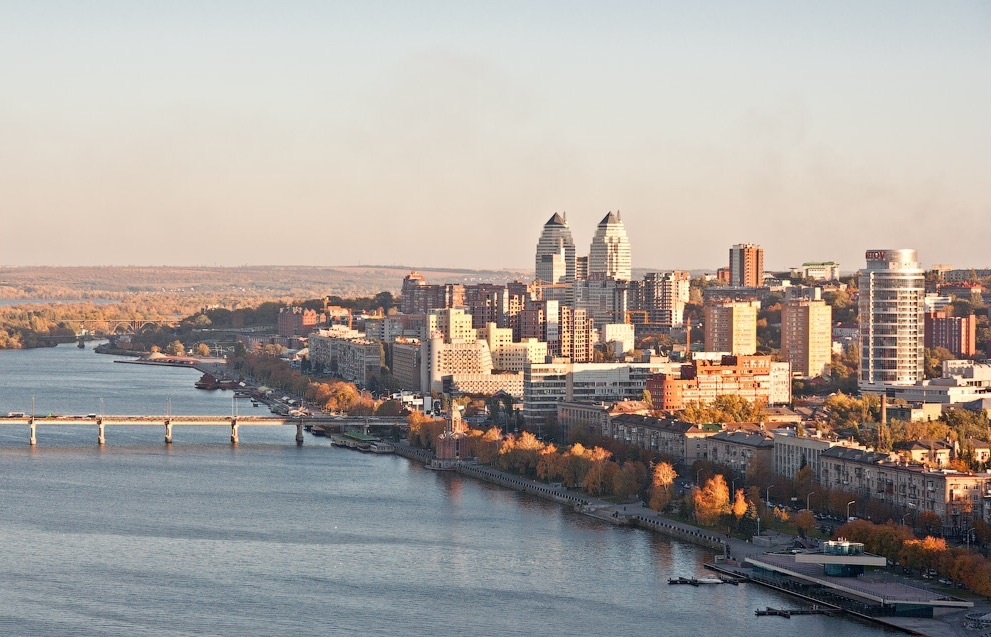
An aerial view of Dnipro. The Dnieper River, city's left and right banks, and a number of bridges can be seen.

The city is built mainly upon both banks of the Dnieper, at its confluence with the Samara River. In the loop of a major meander, the Dnieper changes its course from the north west to continue southerly and later south-westerly through Ukraine, ultimately passing Kherson, where it finally flows into the Black Sea.[citation needed]

Nowadays both the north and south banks play home to a range of industrial enterprises and manufacturing plants. The airport is located about 15 km (9.3 mi) south-east of the city.

The centre of the city is constructed on the right bank which is part of the Dnieper Upland, while the left bank is part of the Dnieper Lowland. The old town is situated atop a hill that is formed as a result of the river's change of course to the south. The change of river's direction is caused by its proximity to the Azov Upland located southeast of the city.[citation needed]

One of the city's streets, Akademik Yavornitskyi Prospekt, links the two major architectural ensembles of the city and constitutes an important thoroughfare through the centre, which along with various suburban radial road systems, provides some of the area's most vital transport links for both suburban and inter-urban travel.

Climate

[edit]

Under the Köppen–Geiger climate classification system, Dnipro has a humid continental climate (Dfa).[205] Snowfall is more common in the hills than at the city's lower elevations. The city has four distinct seasons: a cold, snowy winter; a hot summer; and two relatively wet transition periods. However, according to other schemes (such as the Salvador Rivas-Martínez bioclimatic one), Dnipro has a Supratemperate bioclimate, and belongs to the Temperate xeric steppic thermoclimatic belt, due to high evapotranspiration.[206]

During the summer, Dnipro is very warm (average day temperature in July is 24 to 28 °C (75 to 82 °F), even hot sometimes 32 to 36 °C (90 to 97 °F)). Temperatures as high as 36 °C (97 °F) have been recorded in May. Winter is not so cold (average day temperature in January is −4 to 0 °C (25 to 32 °F), but when there is no snow and the wind blows hard, it feels extremely cold. A mix of snow and rain happens usually in December.

The best time for visiting the city is in late spring (late April and May), and early in autumn: September, October, when the city's trees turn yellow. Other times are mainly dry with a few showers.[207]

"However, the city is characterized with significant pollution of air with industrial emissions."[208] The "severely polluted air and water" and allegedly "vast areas of decimated landscape" of Dnipro and Donetsk are considered by some to be an environmental crisis.[209] Though exactly where in Dnipropetrovsk these areas might be found is not stated.[209]

Climate data for Dnipro (1991–2020, extremes 1948–present)
Month Jan Feb Mar Apr May Jun Jul Aug Sep Oct Nov Dec Year
Record high °C (°F) 12.3
(54.1)
17.5
(63.5)
24.1
(75.4)
31.8
(89.2)
36.1
(97.0)
37.8
(100.0)
39.8
(103.6)
40.9
(105.6)
36.5
(97.7)
32.6
(90.7)
20.6
(69.1)
13.7
(56.7)
40.9
(105.6)
Mean daily maximum °C (°F) −0.9
(30.4)
0.6
(33.1)
7.1
(44.8)
16.0
(60.8)
22.7
(72.9)
26.6
(79.9)
29.1
(84.4)
28.7
(83.7)
22.4
(72.3)
14.4
(57.9)
5.8
(42.4)
0.6
(33.1)
14.4
(57.9)
Daily mean °C (°F) −3.6
(25.5)
−2.8
(27.0)
2.5
(36.5)
10.3
(50.5)
16.5
(61.7)
20.5
(68.9)
22.7
(72.9)
22.1
(71.8)
16.2
(61.2)
9.2
(48.6)
2.6
(36.7)
−1.9
(28.6)
9.5
(49.1)
Mean daily minimum °C (°F) −6.1
(21.0)
−5.8
(21.6)
−1.2
(29.8)
5.1
(41.2)
10.9
(51.6)
15.1
(59.2)
17.1
(62.8)
16.3
(61.3)
11.0
(51.8)
5.2
(41.4)
−0.1
(31.8)
−4.2
(24.4)
5.3
(41.5)
Record low °C (°F) −30.0
(−22.0)
−27.8
(−18.0)
−19.2
(−2.6)
−8.2
(17.2)
−2.4
(27.7)
3.9
(39.0)
5.9
(42.6)
3.9
(39.0)
−3.0
(26.6)
−8.0
(17.6)
−17.9
(−0.2)
−27.8
(−18.0)
−30.0
(−22.0)
Average precipitation mm (inches) 50
(2.0)
43
(1.7)
51
(2.0)
39
(1.5)
51
(2.0)
64
(2.5)
55
(2.2)
45
(1.8)
42
(1.7)
39
(1.5)
44
(1.7)
46
(1.8)
569
(22.4)
Average extreme snow depth cm (inches) 7
(2.8)
10
(3.9)
5
(2.0)
0
(0)
0
(0)
0
(0)
0
(0)
0
(0)
0
(0)
0
(0)
1
(0.4)
4
(1.6)
10
(3.9)
Average rainy days 9 8 11 13 13 13 12 9 10 11 12 11 132
Average snowy days 16 15 9 1 0 0 0 0 0 1 7 15 64
Average relative humidity (%) 88.5 84.7 77.2 64.6 63.2 64.8 63.6 60.5 67.3 77.1 85.5 88.8 73.8
Mean monthly sunshine hours 50 74 132 196 266 281 310 285 211 142 62 37 2,046
Source 1: Pogoda.ru.net[210]
Source 2: NOAA (humidity and sun 1991–2020)[211]

Cityscape

[edit]
Stalinist architecture on the Dmytro Yavornytsky Avenue [uk; ru; de]

Dnipro is a primarily industrial city of around one million people. It has developed into a large urban centre over the past few centuries to become, today, Ukraine's fourth-largest city after Kyiv, Kharkiv and Odesa. Stalinist architecture (monumental soviet classicism) dominates in the city centre.[212]

Immediately after its foundation Yekaterinoslav, began to develop exclusively on the right bank of the Dnieper River. At first the city developed radially from the central point provided by the Transfiguration Cathedral, completed in 1835.[15] Neoclassical structures of brick and stone construction were preferred and the city began to take on the appearance of a typical European city of the era. Many of these buildings have been retained in the city's older Sobornyi District.[213] Among the most important buildings of this era are the Transfiguration Cathedral, and a number of buildings in the area surrounding Akademik Yavornitskyi Prospekt, including the Khrennikov House.

Over the next few decades, until the final end of the Russian Empire with the October Revolution in 1917, the city did not change much in appearance. The predominant architectural style remained neo-classicism. Notable buildings built in the era before 1917 include the main building of the Dnipro Polytechnic, which was built in 1899–1901,[214] the art-nouveau inspired building of the city's former Duma (parliament),[215] the Dnipropetrovsk National Historical Museum, and the Mechnikov Regional Hospital. Other buildings of the era that did not fit the typical architectural style of the time in Dnipropetrovsk include,[216] the Ukrainian-influenced Grand Hotel Ukraine, the Russian revivalist style railway station (since reconstructed),[217] and the art-nouveau Astoriya building on Akademik Yavornitskyi Prospekt.

Once Yekaterinoslav became part of the Soviet Union (officially in 1922), and became Dnipropetrovsk in 1926,[23] the city was gradually purged of tsarist-era monuments. Monumental architecture was stripped of Imperial coats of arms and other non-socialist symbolism. Following the 1917 October Revolution, a monument to Catherine the Great that stood in front of the Mining Institute was replaced with one of Russian academic Mikhail Lomonosov.[51]

Later, due to damage from World War II, badly damaged buildings were, more often than not, demolished completely and replaced with new structures.[218] In the early 1950s, during the ongoing industrialisation of the city, much of Dnipropetrovsk's centre was rebuilt in the Stalinist style of Socialist Realism.[219] This is one of the main reasons why much of Dnipro's central avenue, Akademik Yavornitskyi Prospekt (formerly Karl Marx Prospect), is designed in the style of Stalinist Social Realism.[220] A number of large buildings were reconstructed. The main railway station, for example, was stripped of its Russian-revival ornamentation and redesigned in the style of Stalinist social-realism.[221]

Grand Hotel Ukraine in 2013 and in 1913.

The Grand Hotel Ukraine survived the war but was later simplified much in design, with its roof being reconstructed in a typical French mansard style as opposed to the ornamental Ukrainian Baroque of the pre-war era. Many pre-revolution buildings were reconstructed to suit new purposes. For example, the Emperor Nicholas II Commercial Institute in the city was reconstructed to serve as the administrative centre for the Dnipropetrovsk Oblast, a function it fulfils to this day. Other buildings, such as the Potemkin Palace were given over to "the proletariat" (the working man), in this case as the students' union of the Oles Honchar Dnipro National University.

After the death of Joseph Stalin in 1953 and the appointment of Nikita Khrushchev as General Secretary of the Communist Party of the Soviet Union, the industrialisation of Dnipropetrovsk became even more profound, with the Southern (Yuzhne) Missile and Rocket factory being set up in the city. However, this was not the only development and many other factories, especially metallurgical and heavy-manufacturing plants, were set up in the city.[222]

Khrushchyovkas on Science Avenue [uk; ru] (formerly Gagarin Avenue)[223]

As a result of all this industrialisation the city's inner suburbs became increasingly polluted and were gradually given over to large, industrial enterprises. At the same time the extensive development of the city's left bank and western suburbs as new residential areas began.[222] The low-rise tenant houses of the Khrushchev era (Khrushchyovkas) gave way to the construction of high-rise prefabricated apartment blocks (similar to German Plattenbaus). In 1976, in line with the city's 1926 renaming, a large monumental statue of Grigoriy Petrovsky was placed on the square in front of the city's railway station.[224][225]

Since the independence of Ukraine in 1991 and the economic development that followed, a number of large commercial and business centres have been built in the city's outskirts. To this day the city is characterised by its mix of architectural styles, with much of the city's centre consisting of pre-revolutionary buildings in a variety of styles, stalinist buildings and constructivist architecture, while residential districts are, more often than not, made up of aesthetically simple, technically outdated mid-rise and high-rise housing stock from the Soviet era. Despite this, the city has a large number of 'private sectors' where the tradition of building and maintaining individual detached housing has continued to this day.[citation needed]

The local statue of Lenin was toppled by protesters in February 2014 the day after Ukraine's president Viktor Yanukovych fled to Russia following months of protests against him.[226][227] The square were the statue had stood for some 50 years was soon renamed from "Lenin Square" to "Heroes of Maidan Square".[226]

In late November 2015 about 300 streets, 5 of the 8 city districts and one metro station were renamed to comply with decommunization laws.[163]

The 1976 Petrovsky statue was destroyed by an angry mob on 29 January 2016.[224]

As part of the derussification campaign that swept through Ukraine following the February 2022 Russian invasion of Ukraine, 110 toponyms in the city were renamed from February to September 2022.[148] On 3 May 2022 alone more than a dozen memorials erected during Soviet times were dismantled.[152][151] In December 2022 the Dnipro communal services (in accordance a decision of the Dnipro City Council) removed from the city all monuments to figures of Russian culture and history.[153] This meant that monuments to Alexander Pushkin, Alexander Matrosov, Volodia Dubinin, Maxim Gorky, Valery Chkalov, Yefim Pushkin and Mikhail Lomonosov were removed from the public space of the city.[153] On 16 November 2022 Pushkin Avenue in Dnipro had been renamed Lesya Ukrainka Avenue.[150] In January 2023 a T-34 tank on Akademik Yavornitskyi Prospekt that served as a monument to Hero of the Soviet Union Yefim Pushkin was removed after the Dnipro City Council had decided the monument "has no historical or artistic value."[228][229][nb 9] 26 more streets were renamed in Dnipro on 22 February 2023.[154] In December 2023 the renaming of streets continued with on 20 December 2023 again 53 city toponyms their names being changed by the Dnipro City Council.[231] Also on this day the Dnipro City Council renamed a part of Dnipro's central avenue, Akademik Yavornitskyi Prospekt, in honor of commander of the 1st Mechanized Battalion of the Armed Forces of Ukraine and Hero of Ukraine Dmytro Kotsiubailo (who had perished on 7 March 2023 in battle near Bakhmut).[232] On 31 January 2024 92 other toponyms were renamed by the Dnipro City Council, including the avenue named after (Soviet cosmonaut and first human in space) Yuri Gagarin.[223][233]

A panoramic view of the city

Demographics

[edit]
Historical population
YearPop.±%
1782[40] 2,194—    
1800[235] 6,389+191.2%
1811[236] 9,000+40.9%
1825[237] 8,412−6.5%
1857[238] 13,217+57.1%
1862[237] 19,515+47.7%
1866[239] 22,846+17.1%
1885[237][238] 46,876+105.2%
1897[240]112,839+140.7%
1926[240]187,570+66.2%
1939[240]500,636+166.9%
1943[241] 280,000−44.1%
1959[240]661,547+136.3%
1970[240]862,100+30.3%
1979[240]1,066,016+23.7%
1989[240]1,177,897+10.5%
2001[242]1,065,008−9.6%
2011[240]1,004,853−5.6%
2022[240]968,502−3.6%

The population of the city is about 1 million people. In 2011, the average age of the city's resident population was 40 years. The number of males declined slightly more than the number of females. The natural population growth in Dnipro is slightly higher than growth in Ukraine in general.

Between 1923 and 1933 the Ukrainian proportion of the population of the city increased from 16% to 48%. This was part of a national trend.[243]

Year Ethnicity of Citizens Foreign
Citizens
Reference
Russian Ukrainian Jewish Polish German
1887 47,200 17,787 39,979 3,418 1,438 1,075 [238]
1887 42.6% 16.0% 36.1% 3.1% 1.3% 1.0% [238]
1904(?) 52% 40% 4.5% Not Stated Not Stated [244]
Ethnic group 1926[76] 1939[77] 1959[245] 1989[246] 2001[246] 2017[247]
Ukrainians 36.0% 54.6% 61.5% 62.5% 72.6% 82%
Russians 31.6% 23.4% 27.9% 31.0% 23.5% 13%
Jews 26.8% 17.9% 7.6%  3.2% 1.0%
Belarusians 1.9% 1.9% 1.7% 1.0%

In a survey in June–July 2017, 9% of residents said that they spoke Ukrainian at home, 63% spoke Russian, and 25% spoke Ukrainian and Russian equally.[247]

The same survey reported the following results for the religion of adult residents.[247]

According to a survey conducted by the International Republican Institute in April–May 2023, 27% of the city's population spoke Ukrainian at home, and 66% spoke Russian.[248]

Economy

[edit]
The Alexander Southern Russian Ironworks and Rolling Mill of the Bryansk Joint-Stock Company (currently the Dniprovsky Metallurgical Plant) depicted in 1889.

Dnipro is a major industrial centre of Ukraine.[249] It has several facilities devoted to heavy industry that produce a wide range of products, including cast-iron, launch vehicles, rolled metal, pipes, machinery, different mining combines, agricultural equipment, tractors, trolleybuses, refrigerators, different chemicals and many others.[citation needed] The most famous and the oldest (founded in the 19th century) is the Dniprovsky Metallurgical Plant (from 1922 until the time of decommunization in Ukraine, the plant was named after the Soviet Union statesman Grigory Petrovsky[250]). Other notable industrial company of Dnipro is PA Pivdenmash, a heavy machinery and rocket manufacturer.

Metals and metallurgy is the city's core industry in terms of output. Employment in the city is concentrated in large-sized enterprises. Metallurgical enterprises are based in the city and account for over 47% of its industrial output. These enterprises are important contributors to the city's budget and, with 80% of their output being exported, to Ukraine's foreign exchange reserve. Dnipro serves as the main import hub for foreign goods coming into the oblast and, on average, accounted for 58% of the oblast's imports between 2005 and 2011. With economic conditions improving even further in 2010 and 2011, registered unemployment fell to about 4,100 by the end of 2011.

The city of Dnipro's economy is dominated by the wholesale and retail trade sector, which accounted for 53% of the output of non-financial enterprises in 2010.

Main office PrivatBank

Entrepreneur Ihor Kolomoyskyi's Privat Group, a global business group, is based in the city and grouped around the Privatbank. Privat Group controls thousands of companies of virtually every industry in Ukraine, European Union, Georgia, Ghana, Russia, Romania, United States and other countries. Steel, oil & gas, chemical and energy are sectors of the group's prime influence and expertise. Privat Group is in business conflict with the Interpipe, also based in Dnipro area. The influential metallurgical mill company founded and mostly owned by the local business oligarch Viktor Pinchuk.

Another company headquartered in Dnipro is ATB-Market. This company owns the largest national network of retail shops.

None of the group's capital is publicly traded on the stock exchange. Group's founding owners are natives of Dnipro and made their entire career here. Privatbank, the core of the group, is the largest commercial bank in Ukraine. In March 2014 was named by the American review magazine Global Finance as "the Best Bank in Ukraine for 2014" while British magazine The Banker in November 2013 named again the same bank as "the Bank of the year 2013 in Ukraine".

In 2018 a private Texas-based aerospace firm Firefly Aerospace opened a Research and Development (R&D) centre in Dnipro to develop small and medium-sized launch vehicles for commercial launches to orbit.[251]

Year Factories
& Plants
Employees Production Volume[252] Reference
roubles 2007 £stg
million
2007 US$
million
1880 49 572 1,500,000 £10.5 m $21 m [238]
1903 194 10,649 21,500,000 £177.5 m $355 m [238]
Year Enterprises Earnings[252][253] Reference
roubles £2007 stg
million
2007 US$
million
1900 1,800 40,000,000 £328.7 m $658 m [244]
1940 622 1,096,929,000 £2,120.3 m $4,242 m [238]

Transport

[edit]

Local transportation

[edit]
Akademik Yavornitskyi Prospekt, Dnipro's central avenue, features a green pedestrian boulevard and a tram line

The main forms of public transport used in Dnipro are trams, buses and electric trolley buses. In addition to this there are a large number of taxi firms operating in the city, and many residents have private cars.

The city's municipal roads also suffer from the same funding problems as the trams, with many of them in a very poor technical state.[citation needed] It is not uncommon to find very large potholes and crumbling surfaces on many of Dnipro's smaller roads. Major roads and highways are of better quality. In the early 2010s the situation was improving, with a number of new used trams bought from the German cities of Dresden and Magdeburg,[254] and a number of roads, including Schmidt Street (now Stepan Bandera Street[148]) and Moskovsky Street (now Volodymyr Monomakh Street[255]) were being reconstructed with modern road-building techniques.[256]

A scheme of the Dnipro Metro system in the city

Dnipro also has a metro system, opened in 1995, which consists of one line and 6 stations.[257] The 1980 official plans for four different lines were never made reality.[258] In 2011 the metro was transferred to municipal ownership in the hope that this will help it secure a loan from the European Bank for Reconstruction and Development.[259] In 2011, plans envisioned an expansion of three station, Teatralna, Tsentralna and Muzeina, to be completed by 2015.[260] The opening of these three stations have been repeatedly delayed,[261] and after the February 2022 full-scale Russian invasion of Ukraine all work on the expansion stopped.[262][263] The extension will increase the number of stations to nine, which would extend the line 4 km to a total of 11.8 km (7.3-mile).[261]

Suburban transportation

[edit]
Bridges linking the city's right and left banks are heavily used

Dnipro has some highways crossing through the city. The most popular routes are from Kyiv, Donetsk, Kharkiv and Zaporizhzhia. Transit through the city is also available. As of 2011 the city is also seeing construction of a southern urban bypass, which will allow automobile traffic to proceed around the city centre. This is expected to both improve air quality and reduce transport issues from heavy freight lorries that pass through the city centre.[citation needed]

The largest bus station in eastern Ukraine is located in Dnipro, from where bus routes are available to all over the country, including some international routes to Poland, Germany, Moldova and Turkey. It is located near the city's central railway station. Since the start of the 2022 Russian invasion of Ukraine Ukraine's border crossings with Russia and Belarus are closed to regular traffic.[264]

In the summertime, there are some routes available by hydrofoils on the Dnieper River, while various tourist ships on their way down the river, (Kyiv–KhersonOdesa) tend to make a stop in the city. Dnipro's river port is located close to the area surrounding the central railway station, on the banks of the river.

Rail

[edit]
Dnipro's main station is one of eastern Ukraine's largest

The city is a large railway junction, with many daily trains running to and from Eastern Europe and on domestic routes within Ukraine.

There are two railway terminals, Dnipro Holovnyi (main station) and Dnipro Lotsmanska (south station).

Two express passenger services run each day between Kyiv and Dnipro under the name 'Capital Express'. Other daytime services include suburban trains to towns and villages in the surrounding Dnipropetrovsk Oblast. Most long-distance trains tend to run at night to reduce the amount of daytime hours spent travelling by each passenger.

Domestic connections exist between Dnipro and Kyiv, Lviv, Odesa, Ivano-Frankivsk, Truskavets, Kharkiv and many other smaller Ukrainian cities, while international destinations include, among others the Bulgarian seaside resort of Varna. Following the 2022 Russian invasion of Ukraine all railway connection between Ukraine and Belarus were axed.[265] Meaning that the pre-war international destinations to Minsk in Belarus, Moscow's Kursky Station and Saint Petersburg's Vitebsky Station in Russia and Baku—the capital of Azerbaijan—are no longer in service.[265]

Aviation

[edit]

The city is served by Dnipro International Airport (IATA: DNK) and is connected to European and Middle Eastern cities with daily flights. It is located 15 km (9.3 mi) southeast from the city centre. A Russian attack on 10 April 2022 completely destroyed the airport and the infrastructure nearby.[266]

Water transportation

[edit]

The city has a river port located on the left bank of the Dnieper. There is also a railway freight station.

Education

[edit]
Oles Honchar National University is one of the leading establishments of higher education in Ukraine. It was founded in 1918.

There are 163 educational institutions among them schools, gymnasiums and boarding schools. For children of pre-school age there are 174 institutions, also a lot of out-of -school institutions such as centre of out-of-school work. Eighty-seven institutions that are recognized on all Ukrainian and regional levels.

In a survey in June–July 2017, adult respondents reported the following educational levels:[247]

  • 1% primary or incomplete secondary education
  • 13% general secondary education
  • 46% vocational secondary education
  • 39% university education (including incomplete university education)

In 2006 Dnipropetrovsk hosted the All-Ukrainian Olympiad in Information Technology; in 2008, that for Mathematics, and in 2009 the semi-final of the All-Ukrainian Olympiad in Programming for the Eastern Region. In the same year as the latter took place, the youth group 'Eksperiment', an organisation promoting increased cultural awareness amongst Ukrainians, was founded in the city.

Higher education

[edit]

Dnipro is a major educational centre in Ukraine and is home to two of Ukraine's top-ten universities; the Oles Honchar Dnipro National University and Dnipro Polytechnic National Technical University. The system of high education institutions connects 38 institutions in Dnipro, among them 14 of IV and ІІІ levels of accreditation, and 22 of І and ІІ levels of accreditation. In year 2012 National Mining Institute was on the 7th and National University named after O. Honchar was on the 9th place among the best high education institutions in "TOP-200 Ukraine" list.

The main building of the Dnipro Polytechnic

The list below is a list of all current state-organised higher educational institutions (not included are non-independent subdivisions of other universities not based in Dnipro).

In the 21st century annually around 55,000[citation needed] students studied in Dnipro, a significant number of whom students from abroad.[267]

Culture

[edit]
Dnipropetrovsk House Of Organ And Chamber Music

Attractions

[edit]
Synagogue and Menorah Center
Entrance to the Taras Shevchenko Park

Dnipro has a variety of theatres (Dnipro Academic Drama and Comedy Theatre, Taras Shevchenko Dnipro Academic Ukrainian Music and Drama Theatre and Dnipro Opera and Ballet Theatre), a circus (Dnipro State Circus) and several museums (Dmytro Yavornytsky National Historical Museum, Diorama "Battle of the Dnieper" and Dnipro Art Museum). There are also several restaurants, beaches and parks (Taras Shevchenko Park and Sevastopol Park).

The major streets of the city were renamed in honour of Marxist heroes during the Soviet era.[70] Following the 2015 law on decommunization these have been renamed.[22][163]

The central thoroughfare is known as Akademik Yavornytskyi Prospekt, a wide and long boulevard that stretches east to west through the centre of the city. It was founded in the 18th century and parts of its buildings are the actual decoration of the city. In the heart of the city is Soborna Square, which includes the Transfiguration Cathedral founded by order of Catherine the Great in 1787.[44] On the square, there are some remarkable buildings: the Museum of History, Diorama "Battle of the Dnieper" (World War II).

The Ukrposhta for the city was once housed at the Central Post Office, a 20th-century building. Rising magnificently above the Dnieper, the building's tower has become one of the most identifiable features in the city.[268][269]

Further from the city centre and next to the Dnieper River (spelled "Dnipro" in Ukrainian) is the large Taras Shevchenko Park (which is on the right bank of the river) and Monastyrskyi Island. In the 9th century, Byzantine monks based a monastery here.[270]

The Governor's House is a 19th-century building which formerly housed the Governor of Yekaterinoslav.[271][272] Since 2020, it became the home of the Museum of Dnipro City History.[273][274]

A few areas retain their historical character: all of Central Avenue, some street-blocks on the main hill (the Nagorna part) between Lesya Ukrainka Avenue and Embankment, and sections near Globa (formerly known as Chkalov park until it was renamed) and Shevchenko parks have been untouched for 150 years.[citation needed]

The river keeps the climate mild.[citation needed] It is visible from many points in Dnipro. From any of the three hills in the city, one can see a view of the river, islands, parks, outskirts, river banks and other hills.

There was no need to build skyscrapers in the city in Soviet times. The major industries preferred to locate their offices close to their factories and away from the centre of town. Most new office buildings are built in the same architectural style as the old buildings. A number, however, display more modern aesthetics, and some blend the two styles.

Religion

[edit]

Ludwig Charlemagne-Bode and Pietro Visconti designed and erected the 19th century Holy Trinity Cathedral in Dnipro, which is an Eastern Orthodox cathedral of the UOC of the Moscow Patriarchate.[275] It was known as the Trinity Church for most of the 1800s until changing to the Church of the Descent of the Holy Spirit.[276] It is now a historical landmark within the city.[277]

The UOC's Dnipropetrovsk House Of Organ And Chamber Music is a performance hall and an Eastern Orthodox cathedral from the 20th century. In addition, the structure is a national architectural and historical landmark.[278]

The Saint Nicholas Church in Dnipro is a national monument and the Eastern Orthodox cathedral of the UOC from the 19th century. It is located on what was formerly Novi Kodaky property and is the oldest church in Dnipro.[279][280]

The German Evangelical-Lutheran Church in Ukraine (GELCU) owns the 19th-century Evangelical Lutheran Church of St. Catherine. It is also known as the St. Catherine Evangelical Lutheran Church. It is the first church in Ukraine to open after independence.[281]

Sports

[edit]
Dnipro-Arena

FC Dnipro is the most successful football club of the city.[282][283][284] It is a former second runner-up in the Ukrainian Premier League and in the UEFA Cup it reached and lost the 2015 UEFA Europa League Final.[283][282] It also was the only Soviet team to win the USSR Federation Cup twice. The club was owned by the Privat Group.[284] The club has been inactive since 2019.[282][285] Note: A bandy team, a basketball team and others use the same name.

Other local football clubs include: FC Lokomotyv Dnipropetrovsk and FC Spartak Dnipropetrovsk, both of which have large fan bases. SC Dnipro-1 is another team emerged in 2017.[286] SC Dnipro-1 established itself as the most successful club in town; playing in the Ukrainian Premier League, the UEFA Europa League and the UEFA Europa Conference League.[286]

In 2008 the city built a new soccer stadium; the Dnipro-Arena has a capacity of 31,003 people and was built as a replacement for Dnipro's old stadium, Stadium Meteor.[284] The Dnipro-Arena hosted the 2010 FIFA World Cup qualification game between Ukraine and England on 10 October 2009. The Dnipro Arena was initially chosen as one of the Ukrainian venues for their joint Euro 2012 bid with Poland. However, it was dropped from the list in May 2009 as the capacity fell short of the minimum 33,000 seats required by UEFA.[287] The city is home to BC Dnipro, champion of the 2019–20 Ukrainian Basketball SuperLeague. The team plays its home games at the Palace of Sports Shynnik.

The city is the centre of Ukrainian bandy. The Ukrainian Federation of Bandy and Rink-Bandy has its office in the city.[288] The foremost local bandy club is Dnipro, which won the Ukrainian championship in 2014.

Notable people

[edit]
Helena Blavatsky, 1877
USSR stamp, centenary of Sergei Prokofiev, 1991
Yulia Tymoshenko, 2011
Igor Olshansky, 2011
Olesya Povh, 2011

Sport

[edit]

Twin towns – sister cities

[edit]

Dnipro is twinned with:[292][111]

Friendship cooperation cities

[edit]

Dnipro also cooperates with:[293]

See also

[edit]

Notes

[edit]

References

[edit]

Sources

[edit]
  • Avrich, Paul (1971) [1967]. The Russian Anarchists. Princeton: Princeton University Press. ISBN 0691007667. OCLC 1154930946.
  • Михаил Александрович Шатров (Штейн). Город на трёх холмах. – Днепропетровск: Промiнь, 1969. (in Russian)
  • Алексей Николаевич Толстой. Хождение по мукам. – М.: Художественная литература, 1976. (in Russian)
  • Дмитрий Яворницкий. История города Екатеринослава. – Днепропетровск: Сiч, 1996. (in Russian)
  • Справочник "Освобождение городов: Справочник по освобождению городов в период Великой Отечественной войны 1941—1945" / М. Л. Дударенко, Ю. Г. Перечнев, В. Т. Елисеев и др. М.: Воениздат, 1985. 598 с. (in Russian)
  • Описание населенных мест Екатеринославской губернии на 1-е января 1925 г. – Екатеринослав: Типо-Литография Екатерининской ж.д., 1925. – 635 с. (in Russian)
  • Zhuk, Sergei I. (2010). Rock and Roll in the Rocket City: The West, Identity, and Ideology in Soviet Dniepropetrovsk, 1960–1985 '. Baltimore: Johns Hopkins University Press & Washington, D.C.: Woodrow Wilson Center Press. pp. 18–28.
  • Hilberg, Raul (1985). The Destruction of the European Jews. New York: Holmes & Meier. ISBN 978-0-8419-0832-1.
[edit]
Revisions and contributorsEdit on WikipediaRead on Wikipedia
from Grokipedia
Dnipro is a city in south-central Ukraine situated along the banks of the Dnipro River, serving as the administrative center of Dnipropetrovsk Oblast and ranking as the country's fourth-largest urban area with an estimated population of 931,255 in 2025. Originally founded in 1776 by Prince Grigori Potemkin as Yekaterinoslav at the site of a Cossack settlement, the city experienced multiple renamings—including to Dnipropetrovsk in 1926 to honor Soviet official Grigory Petrovsky—before reverting to Dnipro in 2016 amid Ukraine's decommunization process to excise Soviet-era nomenclature. Historically developed as a fortress and later an industrial powerhouse under imperial Russian and Soviet rule, Dnipro remains a cornerstone of Ukraine's heavy industry, excelling in metallurgy, steel production, and aerospace engineering through facilities like the Yuzhmash rocket plant, which contributed significantly to Soviet intercontinental ballistic missile and space launch vehicle programs. Since Russia's full-scale invasion in February 2022, the city has functioned as a vital rearward logistical node for military supplies, humanitarian aid distribution, and refugee reception, while its industrial base supports wartime production amid ongoing Russian strikes on regional infrastructure.

Name

Etymology and Designations

The name Dnipro derives from the Ukrainian term for the River (Дніпро), on whose banks the city is located, with the river's etymology tracing to Proto-Slavic *Dъněprъ, interpreted as denoting a "deep-flowing" from elements meaning "deep" (dьn-) and "flow" or "current" (prъ- or related roots), possibly with earlier Indo-European or Thracian influences like duno- for river. The city's official designation as Dnipro was adopted on May 19, 2016, by Ukraine's through legislation aimed at removing Soviet-era commemorative names, shortening the prior title Dnipropetrovsk (which combined the river name with reference to Bolshevik leader Hryhoriy Petrovsky). Prior to 1926, it was designated Yekaterinoslav (Ukrainian: Katerynoslav), established in 1787 to honor Russian Empress Catherine II during the city's founding under Potemkin's southern Ukrainian colonization efforts. Earlier pre-urban settlements in the area bore designations like the Cossack sloboda of Polovytsia or the fortress Novyi Kodak, reflecting influences before imperial Russian control. In Russian, the current city name is rendered as Dnepr (Днепр), aligning with the river's Russified form, though Ukrainian official usage prevails post-independence.

Historical Name Changes

The city was established as Katerynoslav (Ukrainian: Катеринослав) in 1787, named in honor of Empress Catherine II of Russia following the construction of the Katerynoslav Fortress in 1783. This name reflected imperial Russian nomenclature, with the city serving as the administrative center of the Katerynoslav Viceroyalty. In 1797, it was briefly renamed (Новороссійск) during a reorganization under Emperor Paul I, but reverted to Katerynoslav in 1802 after Alexander I's ascension. In 1926, Soviet authorities renamed Katerynoslav to Dnipropetrovsk (Russian: Днепропетровск), combining "Dnipro" (from the River, Дніпро in Ukrainian) with the surname of , a Bolshevik leader and head of the Ukrainian Soviet government who supported policies including collectivization linked to the famine. The change aligned with broader Soviet efforts to erase tsarist-era names and honor revolutionary figures, designating the city as a key industrial hub. On May 19, 2016, Ukraine's voted to rename Dnipropetrovsk as Dnipro (Дніпро), shortening it to reference the river without Petrovsky's association, as part of laws enacted in 2015 to eliminate Soviet and communist symbols following the Revolution. The decree was signed on June 1, 2016, making Dnipro the official name effective immediately, though transitional use of the old name persisted briefly in some contexts. This reform targeted over 900 locations, prioritizing removal of names tied to figures like Petrovsky, whom Ukrainian legislation deemed responsible for repressions.

History

Pre-Modern Foundations

The territory of modern Dnipro, situated in the Pontic-Caspian along the Dnipro River, preserves archaeological traces of prehistoric and ancient habitation, with kurgans—tumuli mounds—abundant in the surrounding Dnipropetrovsk region, dating primarily to the 5th–3rd centuries BCE and reflecting the nomadic pastoralist society of Indo-Iranian warriors who dominated the area through -based mobility and . These sites, investigated via geophysical surveys and excavations, reveal including weapons, horse harnesses, and ceramics, indicating a culture reliant on raiding and trade along riverine routes. Post-Scythian periods saw continued nomadic occupation by and later groups, with the Dnipro's lower reaches hosting transient settlements and fortifications, such as Late Scythian hillforts like Konsulivske, though the precise urban site remained steppe wilderness characterized by low due to seasonal migrations and conflicts. The medieval era integrated the region into Kievan Rus' trade networks by the 9th–10th centuries CE, followed by Mongol incursions in the 13th century that depopulated settled areas, leaving the locale under transient control of successors and nomads until the 17th century. By the early 18th century, Russian imperial advances displaced Ottoman and Tatar influences, enabling Zaporozhian Cossacks to found semi-autonomous slobody—free settlements—along the Dnipro's southern bank; the Polovytsia sloboda, established amid these frontiers post-1730s, occupied the elevated terrain of the future city center and grew to over 100 households by the 1770s, serving as a fortified outpost for river crossings and agriculture before its incorporation into Potemkin's planned viceregal hub. This Cossack nucleus provided the immediate demographic and infrastructural base for urban development, bridging nomadic steppe legacies with emerging sedentary patterns.

Imperial Development (1787–1917)

Founding as Katerynoslav

Yekaterinoslav was officially founded on May 9, 1787 (Old Style), when Catherine II laid the cornerstone of the Transfiguration Cathedral on the right bank of the Dnieper River near Koidak Hill, during her imperial tour of southern Russia. This act followed a decree issued on January 22, 1784, directing the establishment of a fortress and settlement to secure and develop the Novorossiya region, with an initial site at the confluence of the Kilchen and Samara rivers later abandoned due to flooding risks. Prince Grigory Potemkin, Catherine's favorite and governor-general of the area, orchestrated the project, envisioning Yekaterinoslav as a third imperial capital rivaling European cities, complete with wide boulevards and monumental architecture to attract settlers and consolidate Russian control over recently acquired territories from the Ottoman Empire and Crimean Khanate. In 1789, the city became the administrative center of the Yekaterinoslav Viceroyalty, merging the Azov and Novorossiysk provinces and facilitating settlement by diverse groups including Germans, Serbs, Bulgarians, and Jews. Early development proceeded slowly amid logistical challenges and Potemkin's death in 1791, with the grand plans partially unrealized; the cathedral, intended as the empire's largest, remained unfinished for decades. By the early 19th century, Yekaterinoslav served primarily as a regional hub for agriculture and trade, though its population remained modest at around 6,000 in 1800.

Expansion and the 1905 Pogrom

The city's growth accelerated in the late 19th century with infrastructure projects, including the construction of a cargo-passenger port in 1875 and the start of railroad lines and a Dnieper bridge in 1881, completed in 1884, linking Yekaterinoslav to broader imperial networks and spurring commerce in grain, iron, and coal from the Donbas. Population expanded rapidly: from 13,217 in 1857 to 22,846 in 1865, 46,876 in 1885, and 104,822 by 1887, comprising roughly 45% Russians, 38% Jews, and 17% Ukrainians, reflecting multiethnic imperial settlement policies. Industrialization intensified, with factories increasing from 49 in 1880 (producing 1.5 million rubles annually and employing 572 workers) to 194 by 1903 (21.5 million rubles and 10,649 workers), as the surrounding governorate led the empire in mineral output by 1897; educational institutions like the Higher Mining School, opened in 1899, supported this metallurgical focus. Tensions from rapid urbanization and ethnic diversity erupted during the 1905 Revolution. An anti-Jewish occurred October 21–23, 1905, amid strikes and unrest following the , with mobs targeting Jewish businesses and residents, reportedly under the auspices of army units and loyal to the tsarist regime. The violence reflected broader patterns of monarchist backlash against revolutionary agitation, concentrated in the Jewish quarter and lasting several days before suppression. By 1917, Yekaterinoslav's population neared 240,000, underscoring its transformation into a key industrial node of the .

Founding as Katerynoslav

Yekaterinoslav was established in 1787 by decree of Empress Catherine II as the administrative center of Novorossiya, the Russian Empire's newly incorporated southern territories following victories over the Ottoman Empire and Crimean Khanate. The city's founding aligned with broader imperial efforts to populate and secure the Black Sea steppe, encouraging settlement by state peasants, foreign colonists, and Cossacks to develop agriculture, trade, and military defenses against potential Ottoman resurgence. Prince Grigory Potemkin, Catherine's advisor and de facto governor of the region, directed the planning, selecting a site on the right bank of the Dnieper River near the mouth of the Kilchen River for its strategic position facilitating control over riverine commerce and fortifications. The ceremonial founding occurred on May 20, 1787, during Catherine's tour of her southern conquests, when she personally laid the foundation stone of the Transfiguration Cathedral, intended as the city's symbolic and architectural centerpiece. Initial construction focused on essential infrastructure, including administrative buildings, barracks, and a grid layout to accommodate rapid population influx, though early development was hampered by harsh conditions, , and logistical challenges inherent to .) By 1789, the provincial chancellery had relocated from Kremenchug, solidifying Yekaterinoslav's role as capital of the Ekaterinoslav , which encompassed vast lands east of the . This establishment reflected causal imperatives of imperial expansion: securing buffer zones post-1774 Treaty of Küçük Kaynarca by transforming nomadic steppes into productive settled territories, thereby enhancing Russia's economic base and geopolitical leverage in the Black Sea basin. Historical records indicate Potemkin's ambitious vision included importing architects and engineers from Europe, though realization lagged due to the Russo-Turkish War (1787–1792), which diverted resources but ultimately expanded the empire's holdings, underscoring the founding's ties to military conquest.)

Expansion and the 1905 Pogrom

Following its establishment as the administrative center of , the city underwent gradual expansion in the early , with reaching 18,881 by 1861.) This growth accelerated after connection to the state railroad network in the early , which boosted in grain exports via links to and enhanced access to regional resources. By the , further rail development, including a line in 1884 transporting iron ore from Krivoy Rog to coal fields across the , transformed Yekaterinoslav into a hub for , particularly and , drawing migrant laborers from rural areas. The surged to 135,552 by 1900, reflecting this industrial boom amid the Russian Empire's broader economic modernization.) In October 1905, during the unrest of the , Yekaterinoslav experienced a violent targeting its community, which comprised about 37% of the population. The riots, fueled by ethnic tensions, economic grievances among workers, and perceptions of Jewish involvement in revolutionary activities, involved mobs looting and attacking Jewish properties and individuals over several days. Official records report 126 Jews killed by rioters and soldiers' gunfire, alongside 47 deaths among the rioters themselves. These figures, drawn from contemporary investigations, likely understate total injuries and , as in industrial cities like Yekaterinoslav often escalated amid labor strikes and breakdowns in imperial authority. The event exemplified the wave of anti-Jewish violence across the empire following Tsar Nicholas II's , with local authorities' responses criticized for complicity or ineffectiveness.

Soviet Era (1917–1991)

Revolution, Civil War, and Early Bolshevization

During the Russian Civil War from 1917 to 1920, Dnipropetrovsk (then still Yekaterinoslav) repeatedly changed hands among Bolshevik, White, and Ukrainian nationalist forces, resulting in widespread looting, rape, and murder. In June 1919, Denikin's White Army committed mass rapes in the city during its occupation. Thousands of Jews sought refuge there amid World War I and the civil war, with the Jewish population reaching 72,928 by 1920. Bolshevik consolidation followed, with the city renamed Dnipropetrovsk in 1926 to honor Grigory Petrovsky, a Ukrainian Bolshevik leader, reflecting early Soviet efforts to integrate Ukrainian territories into the USSR.

Forced Industrialization and Human Costs

Under Stalin's First Five-Year Plan starting in 1928, Dnipropetrovsk emerged as a hub for , particularly and machine-building, with regional plants producing one-fifth of the USSR's by 1932. This rapid development relied on forced labor mobilization and collectivization, contributing to the famine of 1932–1933, which devastated Ukraine's agricultural regions surrounding the city, though urban industrial centers like Dnipropetrovsk experienced somewhat buffered impacts compared to rural areas. A secondary famine in 1946–1947 further strained the population, exacerbated by post-war reconstruction demands and drought. Industrial output prioritized state quotas over worker welfare, leading to documented human costs including and repression of labor unrest.

Nazi Occupation and Liberation (1941–1944)

German forces captured Dnipropetrovsk on August 25, 1941, during , initiating a brutal occupation marked by the systematic extermination of the Jewish population. On October 13–14, 1941, Nazi units and collaborators executed thousands of Jews in mass shootings, part of the Holocaust's early phases in ; Police Battalion 314 participated in these annihilations. The city served as a rear base for German Army Group South, with infrastructure heavily exploited for the war effort. Soviet forces liberated Dnipropetrovsk on October 25, 1943, during the , after intense fighting that left much of the urban area in ruins.

Post-War Militarization and Closed City (1945–1991)

Post-liberation reconstruction emphasized military-industrial priorities, with the Yuzhmash factory—initially established in 1944 for vehicle production—converted in 1951 into the USSR's primary site for manufacturing, including intercontinental models. By , Dnipropetrovsk's strategic role led to its designation as a semi-, restricting foreign access and to safeguard production secrets; full closure persisted until the late 1980s. The facility produced key assets like the SS-18 "Satan" ICBM, bolstering Soviet nuclear capabilities but entrenching economic dependence on defense sectors. , a native of the region, elevated local cadres to national power, fostering a patronage network that prioritized industrial and military growth over diversification.

Late Soviet Dissent and Regional Power Structures

In the Brezhnev era, Dnipropetrovsk's "clan" under leaders like Volodymyr Shcherbytsky wielded influence through party loyalty and industrial output, suppressing overt dissent while maintaining surface stability. Underground democratic movements emerged in the 1960s–1970s, focusing on human rights and cultural autonomy rather than nationalism, though activities were minimal compared to Kyiv or Lviv due to the city's closed status and security apparatus. Repressions in the 1972–1973 Ukrainian purge targeted perceived nationalist elements, reinforcing control by Brezhnev-aligned figures. Limited samizdat and intellectual circles persisted, reflecting broader Soviet Ukrainian dissent against Russification and ideological conformity.

Revolution, Civil War, and Early Bolshevization

In the wake of the 1917 revolutions, Yekaterinoslav became a focal point of competing revolutionary forces, including , Ukrainian nationalists, and other socialists, amid the breakdown of imperial authority. The city's industrial workforce provided a base for radical agitation, but effective Bolshevik control proved ephemeral amid escalating conflict. The ensuing saw Yekaterinoslav change hands repeatedly, exacerbating famine, disease, and violence. German forces occupied the city on April 5, 1918, as part of their intervention following the , enforcing Pavlo Skoropadsky's puppet regime until the armistice in November. Ukrainian Directory forces briefly held it in late 1918 before White advances. In early 1919, Soviet armies entered, initiating a short-lived administration. However, General Anton Denikin's overran the city in spring 1919 during their southern offensive, holding it through summer amid widespread pogroms targeting the Jewish population, prompting mass flight. Bolshevik forces recaptured Yekaterinoslav by late November 1919, coinciding with the collapse of White positions in the region, such as Kharkiv's fall on November 27. Early , post-1919 consolidation, entailed suppressing rival political entities and restructuring society under dominance. All non-Bolshevik parties and organizations ceased operations, with religious sites like synagogues nationalized for secular use. Anarchist and syndicalist elements, initially influential in local unions, were marginalized by 1922 through purges and centralization. This process aligned the city's administration with Moscow's directives, prioritizing proletarian control over industry while quelling dissent via the Cheka's against perceived counter-revolutionaries. Economic requisitions and class-based repression intensified human costs, though the urban proletariat's support facilitated initial stabilization.

Forced Industrialization and Human Costs

The Soviet Union's first Five-Year Plan (1928–1932) prioritized development, with Dnipropetrovsk emerging as a key hub due to its strategic location along the River and proximity to mineral resources like and in the surrounding . The (DneproGES), constructed from 1927 to 1932 under the plan's auspices with involvement from American engineer Hugh Cooper, generated power for regional factories, enabling expansion in metallurgy and machine-building. Factories such as the Petrovsky Machine-Building Plant (later Yuzhmash) shifted from to production, contributing to the oblast's output of 20% of Soviet metallurgical products by 1932. This rapid buildup relied on centralized , high quotas, and labor mobilization, often disregarding local capacities or environmental limits. Industrial growth demanded massive workforce influxes, drawing rural migrants amid agricultural collectivization, but living conditions deteriorated sharply. Workers faced overcrowded barracks, inadequate housing, and , with many resorting to makeshift adaptations like raising on balconies to supplement rations. Labor mobility was curtailed by decrees from October 1930 onward, binding workers to factories and imposing penalties for or turnover to meet production targets. Wages stagnated relative to , exacerbating hardships as grain exports—funded partly by Ukrainian collectivization—prioritized machinery imports over food supplies. The human toll intertwined with broader Stalinist policies, including the 1932–1933 famine () that ravaged , killing an estimated 3–5 million through forced grain requisitions to finance industrialization. , a grain-producing area, suffered acute shortages, with urban workers experiencing ration cuts and swelling from rural refugees fleeing starvation. The (1936–1938) further decimated expertise, targeting engineers and managers accused of sabotage; in Dnipropetrovsk, arrests included hundreds of alleged Trotskyists by 1935, disrupting factory operations and fostering paranoia. These repressions, combined with construction accidents and overwork, underscored the causal link between coerced output and excess mortality, as demographic studies estimate 5–10 million Soviet deaths from forced industrialization's direct and indirect effects between 1929 and 1949.

Nazi Occupation and Liberation (1941–1944)

German forces of captured Dnipropetrovsk on 25 August 1941, after rapid advances through during , following the encirclement of Soviet troops in the Battle of Kiev. The city, a key industrial center, came under initial before integration into broader Nazi occupation structures in the east, with local governance handled by a puppet city administration led by Petro Sokolovskyi, a pre-war Ukrainian born in 1896. Nazi policies emphasized exploitation and extermination, targeting , communists, and perceived partisans. On 12 1941, German representatives decided to annihilate the entire Jewish population, resulting in shootings on 13–14 at sites like the Vovna , where thousands were executed by Einsatzgruppe units and auxiliaries. Overall, 17,000 to 21,000 were killed during the occupation through shootings and conditions. Reprisals extended to Soviet officials and suspected resisters, including the execution of 103 communists and 17 others between January and February 1942. The occupation economy focused on extracting resources for the German war effort, with forced labor mobilized for local factories and infrastructure repair; thousands of civilians, including and remaining , were deported to labor camps under quotas enforced by local police. Soviet partisan detachments in the Dnipropetrovsk region conducted limited against rail lines and garrisons, though operations were constrained by the open terrain and early occupation dynamics compared to later forested strongholds. Soviet forces liberated Dnipropetrovsk in late October 1943 during the Dnieper Offensive, part of the broader (26 August–23 December 1943), which reclaimed through crossings and assaults against fortified German positions. The retreating Germans destroyed much of the city's infrastructure, including bridges and factories, leaving widespread devastation upon Soviet reentry.

Post-War Militarization and Closed City (1945–1991)

Following , Dnipropetrovsk experienced accelerated industrial reconstruction, with Soviet authorities channeling resources into heavy machinery and defense sectors to bolster the USSR's strategic capabilities amid the emerging . The Dnepropetrovsk Machine-Building Plant No. 586, established in 1944 and later renamed Yuzhmash, emerged as a pivotal facility for missile production, manufacturing early ballistic systems including the R-5M—the Soviet Union's first nuclear-armed missile—and subsequent models like the R-12 and R-14 medium-range ballistic missiles. In 1954, the Yuzhnoye Design Bureau was founded under , specializing in (ICBM) development, which further entrenched the city's role in the Soviet nuclear deterrent. The intensification of militarization was amplified by local Communist Party leadership, including , who served as First Secretary of the Dnipropetrovsk regional committee from 1946 to 1950 and prioritized defense industry expansion during his tenure. By the 1960s and 1970s, Yuzhnoye and Yuzhmash produced advanced ICBMs such as the R-16 and R-36 (NATO-designated SS-18 Satan), positioning Dnipropetrovsk as the USSR's primary hub for and contributing to space launch vehicles like the series. This focus drove population influx and economic prioritization, with the military-industrial complex employing tens of thousands under stringent security protocols, though it also fostered a culture of compartmentalized operations to prevent technological leakage. Due to its production of nuclear missiles—the largest such output globally—the city was designated a closed administrative in , barring foreigners and limiting internal Soviet to those with special clearances. This status, enforced until 1987, resulted in Dnipropetrovsk's omission from official maps, travel guides, and public media, with residents subjected to and residency restrictions to safeguard classified projects. The policy reflected the Soviet regime's emphasis on secrecy in high-priority defense nodes, enabling uninterrupted advancement in rocketry but isolating the city socially and informationally until reforms began easing controls in the late 1980s.

Late Soviet Dissent and Regional Power Structures

In the late Soviet period, Dnipropetrovsk's regional power structures centered on the Communist Party of Ukraine's oblast committee, which exercised significant autonomy due to the city's designation as a closed administrative territory from 1959 to 1987, restricting foreign access and internal mobility to safeguard military secrets. This status stemmed from the dominance of the Southern Machine-Building Plant (Yuzhmash), repurposed in 1951 for rocket production after its founding in 1944, which manufactured up to 120 intercontinental ballistic missiles annually by the 1980s and underpinned Soviet strategic deterrence. The local elite, including figures like Oleksiy Vatchenko (first secretary, 1965–1976), maintained direct ties to , fostering patronage networks that elevated Dnipropetrovsk cadres—such as , head of the USSR from 1980 to 1985—to national leadership roles. These structures were reinforced by the Brezhnev-era "clan," rooted in the region's and metallurgical cadres from the 1940s, which prioritized industrial output and ideological conformity over republican oversight from under leaders like (1972–1989). The clan's influence manifested in resource allocation favoring defense sectors, with Yuzhmash employing over 50,000 workers and driving urban development, while the KGB's local apparatus conducted ideological surveillance and experimental repressions, including psychiatric incarcerations at facilities like the Dnipropetrovsk Psychiatric Hospital's special sections. Dissent remained marginal and heavily suppressed amid this apparatus, though isolated acts surfaced among intellectuals and workers. In 1968, over 300 signatories issued the "Letter from Creative Youth," protesting cultural and the erosion of Ukrainian-language education and media in the city. By 1972, factory protests erupted against the influx of Russian workers displacing locals, reflecting underlying ethnic tensions exacerbated by industrial migration. The Ukrainian Helsinki Group drew limited local participation, with Vitaliy Kalynychenko from joining in 1977 to document violations, only to face arrest and a ten-year sentence. Such activities incurred severe reprisals, including punitive and drug testing on prisoners, underscoring the regime's capacity to neutralize threats in a high-security enclave.

Independent Ukraine (1991–Present)

Transition and Renaming to Dnipropetrovsk

Following 's declaration of independence on August 24, 1991, and its confirmation via a nationwide on , 1991—where 90% of Dnipropetrovsk residents voted in favor—the city entered a period of profound economic disruption as Soviet-era supply chains disintegrated. Industrial output in heavy sectors like , machine-building, and rocketry plummeted, with 's overall GDP contracting by approximately 60% between 1991 and 1999 amid peaking at over 10,000% in 1993. schemes in the mid-1990s enabled local business groups, notably the Privat Privatization cluster led by figures like and Gennadiy Boholyubov, to acquire control over key assets including banks, chemical plants, and shares in Yuzhmash, the city's strategic rocket enterprise, often through opaque voucher systems marred by corruption. The city's name, Dnipropetrovsk—imposed in 1926 to honor Soviet member —was retained post-independence despite its communist connotations, reflecting initial political caution amid economic survival priorities. This retention shifted with Ukraine's 2015 decommunization laws, enacted in response to Russian aggression, mandating the removal of Soviet-era toponyms; Dnipropetrovsk's city council proposed "Dnipro" from shortlisted options like Sicheslav or Menorah, prioritizing the river's name (Danapris) for neutrality and historical depth. Ukraine's approved the change on May 19, 2016, by a 247-97 vote, erasing Petrovsky's legacy amid a broader affecting over places and 50,000 streets nationwide by year's end. The renaming symbolized a pivot from Soviet Russified nomenclature but faced local resistance from Russian-speaking residents accustomed to the prior name, though it aligned with efforts to assert Ukrainian identity without evoking separatist associations.

Euromaidan and Anti-Corruption Shifts

Euromaidan protests reached Dnipropetrovsk starting November 21, 2013, with initial gatherings of several thousand demanding President sign the EU Association Agreement, mirroring 's Maidan but on a smaller scale in this industrial hub. Police crackdowns dispersed crowds on November 30, 2013, injuring dozens and fueling escalation, yet local demonstrations persisted through winter, focusing on and rather than . Unlike in , where violence peaked in February 2014 with over 100 deaths, Dnipropetrovsk's events remained contained, partly due to oligarchic control limiting radicalization, though they eroded Yanukovych's regional support base. Post-Euromaidan, anti-corruption momentum waned nationally but prompted local scrutiny of entrenched interests; Dnipropetrovsk's business elites, including Kolomoyskyi, initially hedged but shifted toward pro-Western stances as Yanukovych fled on , 2014. Efforts like the 2015 and later oligarch laws aimed to dismantle crony networks, though implementation faltered, with sources noting persistent judicial capture and asset opacity in the region. By mid-decade, partial reforms exposed Privat Group's irregularities, culminating in the 2016 nationalization of —Ukraine's largest lender—after audits revealed a $5.5 billion hole from insider looting, signaling tentative curbs on local power structures despite ongoing elite entrenchment.

2014 Crimea Annexation and Donbas Conflict

Russia's annexation of in March 2014, following a disputed , heightened tensions in , but avoided the separatist insurgencies plaguing and due to swift local mobilization. Appointed governor on March 25, 2014, by the post-Euromaidan interim government, deployed private funds—estimated at tens of millions of dollars—to arm volunteer battalions like Dnipro-1 and offer $10,000 bounties for captured Russian insurgents, effectively securing the region against pro-Moscow takeovers. His militias, numbering thousands, patrolled borders and disrupted attempts, transforming the city into a logistical rear for the Anti-Terrorist Operation (ATO) in , with hospitals and factories repurposed for . This stability stemmed from geographic buffers—no direct Russia border—and Kolomoyskyi's aggressive tactics, including clashes with rival oligarchs, which deterred unrest despite the oblast's Russian-speaking majority. By August 2014, Ukrainian forces, bolstered by Dnipro-based units, reclaimed much territory, though in September 2014 and February 2015 froze lines with ongoing skirmishes claiming over 13,000 lives by ; the city hosted displaced persons and sustained economic strain from disrupted trade. Kolomoyskyi was dismissed on March 25, 2015, for unauthorized actions like seizing a rival's assets, but his role underscored oligarchic leverage in national security.

Pre-2022 Stability and Oligarch Influence

From 2015 to early 2022, Dnipro enjoyed relative stability as a pro-Ukrainian outpost amid Donbas stalemate, with oligarchs like Kolomoyskyi wielding influence through media empires (e.g., 1+1 TV channel) and regional politics, shaping narratives and blocking rivals. Economic recovery focused on Yuzhmash exports to Middle Eastern clients and steel production, contributing 20% to oblast industrial output, though corruption scandals persisted, including Kolomoyskyi's alleged embezzlement prompting U.S. sanctions in 2021. Kolomoyskyi's dominated local energy and finance until interventions like the 2016 bank nationalization exposed systemic , yet his sway endured via proxies, exemplifying Ukraine's "oligarchic state" where tycoons influenced policy for . Pre-invasion, the city maintained civic order, with population steady around 1 million and infrastructure investments, but underlying vulnerabilities included dependency on Russian gas transit fees and unaddressed legacies.

Full-Scale Russian Invasion (2022–Ongoing)

Russia's full-scale invasion launched on February 24, 2022, spared Dnipro direct ground assault but subjected it to repeated aerial barrages targeting civilian and energy infrastructure, positioning the city as a key logistics node for eastern fronts. A January 14, 2023, Iskander missile strike on a residential high-rise killed at least 46 civilians, including six children, and injured over 80, marking one of the deadliest single attacks on the city. Subsequent strikes included a November 26, 2022, missile hit injuring 13 and damaging homes, while 2025 assaults escalated: a June 24 ballistic missile barrage killed 17 and wounded 279, striking residential areas and a train station, and a September 30 drone attack claimed one life with dozens injured. Cumulative damages by mid-2025 encompassed power grid blackouts, clinic destructions (e.g., a strike killing two and injuring 30), and industrial sites, with over 100 civilian deaths reported in Dnipro from such operations amid Russia's pattern of infrastructure targeting to induce capitulation. The city absorbed hundreds of thousands of internally displaced persons, bolstering volunteer networks and military recruitment, while oligarchic influence waned under wartime nationalization and sanctions, as seen in Kolomoyskyi's 2023 fraud arrest. Ukrainian defenses, including air alerts and Western-supplied systems, mitigated some impacts, preserving Dnipro's role in sustaining resistance without territorial losses.

Transition and Renaming to Dnipropetrovsk

achieved independence from the following a on , , and a nationwide on December 1, , which garnered approximately 92% support overall, with strong backing in industrial regions like . The city of Dnipropetrovsk, a major hub for and production, shed the restrictions of its Soviet-era designation, which had limited access due to strategic military facilities such as the Yuzhmash rocket plant. This shift enabled greater openness but exposed the local economy to market disruptions, as Soviet supply chains disintegrated and export markets in the former USSR contracted sharply. The early 1990s brought profound economic challenges to Dnipropetrovsk, mirroring Ukraine's national contraction where GDP fell by nearly 50% between 1990 and 1994 amid and stalled efforts. Key sectors like and machine-building, which had driven the city's growth under central planning, suffered output declines due to lost subsidized inputs and competition from cheaper imports; for instance, the oblast's industrial production, accounting for a significant share of Ukraine's total, faced chronic underutilization. Privatization initiatives from 1992 onward facilitated the rise of regional business groups, including banking entities like and manufacturing at Pivdenmash, but these were hampered by and incomplete reforms until stabilization measures in the mid-1990s. Politically, Dnipropetrovsk emerged as an influential power base in independent , supplying key figures to national leadership. , general director of the Yuzhmash factory from 1986 to 1992, ascended to in October 1992 and spearheaded early economic stabilization before winning the in July 1994, retaining office until 2005. Regional elites, including who briefly served as in 1996–1997, dominated early cabinets and advocated for reintegration with CIS markets while pursuing selective Western ties, such as with and . This "Dnipropetrovsk clan" shaped policy toward pragmatic industrial preservation over rapid liberalization, contributing to the city's role as a stabilizing industrial anchor despite ongoing socioeconomic strains.

Euromaidan and Anti-Corruption Shifts

In Dnipropetrovsk, protests aligned with the national movement began in late November 2013, drawing thousands to the central Maidan square despite the city's industrial and Russian-speaking demographic, which contrasted with more volatile unrest in nearby regions. Unlike in or , where pro-Russian counter-demonstrations gained traction, local authorities under President maintained control without widespread separatist mobilization, though tensions escalated with reported clashes between pro- and anti-Maidan groups by early 2014. The city's relative stability reflected entrenched regional elite interests prioritizing economic ties over overt alignment with , even as national events culminated in Yanukovych's ouster on February 22, 2014. Following the Revolution of Dignity, the interim government appointed oligarch Ihor Kolomoisky as governor of on March 25, 2014, to fortify the region against Russian-backed separatism amid the annexation of and Donbas insurgency. Kolomoisky, a local billionaire with control over and energy assets, mobilized private funds to equip volunteer battalions such as Dnipro-1, which numbered around 9,000 fighters by mid-2014 and patrolled borders to deter incursions, effectively preventing the spread of into central Ukraine. His aggressive tactics, including alleged abductions of separatist sympathizers and seizures of pro-Russian assets, stabilized the but drew accusations of extralegal , underscoring a pragmatic reliance on oligarchic muscle over nascent state institutions. Kolomoisky was dismissed on March 25, 2015, amid disputes with President over control of Ukrnafta, a state oil firm. Post-Euromaidan reforms, including the 2014 Anti-Corruption Strategy and the establishment of the National Anti-Corruption Bureau (NABU) in 2015, aimed to dismantle systemic graft but yielded limited local impact in Dnipropetrovsk, where Kolomoisky's network retained dominance over industry and media. U.S. investigations later documented Kolomoisky's involvement in corrupt acts during his governorship, such as of state funds, leading to sanctions in 2021. Regional power structures evolved slowly, with oligarchic clans adapting to national scrutiny rather than dissolving, as evidenced by persistent influence in procurement and deals despite efforts. This highlighted a disconnect between Kyiv's institutional reforms and entrenched local , where coexisted with selective enforcement favoring wartime utility.

2014 Crimea Annexation and Donbas Conflict

Following Russia's annexation of on March 18, 2014, pro-Russian protests erupted across eastern Ukraine, including in , where demonstrators briefly raised Russian flags and called for federalization or secession, but these actions lacked sustained momentum and were quickly suppressed by local security forces without significant escalation into armed occupation, unlike in neighboring and oblasts. The city of Dnipropetrovsk, situated on the fault line between pro-Russian east and pro-Ukrainian west, maintained stability amid the rising hybrid threats, serving as a bulwark against the spread of separatist control envisioned in Russia's "" project. To reinforce defenses, oligarch was appointed governor of on March 3, 2014, leveraging his local influence and resources to rally Russian-speaking residents, including a significant Jewish-Ukrainian community, toward Ukrainian sovereignty. Kolomoyskyi funded and directed multiple volunteer battalions, enabling rapid mobilization; estimates indicated he could deploy over 20,000 personnel and reserves by mid-2014. The Dnipro-1 battalion, formed in April 2014 as the first volunteer unit under the Ministry of Internal Affairs, exemplified this effort, with around 2,000 fighters participating in operations such as the liberation of from separatists in June 2014. These units, alongside regular forces, helped secure the as a logistical hub for the Anti-Terrorist Operation in , where Russian-backed separatists had seized government buildings starting April 6, 2014, initiating armed conflict that displaced over a million people by year's end. Dnipropetrovsk's proactive countermeasures, including patrols and intelligence against infiltrators, prevented the conflict's westward expansion, positioning the region as a center of Ukrainian resistance despite its industrial ties to and predominantly Russian-speaking population. Kolomoyskyi's tenure ended in March 2015 amid tensions with over his private militia activities, but the oblast's stability endured, averting the separatist violence that engulfed .

Pre-2022 Stability and Oligarch Influence

Following Ukraine's independence in 1991, Dnipro (then Dnipropetrovsk) emerged as a center of oligarchic power, with local business elites leveraging the city's Soviet-era industrial base in , rocketry, and heavy machinery to dominate national politics and economics. The Dnipropetrovsk clan, comprising figures tied to state enterprises like Yuzhmash, ascended rapidly; , former director of the rocket factory, served as from 1992 to 1993 before becoming president in 1994, consolidating clan influence over energy and metal sectors amid the post-Soviet wave. This group's in coal, steel, and finance enabled economic scale but entrenched monopolies, with oligarchs like Viktor Pinchuk (Interpipe pipes) and (Privat Group banking and assets) controlling key assets by the early 2000s. Oligarchic sway persisted through political turbulence, including the 2004 , which temporarily disrupted but did not dismantle clan networks; Kuchma's allies regained leverage under subsequent administrations, funding parties and media to shape policy. In Dnipro specifically, these elites maintained regional control via patronage and industrial output, contributing to Ukraine's GDP through exports of and pipes, though marked by corruption scandals like those involving ex-prime minister Pavlo Lazarenko's in the 1990s. Pre-2014, the city's economy showed relative resilience, with unemployment dropping below 5% by 2011 amid industrial recovery, contrasting national stagnation. The 2014 Euromaidan Revolution and ensuing conflict tested but reinforced Dnipro's stability under oligarch stewardship. Kolomoyskyi, appointed governor in March 2014, mobilized private funds and volunteer battalions to thwart separatist advances, preventing the city—unlike neighboring —from falling to pro-Russian forces and earning local legitimacy. This defense, coupled with oligarch-backed infrastructure, sustained economic continuity; Dnipro's buffered regional GDP, with output steady through 2021 despite national reforms targeting oligarch monopolies. Crime rates remained lower than in or eastern war zones, supported by oligarch-influenced security arrangements, fostering a stability that prioritized industrial over ideological shifts. By early 2022, while national anti-oligarch laws loomed, Dnipro's model exemplified how concentrated elite control yielded short-term order amid Ukraine's fragmented governance.

Full-Scale Russian Invasion (2022–Ongoing)

The full-scale , launched on February 24, 2022, positioned Dnipro as a vital rear-area support center for Ukrainian forces operating in the eastern region, leveraging its industrial infrastructure, rail connections, and proximity to frontline areas without experiencing direct ground occupation. The city's role expanded to include logistics coordination, medical evacuations for wounded soldiers, and assembly points for volunteers and , sustaining operations amid Russian advances that were halted short of Dnipro in spring 2022. Despite these functions, Russian forces have conducted over 100 documented on the city and surrounding since the invasion's onset, primarily using missiles and drones targeting energy infrastructure, rail lines, and civilian areas, which Ukrainian officials and international observers attribute to efforts to disrupt supply chains and demoralize the population. Dnipro has suffered heavy civilian tolls from these attacks, with a January 14, 2023, strike by a Russian Kh-22 cruise missile destroying part of a nine-story residential building and killing 46 people, including six children, in one of the deadliest single incidents. Subsequent assaults intensified in 2025, including a ballistic missile barrage that killed at least 17 residents in Dnipro amid broader regional strikes claiming 21 lives and injuring over 300, with damage to infrastructure like apartment blocks and a . A September 30, 2025, drone attack further killed one and wounded 28 others in the city center. These strikes have prompted frequent air raid alerts, partial evacuations of vulnerable groups, and fortified urban defenses, yet Dnipro's has remained relatively stable at around 1 million, bolstered by its economic resilience in and machinery production essential to Ukraine's . Ongoing Russian targeting of Dnipro's power grid and transport nodes has exacerbated energy shortages and logistical challenges, contributing to increased wartime crime such as black-market linked to its hub status, though local authorities have maintained governance and international aid flows. Ukrainian defenses, including air defense systems, have intercepted many incoming threats, limiting some damage, but the persistent aerial campaign underscores Dnipro's strategic value in Russia's attrition strategy against Ukraine's eastern defenses as of October 2025.

Geography

Physical Setting and River Role

Dnipro lies in south-central at approximately 48.45°N and 35.04°E , spanning both banks of the Dnipro River near its with the Samara River. The city covers an area of 405 km², with terrain characteristic of the Ukrainian steppe, featuring gently rolling hills on the right (western) bank rising to elevations around 155 m above , while the left (eastern) bank consists of lower, flatter floodplains closer to 50-100 m. The Dnipro River, Europe's third-longest at 2,200 km, forms a central divide in the city's geography, reaching widths of up to 1 km within urban limits and influencing settlement patterns by providing natural boundaries and corridors. As a key navigable , it supports Dnipro's river , facilitating including metals and , which underpins the region's industrial economy. The river also serves as the primary source for municipal , irrigating agricultural lands and sustaining local ecosystems, though upstream reservoirs regulate flow to mitigate flooding and ensure year-round usability.

Climate Patterns

Dnipro experiences a classified as Dfa under the Köppen-Geiger system, characterized by cold, snowy winters and warm, humid summers with no . The city's location on the River influences moderate temperatures relative to more extreme inland areas, though continental air masses drive significant seasonal variation. Annual averages 547 mm, distributed relatively evenly but peaking in early summer. Winters, from late November to mid-March, feature average daily highs below 5°C and lows often dipping to -5°C or lower, with as the coldest month at an average high of -0.6°C and low of -6°C. Snowfall accumulates primarily during this period, totaling up to 114 mm in January alone, though thaws are common due to occasional mild spells. Summers, spanning late May to early , bring average highs exceeding 23°C, with peaking at 28°C highs and 17°C lows; humidity rises, leading to muggy conditions with occasional thunderstorms. Precipitation is highest in June at 46 mm, with a wet season probability exceeding 20% from mid-May to mid-July, while February is driest at 13 mm. Winds are strongest in winter, averaging 18 km/h in February. Historical extremes include a record high of 41°C on August 8, 2010, and lows rarely falling below -17°C.
MonthAvg. High (°C)Avg. Low (°C)Precip. (mm)
-0.6-6.140
0.6-5.613
6.7-1.135
April155.640
May22.211.150
25.61546
28.316.745
27.815.640
21.710.640
13.3540
6.7-0.645
0.6-4.445
Data approximated from historical averages; annual total precipitation ~547 mm.

Urban Landscape and Infrastructure

Dnipro spans both banks of the Dnieper River, with its urban layout originating from Soviet-era planning that emphasized industrial zones, central administrative hubs on the right bank, and expansive residential micro-districts on the periphery. These micro-districts, typically comprising 5-10 panel-block buildings clustered around essential services like schools and shops, dominate the outskirts and reflect standardized mass housing constructed from the 1950s onward to accommodate rapid population growth tied to heavy industry. Districts such as Peremoha, developed in the 1970s, exemplify this approach, featuring mid- and high-rise concrete structures designed for functional efficiency rather than aesthetic variety. The city center preserves elements of pre-Soviet neoclassical architecture amid Soviet constructivist influences, though much of the housing stock remains technically outdated with grey facades typical of post-war reconstruction. Recent urban renewal projects have introduced modern interventions, including the 2021 Pedestrian Boulevard in the center, a 4,630-square-meter space blending landscape elements with historical narratives to enhance pedestrian connectivity. Similarly, the 2024 reconstruction of Uspenska Square, one of the city's oldest public areas dating back over 200 years, incorporated parametric fencing, custom trunk gratings, and steel-scaled public restrooms to improve functionality and social gathering potential. Contemporary additions like the Cube Building serve as minimalist landmarks, symbolizing resilience by juxtaposing clean lines against the historical core. Green spaces frame the urban fabric, particularly along the Dnieper embankment, a key recreational corridor supporting parks, bike paths, and white-sand beaches in newer developments. analyses reveal district-level variations in green coverage, with central areas often denser due to planned Soviet greenery belts offsetting industrial . Ongoing initiatives aim to expand protected natural areas, restore ecosystems, and reduce industrial through enhancement and cultural integration. Dnipro's infrastructure centers on , including a single spanning approximately 8 kilometers with limited stations, supplemented by plans for a 4-kilometer extension adding three stations as of May 2024 to alleviate surface congestion. Surface systems comprise extensive , , and bus networks, though they struggle with capacity amid the city's industrial legacy and post-2022 war disruptions. Multiple bridges, such as the Central Bridge and Amur Bridge, connect the banks, forming critical arteries for vehicular and pedestrian traffic across the river. handles domestic and limited international flights, while the river port facilitates cargo linked to regional trade. Rail lines integrate with Ukraine's broader network, supporting freight from steel and sectors.

Demographics

Population Dynamics and Migration

The population of Dnipro grew rapidly during Soviet industrialization in the 1930s, as migrants from rural and other Soviet regions were drawn to burgeoning heavy industries like and , increasing city dwellers to over 500,000 by 1939. This influx reflected broader patterns of to urban centers, where workers sought employment in state-directed factories, contributing to the region's status as one of Soviet 's most urbanized areas. Post-independence, demographic decline set in amid economic turmoil, with low birth rates, aging population, and net out-migration to and eroding resident numbers; Ukraine's overall population fell from 51.7 million in 1991 to 46.0 million by 2009, with Dnipro mirroring this trend through reduced natural increase and labor outflows. Official data recorded 968,502 residents in 2022, down from peaks exceeding 1 million in the early 1990s. Russia's full-scale invasion from February 2022 intensified outflows, with war-induced and offsetting temporary inflows of internally displaced persons from eastern oblasts; Ukraine's national population dropped sharply due to over 6 million refugees abroad and 3.7 million internal displacements by mid-2025. Projections for Dnipro indicate further contraction to 931,000 by 2025, driven by sustained negative net migration amid ongoing hostilities.

Ethnic and Linguistic Composition

According to the , the population of —which encompasses Dnipro as its largest urban center—consisted of 79.3% , 17.6% , 0.8% , 0.4% , 0.3% , and smaller percentages of other groups including , Azeris, , and . These figures reflect Soviet-era industrialization that drew Russian-speaking migrants to the region's heavy industry hubs, including Dnipro, where the ethnic Russian share was likely higher than the oblast average due to concentrated urban settlement patterns. Smaller communities, such as the Jewish population in Dnipro (0.98%, or 10,503 individuals), trace roots to pre-revolutionary demographics and interwar migrations. No nationwide census has occurred since 2001 amid political instability and the ongoing war, precluding updated ethnic breakdowns; however, a 2024 national survey reported 95% of respondents self-identifying as ethnic , suggesting a post-2022 consolidation of Ukrainian identity even in historically mixed eastern areas like Dnipro. Linguistically, Dnipro has long been characterized by predominant Russian usage in everyday communication, a legacy of 20th-century Russification policies that prioritized Russian in education, media, and industry. In 1959, 82.6% of students in Dnipropetrovsk (now Dnipro) attended Russian-language schools, compared to just 17.4% in Ukrainian-language ones, underscoring the city's Russophone orientation despite a nominal Ukrainian ethnic majority. The 2001 census indicated that while many declared Ukrainian as their native language (aligning with national trends of 67.5% Ukrainian native speakers), actual proficiency and daily practice in Dnipro favored Russian, with estimates for eastern oblasts like Dnipropetrovsk placing Russian native declarations around 25-30%. Post-2014 decommunization efforts and the 2022 Russian invasion accelerated a linguistic pivot: surveys show a nationwide rise in exclusive Ukrainian speakers to 41% by late 2022, with eastern residents—including in Dnipro—reporting reduced Russian use in homes and public spaces as a marker of resistance and national unity. For example, older Russophone residents have increasingly adopted Ukrainian, driven by wartime solidarity and policy shifts mandating Ukrainian in official domains. This transition reflects causal pressures from conflict rather than organic pre-war preferences, as evidenced by pre-invasion polls where over 80% supported Russian-language education options.

Socioeconomic Indicators

As of 2023, the monthly in Dnipro was approximately $485, higher than the national due to the city's industrial base in and , though and wartime disruptions have eroded real . Recent job indicate an gross of around 25,000 UAH (approximately $600 at current exchange rates), with medians drawn from over 12,000 postings reflecting demand in technical sectors. Unemployment in , dominated by Dnipro, remains among Ukraine's lowest regional rates, benefiting from sustained activity despite national wartime increases to 14% in 2024; local figures hover below the country average, supported by rates of 64.3% among working-age residents. Poverty rates in Dnipro have risen less sharply than in frontline regions since the 2022 invasion, with the city's relative stability limiting increases compared to national trends where doubled to 35-37% by 2023-2024 based on subsistence minimum thresholds; eastern oblasts like Dnipropetrovsk report moderated impacts from ongoing aid and industrial output. Educational attainment in Dnipro reflects Ukraine's high tertiary enrollment, with regional universities like Oles Honchar Dnipro National University contributing to over 50% of adults holding higher education degrees nationally; local institutions rank in Ukraine's top 20 for technical fields, though war-related disruptions have affected access since 2022. Healthcare indicators lag national averages, with life expectancy in Dnipropetrovsk Oblast at 69.6 years as of early 2010s data, influenced by industrial pollution and post-Soviet legacies; wartime strains have increased rates among the elderly by 1.5 times for cardiovascular conditions by 2022, amid national healthy of 61.6 years in 2021.

Government and Politics

Administrative Structure

Dnipro serves as the administrative center of and Dnipro Raion, the latter formed through Ukraine's 2020 decentralization reform that consolidated former raions including the city itself and surrounding territories into a single district encompassing approximately 3,060 square kilometers. The city's governance operates under Ukraine's framework for cities of oblast significance, functioning as a unified territorial community () that integrates urban and adjacent rural areas for local self-government. The executive branch is headed by the , currently Borys Filatov, who assumed office on November 18, 2015, following election as an independent candidate and secured re-election in the 2020 local elections with over 78% of the vote in a runoff. The oversees executive committees and departments responsible for services such as housing, transport, and utilities, while coordinating with the oblast state administration appointed by the central government. The legislative body, Dnipro City Council, comprises elected deputies serving five-year terms, empowered to approve budgets, , and local regulations on behalf of the territorial community of roughly 983,000 residents. Internally, Dnipro is subdivided into eight urban districts (raiony v misti)—Amur-Nyzhnodniprovskyi, Industrialnyi, Novokodatskyi, Samarskyi, Sobornyi, Tsentralnyi, Chechelivskyi, and Shevchenkivskyi—each managed by district administrations handling localized services like , healthcare, and under the oversight of the city council. These districts facilitate decentralized administration within the city's 407 square kilometers, supporting efficient amid its industrial and status.

Political Evolution and Local Power Dynamics

During the Soviet period, Dnipro (then Dnipropetrovsk) served as a key political and administrative hub in the Ukrainian SSR, with local leadership closely intertwined with the city's and military-industrial complex, fostering a elite that prioritized rapid industrialization and rocket production under Stalinist policies. The city's renaming in after , a Bolshevik leader, underscored its alignment with central directives, while its partial closed-city status limited external scrutiny and reinforced insular power structures dominated by party officials overseeing enterprises like Yuzhmash. Following Ukraine's independence in 1991, local power dynamics shifted toward oligarchic clans rooted in the region's Soviet-era industrial base, forming the influential "Dnipropetrovsk clan" that exerted national sway through figures like , who transitioned from local factory director to prime minister (1992–1993) and president (1994–2005). This group, including (prime minister 1996–1997) and later Ihor Kolomoisky, leveraged control over steel, energy, and aerospace sectors to influence politics, often through patronage networks and regional governorships, though internal rivalries fragmented cohesion after the 2004 . Post-Euromaidan in 2014, Kolomoisky briefly governed (2014–2015), using private militias to counter Russian-backed separatism, which solidified the region's pro-Ukrainian pivot despite its Russian-speaking majority and historical passivity toward Maidan protests. The 2015 mayoral election marked a contest between Borys Filatov, a former deputy head under Kolomoisky, and , backed by pro-Russian leaning industrialists, with Filatov securing victory amid heightened regional tensions and establishing a pattern of business-politics fusion. Filatov's administration navigated de-communization efforts, including the city's 2016 renaming to Dnipro, which he initially criticized as divisive, reflecting ongoing elite resistance to central reforms. Since Russia's 2022 , has suspended elections, concentrating power in Filatov's hands as he coordinates defense logistics, volunteer units, and from Dnipro's strategic rear position, though frictions with over local autonomy have emerged, exemplified by central pushes against perceived rebellious mayors. This wartime consolidation has diminished overt oligarchic maneuvering but preserved underlying clan influences through economic ties, with the city council retaining direct oversight of ad hoc formations like .

Economy

Soviet Industrial Inheritance

During the Soviet period, Dnipropetrovsk emerged as a pivotal hub for under the USSR's centralized planning, particularly through the First Five-Year Plan (1928–1932), which prioritized rapid metallurgical and machine-building expansion to support national armament and infrastructure goals. The city's strategic location near deposits and the River facilitated this growth, with forming the economic backbone by the mid-1930s, complemented by burgeoning machine-building enterprises focused on industrial equipment. The completion of the Dnipro Hydroelectric Station in 1932, initiated in 1927, supplied critical power for electro-intensive sectors, enabling the establishment of steel mills, aluminum processing, and chemical plants that processed local and iron resources. By the late 1930s, machine-building had accelerated, producing components for , , and transportation, while chemical industries utilized regional raw materials for fertilizers and synthetics, reflecting the USSR's emphasis on from extraction to fabrication. Post-World War II reconstruction amplified this focus, with the relocation of industrial assets from western regions bolstering output; the Southern Machine-Building Plant, founded on July 21, 1944, via a USSR decree as an automotive facility, pivoted to production by 1951 under Mikhail Yangel's bureau (OKB-586), manufacturing intercontinental ballistic missiles like the R-36 that underpinned Soviet strategic deterrence. This defense-oriented infrastructure, shielded by the city's closed status from 1950s onward, entrenched a legacy of and high-output , with plants achieving capacities exceeding pre-war levels by the through state investments exceeding billions of rubles annually in the Ukrainian SSR's industrial portfolio. The Soviet inheritance thus positioned Dnipropetrovsk as a mono-industrial powerhouse, where alone accounted for a substantial share of Ukrainian SSR production— output in regional plants reaching over 1 million tons by early benchmarks—fostering workforce specialization but also dependency on Moscow-directed and military priorities. This structure persisted into the post-Soviet era, shaping economic vulnerabilities tied to volatile global commodity prices and geopolitical shifts.

Core Industries: Steel, Aerospace, and Engineering

Dnipro's sector centers on facilities like the Dnipro Metallurgical Plant (DMZ), which produces rolled products using integrated processes including coke and ironmaking. In 2024, DMZ output totaled 42.9 thousand tons of rolled , reflecting operational resilience amid supply constraints and energy shortages. Complementing this, Interpipe Steel operates an complex in the city, specializing in square and round billets for seamless pipes and railway wheels, with monthly production exceeding 90 thousand tons as of mid-2021 before wartime interruptions. These plants leverage Dnipro's logistical advantages near deposits in and in Nikopol, forming a foundational export-oriented cluster that historically drove regional GDP contributions through high-value metallurgical outputs. The industry is epitomized by Yuzhmash (Pivdenne Machine-Building Plant), a state enterprise established in 1944 and converted to rocket production in 1951 under Soviet directives. This facility mastered liquid-propellant rocket engines, intercontinental ballistic missiles like the R-36 (SS-18 Satan), and launch vehicles such as Zenit, achieving peak output of 120 ICBMs per year in the late . Post-independence, Yuzhmash diversified into civilian applications, including components and production, while retaining capabilities in castings, forgings, and propulsion systems integral to Ukraine's space program participation. The plant's vertically integrated operations—spanning design, testing, and assembly—position Dnipro as a rare hub for full-cycle manufacturing outside major powers. Engineering underpins these sectors through specialized machine-building and R&D, with Yuzhmash's in-house branches handling , , and materials for precision components. Local firms extend this to industrial applications, such as Interpipe's seamless pipe technologies weighing up to 3 tons for energy infrastructure, launched in production as of May 2025. Dnipro's ecosystem, bolstered by institutions like Oles Honchar Dnipro National University since the 1980s, emphasizes materials and electro-, fostering innovations in defense-adjacent fields despite geopolitical decoupling from Russian supply chains since 2014.

Post-Soviet Adaptations and War Disruptions

Following Ukraine's 1991 independence, Dnipro's heavy industries grappled with the abrupt loss of Soviet-era integrated supply chains and subsidized markets, prompting uneven efforts. Between 1992 and 1994, initial privatization laws facilitated the transfer of thousands of state assets, including metallurgical and engineering firms in the Dnipropetrovsk , often through preferential share allocations that favored insiders and fostered oligarchic control. By the mid-1990s, mass privatization accelerated, but scandals and undervalued sales concentrated ownership in politically connected hands, yielding limited reinvestment in modernization for pipe production and related engineering sectors. Yuzhmash, Dnipro's flagship enterprise, exemplified adaptation struggles, with its workforce contracting from 52,000 in 1991 amid vanishing military contracts and failed defense-to-civilian conversions. The plant shifted toward space launchers like the Zenit rocket, securing limited international partnerships, but chronic underfunding, technological lag, and export barriers stymied diversification into commercial satellites or non-military engineering. Steel and heavy engineering firms pursued export-oriented reforms, targeting energy infrastructure products, yet , energy shortages, and eroded competitiveness, leaving industrial output well below potential through the . Russia's 2022 full-scale invasion inflicted acute disruptions on Dnipro's economy, compounding prior strains from the 2014 conflict. Ukraine's overall manufacturing output declined 40% in 2022, driven by severed , energy blackouts, and labor mobilization, with Dnipro's —contributing about 20% of national industry pre-war—experiencing sharp production drops in metals and machinery. Metallurgical output nationwide fell 66.5% that year, as Dnipro-area plants faced shortages and halted exports amid Black Sea blockades. Yuzhmash endured repeated Russian strikes, including a July 2022 attack that killed three workers and damaged rocket assembly facilities, alongside later 2024-2025 assaults explicitly targeting its heritage sites to curb Ukraine's defense output. These hits, combined with sanctions on components and workforce emigration, halted civilian space projects while straining wartime retooling for cruise missiles, underscoring the facility's vulnerability despite its rear-area location. sectors similarly suffered from degradation, with regional industrial exports plummeting over 75% in key categories by late 2022.

Strategic and Military Significance

Historical Closed City and Arms Production

During the post-World War II era, Dnipropetrovsk (now Dnipro) developed into a critical center for Soviet arms manufacturing, driven by the expansion of the military-industrial complex. The Yuzhmash (Pivdenmash) facility, founded in as a machinery plant, underwent a major reconfiguration in 1951 to produce ballistic missiles, establishing it as one of the USSR's premier sites for strategic weaponry. This shift aligned with broader Soviet efforts to build a nuclear arsenal, including early nuclear-capable rockets and later intercontinental ballistic missiles (ICBMs) that formed the backbone of the nation's deterrent capabilities. The sensitivity of these operations, involving designs from bureaus like that of , imposed severe secrecy protocols, transforming Dnipropetrovsk into a . From 1959 to 1987, the city was officially barred to all foreigners, with even Soviet citizens subjected to residency permits, travel restrictions, and oversight to safeguard classified sites. This regime, among the strictest in Soviet Ukraine's eleven closed cities, reflected the facilities' role in producing components integral to the , including missile airframes and propulsion systems that supported deployments numbering in the thousands. By the late , the city's population exceeded one million, fueled by influxes of specialized workers, yet its isolation from external scrutiny preserved operational secrecy at the expense of cultural and economic openness. The closed status was gradually dismantled starting in 1987 amid reforms, with full openness following the USSR's collapse in 1991, enabling foreign investment and declassification of some archives. Nonetheless, the arms production legacy endured, positioning Yuzhmash as a dual-use enterprise blending military and space applications, though persistent funding shortfalls and geopolitical shifts later challenged its viability. This historical emphasis on defense manufacturing not only propelled Dnipropetrovsk's industrialization but also embedded a culture of compartmentalized expertise, influencing local demographics and socioeconomic patterns long after the Soviet era.

Aerospace Legacy and Yuzhmash

The Southern Machine-Building Plant, known as Pivdenmash (formerly Yuzhmash under Soviet nomenclature), established in Dnipro in the aftermath of , emerged as a cornerstone of the Soviet Union's and from the onward. Spanning 744 hectares and functioning as a self-contained complex, it specialized in the production of intercontinental ballistic missiles (ICBMs), launch vehicles, and related components, collaborating closely with the adjacent Yuzhnoye State Design Office. This design bureau, founded in 1954, pioneered key developments such as the R-12 medium-range missile (NATO designation SS-4 Sandal), the most mass-produced in Soviet history. During the , Pivdenmash achieved peak output, manufacturing up to 120 ICBMs annually, including four generations of strategic systems like the R-36 (SS-18 Satan), which formed the backbone of the USSR's nuclear deterrent. The facility also contributed to by producing components for approximately 400 spacecraft and adapting missile technologies for orbital launches, such as the and Zenit families derived from ICBM designs. Dnipro's enterprises, including Pivdenmash, accounted for nearly a third of the Soviet rocket industry's capacity, earning a reputation for producing the highest-quality in the union. These efforts positioned the city as a secretive "closed" hub, with production shielded from foreign intelligence amid the . Post-1991 independence, Pivdenmash transitioned to civilian applications, converting ICBM surplus into launchers like the Dnepr for commercial satellites and supplying Zenit boosters for international ventures, including NASA's Antares rocket and the Sea Launch platform. However, the loss of Russian integration—Ukraine inherited much of the Soviet space infrastructure but faced severed supply chains and funding shortfalls—led to chronic underutilization, with output dropping sharply and bankruptcy threats recurring by the 2010s. Efforts to pivot toward Western partnerships, such as European collaborations, have yielded limited success amid geopolitical isolation, while the 2022 Russian invasion prompted Russian strikes on the facility and repurposing of its expertise for Ukrainian military R&D, underscoring its enduring dual-use legacy despite industrial decline.

Defense Role in Post-1991 Conflicts

Dnipro emerged as a pivotal rear-area hub during the initial phase of the conflict in 2014, facilitating Ukrainian military operations by serving as a staging base for troop deployments to the front lines and providing logistical support amid separatist advances in adjacent and oblasts. Local initiatives, including volunteer battalions like the Dnipro unit, contributed directly to early counteroffensives, integrating with regular forces to reclaim territory from Russian-backed separatists. The city's pragmatic, Russian-speaking Ukrainian leadership coordinated defenses that prevented the further westward expansion of the so-called "" project, maintaining oblast stability through resource mobilization and civil-military cooperation. With the escalation of Russia's full-scale on February 24, 2022, Dnipro's strategic position solidified its function as a primary and supply node for eastern front operations, leveraging its rail, road, and river to channel aid, ammunition, and reinforcements toward and sectors despite recurrent Russian interdiction attempts. The Yuzhmash plant, a legacy Soviet-era facility specializing in ballistic and vehicles, adapted production lines to support Ukraine's defense needs, including components for operational missile systems, which drew targeted Russian strikes to disrupt output—such as the July 16, 2022, cruise attack that damaged facilities and killed three workers. Further assaults, including experimental intermediate-range ballistic missiles launched at Yuzhmash on November 21, 2024, highlighted its ongoing role in sustaining Ukraine's long-range strike capabilities amid resource constraints. Local Territorial Defense Forces units, activated nationwide in response to the , bolstered Dnipro's perimeter security and rear-area resilience, integrating civilian volunteers into patrols and infrastructure protection while coordinating with elements to counter aerial threats and sabotage risks. The city's proximity to active combat zones—approximately 100-150 km from front lines in —positioned it as a conduit for evacuating wounded personnel and refugees, with over 100,000 IDPs processed since 2014, freeing frontline resources for sustained engagements. Russian advances into peripheral villages, such as Sichneve on August 5, 2025, tested these defenses but did not breach urban core logistics, underscoring Dnipro's adaptive hardening against encirclement tactics.

Environment

Legacy Pollution from Heavy Industry

Dnipro's development as a major Soviet industrial hub, centered on , , and , generated extensive that persists in air, soil, and water systems. Metallurgical facilities, such as those producing steel and alloys, released substantial emissions of including , lead, and , alongside particulate matter and sulfur compounds, contaminating local soils and the Dnipro River basin. , notably the Pridneprovsky involved in processing, contributed to radioactive residues and accumulation, with average annual emissions from such enterprises reaching about 2,000 tons during the late Soviet period. These industries prioritized output over environmental controls, leading to elevated concentrations of pollutants that exceed permissible limits in industrial zones even decades later. Soil contamination remains a core legacy issue, with urban and peri-industrial areas showing polyelemental heavy metal pollution, including cadmium and sulfur from metallurgical sources, posing ecological risks to flora and groundwater. Studies indicate that pre-1991 industrial practices embedded toxins deep into the soil profile, complicating natural attenuation and agricultural use, as evidenced by bioaccumulation in local vegetation. Air quality has been chronically impaired by legacy emissions, with nitrogen dioxide levels in industrial districts surpassing maximum permissible concentrations by 1.25 to 2.25 times over recent monitoring periods, traceable to incomplete Soviet-era stack controls on power and metallurgical plants. The Dnipro River, vital for regional water supply, carries residual heavy metals and organic wastes from upstream metallurgical discharges, contributing to sediment pollution levels that impair aquatic ecosystems. This Soviet inheritance constituted a pre-existing crisis, with heavy metal exposures linked to elevated disease burdens in the population, including respiratory and carcinogenic risks, before subsequent disruptions like warfare compounded the damage. Remediation efforts post-independence have been limited by economic constraints and the scale of , leaving hotspots such as former chemical sites with unmanaged radioactive that continue to leach into aquifers. Regional assessments classify among Europe's most polluted due to this industrial concentration, underscoring the causal link between unchecked Soviet expansion of and chemical sectors and enduring toxic legacies.

War-Induced Ecological Damage

Russian missile strikes on the Dnipro Hydroelectric Power Plant (DniproHES) on March 22, 2024, caused the leakage of approximately 0.5 tons of petroleum products into the Dnipro River, contaminating soil and water in the immediate vicinity. Oil concentrations downstream exceeded permissible limits by 4.2 times at 1.4 km from the site and 2.9 times at 2.5 km, with pollution affecting over 7,500 square meters of the river's surface area. The incident also elevated pH levels slightly above norms near affected drinking water intakes, such as in the Bilenkivska community, where oil products reached 2.12 times the limit on March 23. Total environmental damage from the strikes was assessed at over $3.5 million, encompassing water pollution, explosions, and combustion impacts. Shelling and military operations across have introduced into soils through explosions, fuel spills, and burning of equipment, with confirmed chemical contamination persisting into 2025. These activities release particulates and toxins, compounding pre-existing industrial and hindering natural remediation processes. Infrastructure disruptions from the conflict, including power outages and damaged treatment facilities, have increased untreated urban wastewater discharge into the Dnipro River, elevating organic and chemical pollutant loads since February 2022. Aggregate wartime pollution in the Dnipro River includes over 150 tons of machine oil from multiple incidents, alongside and organic wastes swept into the waterway. Such threatens aquatic ecosystems and downstream water users, with recovery dependent on cessation of hostilities and targeted cleanup efforts.

Remediation Challenges and Realism

Remediation of industrial legacy pollution in Dnipro faces compounded difficulties from Soviet-era contaminants, including , radionuclides from processing at sites like the Pridneprovsky , and chemical residues from and production, which have persisted due to inadequate post-1991 cleanup funding and technical capacity. The Russian invasion since February 2022 has intensified these issues through strikes on industrial facilities, releasing additional toxins via explosions and fires, while restricting access to contaminated zones amid active hostilities in . Efforts like the Research Centre's Dnipro River Basin program in the 1990s-2000s achieved partial institutional revival but struggled against entrenched attitudes prioritizing economic output over environmental safeguards, highlighting systemic underinvestment. Logistical and financial barriers dominate: war-damaged hampers monitoring and excavation, with toxic industrial chemical (TIC) remediation requiring years of specialized and treatment at costs potentially exceeding billions amid Ukraine's strained GDP, estimated at over $56 billion in total environmental war nationwide. International assessments note overlaps and gaps in evaluations, complicating prioritized action, while dispersion—such as metals leaching into —escalates long-term remediation complexity if delayed. NGO mapping initiatives, like those by Arnika in 2025, document hotspots but underscore limited on-ground intervention due to security risks and lack of coordinated . Realistically, comprehensive remediation remains improbable without sustained and external financing dwarfing current , as historical patterns show partial measures yielding incomplete results, perpetuating risks like elevated cancer rates from chronic exposure. Ukraine's focus on military defense diverts resources from , mirroring post-Soviet delays where industrial output trumped cleanup, potentially leaving Dnipro's soils and Dnipro River sediments as enduring hazards for decades. Peer-reviewed analyses emphasize that war-induced disruptions, including munitions debris and facility breaches, amplify legacy toxins' bioavailability, rendering full restoration technically feasible only with unprecedented investment unlikely under fiscal constraints.

Transport

Intra-City Systems

Dnipro's intra-city public transportation network encompasses metro, , , bus, and fixed-route minibus () services, serving over a million residents amid ongoing wartime challenges. The system, managed primarily by municipal operators, includes approximately 16 routes, more than 20 routes, over 150 bus routes, and around 30 lines, facilitating connectivity across the city's expansive urban area. The , operational since 1995, consists of a single 7.8 km line with six stations, handling a significant portion of peak-hour commuters despite its limited scope compared to larger Ukrainian systems. Plans for extension, including 4 km with three additional stations, were advanced through expressions of interest in to alleviate surface congestion, though construction faces delays due to resource constraints from the Russia-Ukraine conflict. Tram services, among Ukraine's most extensive outside , utilize a network dating to , with recent modernization efforts including a February 2025 contract for five low-floor K1T306 trams from Tatra-Yug to improve accessibility. Trolleybus operations, electrified since 1940, complement trams by covering radial and suburban links, though both face declining ridership shifts toward buses amid infrastructure wear and fuel efficiency priorities. Bus and marshrutka routes dominate flexible, high-frequency intra-city travel, with buses often replacing disrupted electric lines during air raids or maintenance; services generally continue under alert conditions, prioritizing shelters at terminals. Fares across modes averaged 8-10 UAH in 2025, payable via mobile apps or contactless cards, reflecting post-2022 inflation adjustments while maintaining subsidies for vulnerable groups. Dnipro serves as a key regional within , connected by a dense railway network that leads in track saturation and handles the majority of passenger and freight movement. Regional rail lines link the city to nearby centers such as (approximately 130 km south) and (about 100 km northeast), with frequent suburban trains operated by Ukrzaliznytsia facilitating daily commutes and goods transport. Road connections include segments of (Ukrainian M04), extending westward toward industrial areas and eastward to borders, supporting intra-oblast travel despite wartime security measures. Nationally, Dnipro's central railway station, Dnipro-Holovnyi, anchors connections to (450 km northwest, 4-6 hours by ), (220 km northeast), and (450 km south), forming part of Ukrzaliznytsia's high-volume corridors that carried over 2 billion passengers across in 2024 amid ongoing conflict. Highway provides a direct link to , while routes like H23 facilitate access to , with average drive times of 5-7 hours under normal conditions, though subject to military checkpoints and repairs. Intercity buses from Dnipro's central terminal operate daily to these destinations, with services taking 7-8 hours at fares from 500 UAH, offered by operators including local firms and international lines like for extended networks. These links underscore Dnipro's role in national logistics, bolstered by its position on European transport corridors, though Russian strikes have periodically disrupted rail and road operations, prompting resilience measures like alternative routing and repairs that supported a 6.8% rise in national passenger transport in 2024.

Air, Rail, and River Facilities

(IATA: DNK), situated approximately 15 kilometers southeast of the city center, operated as the principal aviation hub handling domestic and limited international flights prior to 2022. Its terminal complex was designed with a capacity of 1,200 passengers per hour, adhering to ICAO standards for space allocation. A government-backed reconstruction project, initiated in 2020, included extending the to 3,200 meters to support larger aircraft and increased traffic. Civilian operations ceased nationwide on February 24, 2022, amid the Russian invasion, with Ukrainian airspace closed to all non-military flights. Dnipro's suffered catastrophic damage from Russian missile strikes, including a complete destruction of reported in April 2022, preventing any resumption of commercial service as of 2025. The facility has since been repurposed for potential military or , though no passenger flights occur. The Dnipro-Holovnyi railway station serves as the central rail facility, acting as a key junction for passenger and freight lines linking Dnipro to , , , and cross-border routes into . It supports daily long-distance services and commuter traffic within Ukraine's broader network, which expanded terminals in Dnipro during the Soviet era for enhanced connectivity. The station, featuring monumental , underwent modernization prior to the war but sustained damage from rocket attacks in March 2022, including destruction of nearby ; repairs have allowed continued operations despite heightened security measures. River facilities center on the navigable Dnieper River, which bisects the city and enables freight transport via multiple ports in , including terminals handling containers, metals, and agricultural goods with integrated rail and road access. The "Tavria Line" operates as Ukraine's inaugural domestic container shipping route on the river, supporting regional logistics. Legislative updates in August 2023 harmonized regulations with EU norms to boost capacity and efficiency, yet wartime disruptions—such as the June 2023 breach causing downstream sedimentation and hazards—have curtailed full operations, prioritizing essential cargo over passenger services.

Education and Research

Higher Education Institutions

Dnipro hosts several prominent higher education institutions, primarily focused on technical, , and natural sciences fields, aligning with the city's historical role as an industrial and hub in . These universities collectively enroll tens of thousands of students and emphasize applied in areas such as , , chemistry, and , though enrollment figures have fluctuated due to regional challenges including the ongoing conflict. In national rankings for 2024, institutions from Dnipro occupy top positions within , with strong performances in and disciplines. Oles Honchar Dnipro National University, established in 1918, is the city's flagship institution and the oldest university in the region, offering bachelor's, master's, and PhD programs across 14 faculties including physics, , , and law. It currently enrolls over 8,000 students, including international participants from more than 20 countries, with a selective admission rate of 20-29%. The university maintains partnerships with over 100 foreign institutions and ranks 10th nationally and 1st in Dnipro per 2024 assessments. Dnipro University of Technology, tracing its origins to the 1899 Yekaterinoslav Higher Mining School, specializes in , , , and information technologies, preparing professionals for 31 technical and humanitarian fields with a focus on resource extraction and . It ranks 2nd among Dnipro universities and 24th nationally in 2025 uniRank evaluations, producing graduates for Ukraine's sectors. Other notable institutions include Dnipro State Medical University, which trains physicians and biomedical specialists and ranks 3rd locally, and the Ukrainian State University of Science and Technologies, formed in 2022 by merging four technical academies to become Ukraine's sixth-largest university by enrollment, emphasizing , , and with strong scientometric indicators placing it 5th in Dnipro for 2024.

Scientific and Technical Achievements

The Yuzhnoye State Design Office, established in Dnipro in 1954 under , pioneered the development of Soviet intercontinental ballistic missiles, evolving into a key center for space launch vehicles that supported over 1,000 orbital insertions by the late . Its designs, including the Kosmos, Cyclone-2, and Cyclone-3 systems derived from military rockets, enabled scientific deployments and international collaborations under the Intercosmos program, with the first such launched in 1969. Pivdenmash, Dnipro's primary production facility operational since 1944 and reoriented to post-World War II, manufactured four generations of launch vehicles, including the Zenit family, whose Zenit-2 variant achieved its inaugural successful flight on April 13, 1985, from , demonstrating advanced liquid-propellant engine technology for medium-lift payloads. The Dnepr commercial launcher, adapted from the R-36M ICBM (NATO: SS-18 Satan) and first flown on April 21, 1999, carried multiple foreign satellites, marking Ukraine's entry into the global space market with reliable conversion of surplus missiles into peaceful orbital carriers. The Institute of Technical Mechanics, affiliated with Ukraine's and State Space Agency, has advanced rocket dynamics and since its founding, contributing theoretical models for stability and earning the in 1990 for research, alongside multiple Prizes for structural integrity innovations. In , Dnipro-based research at institutions like the National Metallurgical Academy has developed high-chromium alloys with nanostructured matrices for enhanced wear resistance in industrial applications, supporting the city's heavy sector. These efforts underscore Dnipro's role in transitioning Soviet-era military hardware to civilian space applications, though post-2014 geopolitical disruptions have constrained further commercialization.

Culture

Architectural and Historical Sites

The Saviour Transfiguration Cathedral, built between 1830 and 1835 in neoclassical style, serves as a key architectural monument of national significance in Dnipro, featuring a central dome and that dominate the city's skyline. Its construction utilized local materials and reflected imperial Russian architectural influences prevalent during the early under I. The Dmytro Yavornytsky National Historical Museum, housed in a structure dating to the , maintains a collection exceeding 280,000 artifacts spanning from tools to exhibits, including Scythian gold and Cossack weaponry, underscoring Dnipro's layered historical development from ancient settlements to industrial hub. Monastery Island, located on the River, preserves remnants of 17th-century Cossack fortifications and later monastic structures, offering insight into the region's defensive history during the and periods; the site includes restored churches and bridges integral to the city's early urban layout. The Dnipro Embankment, developed in the 19th and early 20th centuries, stretches over 20 kilometers along the riverbank and incorporates historical elements like granite revetments and statues commemorating industrial pioneers, blending Baroque-inspired pavilions with Soviet-era additions to form a continuous public promenade. The Governor's House, erected in the mid-19th century as an administrative center for the , exemplifies Empire-style architecture with columned facades and serves as a preserved example of pre-revolutionary governance infrastructure in the region. The House of Organ and Chamber Music, originally the Bryansk Church constructed in 1912 in neo-Byzantine style, stands as a national architectural landmark despite partial damage from military actions in 2022, highlighting early 20th-century ecclesiastical design adapted for cultural use post-Soviet era.

Religious Diversity and Practices

Eastern Orthodoxy predominates in Dnipro, aligning with national trends where approximately 60.8% of Ukrainians identified as Orthodox Christians in a 2023 survey. The city's Orthodox community primarily follows the Orthodox Church of Ukraine (OCU), granted autocephaly in 2018, though a minority of parishes retain affiliation with the Ukrainian Orthodox Church of the Moscow Patriarchate (UOC-MP), which maintains historical ties to the Russian Orthodox Church. Key sites include the Savior-Transfiguration Cathedral, constructed in the early 20th century, where services adhere to traditional Byzantine rites, including icon veneration, liturgical chanting, and observance of major feasts like Easter (Pascha) and Christmas. Local practices also encompass pilgrimages to nearby monasteries and participation in religious processions, intensified by the ongoing war's spiritual demands. Dnipro maintains one of Ukraine's largest Jewish communities, estimated at 50,000 individuals before the 2022 full-scale Russian invasion. Centered around the Synagogue, rebuilt in 1998 after Soviet-era destruction, the community practices under Chief Rabbi Shmuel Kaminetsky. Activities include daily prayers, services, kosher dietary observance, and lifecycle events like bar mitzvahs, supported by institutions such as schools, welfare programs, and cultural centers that promote and communal solidarity. The synagogue complex also houses museums and libraries preserving Jewish heritage from the city's pre-Holocaust era, when Yekaterinoslav (Dnipro's former name) was a major Jewish hub. Protestant groups form a notable minority, including , Pentecostals, and Evangelicals, with congregations engaging in Bible-centered worship, evangelism, and aid distribution amid conflict. These churches, often supported by Western missionaries, hold services featuring contemporary music, preaching, and small-group fellowships, contrasting with Orthodox liturgical formality. Smaller Roman Catholic and Ukrainian Greek Catholic presences exist, alongside negligible Muslim communities, reflecting Dnipro's industrial-era migrations but overshadowed by Orthodox and Jewish majorities. Overall, religious observance in Dnipro emphasizes resilience, with interfaith cooperation in humanitarian efforts during wartime challenges.

Sports and Civic Life

Dnipro maintains a robust sports culture, anchored by professional football and clubs that have achieved national and international recognition. The city's most storied football team, , secured the titles in 1983 and 1988, along with the USSR Cup in 1989, establishing it as a powerhouse during the late Soviet era. In the post-independence period, reached the final in 2015, defeating strong European sides en route but falling 3-2 to , marking 's third appearance in a major European final. The club faced financial collapse and dissolution in 2018 due to debts, but its successor, , has competed in the since 2018, winning the in 2021 to earn promotion. Basketball enjoys significant popularity in Dnipro, with (also known as BK Dnipro) competing in the Ukrainian SuperLeague and the . Founded as a professional outfit, the team plays home games at the Palace of Sports Shynnik and has built a competitive roster featuring and orange as its colors. As of the 2025-26 season, BC Dnipro leads the SuperLeague standings with a perfect 6-0 record after six games, underscoring its dominance in domestic play. Civic life in Dnipro reflects a proactive , particularly shaped by regional challenges since 2014, including Russia's invasion and ongoing conflict. The Local Democracy Agency (LDA) of the Dnipropetrovsk Region, established in 2015 as Ukraine's first such entity, serves as a key platform for dialogue, exchange, and cooperation between local government, NGOs, and residents to advance democratic processes and . Local organizations like the Tamarisk Center have focused on enhancing professionalism and influence in the region through training and advocacy projects. In the context of wartime recovery, civic groups in the Dnipro area have mobilized for transitions to sustainable rebuilding, emphasizing transparent reconstruction and amid oblast-wide efforts. These initiatives highlight Dnipro's role as a hub for in , prioritizing practical collaboration over centralized directives.

Notable Individuals

Political and Economic Figures

, born in Dnipro (then Dnipropetrovsk) in 1960, rose from business origins in the gas trade to become a leading Ukrainian politician, serving as twice—first from January 2005 to September 2005, and again from December 2007 to September 2010. Her tenure involved pushing economic reforms amid post-Soviet challenges, though marked by allegations and conflicts with rivals like President . Tymoshenko's role in the 2004 elevated her as a symbol of opposition to , leading to her leadership of the party. Ihor Kolomoyskyi, born in Dnipro on February 13, 1963, emerged as one of Ukraine's most influential oligarchs through the , which he co-founded in the 1990s and expanded into banking (), metallurgy, and media holdings generating billions in assets by the 2010s. His economic empire leveraged post-Soviet industrial , particularly in Dnipro's base, but faced of in 2016 after $5.5 billion in losses tied to alleged insider lending. Kolomoyskyi wielded political influence, including as governor of from March to August 2014, where he funded volunteer battalions against Russian-backed separatists in . Borys Filatov, born in Dnipro in 1972, has served as the city's since November 2015, overseeing infrastructure projects and wartime defense efforts, including shelter expansions and distribution amid Russia's 2022 . Prior to mayoralty, Filatov worked as a and advisor to Kolomoyskyi, entering via the and briefly acting as deputy in 2014. His administration has prioritized digital services and urban resilience, though criticized for selective enforcement during protests.

Scientists and Innovators

Isaak Markovich Khalatnikov (1919–2021), born in Dnipro (then Ekaterinoslav), was a prominent theoretical physicist who graduated from Dnipropetrovsk State University in 1941 before advancing work on , , and cosmological singularities, including co-developing the Belyakov–Khalatnikov–Lifshitz (BKL) conjecture describing the behavior of near singularities in . His contributions earned recognition from the Soviet Academy of Sciences, where he directed the Landau Institute for Theoretical Physics from 1965 to 1992, emphasizing rigorous mathematical modeling of physical phenomena. Mikhail Kuzmich Yangel (1911–1971), though born elsewhere, established and led the Yuzhnoye Design Bureau (OKB-586) in Dnipro starting in 1954, pioneering intercontinental ballistic missiles like the R-16 (first Soviet liquid-fueled ICBM tested successfully in 1961) and R-36 (deployed 1967, known for its heavy payload capacity exceeding 18 megatons equivalent). These innovations, derived from first-principles and engineering, were adapted into reliable vehicles such as Kosmos, , and Dnepr, enabling over 400 orbital missions by the early 21st century and underscoring Dnipro's role as a hub for applied rocketry despite geopolitical constraints on data transparency. Dnipro's scientific ecosystem, centered around institutions like Oles Honchar Dnipro National University and the Yuzhnoye bureau, has fostered innovations in and , though systemic underreporting in Soviet-era records limits full attribution; peer-reviewed analyses confirm the bureau's output accounted for roughly 10% of Soviet ICBM deployments by 1970.

Cultural and Athletic Personalities

(1831–1891), born in Yekaterinoslav (present-day Dnipro), was a Russian occultist, writer, and co-founder of the , whose works on esoteric philosophy, including (1877) and (1888), influenced modern spiritual movements despite criticisms of pseudoscience from contemporaries like the . In athletics, (born November 16, 1977), a figure skater raised in Dnipro after her mother's death, won the gold medal in ladies' singles at the in at age 16, becoming the first Ukrainian to claim Olympic gold post-independence, with her free skate program to Chopin's music scoring 5.8s across all judges for artistic impression. (born September 19, 2001), also from Dnipro, established herself as a premier high jumper, setting the world under-20 record of 2.04 meters in 2019 and securing Ukraine's first gold at the 2024 Paris Olympics with a 2.00-meter clearance, while her personal best of 2.06 meters outdoors reflects consistent elite performance amid national challenges. Football has produced figures like Andriy Rusol (born January 16, 1983), a Dnipro native who captained for over a decade from 2003 to 2012, earning 18 caps for the national team and contributing to the club's wins in 2004 and 2010 through his defensive reliability in over 200 league appearances.

References

Add your contribution
Related Hubs
Contribute something
User Avatar
No comments yet.