
Recent from talks
Eddie Shore
Knowledge base stats:
Talk channels stats:
Members stats:
Eddie Shore
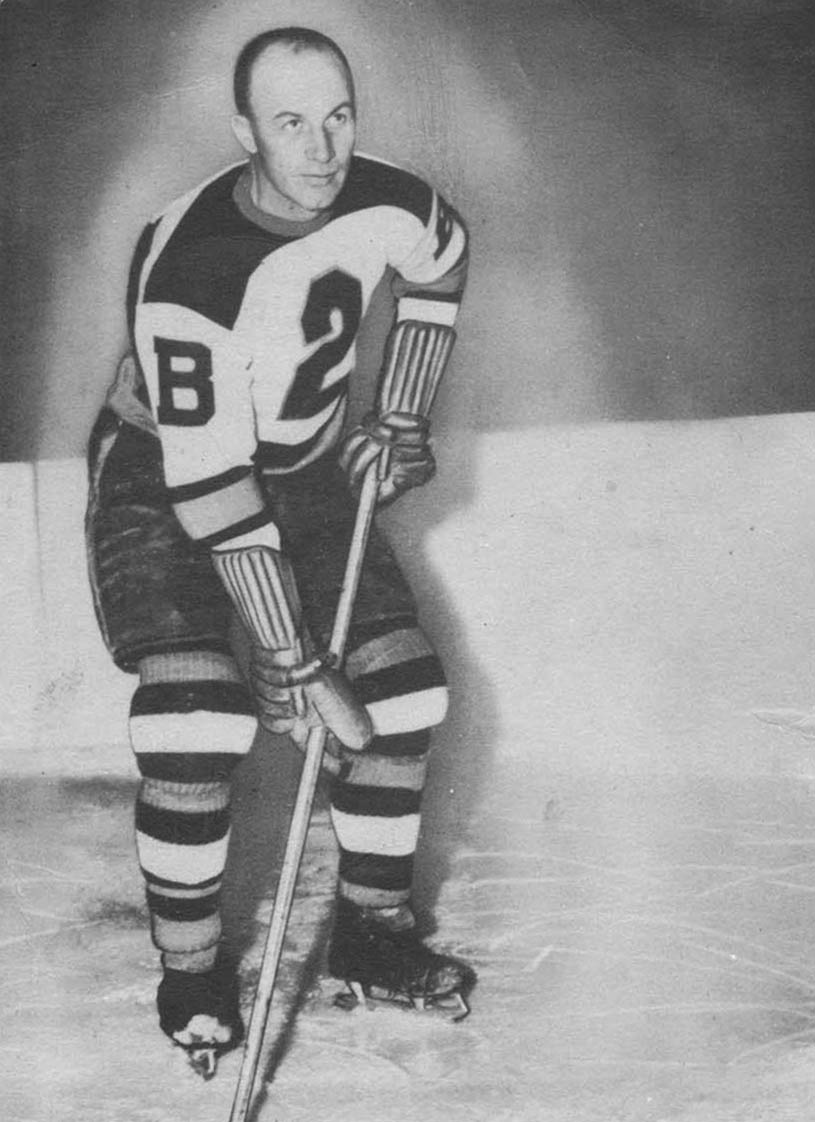
Edward William Shore (November 25, 1902 – March 16, 1985) was a Canadian professional ice hockey defenceman, principally for the Boston Bruins of the National Hockey League, and the longtime owner of the Springfield Indians of the American Hockey League. Iconic for his aggressiveness, toughness and defensive skill, he was called both "Old Blood and Guts" and "the Edmonton Express". In 2017, Shore was named one of the '100 Greatest NHL Players' in history.
Shore won the Hart Trophy as the NHL's most valuable player four times, the most of any defenceman; only Wayne Gretzky and Gordie Howe have won it more often. After the league began naming NHL All-Star teams at the end of Shore's fifth season, Shore was honoured as a First Team All-Star in seven of his last nine seasons, while being named a Second Team All-Star one of the other seasons; in the remaining season he missed over half the schedule due to injury. A bruiser known for his violence, Shore set a then-NHL record for 165 penalty minutes in his second season.
Shore was born to Katherine and John T. Shore in rural Saskatchewan and grew up in the small town of Cupar, which had only an outdoor rink for him to skate on. Shore had six siblings, and his family owned a ranch, which helped him develop a strong athletic foundation. As a youngster, Shore was not considered the most talented player even in his own household—his older brother Aubrey held that title. Eddie did not begin taking hockey seriously until his teenage years. After the First World War he attended an agricultural college in Manitoba. He originally did not make the school's hockey team; however, after taunting from his older brother, Shore started to take the game seriously once again, improving his skills and making the college team.
Shore started his career with his hometown minor hockey team, the Cupar Canucks. He played for the Melville Millionaires and won the 1923–24 Saskatchewan senior championship.
Shore moved up to professional hockey with the Regina Capitals of the Western Canada Hockey League in 1925. His team finished last in the league and moved to Portland after the season. Shore moved to the league champion Edmonton Eskimos in 1926, where he converted from forward to defence and was given the nickname "the Edmonton Express".
When the Western Hockey League (renamed from the WCHL) folded in 1926, Shore was sold to the Boston Bruins of the NHL. As a rookie, he scored 12 goals and 6 assists for a total of 18 points and accumulated 130 penalty minutes. His first goal came on November 20, 1926, in Boston's 5–1 loss to Chicago. When he joined the Bruins, he was paired with fellow defenceman Lionel Hitchman. The two were quickly recognized as the league’s best defensive pairing. They remained partners for the rest of Hitchman’s career, with Shore’s rushing style complementing Hitchman’s stay-at-home play. During Shore’s second year with the team, he and Hitchman helped lead the Bruins to the Stanley Cup Final, though they ultimately lost to the Ottawa Senators. Two years later, the pair anchored a defence that was virtually impenetrable. The Bruins surrendered only 52 goals over 44 games, helping the team capture its first Stanley Cup in 1929. That year he also became one of the highest paid athletes in the country with a $25,000 salary.
Shore was named to the NHL First All-Star Team for the first time in 1931 after recording 31 points with a career-high 15 goals. His best statistical season came in 1932–33, when he scored 8 goals and 35 points, earning him the Hart Memorial Trophy as the NHL’s Most Valuable Player for the first time. That year he also finished 12th in the league's scoring race, which was unheard of for a defenceman at that time.
He became one of the earliest defencemen to use speed and stick-handling skill to carry the puck deep into the offensive zone, doing so with an upright skating style and a defiant air, daring opponents to try to stop him. Bruins trainer Hammy Moore said, "He was the only player I ever saw who had the whole arena standing every time he rushed down the ice. He would either end up bashing somebody, get into a fight, or score a goal."
Hub AI
Eddie Shore AI simulator
(@Eddie Shore_simulator)
Eddie Shore
Edward William Shore (November 25, 1902 – March 16, 1985) was a Canadian professional ice hockey defenceman, principally for the Boston Bruins of the National Hockey League, and the longtime owner of the Springfield Indians of the American Hockey League. Iconic for his aggressiveness, toughness and defensive skill, he was called both "Old Blood and Guts" and "the Edmonton Express". In 2017, Shore was named one of the '100 Greatest NHL Players' in history.
Shore won the Hart Trophy as the NHL's most valuable player four times, the most of any defenceman; only Wayne Gretzky and Gordie Howe have won it more often. After the league began naming NHL All-Star teams at the end of Shore's fifth season, Shore was honoured as a First Team All-Star in seven of his last nine seasons, while being named a Second Team All-Star one of the other seasons; in the remaining season he missed over half the schedule due to injury. A bruiser known for his violence, Shore set a then-NHL record for 165 penalty minutes in his second season.
Shore was born to Katherine and John T. Shore in rural Saskatchewan and grew up in the small town of Cupar, which had only an outdoor rink for him to skate on. Shore had six siblings, and his family owned a ranch, which helped him develop a strong athletic foundation. As a youngster, Shore was not considered the most talented player even in his own household—his older brother Aubrey held that title. Eddie did not begin taking hockey seriously until his teenage years. After the First World War he attended an agricultural college in Manitoba. He originally did not make the school's hockey team; however, after taunting from his older brother, Shore started to take the game seriously once again, improving his skills and making the college team.
Shore started his career with his hometown minor hockey team, the Cupar Canucks. He played for the Melville Millionaires and won the 1923–24 Saskatchewan senior championship.
Shore moved up to professional hockey with the Regina Capitals of the Western Canada Hockey League in 1925. His team finished last in the league and moved to Portland after the season. Shore moved to the league champion Edmonton Eskimos in 1926, where he converted from forward to defence and was given the nickname "the Edmonton Express".
When the Western Hockey League (renamed from the WCHL) folded in 1926, Shore was sold to the Boston Bruins of the NHL. As a rookie, he scored 12 goals and 6 assists for a total of 18 points and accumulated 130 penalty minutes. His first goal came on November 20, 1926, in Boston's 5–1 loss to Chicago. When he joined the Bruins, he was paired with fellow defenceman Lionel Hitchman. The two were quickly recognized as the league’s best defensive pairing. They remained partners for the rest of Hitchman’s career, with Shore’s rushing style complementing Hitchman’s stay-at-home play. During Shore’s second year with the team, he and Hitchman helped lead the Bruins to the Stanley Cup Final, though they ultimately lost to the Ottawa Senators. Two years later, the pair anchored a defence that was virtually impenetrable. The Bruins surrendered only 52 goals over 44 games, helping the team capture its first Stanley Cup in 1929. That year he also became one of the highest paid athletes in the country with a $25,000 salary.
Shore was named to the NHL First All-Star Team for the first time in 1931 after recording 31 points with a career-high 15 goals. His best statistical season came in 1932–33, when he scored 8 goals and 35 points, earning him the Hart Memorial Trophy as the NHL’s Most Valuable Player for the first time. That year he also finished 12th in the league's scoring race, which was unheard of for a defenceman at that time.
He became one of the earliest defencemen to use speed and stick-handling skill to carry the puck deep into the offensive zone, doing so with an upright skating style and a defiant air, daring opponents to try to stop him. Bruins trainer Hammy Moore said, "He was the only player I ever saw who had the whole arena standing every time he rushed down the ice. He would either end up bashing somebody, get into a fight, or score a goal."
Recent media