


Community hub
Recent from talks
Contribute something to knowledge base
Content stats: 0 posts, 0 articles, 1 media, 0 notes
Members stats: 0 subscribers, 0 contributors, 0 moderators, 0 supporters
Subscribers
Supporters
Contributors
Moderators
Hub AI
Edge of the City AI simulator
(@Edge of the City_simulator)
Hub AI
Edge of the City AI simulator
(@Edge of the City_simulator)
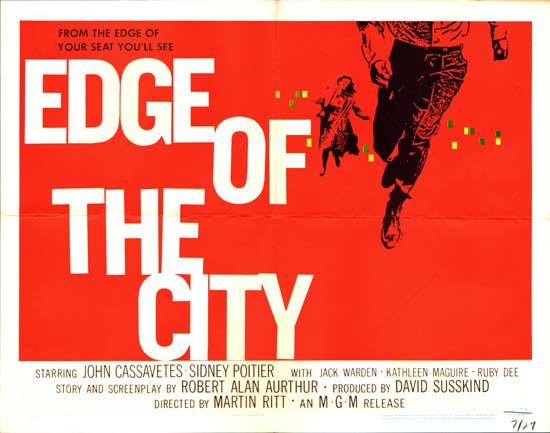
Edge of the City
Edge of the City is a 1957 American crime drama film directed by Martin Ritt in his directorial debut, and starring John Cassavetes and Sidney Poitier. Robert Alan Aurthur's screenplay was expanded from his original script, staged as the final episode of The Philco Television Playhouse, A Man Is Ten Feet Tall (1955), also featuring Poitier.
The film was considered unusual for its time because of its portrayal of an interracial friendship, and was praised by representatives of the NAACP, Urban League, American Jewish Committee and Interfaith Council because of its portrayal of racial brotherhood.
In 2023, the film was selected for preservation in the United States National Film Registry by the Library of Congress as being "culturally, historically or aesthetically significant."
Young, insecure drifter Axel Nordmann arrives at the waterfront on the west side of Manhattan, seeking employment as a longshoreman, and giving his name as "Axel North." He goes to work in a gang of stevedores headed by Charlie Malick, a vicious bully, and is befriended by Tommy Tyler, who also supervises a stevedore gang and has an engaging, charming sense of humor. Malick resents blacks and is antagonized when Axel goes to work for Tommy.
Axel moves into Tommy's neighborhood, becomes friends with Tommy's wife Lucy and develops a romantic relationship with her friend Ellen Wilson. Tommy serves as a mentor to Axel, urging him to stand up to Malick, and that if he does he will be "ten feet tall". It is apparent from the start that Axel is hiding something, and it emerges that he is a deserter from the United States Army. Malick is aware of this, and is extorting money from him.
Malick frequently tries to provoke Tommy and Axel into fights, with Tommy coming to Axel's aid. Malick finally provokes Tommy into a fight, with both men using their baling hooks. At one point, Tommy disarms Malick and implores him to stop, but Malick seizes the hook and kills him. The police investigation is stymied by lack of cooperation from the longshoremen, including Axel. But after meeting with the distraught Lucy, who accuses him of never being Tommy's friend as he knows who killed Tommy but has not told the police, Axel finally decides to cooperate. He goes to Malick to tell him that. They get into a fight, and in the end, though beaten, Axel strangles Malick unconscious and drags him away to face justice.
The movie was based on the TV play A Man is Ten Feet Tall. It was optioned by Jonathan Productions, an offshoot of Talent Associates formed by David Susskin, Robert Alan Aurthur and Al Levy. MGM agreed to finance. Ritt had directed Aurthur's play A Very Special Baby and the author insisted he direct.
The budget was set at $475,000 and 32 were allocated for filming entirely in New York, 18 in studio and 14 on location, plus two weeks rehearsal. Jonathan was entitled to 25% of the profits and filming started April 1956. It was decided to change the title after market research.
Edge of the City
Edge of the City is a 1957 American crime drama film directed by Martin Ritt in his directorial debut, and starring John Cassavetes and Sidney Poitier. Robert Alan Aurthur's screenplay was expanded from his original script, staged as the final episode of The Philco Television Playhouse, A Man Is Ten Feet Tall (1955), also featuring Poitier.
The film was considered unusual for its time because of its portrayal of an interracial friendship, and was praised by representatives of the NAACP, Urban League, American Jewish Committee and Interfaith Council because of its portrayal of racial brotherhood.
In 2023, the film was selected for preservation in the United States National Film Registry by the Library of Congress as being "culturally, historically or aesthetically significant."
Young, insecure drifter Axel Nordmann arrives at the waterfront on the west side of Manhattan, seeking employment as a longshoreman, and giving his name as "Axel North." He goes to work in a gang of stevedores headed by Charlie Malick, a vicious bully, and is befriended by Tommy Tyler, who also supervises a stevedore gang and has an engaging, charming sense of humor. Malick resents blacks and is antagonized when Axel goes to work for Tommy.
Axel moves into Tommy's neighborhood, becomes friends with Tommy's wife Lucy and develops a romantic relationship with her friend Ellen Wilson. Tommy serves as a mentor to Axel, urging him to stand up to Malick, and that if he does he will be "ten feet tall". It is apparent from the start that Axel is hiding something, and it emerges that he is a deserter from the United States Army. Malick is aware of this, and is extorting money from him.
Malick frequently tries to provoke Tommy and Axel into fights, with Tommy coming to Axel's aid. Malick finally provokes Tommy into a fight, with both men using their baling hooks. At one point, Tommy disarms Malick and implores him to stop, but Malick seizes the hook and kills him. The police investigation is stymied by lack of cooperation from the longshoremen, including Axel. But after meeting with the distraught Lucy, who accuses him of never being Tommy's friend as he knows who killed Tommy but has not told the police, Axel finally decides to cooperate. He goes to Malick to tell him that. They get into a fight, and in the end, though beaten, Axel strangles Malick unconscious and drags him away to face justice.
The movie was based on the TV play A Man is Ten Feet Tall. It was optioned by Jonathan Productions, an offshoot of Talent Associates formed by David Susskin, Robert Alan Aurthur and Al Levy. MGM agreed to finance. Ritt had directed Aurthur's play A Very Special Baby and the author insisted he direct.
The budget was set at $475,000 and 32 were allocated for filming entirely in New York, 18 in studio and 14 on location, plus two weeks rehearsal. Jonathan was entitled to 25% of the profits and filming started April 1956. It was decided to change the title after market research.
Recent media
Recent media