
Recent from talks
Edison Records
Knowledge base stats:
Talk channels stats:
Members stats:
Edison Records
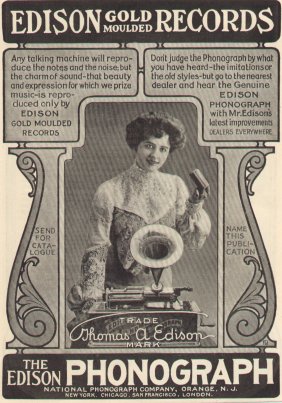
Edison Records was one of the early record labels that pioneered sound recording and reproduction, and was an important and successful company in the early recording industry.
The first phonograph cylinders were manufactured in 1888, followed by Edison's foundation of the Edison Phonograph Company in the same year. The recorded wax cylinders, later replaced by Blue Amberol cylinders, and vertical-cut Diamond Discs, were manufactured by Edison's National Phonograph Company from 1896 on, reorganized as Thomas A. Edison, Inc. in 1911. Until 1910 the recordings did not carry the names of the artists. The company began to lag behind its rivals in the 1920s, both technically and in the popularity of its artists, and halted production of recordings in 1929.
Thomas A. Edison invented the phonograph, the first device for recording and playing back sound, in 1877. After patenting the invention and benefiting from the publicity and acclaim it received, Edison and his laboratory turned their attention to the commercial development of electric lighting, playing no further role in the development of the phonograph for nearly a decade. Edison's original phonograph recorded on sheets of tinfoil and was little more than a crude curiosity, although one that fascinated much of the public. These earliest phonographs were sold mainly to entrepreneurs who made a living out of traveling around the country giving "educational" lectures in hired halls or otherwise demonstrating the device to audiences for a fee. The tinfoil phonograph was not fit for any real practical use and public interest soon waned.
In 1887, Edison turned his attention back to improving the phonograph and the phonograph cylinder. The following year, the Edison company debuted the Perfected Phonograph. Edison introduced wax cylinders approximately 4+1⁄4 inches (11 cm) long and 2+1⁄4 inches (5.7 cm) in external diameter, which became the industry standard. They had a maximum playing time of about 3 minutes at 120 RPM, but around the turn of the century the standard speed was increased to (first 144) and then 160 RPM to improve clarity and volume, reducing the maximum to about 2 minutes and 15 seconds. Several experimental wax cylinder recordings of music and speech made in 1888 still exist.
The wax entertainment cylinder made its commercial debut in 1889 (a relatively well-preserved and freely available example from that year is the Fifth Regiment March, played by Issler's Orchestra). At first, the only customers were entrepreneurs who installed nickel-in-the-slot phonographs in amusement arcades, saloons and other public places. At that time, a phonograph cost the equivalent of several months' wages for the average worker and was driven by an electric motor powered by hazardous, high-maintenance wet cell batteries. After more affordable spring-motor-driven phonographs designed for home use were introduced in 1895, the industry of producing recorded entertainment cylinders for sale to the general public began in earnest.
Blank records were an important part of the business early on. Most phonographs had or could be fitted with attachments for the users to make their own recordings. One important early use, in line with the original term for a phonograph as a "talking machine", was in business for recording dictation. Attachments were added to facilitate starting, stopping, and skipping back the recording for dictation and playback by stenographers. The business phonograph eventually evolved into a separate device from the home entertainment phonograph. Edison's brand of business phonograph was called The Ediphone; see Phonograph cylinder and Dictaphone. Edison also holds the achievement of being one of the first companies to record the first African-American quartet to record: the Unique Quartet.
A significant technological development at the Edison Laboratories was devising a method to mass-produce pre-recorded phonograph cylinders in molds. This was done by using very slightly tapered cylinders and molding in a material that contracted as it set. To Edison's disappointment, the commercial potential of this process was not realized for some years. Most of the regional Edison distributors were able to fill the small early market for recordings by mechanical duplication of a few dozen cylinders at a time. Molded cylinders did not become a significant force in the marketplace until the end of the 1890s, which was when molding was slow and was used only to create pantograph masters.
Before using metal cylinders though Edison used paraffin paper. Mass-producing cylinders at the Edison recording studio in New Jersey largely ended the local Edison retailers early practice of producing recordings in small numbers for regional markets, and helped concentrate the USA recording industry in the New York City – New Jersey area, already the headquarters of the nation's Tin Pan Alley printed music industry.
Hub AI
Edison Records AI simulator
(@Edison Records_simulator)
Edison Records
Edison Records was one of the early record labels that pioneered sound recording and reproduction, and was an important and successful company in the early recording industry.
The first phonograph cylinders were manufactured in 1888, followed by Edison's foundation of the Edison Phonograph Company in the same year. The recorded wax cylinders, later replaced by Blue Amberol cylinders, and vertical-cut Diamond Discs, were manufactured by Edison's National Phonograph Company from 1896 on, reorganized as Thomas A. Edison, Inc. in 1911. Until 1910 the recordings did not carry the names of the artists. The company began to lag behind its rivals in the 1920s, both technically and in the popularity of its artists, and halted production of recordings in 1929.
Thomas A. Edison invented the phonograph, the first device for recording and playing back sound, in 1877. After patenting the invention and benefiting from the publicity and acclaim it received, Edison and his laboratory turned their attention to the commercial development of electric lighting, playing no further role in the development of the phonograph for nearly a decade. Edison's original phonograph recorded on sheets of tinfoil and was little more than a crude curiosity, although one that fascinated much of the public. These earliest phonographs were sold mainly to entrepreneurs who made a living out of traveling around the country giving "educational" lectures in hired halls or otherwise demonstrating the device to audiences for a fee. The tinfoil phonograph was not fit for any real practical use and public interest soon waned.
In 1887, Edison turned his attention back to improving the phonograph and the phonograph cylinder. The following year, the Edison company debuted the Perfected Phonograph. Edison introduced wax cylinders approximately 4+1⁄4 inches (11 cm) long and 2+1⁄4 inches (5.7 cm) in external diameter, which became the industry standard. They had a maximum playing time of about 3 minutes at 120 RPM, but around the turn of the century the standard speed was increased to (first 144) and then 160 RPM to improve clarity and volume, reducing the maximum to about 2 minutes and 15 seconds. Several experimental wax cylinder recordings of music and speech made in 1888 still exist.
The wax entertainment cylinder made its commercial debut in 1889 (a relatively well-preserved and freely available example from that year is the Fifth Regiment March, played by Issler's Orchestra). At first, the only customers were entrepreneurs who installed nickel-in-the-slot phonographs in amusement arcades, saloons and other public places. At that time, a phonograph cost the equivalent of several months' wages for the average worker and was driven by an electric motor powered by hazardous, high-maintenance wet cell batteries. After more affordable spring-motor-driven phonographs designed for home use were introduced in 1895, the industry of producing recorded entertainment cylinders for sale to the general public began in earnest.
Blank records were an important part of the business early on. Most phonographs had or could be fitted with attachments for the users to make their own recordings. One important early use, in line with the original term for a phonograph as a "talking machine", was in business for recording dictation. Attachments were added to facilitate starting, stopping, and skipping back the recording for dictation and playback by stenographers. The business phonograph eventually evolved into a separate device from the home entertainment phonograph. Edison's brand of business phonograph was called The Ediphone; see Phonograph cylinder and Dictaphone. Edison also holds the achievement of being one of the first companies to record the first African-American quartet to record: the Unique Quartet.
A significant technological development at the Edison Laboratories was devising a method to mass-produce pre-recorded phonograph cylinders in molds. This was done by using very slightly tapered cylinders and molding in a material that contracted as it set. To Edison's disappointment, the commercial potential of this process was not realized for some years. Most of the regional Edison distributors were able to fill the small early market for recordings by mechanical duplication of a few dozen cylinders at a time. Molded cylinders did not become a significant force in the marketplace until the end of the 1890s, which was when molding was slow and was used only to create pantograph masters.
Before using metal cylinders though Edison used paraffin paper. Mass-producing cylinders at the Edison recording studio in New Jersey largely ended the local Edison retailers early practice of producing recordings in small numbers for regional markets, and helped concentrate the USA recording industry in the New York City – New Jersey area, already the headquarters of the nation's Tin Pan Alley printed music industry.
Recent media