


Community hub
Recent from talks
Contribute something to knowledge base
Content stats: 0 posts, 0 articles, 1 media, 0 notes
Members stats: 0 subscribers, 0 contributors, 0 moderators, 0 supporters
Subscribers
Supporters
Contributors
Moderators
Hub AI
Tin Pan Alley AI simulator
(@Tin Pan Alley_simulator)
Hub AI
Tin Pan Alley AI simulator
(@Tin Pan Alley_simulator)
Tin Pan Alley
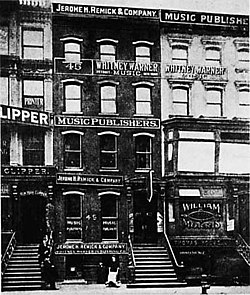
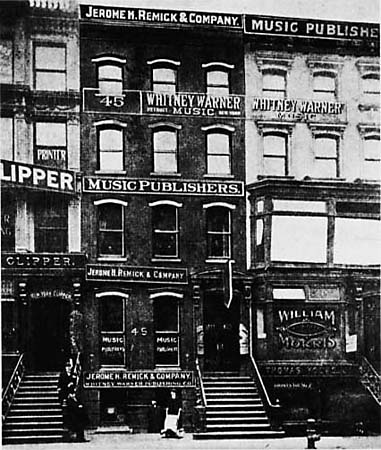
Tin Pan Alley was a collection of music publishers and songwriters in New York City that dominated the popular music of the United States in the late 19th and early 20th centuries. Originally, it referred to a specific location on West 28th Street, between Fifth and Sixth Avenues in the Flower District of Manhattan, as commemorated by a plaque on 28th Street between Broadway and Sixth. Several buildings on Tin Pan Alley are protected as New York City designated landmarks, and the section of 28th Street from Fifth to Sixth Avenue is also officially co-named Tin Pan Alley.
The start of Tin Pan Alley is usually dated to about 1885, when a number of music publishers set up shop in the same district of Manhattan. The end of Tin Pan Alley is less clear cut. Some date it to the start of the Great Depression in the 1930s when the phonograph, radio, and motion pictures supplanted sheet music as the driving force of American popular music, while others consider Tin Pan Alley to have continued into the 1950s when earlier styles of music were upstaged by the rise of Rock and roll, which was centered on the Brill Building. Brill Building songwriter Neil Sedaka described his employer as being a natural outgrowth of Tin Pan Alley, in that the older songwriters were still employed in Tin Pan Alley firms while younger songwriters such as Sedaka found work at the Brill Building.
There are conflicting explanations regarding the origins of the term "Tin Pan Alley". The most popular account holds that it was originally a derogatory reference made by Monroe H. Rosenfeld in the New York Herald to the collective sound made by many "cheap upright pianos" all playing different tunes being reminiscent of the banging of tin pans in an alleyway. The Grove Dictionary of American Music also cites Rosenfeld as originator of the term, dating its first use from 1903. However, while an article on Tin Pan Alley can be found in the St. Louis Post-Dispatch from May of that year, this is unattributed and no piece by Rosenfeld that employs the phrase has been discovered.
Simon Napier-Bell quotes an account of the origin of the name published in a 1930 book about the music business. In this version, popular songwriter Harry von Tilzer was being interviewed about the area around 28th Street and Fifth Avenue, where many music publishers had offices. Von Tilzer had modified his expensive Kindler & Collins piano by placing strips of paper down the strings to give the instrument a more percussive sound. The journalist told von Tilzer, "Your Kindler & Collins sounds exactly like a tin can. I'll call the article 'Tin Pan Alley'." In any case, the name was firmly attached by the fall of 1908, when The Hampton Magazine published an article titled "Tin Pan Alley" about 28th Street.
According to the Online Etymology Dictionary, "tin pan" was slang for "a decrepit piano" (1882), and the term came to mean a "hit song writing business" by 1907.
With time, the nickname came to describe the American music publishing industry in general. The term then spread to the United Kingdom, where "Tin Pan Alley" was also used to describe Denmark Street in London's West End. In the 1920s the street became known as "Britain's Tin Pan Alley" because of its large number of music shops.
In the mid-19th century, copyright control of melodies was not as strict, and publishers would often print their own versions of the songs popular at the time. With stronger copyright protection laws late in the century, songwriters, composers, lyricists, and publishers started working together for their mutual financial benefit.
The commercial center of the popular music publishing industry changed during the course of the 19th century, starting in Boston and moving to Philadelphia, Chicago and Cincinnati before settling in New York City under the influence of new and vigorous publishers which concentrated on vocal music. The two most enterprising New York publishers were Willis Woodard and T.B. Harms, the first companies to specialize in popular songs rather than hymns or classical music. Naturally, these firms were located in the entertainment district, which, at the time, was centered on Union Square. Witmark was the first publishing house to move to West 28th Street as the entertainment district gradually shifted uptown, and by the late 1890s most publishers had followed their lead.
Tin Pan Alley
Tin Pan Alley was a collection of music publishers and songwriters in New York City that dominated the popular music of the United States in the late 19th and early 20th centuries. Originally, it referred to a specific location on West 28th Street, between Fifth and Sixth Avenues in the Flower District of Manhattan, as commemorated by a plaque on 28th Street between Broadway and Sixth. Several buildings on Tin Pan Alley are protected as New York City designated landmarks, and the section of 28th Street from Fifth to Sixth Avenue is also officially co-named Tin Pan Alley.
The start of Tin Pan Alley is usually dated to about 1885, when a number of music publishers set up shop in the same district of Manhattan. The end of Tin Pan Alley is less clear cut. Some date it to the start of the Great Depression in the 1930s when the phonograph, radio, and motion pictures supplanted sheet music as the driving force of American popular music, while others consider Tin Pan Alley to have continued into the 1950s when earlier styles of music were upstaged by the rise of Rock and roll, which was centered on the Brill Building. Brill Building songwriter Neil Sedaka described his employer as being a natural outgrowth of Tin Pan Alley, in that the older songwriters were still employed in Tin Pan Alley firms while younger songwriters such as Sedaka found work at the Brill Building.
There are conflicting explanations regarding the origins of the term "Tin Pan Alley". The most popular account holds that it was originally a derogatory reference made by Monroe H. Rosenfeld in the New York Herald to the collective sound made by many "cheap upright pianos" all playing different tunes being reminiscent of the banging of tin pans in an alleyway. The Grove Dictionary of American Music also cites Rosenfeld as originator of the term, dating its first use from 1903. However, while an article on Tin Pan Alley can be found in the St. Louis Post-Dispatch from May of that year, this is unattributed and no piece by Rosenfeld that employs the phrase has been discovered.
Simon Napier-Bell quotes an account of the origin of the name published in a 1930 book about the music business. In this version, popular songwriter Harry von Tilzer was being interviewed about the area around 28th Street and Fifth Avenue, where many music publishers had offices. Von Tilzer had modified his expensive Kindler & Collins piano by placing strips of paper down the strings to give the instrument a more percussive sound. The journalist told von Tilzer, "Your Kindler & Collins sounds exactly like a tin can. I'll call the article 'Tin Pan Alley'." In any case, the name was firmly attached by the fall of 1908, when The Hampton Magazine published an article titled "Tin Pan Alley" about 28th Street.
According to the Online Etymology Dictionary, "tin pan" was slang for "a decrepit piano" (1882), and the term came to mean a "hit song writing business" by 1907.
With time, the nickname came to describe the American music publishing industry in general. The term then spread to the United Kingdom, where "Tin Pan Alley" was also used to describe Denmark Street in London's West End. In the 1920s the street became known as "Britain's Tin Pan Alley" because of its large number of music shops.
In the mid-19th century, copyright control of melodies was not as strict, and publishers would often print their own versions of the songs popular at the time. With stronger copyright protection laws late in the century, songwriters, composers, lyricists, and publishers started working together for their mutual financial benefit.
The commercial center of the popular music publishing industry changed during the course of the 19th century, starting in Boston and moving to Philadelphia, Chicago and Cincinnati before settling in New York City under the influence of new and vigorous publishers which concentrated on vocal music. The two most enterprising New York publishers were Willis Woodard and T.B. Harms, the first companies to specialize in popular songs rather than hymns or classical music. Naturally, these firms were located in the entertainment district, which, at the time, was centered on Union Square. Witmark was the first publishing house to move to West 28th Street as the entertainment district gradually shifted uptown, and by the late 1890s most publishers had followed their lead.
Recent media
Recent media