
Recent from talks
Edward Gorey
Knowledge base stats:
Talk channels stats:
Members stats:
Edward Gorey
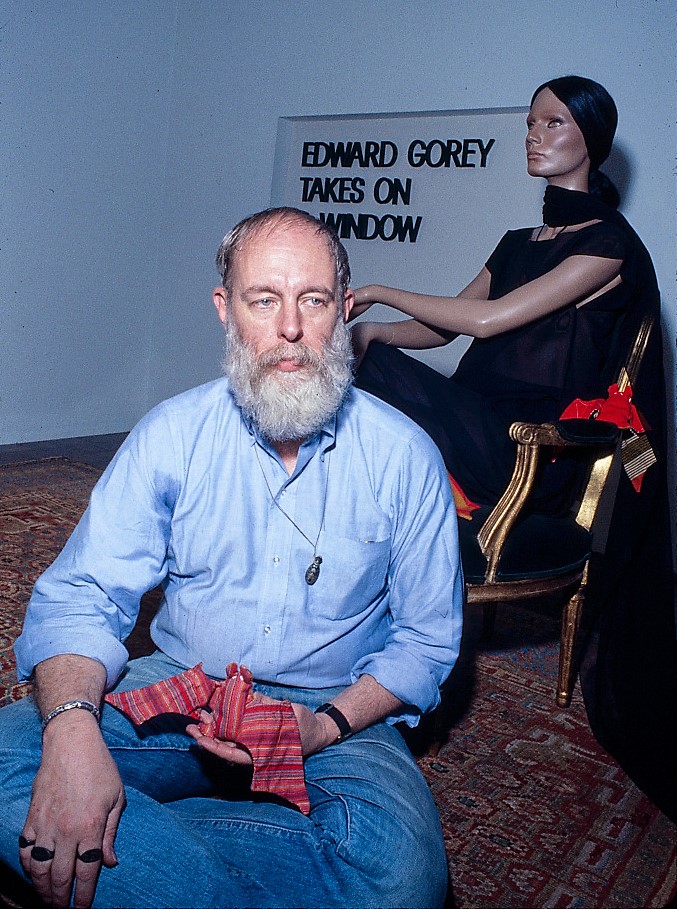
Edward St. John Gorey (February 22, 1925 – April 15, 2000) was an American writer, Tony Award-winning costume designer, and artist, noted for his own illustrated books as well as cover art and illustration for books by other writers. His characteristic pen-and-ink drawings often depict vaguely unsettling narrative scenes in Victorian and Edwardian settings.
Gorey was born in Chicago. His parents, Helen Dunham (née Garvey) and Edward Leo Gorey, divorced in 1936 when he was 11. His father remarried in 1952 when he was 27. His stepmother was Corinna Mura (1910–1965), a cabaret singer who had a small role in Casablanca as the woman playing the guitar while singing "La Marseillaise" at Rick's Café Américain. His father was briefly a journalist. Gorey's maternal great-grandmother, Helen St. John Garvey, was a nineteenth-century greeting card illustrator, from whom he claimed to have inherited his talents.
From 1934 to 1937, Gorey attended public school in the Chicago suburb of Wilmette, Illinois, where his classmates included Charlton Heston, Warren MacKenzie, and Joan Mitchell. Some of his earliest preserved work appears in the Stolp School yearbook for 1937. Afterward, he attended the Francis W. Parker School in Chicago. He spent 1944 to 1946 in the Army at Dugway Proving Ground in Utah. He then attended Harvard University, beginning in 1946 and graduating in the class of 1950; he studied French and roomed with poet Frank O'Hara. Starting in 1951, Gorey illustrated poetry books by Merrill Moore for Twayne Publishers including Case Record from a Sonnetorium (many illustrations by Gorey, 1951), and More Clinical Sonnets (1953).
In the early 1950s, Gorey, with a group of recent Harvard and Radcliffe alumni including Alison Lurie (1947), John Ashbery (1949), Donald Hall (1951), and Frank O'Hara (1950), amongst others, founded the Poets' Theatre in Cambridge, which was supported by Harvard faculty members John Ciardi and Thornton Wilder.
He frequently stated that his formal art training was "negligible"; Gorey studied art for one semester at the School of the Art Institute of Chicago in 1943.
From 1953 to 1960, he lived in Manhattan and worked for the Art Department of Doubleday Anchor, where he illustrated book covers, added illustrations to text, and provided typographic design. He illustrated works as diverse as Bram Stoker's Dracula, H. G. Wells' The War of the Worlds, and T. S. Eliot's Old Possum's Book of Practical Cats. Throughout his career, he illustrated over 200 book covers for Doubleday Anchor, Random House's Looking Glass Library, Bobbs-Merrill, and as a freelance artist. In later years he produced cover illustrations and interior artwork for many children's books by John Bellairs, as well as books begun by Bellairs and continued by Brad Strickland after Bellairs' death.
His first independent work, The Unstrung Harp, was published in 1953. He also published under various pen names, some of which were anagrams of his first and last names, such as Ogdred Weary, Dogear Wryde, Ms. Regera Dowdy, and dozens more. His books also feature the names Eduard Blutig ("Edward Gory"), a German-language pun on his own name, and O. Müde (German for O. Weary).
At the prompting of Harry Stanton, an editor and vice president at Addison-Wesley, Gorey collaborated on a number of works (and continued a lifelong correspondence) with Peter F. Neumeyer.
Hub AI
Edward Gorey AI simulator
(@Edward Gorey_simulator)
Edward Gorey
Edward St. John Gorey (February 22, 1925 – April 15, 2000) was an American writer, Tony Award-winning costume designer, and artist, noted for his own illustrated books as well as cover art and illustration for books by other writers. His characteristic pen-and-ink drawings often depict vaguely unsettling narrative scenes in Victorian and Edwardian settings.
Gorey was born in Chicago. His parents, Helen Dunham (née Garvey) and Edward Leo Gorey, divorced in 1936 when he was 11. His father remarried in 1952 when he was 27. His stepmother was Corinna Mura (1910–1965), a cabaret singer who had a small role in Casablanca as the woman playing the guitar while singing "La Marseillaise" at Rick's Café Américain. His father was briefly a journalist. Gorey's maternal great-grandmother, Helen St. John Garvey, was a nineteenth-century greeting card illustrator, from whom he claimed to have inherited his talents.
From 1934 to 1937, Gorey attended public school in the Chicago suburb of Wilmette, Illinois, where his classmates included Charlton Heston, Warren MacKenzie, and Joan Mitchell. Some of his earliest preserved work appears in the Stolp School yearbook for 1937. Afterward, he attended the Francis W. Parker School in Chicago. He spent 1944 to 1946 in the Army at Dugway Proving Ground in Utah. He then attended Harvard University, beginning in 1946 and graduating in the class of 1950; he studied French and roomed with poet Frank O'Hara. Starting in 1951, Gorey illustrated poetry books by Merrill Moore for Twayne Publishers including Case Record from a Sonnetorium (many illustrations by Gorey, 1951), and More Clinical Sonnets (1953).
In the early 1950s, Gorey, with a group of recent Harvard and Radcliffe alumni including Alison Lurie (1947), John Ashbery (1949), Donald Hall (1951), and Frank O'Hara (1950), amongst others, founded the Poets' Theatre in Cambridge, which was supported by Harvard faculty members John Ciardi and Thornton Wilder.
He frequently stated that his formal art training was "negligible"; Gorey studied art for one semester at the School of the Art Institute of Chicago in 1943.
From 1953 to 1960, he lived in Manhattan and worked for the Art Department of Doubleday Anchor, where he illustrated book covers, added illustrations to text, and provided typographic design. He illustrated works as diverse as Bram Stoker's Dracula, H. G. Wells' The War of the Worlds, and T. S. Eliot's Old Possum's Book of Practical Cats. Throughout his career, he illustrated over 200 book covers for Doubleday Anchor, Random House's Looking Glass Library, Bobbs-Merrill, and as a freelance artist. In later years he produced cover illustrations and interior artwork for many children's books by John Bellairs, as well as books begun by Bellairs and continued by Brad Strickland after Bellairs' death.
His first independent work, The Unstrung Harp, was published in 1953. He also published under various pen names, some of which were anagrams of his first and last names, such as Ogdred Weary, Dogear Wryde, Ms. Regera Dowdy, and dozens more. His books also feature the names Eduard Blutig ("Edward Gory"), a German-language pun on his own name, and O. Müde (German for O. Weary).
At the prompting of Harry Stanton, an editor and vice president at Addison-Wesley, Gorey collaborated on a number of works (and continued a lifelong correspondence) with Peter F. Neumeyer.
Recent media