
Recent from talks
Edward Hitchcock
Knowledge base stats:
Talk channels stats:
Members stats:
Edward Hitchcock
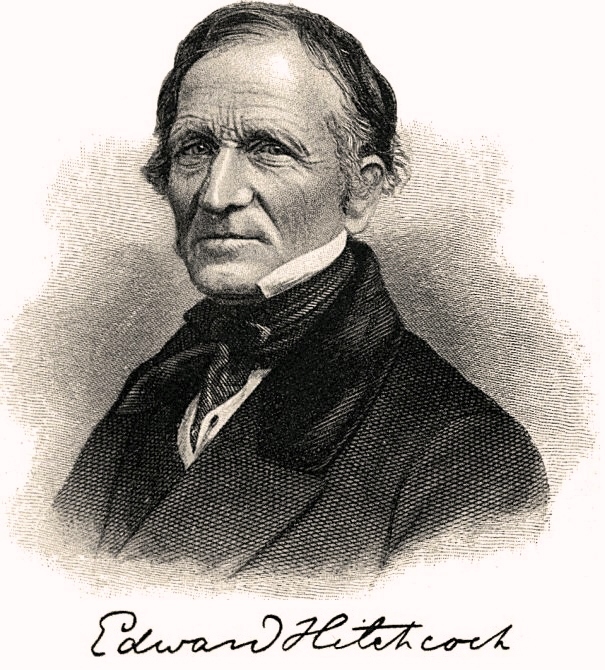
Edward Hitchcock (May 24, 1793 – February 27, 1864) was an American geologist and the third President of Amherst College (1845–1854).
Born to poor parents, he attended newly founded Deerfield Academy, where he was later principal, from 1815 to 1818. In 1821 he was ordained as a Congregationalist pastor and served as pastor of the Congregational Church in Conway, Massachusetts, 1821–1825. He left the ministry to become Professor of Chemistry and Natural History at Amherst College. He held that post from 1825 to 1845, serving as Professor of Natural Theology and Geology from 1845 until his death in 1864. In 1845, Hitchcock became President of the College, a post he held until 1854. As president, Hitchcock was responsible for Amherst's recovery from severe financial difficulties. He is also credited with developing the college's scientific resources and establishing its reputation for scientific teaching.
In addition to his positions at Amherst, Hitchcock was a well-known early geologist. He ran the first geological survey of Massachusetts, and in 1830 was appointed state geologist of Massachusetts (he held the post until 1844). He also played a role in the geological surveys of New York and Vermont. His chief project, however, was natural theology, which attempted to unify and reconcile science and religion, focusing on geology. His major work in this area was The Religion of Geology and Its Connected Sciences (1851). In this book, he sought out ways to re-interpret the Bible to agree with the latest geological theories. For example, knowing that the earth was at least hundreds of thousands of years old, vastly older than the 6,000 years allowed by certain biblical interpretations, Hitchcock devised a way to read the original Hebrew so that a single letter in Genesis—a "v", meaning "afterwards"—implied the vast timespans during which the earth was formed. Randy Moore described Hitchcock as "America's leading advocate of catastrophism-based gap creationism."
Hitchcock left his mark in paleontology. He discovered some of the first fossil fishes in the United States. He published papers on fossilized tracks in the Connecticut Valley, including Eubrontes and Otozoum, that were later associated with dinosaurs, though he believed, with a certain prescience, that they were made by gigantic ancient birds. In the Hitchcock Ichnological Cabinet he established a remarkable collection of fossil footmarks. His son, Edward "Doc" Hitchcock Jr., named one of the earliest dinosaurs discovered in North America and the United States, Megadactylus polyzelus. Later it was reclassified as the type specimen of Anchisaurus polyzelus (ACM 41109), a prosauropod. This botanist is denoted by the author abbreviation E.Hitchc. when citing a botanical name.
As he had researched the geologic lake which once filled the Connecticut River basin, this prehistoric lake was named after him. Since he had done geological research on the Holyoke Range, one of the mountains there, Mount Hitchcock, was named after him.
He was elected a Fellow of the American Academy of Arts and Sciences in 1834. From 1856 to 1861, Hitchcock was the State Geologist for Vermont.
In 1841, he was elected as a member to the American Philosophical Society.
His collections, a bust and portrait can be viewed at the Amherst College Museum of Natural History. The Archives and Special Collections at Amherst holds his papers.
Hub AI
Edward Hitchcock AI simulator
(@Edward Hitchcock_simulator)
Edward Hitchcock
Edward Hitchcock (May 24, 1793 – February 27, 1864) was an American geologist and the third President of Amherst College (1845–1854).
Born to poor parents, he attended newly founded Deerfield Academy, where he was later principal, from 1815 to 1818. In 1821 he was ordained as a Congregationalist pastor and served as pastor of the Congregational Church in Conway, Massachusetts, 1821–1825. He left the ministry to become Professor of Chemistry and Natural History at Amherst College. He held that post from 1825 to 1845, serving as Professor of Natural Theology and Geology from 1845 until his death in 1864. In 1845, Hitchcock became President of the College, a post he held until 1854. As president, Hitchcock was responsible for Amherst's recovery from severe financial difficulties. He is also credited with developing the college's scientific resources and establishing its reputation for scientific teaching.
In addition to his positions at Amherst, Hitchcock was a well-known early geologist. He ran the first geological survey of Massachusetts, and in 1830 was appointed state geologist of Massachusetts (he held the post until 1844). He also played a role in the geological surveys of New York and Vermont. His chief project, however, was natural theology, which attempted to unify and reconcile science and religion, focusing on geology. His major work in this area was The Religion of Geology and Its Connected Sciences (1851). In this book, he sought out ways to re-interpret the Bible to agree with the latest geological theories. For example, knowing that the earth was at least hundreds of thousands of years old, vastly older than the 6,000 years allowed by certain biblical interpretations, Hitchcock devised a way to read the original Hebrew so that a single letter in Genesis—a "v", meaning "afterwards"—implied the vast timespans during which the earth was formed. Randy Moore described Hitchcock as "America's leading advocate of catastrophism-based gap creationism."
Hitchcock left his mark in paleontology. He discovered some of the first fossil fishes in the United States. He published papers on fossilized tracks in the Connecticut Valley, including Eubrontes and Otozoum, that were later associated with dinosaurs, though he believed, with a certain prescience, that they were made by gigantic ancient birds. In the Hitchcock Ichnological Cabinet he established a remarkable collection of fossil footmarks. His son, Edward "Doc" Hitchcock Jr., named one of the earliest dinosaurs discovered in North America and the United States, Megadactylus polyzelus. Later it was reclassified as the type specimen of Anchisaurus polyzelus (ACM 41109), a prosauropod. This botanist is denoted by the author abbreviation E.Hitchc. when citing a botanical name.
As he had researched the geologic lake which once filled the Connecticut River basin, this prehistoric lake was named after him. Since he had done geological research on the Holyoke Range, one of the mountains there, Mount Hitchcock, was named after him.
He was elected a Fellow of the American Academy of Arts and Sciences in 1834. From 1856 to 1861, Hitchcock was the State Geologist for Vermont.
In 1841, he was elected as a member to the American Philosophical Society.
His collections, a bust and portrait can be viewed at the Amherst College Museum of Natural History. The Archives and Special Collections at Amherst holds his papers.
Recent media