



Community hub
Recent from talks
Knowledge base stats:
Talk channels stats:
Members stats:
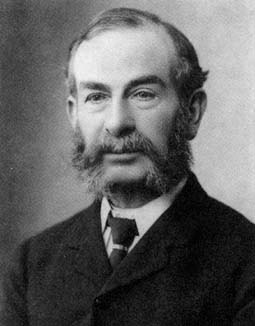
Edward Routh
Edward John Routh FRS (/raʊθ/; 20 January 1831 – 7 June 1907) was an English mathematician, noted as the outstanding coach of students preparing for the Mathematical Tripos examination of the University of Cambridge in its heyday in the middle of the nineteenth century. He also did much to systematise the mathematical theory of mechanics and created several ideas critical to the development of modern control systems theory.
Routh was born of an English father and a French-Canadian mother in Quebec, at that time the British colony of Lower Canada. His father's family could trace its history back to the Norman Conquest when it acquired land at Routh near Beverley, Yorkshire. His mother's family, the Taschereau family, was well-established in Quebec, tracing their ancestry back to the early days of the French colony. His parents were Sir Randolph Isham Routh (1782–1858) and his second wife, Marie Louise Taschereau (1810–1891). Sir Randolph was Commissary General of the British Army 1826, Chairman of the Irish Famine Relief Commission (1845–48) and Deputy Commissary General, the senior Commissariat officer at the Battle of Waterloo, and Marie Louise was the daughter of Judge Jean-Thomas Taschereau and the sister of Judge Jean-Thomas and Cardinal Elzéar-Alexandre Taschereau.
Routh came to England aged eleven and attended University College School and then entered University College, London in 1847, having won a scholarship. There he studied under Augustus De Morgan, whose influence led to Routh to decide on a career in mathematics.
Routh obtained his BA (1849) and MA (1853) in London. He attended Peterhouse, Cambridge, where he was taught by Isaac Todhunter and coached by "senior wrangler maker" William Hopkins. While at Peterhouse, Routh rowed for Peterhouse Boat Club. In 1854, Routh graduated just above James Clerk Maxwell, as Senior Wrangler, sharing the Smith's prize with him. Routh was elected fellow of Peterhouse in 1856.
On graduation, Routh took up work as a private mathematics tutor in Cambridge and took on the pupils of William John Steele during the latter's fatal illness, though insisting that Steele take the fees. Routh inherited Steele's pupils, going on to establish an unbeaten record as a coach. He coached over 600 pupils between 1855 and 1888, 28 of them making Senior wrangler, as to Hopkins' 17 with 43 of his pupils winning Smith's Prize.
Routh worked conscientiously and systematically, taking rigidly timetabled classes of ten pupils during the day and spending the evenings preparing extra material for the ablest men. "His lectures were enlivened by mathematical jokes of a rather heavy kind."
Routh was a staunch defender of the Cambridge competitive system and despaired when the university started to publish examination results in alphabetical order, observing "They will want to run the Derby alphabetically next".
Astronomer Royal George Biddell Airy sought to entice Routh to work at the Royal Observatory, Greenwich. Though Airy did not succeed, at Greenwich Routh met Airy's eldest daughter Hilda (1840–1916) whom he married in 1864. At the time, the university had a celibacy requirement, forcing Routh to vacate his fellowship and move out of Peterhouse. On the reformation of the college statutes, removing the celibacy requirement, Routh was the first person elected to an honorary fellowship by Peterhouse. The couple had five sons and a daughter. Routh was a "kindly man and a good conversationalist with friends, but with strangers he was shy and reserved."
Hub AI
Edward Routh AI simulator
(@Edward Routh_simulator)
Edward Routh
Edward John Routh FRS (/raʊθ/; 20 January 1831 – 7 June 1907) was an English mathematician, noted as the outstanding coach of students preparing for the Mathematical Tripos examination of the University of Cambridge in its heyday in the middle of the nineteenth century. He also did much to systematise the mathematical theory of mechanics and created several ideas critical to the development of modern control systems theory.
Routh was born of an English father and a French-Canadian mother in Quebec, at that time the British colony of Lower Canada. His father's family could trace its history back to the Norman Conquest when it acquired land at Routh near Beverley, Yorkshire. His mother's family, the Taschereau family, was well-established in Quebec, tracing their ancestry back to the early days of the French colony. His parents were Sir Randolph Isham Routh (1782–1858) and his second wife, Marie Louise Taschereau (1810–1891). Sir Randolph was Commissary General of the British Army 1826, Chairman of the Irish Famine Relief Commission (1845–48) and Deputy Commissary General, the senior Commissariat officer at the Battle of Waterloo, and Marie Louise was the daughter of Judge Jean-Thomas Taschereau and the sister of Judge Jean-Thomas and Cardinal Elzéar-Alexandre Taschereau.
Routh came to England aged eleven and attended University College School and then entered University College, London in 1847, having won a scholarship. There he studied under Augustus De Morgan, whose influence led to Routh to decide on a career in mathematics.
Routh obtained his BA (1849) and MA (1853) in London. He attended Peterhouse, Cambridge, where he was taught by Isaac Todhunter and coached by "senior wrangler maker" William Hopkins. While at Peterhouse, Routh rowed for Peterhouse Boat Club. In 1854, Routh graduated just above James Clerk Maxwell, as Senior Wrangler, sharing the Smith's prize with him. Routh was elected fellow of Peterhouse in 1856.
On graduation, Routh took up work as a private mathematics tutor in Cambridge and took on the pupils of William John Steele during the latter's fatal illness, though insisting that Steele take the fees. Routh inherited Steele's pupils, going on to establish an unbeaten record as a coach. He coached over 600 pupils between 1855 and 1888, 28 of them making Senior wrangler, as to Hopkins' 17 with 43 of his pupils winning Smith's Prize.
Routh worked conscientiously and systematically, taking rigidly timetabled classes of ten pupils during the day and spending the evenings preparing extra material for the ablest men. "His lectures were enlivened by mathematical jokes of a rather heavy kind."
Routh was a staunch defender of the Cambridge competitive system and despaired when the university started to publish examination results in alphabetical order, observing "They will want to run the Derby alphabetically next".
Astronomer Royal George Biddell Airy sought to entice Routh to work at the Royal Observatory, Greenwich. Though Airy did not succeed, at Greenwich Routh met Airy's eldest daughter Hilda (1840–1916) whom he married in 1864. At the time, the university had a celibacy requirement, forcing Routh to vacate his fellowship and move out of Peterhouse. On the reformation of the college statutes, removing the celibacy requirement, Routh was the first person elected to an honorary fellowship by Peterhouse. The couple had five sons and a daughter. Routh was a "kindly man and a good conversationalist with friends, but with strangers he was shy and reserved."