
Recent from talks
Effective medium approximations
Knowledge base stats:
Talk channels stats:
Members stats:
Effective medium approximations
In materials science, effective medium approximations (EMA) or effective medium theory (EMT) pertain to analytical or theoretical modeling that describes the macroscopic properties of composite materials. EMAs or EMTs are developed from averaging the multiple values of the constituents that directly make up the composite material. At the constituent level, the values of the materials vary and are inhomogeneous. Precise calculation of the many constituent values is nearly impossible. However, theories have been developed that can produce acceptable approximations which in turn describe useful parameters including the effective permittivity and permeability of the materials as a whole. In this sense, effective medium approximations are descriptions of a medium (composite material) based on the properties and the relative fractions of its components and are derived from calculations, and effective medium theory. There are two widely used formulae.
Effective permittivity and permeability are averaged dielectric and magnetic characteristics of a microinhomogeneous medium. They both were derived in quasi-static approximation when the electric field inside a mixture particle may be considered as homogeneous. So, these formulae can not describe the particle size effect. Many attempts were undertaken to improve these formulae.
There are many different effective medium approximations, each of them being more or less accurate in distinct conditions. Nevertheless, they all assume that the macroscopic system is homogeneous and, typical of all mean field theories, they fail to predict the properties of a multiphase medium close to the percolation threshold due to the absence of long-range correlations or critical fluctuations in the theory.
The properties under consideration are usually the conductivity or the dielectric constant of the medium. These parameters are interchangeable in the formulas in a whole range of models due to the wide applicability of the Laplace equation. The problems that fall outside of this class are mainly in the field of elasticity and hydrodynamics, due to the higher order tensorial character of the effective medium constants.


EMAs can be discrete models, such as applied to resistor networks, or continuum theories as applied to elasticity or viscosity. However, most of the current theories have difficulty in describing percolating systems. Indeed, among the numerous effective medium approximations, only Bruggeman's symmetrical theory is able to predict a threshold. This characteristic feature of the latter theory puts it in the same category as other mean field theories of critical phenomena.[citation needed]
For a mixture of two materials with permittivities and with corresponding volume fractions and , D.A.G. Bruggeman proposed a formula of the following form:


Here the positive sign before the square root must be altered to a negative sign in some cases in order to get the correct imaginary part of effective complex permittivity which is related with electromagnetic wave attenuation. The formula is symmetric with respect to swapping the 'd' and 'm' roles. This formula is based on the equality
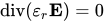
where is the jump of electric displacement flux all over the integration surface, is the component of microscopic electric field normal to the integration surface, is the local relative complex permittivity which takes the value inside the picked metal particle, the value inside the picked dielectric particle and the value outside the picked particle, is the normal component of the macroscopic electric field. Formula (4) comes out of Maxwell's equality . Thus only one picked particle is considered in Bruggeman's approach. The interaction with all the other particles is taken into account only in a mean field approximation described by . Formula (3) gives a reasonable resonant curve for plasmon excitations in metal nanoparticles if their size is 10 nm or smaller. However, it is unable to describe the size dependence for the resonant frequency of plasmon excitations that are observed in experiments


Hub AI
Effective medium approximations AI simulator
(@Effective medium approximations_simulator)
Effective medium approximations
In materials science, effective medium approximations (EMA) or effective medium theory (EMT) pertain to analytical or theoretical modeling that describes the macroscopic properties of composite materials. EMAs or EMTs are developed from averaging the multiple values of the constituents that directly make up the composite material. At the constituent level, the values of the materials vary and are inhomogeneous. Precise calculation of the many constituent values is nearly impossible. However, theories have been developed that can produce acceptable approximations which in turn describe useful parameters including the effective permittivity and permeability of the materials as a whole. In this sense, effective medium approximations are descriptions of a medium (composite material) based on the properties and the relative fractions of its components and are derived from calculations, and effective medium theory. There are two widely used formulae.
Effective permittivity and permeability are averaged dielectric and magnetic characteristics of a microinhomogeneous medium. They both were derived in quasi-static approximation when the electric field inside a mixture particle may be considered as homogeneous. So, these formulae can not describe the particle size effect. Many attempts were undertaken to improve these formulae.
There are many different effective medium approximations, each of them being more or less accurate in distinct conditions. Nevertheless, they all assume that the macroscopic system is homogeneous and, typical of all mean field theories, they fail to predict the properties of a multiphase medium close to the percolation threshold due to the absence of long-range correlations or critical fluctuations in the theory.
The properties under consideration are usually the conductivity or the dielectric constant of the medium. These parameters are interchangeable in the formulas in a whole range of models due to the wide applicability of the Laplace equation. The problems that fall outside of this class are mainly in the field of elasticity and hydrodynamics, due to the higher order tensorial character of the effective medium constants.
EMAs can be discrete models, such as applied to resistor networks, or continuum theories as applied to elasticity or viscosity. However, most of the current theories have difficulty in describing percolating systems. Indeed, among the numerous effective medium approximations, only Bruggeman's symmetrical theory is able to predict a threshold. This characteristic feature of the latter theory puts it in the same category as other mean field theories of critical phenomena.[citation needed]
For a mixture of two materials with permittivities and with corresponding volume fractions and , D.A.G. Bruggeman proposed a formula of the following form:
Here the positive sign before the square root must be altered to a negative sign in some cases in order to get the correct imaginary part of effective complex permittivity which is related with electromagnetic wave attenuation. The formula is symmetric with respect to swapping the 'd' and 'm' roles. This formula is based on the equality
where is the jump of electric displacement flux all over the integration surface, is the component of microscopic electric field normal to the integration surface, is the local relative complex permittivity which takes the value inside the picked metal particle, the value inside the picked dielectric particle and the value outside the picked particle, is the normal component of the macroscopic electric field. Formula (4) comes out of Maxwell's equality . Thus only one picked particle is considered in Bruggeman's approach. The interaction with all the other particles is taken into account only in a mean field approximation described by . Formula (3) gives a reasonable resonant curve for plasmon excitations in metal nanoparticles if their size is 10 nm or smaller. However, it is unable to describe the size dependence for the resonant frequency of plasmon excitations that are observed in experiments