


Community hub
Recent from talks
Contribute something
Nothing was collected or created yet.
Percolation threshold
View on Wikipedia | This article may be too technical for most readers to understand. (March 2021) |
| Part of a series on | ||||
| Network science | ||||
|---|---|---|---|---|
| Network types | ||||
| Graphs | ||||
|
||||
| Models | ||||
|
||||
| ||||

The percolation threshold is a mathematical concept in percolation theory that describes the formation of long-range connectivity in random systems. Below the threshold a giant connected component does not exist; while above it, there exists a giant component of the order of system size. In engineering and coffee making, percolation represents the flow of fluids through porous media, but in the mathematics and physics worlds it generally refers to simplified lattice models of random systems or networks (graphs), and the nature of the connectivity in them. The percolation threshold is the critical value of the occupation probability p, or more generally a critical surface for a group of parameters p1, p2, ..., such that infinite connectivity (percolation) first occurs.[1]
Percolation models
[edit]The most common percolation model is to take a regular lattice, like a square lattice, and make it into a random network by randomly "occupying" sites (vertices) or bonds (edges) with a statistically independent probability p. At a critical threshold pc, large clusters and long-range connectivity first appear, and this is called the percolation threshold. Depending on the method for obtaining the random network, one distinguishes between the site percolation threshold and the bond percolation threshold. More general systems have several probabilities p1, p2, etc., and the transition is characterized by a critical surface or manifold. One can also consider continuum systems, such as overlapping disks and spheres placed randomly, or the negative space (Swiss-cheese models).
To understand the threshold, you can consider a quantity such as the probability that there is a continuous path from one boundary to another along occupied sites or bonds—that is, within a single cluster. For example, one can consider a square system, and ask for the probability P that there is a path from the top boundary to the bottom boundary. As a function of the occupation probability p, one finds a sigmoidal plot that goes from P=0 at p=0 to P=1 at p=1. The larger the square is compared to the lattice spacing, the sharper the transition will be. When the system size goes to infinity, P(p) will be a step function at the threshold value pc. For finite large systems, P(pc) is a constant whose value depends upon the shape of the system; for the square system discussed above, P(pc)=1⁄2 exactly for any lattice by a simple symmetry argument.
There are other signatures of the critical threshold. For example, the size distribution (number of clusters of size s) drops off as a power-law for large s at the threshold, ns(pc) ~ s−τ, where τ is a dimension-dependent percolation critical exponents. For an infinite system, the critical threshold corresponds to the first point (as p increases) where the size of the clusters become infinite.
In the systems described so far, it has been assumed that the occupation of a site or bond is completely random—this is the so-called Bernoulli percolation. For a continuum system, random occupancy corresponds to the points being placed by a Poisson process. Further variations involve correlated percolation, such as percolation clusters related to Ising and Potts models of ferromagnets, in which the bonds are put down by the Fortuin–Kasteleyn method.[2] In bootstrap or k-sat percolation, sites and/or bonds are first occupied and then successively culled from a system if a site does not have at least k neighbors. Another important model of percolation, in a different universality class altogether, is directed percolation, where connectivity along a bond depends upon the direction of the flow. Another variation of recent interest is Explosive Percolation, whose thresholds are listed on that page.
Over the last several decades, a tremendous amount of work has gone into finding exact and approximate values of the percolation thresholds for a variety of these systems. Exact thresholds are only known for certain two-dimensional lattices that can be broken up into a self-dual array, such that under a triangle-triangle transformation, the system remains the same. Studies using numerical methods have led to numerous improvements in algorithms and several theoretical discoveries.
Simple duality in two dimensions implies that all fully triangulated lattices (e.g., the triangular, union jack, cross dual, martini dual and asanoha or 3-12 dual, and the Delaunay triangulation) all have site thresholds of 1⁄2, and self-dual lattices (square, martini-B) have bond thresholds of 1⁄2.
The notation such as (4,82) comes from Grünbaum and Shephard,[3] and indicates that around a given vertex, going in the clockwise direction, one encounters first a square and then two octagons. Besides the eleven Archimedean lattices composed of regular polygons with every site equivalent, many other more complicated lattices with sites of different classes have been studied.
Error bars in the last digit or digits are shown by numbers in parentheses. Thus, 0.729724(3) signifies 0.729724 ± 0.000003, and 0.74042195(80) signifies 0.74042195 ± 0.00000080. The error bars variously represent one or two standard deviations in net error (including statistical and expected systematic error), or an empirical confidence interval, depending upon the source.
Percolation on networks
[edit]For a random tree-like network (i.e., a connected network with no cycle) without degree-degree correlation, it can be shown that such network can have a giant component, and the percolation threshold (transmission probability) is given by
.
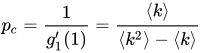
Where is the generating function corresponding to the excess degree distribution, is the average degree of the network and is the second moment of the degree distribution. So, for example, for an ER network, since the degree distribution is a Poisson distribution, where the threshold is at .


In networks with low clustering, , the critical point gets scaled by such that:[4]


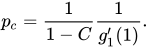
This indicates that for a given degree distribution, the clustering leads to a larger percolation threshold, mainly because for a fixed number of links, the clustering structure reinforces the core of the network with the price of diluting the global connections. For networks with high clustering, strong clustering could induce the core–periphery structure, in which the core and periphery might percolate at different critical points, and the above approximate treatment is not applicable.[5]
Percolation in 2D
[edit]Thresholds on Archimedean lattices
[edit]
| Lattice | z | Site percolation threshold | Bond percolation threshold | |
|---|---|---|---|---|
| 3-12 or super-kagome, (3, 122 ) | 3 | 3 | 0.807900764... = (1 − 2 sin (π/18))1⁄2[7] | 0.74042195(80),[8] 0.74042077(2),[9] 0.740420800(2),[10] 0.7404207988509(8),[11][12] 0.740420798850811610(2),[13] |
| cross, truncated trihexagonal (4, 6, 12) | 3 | 3 | 0.746,[14] 0.750,[15] 0.747806(4),[7] 0.7478008(2)[11] | 0.6937314(1),[11] 0.69373383(72),[8] 0.693733124922(2)[13] |
| square octagon, bathroom tile, 4-8, truncated square
(4, 82) |
3 | - | 0.729,[14] 0.729724(3),[7] 0.7297232(5)[11] | 0.6768,[16] 0.67680232(63),[8] 0.6768031269(6),[11] 0.6768031243900113(3),[13] |
| honeycomb (63) | 3 | 3 | 0.6962(6),[17] 0.697040230(5),[11] 0.6970402(1),[18] 0.6970413(10),[19] 0.697043(3),[7] | 0.652703645... = 1-2 sin (π/18), 1+ p3-3p2=0[20] |
| kagome (3, 6, 3, 6) | 4 | 4 | 0.652703645... = 1 − 2 sin(π/18)[20] | 0.5244053(3),[21] 0.52440516(10),[19] 0.52440499(2),[18] 0.524404978(5),[9] 0.52440572...,[22] 0.52440500(1),[10] 0.524404999173(3),[11][12] 0.524404999167439(4)[23] 0.52440499916744820(1)[13] |
| ruby,[24] rhombitrihexagonal (3, 4, 6, 4) | 4 | 4 | 0.620,[14] 0.621819(3),[7] 0.62181207(7)[11] | 0.52483258(53),[8] 0.5248311(1),[11] 0.524831461573(1)[13] |
| square (44) | 4 | 4 | 0.59274(10),[25] 0.59274605079210(2),[23] 0.59274601(2),[11] 0.59274605095(15),[26] 0.59274621(13),[27] 0.592746050786(3),[28] 0.5927460507896(1),[29] 0.59274621(33),[30] 0.59274598(4),[31][32] 0.59274605(3),[18] 0.593(1),[33] 0.591(1),[34] 0.569(13),[35] 0.59274(5)[36] | 1⁄2 |
| snub hexagonal, maple leaf[37] (34,6) | 5 | 5 | 0.579[15] 0.579498(3)[7] | 0.43430621(50),[8] 0.43432764(3),[11] 0.4343283172240(6),[13] |
| snub square, puzzle (32, 4, 3, 4 ) | 5 | 5 | 0.550,[14][38] 0.550806(3)[7] | 0.41413743(46),[8] 0.4141378476(7),[11] 0.4141378565917(1),[13] |
| frieze, elongated triangular(33, 42) | 5 | 5 | 0.549,[14] 0.550213(3),[7] 0.5502(8)[39] | 0.4196(6),[39] 0.41964191(43),[8] 0.41964044(1),[11] 0.41964035886369(2)[13] |
| triangular (36) | 6 | 6 | 1⁄2 | 0.347296355... = 2 sin (π/18), 1 + p3 − 3p = 0[20] |

Note: sometimes "hexagonal" is used in place of honeycomb, although in some contexts a triangular lattice is also called a hexagonal lattice. z = bulk coordination number.
2D lattices with extended and complex neighborhoods
[edit]In this section, sq-1,2,3 corresponds to square (NN+2NN+3NN),[40] etc. Equivalent to square-2N+3N+4N,[41] sq(1,2,3).[42] tri = triangular, hc = honeycomb.
| Lattice | z | Site percolation threshold | Bond percolation threshold |
|---|---|---|---|
| sq-1, sq-2, sq-3, sq-5 | 4 | 0.5927...[40][41] (square site) | |
| sq-1,2, sq-2,3, sq-3,5... 3x3 square | 8 | 0.407...[40][41][43] (square matching) | 0.25036834(6),[18] 0.2503685,[44] 0.25036840(4)[45] |
| sq-1,3 | 8 | 0.337[40][41] | 0.2214995[44] |
| sq-2,5: 2NN+5NN | 8 | 0.337[41] | |
| hc-1,2,3: honeycomb-NN+2NN+3NN | 12 | 0.300,[42] 0.300,[15] 0.302960... = 1-pc(site, hc)[46] | |
| tri-1,2: triangular-NN+2NN | 12 | 0.295,[42] 0.289,[15] 0.290258(19)[47] | |
| tri-2,3: triangular-2NN+3NN | 12 | 0.232020(36),[48] 0.232020(20)[47] | |
| sq-4: square-4NN | 8 | 0.270...[41] | |
| sq-1,5: square-NN+5NN (r ≤ 2) | 8 | 0.277[41] | |
| sq-1,2,3: square-NN+2NN+3NN | 12 | 0.292,[49] 0.290(5)[50] 0.289,[15] 0.288,[40][41] 0.2891226(14)[51] | 0.1522203[44] |
| sq-2,3,5: square-2NN+3NN+5NN | 12 | 0.288[41] | |
| sq-1,4: square-NN+4NN | 12 | 0.236[41] | |
| sq-2,4: square-2NN+4NN | 12 | 0.225[41] | |
| tri-4: triangular-4NN | 12 | 0.192450(36),[48] 0.1924428(50)[47] | |
| hc-2,4: honeycomb-2NN+4NN | 12 | 0.2374[52] | |
| tri-1,3: triangular-NN+3NN | 12 | 0.264539(21)[47] | |
| tri-1,2,3: triangular-NN+2NN+3NN | 18 | 0.225,[49] 0.215,[15] 0.215459(36)[48] 0.2154657(17)[47] | |
| sq-3,4: 3NN+4NN | 12 | 0.221[41] | |
| sq-1,2,5: NN+2NN+5NN | 12 | 0.240[41] | 0.13805374[44] |
| sq-1,3,5: NN+3NN+5NN | 12 | 0.233[41] | |
| sq-4,5: 4NN+5NN | 12 | 0.199[41] | |
| sq-1,2,4: NN+2NN+4NN | 16 | 0.219[41] | |
| sq-1,3,4: NN+3NN+4NN | 16 | 0.208[41] | |
| sq-2,3,4: 2NN+3NN+4NN | 16 | 0.202[41] | |
| sq-1,4,5: NN+4NN+5NN | 16 | 0.187[41] | |
| sq-2,4,5: 2NN+4NN+5NN | 16 | 0.182[41] | |
| sq-3,4,5: 3NN+4NN+5NN | 16 | 0.179[41] | |
| sq-1,2,3,5 asterisk pattern | 16 | 0.208[41] | 0.1032177[44] |
| tri-4,5: 4NN+5NN | 18 | 0.140250(36),[48] | |
| sq-1,2,3,4: NN+2NN+3NN+4NN () | 20 | 0.19671(9),[53] 0.196,[41] 0.196724(10),[54] 0.1967293(7)[51] | 0.0841509[44] |
| sq-1,2,4,5: NN+2NN+4NN+5NN | 20 | 0.177[41] | |
| sq-1,3,4,5: NN+3NN+4NN+5NN | 20 | 0.172[41] | |
| sq-2,3,4,5: 2NN+3NN+4NN+5NN | 20 | 0.167[41] | |
| sq-1,2,3,5,6 asterisk pattern | 20 | 0.0783110[44] | |
| sq-1,2,3,4,5: NN+2NN+3NN+4NN+5NN (, also within a 5 x 5 square) | 24 | 0.164,[15] 0.164,[41] 0.1647124(6)[51] | |
| sq-1,2,3,4,6: NN+2NN+3NN+4NN+6NN (diamond ) | 24 | 0.16134,[55] | |
| tri-1,4,5: NN+4NN+5NN | 24 | 0.131660(36)[48] | |
| sq-1,...,6: NN+...+6NN (r≤3) | 28 | 0.142,[15] 0.1432551(9)[51] | 0.0558493[44] |
| tri-2,3,4,5: 2NN+3NN+4NN+5NN | 30 | 0.117460(36)[48] 0.135823(27)[47] | |
| tri-1,2,3,4,5: NN+2NN+3NN+4NN+5NN |
36 | 0.115,[15] 0.115740(36),[48] 0.1157399(58)[47] | |
| sq-1,...,7: NN+...+7NN () | 36 | 0.113,[15] 0.1153481(9)[51] | 0.04169608[44] |
| sq lat, diamond boundary: dist. ≤ 4 | 40 | 0.105(5)[50] | |
| sq-1,...,8: NN+..+8NN () | 44 | 0.095,[38] 0.095765(5),[54] 0.09580(2),[53] 0.0957661(9)[51] | |
| sq-1,...,9: NN+..+9NN (r≤4) | 48 | 0.086[15] | 0.02974268[44] |
| sq-1,...,11: NN+...+11NN () | 60 | 0.02301190(3)[44] | |
| sq-1,...,23 (r ≤ 7) | 148 | 0.008342595[45] | |
| sq-1,...,32: NN+...+32NN () | 224 | 0.0053050415(33)[44] | |
| sq-1,...,86: NN+...+86NN (r≤15) | 708 | 0.001557644(4)[56] | |
| sq-1,...,141: NN+...+141NN () | 1224 | 0.000880188(90)[44] | |
| sq-1,...,185: NN+...+185NN (r≤23) | 1652 | 0.000645458(4)[56] | |
| sq-1,...,317: NN+...+317NN (r≤31) | 3000 | 0.000349601(3)[56] | |
| sq-1,...,413: NN+...+413NN () | 4016 | 0.0002594722(11)[44] | |
| sq lat, diamond boundary: dist. ≤ 6 | 84 | 0.049(5)[50] | |
| sq lat, diamond boundary: dist. ≤ 8 | 144 | 0.028(5)[50] | |
| sq lat, diamond boundary: dist. ≤ 10 | 220 | 0.019(5)[50] | |
| 2x2 touching lattice squares* (same as sq-1,2,3,4) | 20 | φc = 0.58365(2),[54] pc = 0.196724(10),[54] 0.19671(9),[53] | |
| 3x3 touching lattice squares* (same as sq-1,...,8)) | 44 | φc = 0.59586(2),[54] pc = 0.095765(5),[54] 0.09580(2)[53] | |
| 4x4 touching lattice squares* | 76 | φc = 0.60648(1),[54] pc = 0.0566227(15),[54] 0.05665(3),[53] | |
| 5x5 touching lattice squares* | 116 | φc = 0.61467(2),[54] pc = 0.037428(2),[54] 0.03745(2),[53] | |
| 6x6 touching lattice squares* | 220 | pc = 0.02663(1),[53] | |
| 10x10 touching lattice squares* | 436 | φc = 0.63609(2),[54] pc = 0.0100576(5)[54] | |
| within 11 x 11 square (r=5) | 120 | 0.01048079(6)[56] | |
| within 15 x 15 square (r=7) | 224 | 0.005287692(22)[56] | |
| 20x20 touching lattice squares* | 1676 | φc = 0.65006(2),[54] pc = 0.0026215(3)[54] | |
| within 31 x 31 square (r=15) | 960 | 0.001131082(5)[56] | |
| 100x100 touching lattice squares* | 40396 | φc = 0.66318(2),[54] pc = 0.000108815(12)[54] | |
| 1000x1000 touching lattice squares* | 4003996 | φc = 0.66639(1),[54] pc = 1.09778(6)E-06 [54] |


Here NN = nearest neighbor, 2NN = second nearest neighbor (or next nearest neighbor), 3NN = third nearest neighbor (or next-next nearest neighbor), etc. These are also called 2N, 3N, 4N respectively in some papers.[40]
- For overlapping or touching squares, (site) given here is the net fraction of sites occupied similar to the in continuum percolation. The case of a 2×2 square is equivalent to percolation of a square lattice NN+2NN+3NN+4NN or sq-1,2,3,4 with threshold with .[54] The 3×3 square corresponds to sq-1,2,3,4,5,6,7,8 with z=44 and . The value of z for a k x k square is (2k+1)2-5.




2D distorted lattices
[edit]Here, one distorts a regular lattice of unit spacing by moving vertices uniformly within the box , and considers percolation when sites are within Euclidean distance of each other.


| Lattice | Site percolation threshold | Bond percolation threshold | |||
|---|---|---|---|---|---|
| square | 0.2 | 1.1 | 0.8025(2)[57] | ||
| 0.2 | 1.2 | 0.6667(5)[57] | |||
| 0.1 | 1.1 | 0.6619(1)[57] |

Overlapping shapes on 2D lattices
[edit]Site threshold is number of overlapping objects per lattice site. k is the length (net area). Overlapping squares are shown in the complex neighborhood section. Here z is the coordination number to k-mers of either orientation, with for sticks.


| System | k | z | Site coverage φc | Site percolation threshold pc |
|---|---|---|---|---|
| 1 x 2 dimer, square lattice | 2 | 22 | 0.54691[53]
0.5483(2)[58] |
0.17956(3)[53]
0.18019(9)[58] |
| 1 x 2 aligned dimer, square lattice | 2 | 14(?) | 0.5715(18)[58] | 0.3454(13)[58] |
| 1 x 3 trimer, square lattice | 3 | 37 | 0.49898[53]
0.50004(64)[58] |
0.10880(2)[53]
0.1093(2)[58] |
| 1 x 4 stick, square lattice | 4 | 54 | 0.45761[53] | 0.07362(2)[53] |
| 1 x 5 stick, square lattice | 5 | 73 | 0.42241[53] | 0.05341(1)[53] |
| 1 x 6 stick, square lattice | 6 | 94 | 0.39219[53] | 0.04063(2)[53] |
The coverage is calculated from by for sticks, because there are sites where a stick will cause an overlap with a given site.


For aligned sticks:

Approximate formulas for thresholds of Archimedean lattices
[edit]| Lattice | z | Site percolation threshold | Bond percolation threshold |
|---|---|---|---|
| (3, 122 ) | 3 | ||
| (4, 6, 12) | 3 | ||
| (4, 82) | 3 | 0.676835..., 4p3 + 3p4 − 6 p5 − 2 p6 = 1[59] | |
| honeycomb (63) | 3 | ||
| kagome (3, 6, 3, 6) | 4 | 0.524430..., 3p2 + 6p3 − 12 p4+ 6 p5 − p6 = 1[60] | |
| (3, 4, 6, 4) | 4 | ||
| square (44) | 4 | 1⁄2 (exact) | |
| (34,6 ) | 5 | 0.434371..., 12p3 + 36p4 − 21p5 − 327 p6 + 69p7 + 2532p8 − 6533 p9 + 8256 p10 − 6255p11 + 2951p12 − 837 p13 + 126 p14 − 7p15 = 1 [citation needed] | |
| snub square, puzzle (32, 4, 3, 4 ) | 5 | ||
| (33, 42) | 5 | ||
| triangular (36) | 6 | 1⁄2 (exact) |
AB percolation and colored percolation in 2D
[edit]In AB percolation, a is the proportion of A sites among B sites, and bonds are drawn between sites of opposite species.[61] It is also called antipercolation.

In colored percolation, occupied sites are assigned one of colors with equal probability, and connection is made along bonds between neighbors of different colors.[62]

| Lattice | z | Site percolation threshold | |
|---|---|---|---|
| triangular AB | 6 | 6 | 0.2145,[61] 0.21524(34),[63] 0.21564(3)[64] |
| AB on square-covering lattice | 6 | 6 | [65] |
| square three-color | 4 | 4 | 0.80745(5)[62] |
| square four-color | 4 | 4 | 0.73415(4)[62] |
| square five-color | 4 | 4 | 0.69864(7)[62] |
| square six-color | 4 | 4 | 0.67751(5)[62] |
| triangular two-color | 6 | 6 | 0.72890(4)[62] |
| triangular three-color | 6 | 6 | 0.63005(4)[62] |
| triangular four-color | 6 | 6 | 0.59092(3)[62] |
| triangular five-color | 6 | 6 | 0.56991(5)[62] |
| triangular six-color | 6 | 6 | 0.55679(5)[62] |

Site-bond percolation in 2D
[edit]Site bond percolation. Here is the site occupation probability and is the bond occupation probability, and connectivity is made only if both the sites and bonds along a path are occupied. The criticality condition becomes a curve = 0, and some specific critical pairs are listed below.


Square lattice:
| Lattice | z | Site percolation threshold | Bond percolation threshold | |
|---|---|---|---|---|
| square | 4 | 4 | 0.615185(15)[66] | 0.95 |
| 0.667280(15)[66] | 0.85 | |||
| 0.732100(15)[66] | 0.75 | |||
| 0.75 | 0.726195(15)[66] | |||
| 0.815560(15)[66] | 0.65 | |||
| 0.85 | 0.615810(30)[66] | |||
| 0.95 | 0.533620(15)[66] |
Honeycomb (hexagonal) lattice:
| Lattice | z | Site percolation threshold | Bond percolation threshold | |
|---|---|---|---|---|
| honeycomb | 3 | 3 | 0.7275(5)[67] | 0.95 |
| 0. 0.7610(5)[67] | 0.90 | |||
| 0.7986(5)[67] | 0.85 | |||
| 0.80 | 0.8481(5)[67] | |||
| 0.8401(5)[67] | 0.80 | |||
| 0.85 | 0.7890(5)[67] | |||
| 0.90 | 0.7377(5)[67] | |||
| 0.95 | 0.6926(5)[67] |
Kagome lattice:
| Lattice | z | Site percolation threshold | Bond percolation threshold | |
|---|---|---|---|---|
| kagome | 4 | 4 | 0.6711(4),[67] 0.67097(3)[68] | 0.95 |
| 0.6914(5),[67] 0.69210(2)[68] | 0.90 | |||
| 0.7162(5),[67] 0.71626(3)[68] | 0.85 | |||
| 0.7428(5),[67] 0.74339(3)[68] | 0.80 | |||
| 0.75 | 0.7894(9)[67] | |||
| 0.7757(8),[67] 0.77556(3)[68] | 0.75 | |||
| 0.80 | 0.7152(7)[67] | |||
| 0.81206(3)[68] | 0.70 | |||
| 0.85 | 0.6556(6)[67] | |||
| 0.85519(3)[68] | 0.65 | |||
| 0.90 | 0.6046(5)[67] | |||
| 0.90546(3)[68] | 0.60 | |||
| 0.95 | 0.5615(4)[67] | |||
| 0.96604(4)[68] | 0.55 | |||
| 0.9854(3)[68] | 0.53 |
* For values on different lattices, see "An investigation of site-bond percolation on many lattices".[67]
Approximate formula for site-bond percolation on a honeycomb lattice
| Lattice | z | Threshold | Notes | |
|---|---|---|---|---|
| (63) honeycomb | 3 | 3 | , When equal: ps = pb = 0.82199 | approximate formula, ps = site prob., pb = bond prob., pbc = 1 − 2 sin (π/18),[19] exact at ps=1, pb=pbc. |
![{\displaystyle p_{b}p_{s}[1-({\sqrt {p_{bc}}}/(3-p_{bc}))({\sqrt {p_{b}}}-{\sqrt {p_{bc}}})]=p_{bc}}](https://wikimedia.org/api/rest_v1/media/math/render/svg/841ca3acd9efa5a314d4308e4cae70eacb5fd1e5)
Archimedean duals (Laves lattices)
[edit]
Laves lattices are the duals to the Archimedean lattices. Drawings from.[6] See also Uniform tilings.
| Lattice | z | Site percolation threshold | Bond percolation threshold | |
|---|---|---|---|---|
| Cairo pentagonal
D(32,4,3,4)=(2⁄3)(53)+(1⁄3)(54) |
3,4 | 3 1⁄3 | 0.6501834(2),[11] 0.650184(5)[6] | 0.585863... = 1 − pcbond(32,4,3,4) |
| Pentagonal D(33,42)=(1⁄3)(54)+(2⁄3)(53) | 3,4 | 3 1⁄3 | 0.6470471(2),[11] 0.647084(5),[6] 0.6471(6)[39] | 0.580358... = 1 − pcbond(33,42), 0.5800(6)[39] |
| D(34,6)=(1⁄5)(46)+(4⁄5)(43) | 3,6 | 3 3⁄5 | 0.639447[6] | 0.565694... = 1 − pcbond(34,6 ) |
| dice, rhombille tiling
D(3,6,3,6) = (1⁄3)(46) + (2⁄3)(43) |
3,6 | 4 | 0.5851(4),[69] 0.585040(5)[6] | 0.475595... = 1 − pcbond(3,6,3,6 ) |
| ruby dual
D(3,4,6,4) = (1⁄6)(46) + (2⁄6)(43) + (3⁄6)(44) |
3,4,6 | 4 | 0.582410(5)[6] | 0.475167... = 1 − pcbond(3,4,6,4 ) |
| union jack, tetrakis square tiling
D(4,82) = (1⁄2)(34) + (1⁄2)(38) |
4,8 | 6 | 1⁄2 | 0.323197... = 1 − pcbond(4,82 ) |
| bisected hexagon,[70] cross dual
D(4,6,12)= (1⁄6)(312)+(2⁄6)(36)+(1⁄2)(34) |
4,6,12 | 6 | 1⁄2 | 0.306266... = 1 − pcbond(4,6,12) |
| asanoha (hemp leaf)[71]
D(3, 122)=(2⁄3)(33)+(1⁄3)(312) |
3,12 | 6 | 1⁄2 | 0.259579... = 1 − pcbond(3, 122) |
2-uniform lattices
[edit]Top 3 lattices: #13 #12 #36
Bottom 3 lattices: #34 #37 #11

Top 2 lattices: #35 #30
Bottom 2 lattices: #41 #42

Top 4 lattices: #22 #23 #21 #20
Bottom 3 lattices: #16 #17 #15

Top 2 lattices: #31 #32
Bottom lattice: #33

| # | Lattice | z | Site percolation threshold | Bond percolation threshold | |
|---|---|---|---|---|---|
| 41 | (1⁄2)(3,4,3,12) + (1⁄2)(3, 122) | 4,3 | 3.5 | 0.7680(2)[72] | 0.67493252(36)[citation needed] |
| 42 | (1⁄3)(3,4,6,4) + (2⁄3)(4,6,12) | 4,3 | 31⁄3 | 0.7157(2)[72] | 0.64536587(40)[citation needed] |
| 36 | (1⁄7)(36) + (6⁄7)(32,4,12) | 6,4 | 4 2⁄7 | 0.6808(2)[72] | 0.55778329(40)[citation needed] |
| 15 | (2⁄3)(32,62) + (1⁄3)(3,6,3,6) | 4,4 | 4 | 0.6499(2)[72] | 0.53632487(40)[citation needed] |
| 34 | (1⁄7)(36) + (6⁄7)(32,62) | 6,4 | 4 2⁄7 | 0.6329(2)[72] | 0.51707873(70)[citation needed] |
| 16 | (4⁄5)(3,42,6) + (1⁄5)(3,6,3,6) | 4,4 | 4 | 0.6286(2)[72] | 0.51891529(35)[citation needed] |
| 17 | (4⁄5)(3,42,6) + (1⁄5)(3,6,3,6)* | 4,4 | 4 | 0.6279(2)[72] | 0.51769462(35)[citation needed] |
| 35 | (2⁄3)(3,42,6) + (1⁄3)(3,4,6,4) | 4,4 | 4 | 0.6221(2)[72] | 0.51973831(40)[citation needed] |
| 11 | (1⁄2)(34,6) + (1⁄2)(32,62) | 5,4 | 4.5 | 0.6171(2)[72] | 0.48921280(37)[citation needed] |
| 37 | (1⁄2)(33,42) + (1⁄2)(3,4,6,4) | 5,4 | 4.5 | 0.5885(2)[72] | 0.47229486(38)[citation needed] |
| 30 | (1⁄2)(32,4,3,4) + (1⁄2)(3,4,6,4) | 5,4 | 4.5 | 0.5883(2)[72] | 0.46573078(72)[citation needed] |
| 23 | (1⁄2)(33,42) + (1⁄2)(44) | 5,4 | 4.5 | 0.5720(2)[72] | 0.45844622(40)[citation needed] |
| 22 | (2⁄3)(33,42) + (1⁄3)(44) | 5,4 | 4 2⁄3 | 0.5648(2)[72] | 0.44528611(40)[citation needed] |
| 12 | (1⁄4)(36) + (3⁄4)(34,6) | 6,5 | 5 1⁄4 | 0.5607(2)[72] | 0.41109890(37)[citation needed] |
| 33 | (1⁄2)(33,42) + (1⁄2)(32,4,3,4) | 5,5 | 5 | 0.5505(2)[72] | 0.41628021(35)[citation needed] |
| 32 | (1⁄3)(33,42) + (2⁄3)(32,4,3,4) | 5,5 | 5 | 0.5504(2)[72] | 0.41549285(36)[citation needed] |
| 31 | (1⁄7)(36) + (6⁄7)(32,4,3,4) | 6,5 | 5 1⁄7 | 0.5440(2)[72] | 0.40379585(40)[citation needed] |
| 13 | (1⁄2)(36) + (1⁄2)(34,6) | 6,5 | 5.5 | 0.5407(2)[72] | 0.38914898(35)[citation needed] |
| 21 | (1⁄3)(36) + (2⁄3)(33,42) | 6,5 | 5 1⁄3 | 0.5342(2)[72] | 0.39491996(40)[citation needed] |
| 20 | (1⁄2)(36) + (1⁄2)(33,42) | 6,5 | 5.5 | 0.5258(2)[72] | 0.38285085(38)[citation needed] |
Inhomogeneous 2-uniform lattice
[edit]
This figure shows something similar to the 2-uniform lattice #37, except the polygons are not all regular—there is a rectangle in the place of the two squares—and the size of the polygons is changed. This lattice is in the isoradial representation in which each polygon is inscribed in a circle of unit radius. The two squares in the 2-uniform lattice must now be represented as a single rectangle in order to satisfy the isoradial condition. The lattice is shown by black edges, and the dual lattice by red dashed lines. The green circles show the isoradial constraint on both the original and dual lattices. The yellow polygons highlight the three types of polygons on the lattice, and the pink polygons highlight the two types of polygons on the dual lattice. The lattice has vertex types (1⁄2)(33,42) + (1⁄2)(3,4,6,4), while the dual lattice has vertex types (1⁄15)(46)+(6⁄15)(42,52)+(2⁄15)(53)+(6⁄15)(52,4). The critical point is where the longer bonds (on both the lattice and dual lattice) have occupation probability p = 2 sin (π/18) = 0.347296... which is the bond percolation threshold on a triangular lattice, and the shorter bonds have occupation probability 1 − 2 sin(π/18) = 0.652703..., which is the bond percolation on a hexagonal lattice. These results follow from the isoradial condition[73] but also follow from applying the star-triangle transformation to certain stars on the honeycomb lattice. Finally, it can be generalized to having three different probabilities in the three different directions, p1, p2 and p3 for the long bonds, and 1 − p1, 1 − p2, and 1 − p3 for the short bonds, where p1, p2 and p3 satisfy the critical surface for the inhomogeneous triangular lattice.
Thresholds on 2D bow-tie and martini lattices
[edit]To the left, center, and right are: the martini lattice, the martini-A lattice, the martini-B lattice. Below: the martini covering/medial lattice, same as the 2×2, 1×1 subnet for kagome-type lattices (removed).

Some other examples of generalized bow-tie lattices (a-d) and the duals of the lattices (e-h):

| Lattice | z | Site percolation threshold | Bond percolation threshold | |
|---|---|---|---|---|
| martini (3⁄4)(3,92)+(1⁄4)(93) | 3 | 3 | 0.764826..., 1 + p4 − 3p3 = 0[74] | 0.707107... = 1/√2[75] |
| bow-tie (c) | 3,4 | 3 1⁄7 | 0.672929..., 1 − 2p3 − 2p4 − 2p5 − 7p6 + 18p7 + 11p8 − 35p9 + 21p10 − 4p11 = 0[76] | |
| bow-tie (d) | 3,4 | 3 1⁄3 | 0.625457..., 1 − 2p2 − 3p3 + 4p4 − p5 = 0[76] | |
| martini-A (2⁄3)(3,72)+(1⁄3)(3,73) | 3,4 | 3 1⁄3 | 1/√2[76] | 0.625457..., 1 − 2p2 − 3p3 + 4p4 − p5 = 0[76] |
| bow-tie dual (e) | 3,4 | 3 2⁄3 | 0.595482..., 1-pcbond (bow-tie (a))[76] | |
| bow-tie (b) | 3,4,6 | 3 2⁄3 | 0.533213..., 1 − p − 2p3 -4p4-4p5+156+ 13p7-36p8+19p9+ p10 + p11=0[76] | |
| martini covering/medial (1⁄2)(33,9) + (1⁄2)(3,9,3,9) | 4 | 4 | 0.707107... = 1/√2[75] | 0.57086651(33)[citation needed] |
| martini-B (1⁄2)(3,5,3,52) + (1⁄2)(3,52) | 3, 5 | 4 | 0.618034... = 2/(1 + √5), 1- p2 − p = 0[74][76] | 1⁄2[75][76] |
| bow-tie dual (f) | 3,4,8 | 4 2⁄5 | 0.466787..., 1 − pcbond (bow-tie (b))[76] | |
| bow-tie (a) (1⁄2)(32,4,32,4) + (1⁄2)(3,4,3) | 4,6 | 5 | 0.5472(2),[39] 0.5479148(7)[77] | 0.404518..., 1 − p − 6p2 + 6p3 − p5 = 0[76][78] |
| bow-tie dual (h) | 3,6,8 | 5 | 0.374543..., 1 − pcbond(bow-tie (d))[76] | |
| bow-tie dual (g) | 3,6,10 | 5 1⁄2 | 0.547... = pcsite(bow-tie(a)) | 0.327071..., 1 − pcbond(bow-tie (c))[76] |
| martini dual (1⁄2)(33) + (1⁄2)(39) | 3,9 | 6 | 1⁄2 | 0.292893... = 1 − 1/√2[75] |
Thresholds on 2D covering, medial, and matching lattices
[edit]| Lattice | z | Site percolation threshold | Bond percolation threshold | |
|---|---|---|---|---|
| (4, 6, 12) covering/medial | 4 | 4 | pcbond(4, 6, 12) = 0.693731... | 0.5593140(2),[11] 0.559315(1)[citation needed] |
| (4, 82) covering/medial, square kagome | 4 | 4 | pcbond(4,82) = 0.676803... | 0.544798017(4),[11] 0.54479793(34)[citation needed] |
| (34, 6) medial | 4 | 4 | 0.5247495(5)[11] | |
| (3,4,6,4) medial | 4 | 4 | 0.51276[11] | |
| (32, 4, 3, 4) medial | 4 | 4 | 0.512682929(8)[11] | |
| (33, 42) medial | 4 | 4 | 0.5125245984(9)[11] | |
| square covering (non-planar) | 6 | 6 | 1⁄2 | 0.3371(1)[59] |
| square matching lattice (non-planar) | 8 | 8 | 1 − pcsite(square) = 0.407253... | 0.25036834(6)[18] |


_medial_lattice.svg)
_medial_dual.svg)
Thresholds on 2D chimera non-planar lattices
[edit]| Lattice | z | Site percolation threshold | Bond percolation threshold | |
|---|---|---|---|---|
| K(2,2) | 4 | 4 | 0.51253(14)[81] | 0.44778(15)[81] |
| K(3,3) | 6 | 6 | 0.43760(15)[81] | 0.35502(15)[81] |
| K(4,4) | 8 | 8 | 0.38675(7)[81] | 0.29427(12)[81] |
| K(5,5) | 10 | 10 | 0.35115(13)[81] | 0.25159(13)[81] |
| K(6,6) | 12 | 12 | 0.32232(13)[81] | 0.21942(11)[81] |
| K(7,7) | 14 | 14 | 0.30052(14)[81] | 0.19475(9)[81] |
| K(8,8) | 16 | 16 | 0.28103(11)[81] | 0.17496(10)[81] |
Thresholds on subnet lattices
[edit]
The 2 x 2, 3 x 3, and 4 x 4 subnet kagome lattices. The 2 × 2 subnet is also known as the "triangular kagome" lattice.[82]
| Lattice | z | Site percolation threshold | Bond percolation threshold | |
|---|---|---|---|---|
| checkerboard – 2 × 2 subnet | 4,3 | 0.596303(1)[83] | ||
| checkerboard – 4 × 4 subnet | 4,3 | 0.633685(9)[83] | ||
| checkerboard – 8 × 8 subnet | 4,3 | 0.642318(5)[83] | ||
| checkerboard – 16 × 16 subnet | 4,3 | 0.64237(1)[83] | ||
| checkerboard – 32 × 32 subnet | 4,3 | 0.64219(2)[83] | ||
| checkerboard – subnet | 4,3 | 0.642216(10)[83] | ||
| kagome – 2 × 2 subnet = (3, 122) covering/medial | 4 | pcbond (3, 122) = 0.74042077... | 0.600861966960(2),[11] 0.6008624(10),[19] 0.60086193(3)[9] | |
| kagome – 3 × 3 subnet | 4 | 0.6193296(10),[19] 0.61933176(5),[9] 0.61933044(32)[citation needed] | ||
| kagome – 4 × 4 subnet | 4 | 0.625365(3),[19] 0.62536424(7)[9] | ||
| kagome – subnet | 4 | 0.628961(2)[19] | ||
| kagome – (1 × 1):(2 × 2) subnet = martini covering/medial | 4 | pcbond(martini) = 1/√2 = 0.707107... | 0.57086648(36)[citation needed] | |
| kagome – (1 × 1):(3 × 3) subnet | 4,3 | 0.728355596425196...[9] | 0.58609776(37)[citation needed] | |
| kagome – (1 × 1):(4 × 4) subnet | 0.738348473943256...[9] | |||
| kagome – (1 × 1):(5 × 5) subnet | 0.743548682503071...[9] | |||
| kagome – (1 × 1):(6 × 6) subnet | 0.746418147634282...[9] | |||
| kagome – (2 × 2):(3 × 3) subnet | 0.61091770(30)[citation needed] | |||
| triangular – 2 × 2 subnet | 6,4 | 0.471628788[83] | ||
| triangular – 3 × 3 subnet | 6,4 | 0.509077793[83] | ||
| triangular – 4 × 4 subnet | 6,4 | 0.524364822[83] | ||
| triangular – 5 × 5 subnet | 6,4 | 0.5315976(10)[83] | ||
| triangular – subnet | 6,4 | 0.53993(1)[83] |

Thresholds of random sequentially adsorbed objects
[edit](For more results and comparison to the jamming density, see Random sequential adsorption)
| system | z | Site threshold |
|---|---|---|
| dimers on a honeycomb lattice | 3 | 0.69,[84] 0.6653 [85] |
| dimers on a triangular lattice | 6 | 0.4872(8),[84] 0.4873,[85] |
| aligned linear dimers on a triangular lattice | 6 | 0.5157(2)[86] |
| aligned linear 4-mers on a triangular lattice | 6 | 0.5220(2)[86] |
| aligned linear 8-mers on a triangular lattice | 6 | 0.5281(5)[86] |
| aligned linear 12-mers on a triangular lattice | 6 | 0.5298(8)[86] |
| linear 16-mers on a triangular lattice | 6 | aligned 0.5328(7)[86] |
| linear 32-mers on a triangular lattice | 6 | aligned 0.5407(6)[86] |
| linear 64-mers on a triangular lattice | 6 | aligned 0.5455(4)[86] |
| aligned linear 80-mers on a triangular lattice | 6 | 0.5500(6)[86] |
| aligned linear k on a triangular lattice | 6 | 0.582(9)[86] |
| dimers and 5% impurities, triangular lattice | 6 | 0.4832(7)[87] |
| parallel dimers on a square lattice | 4 | 0.5863[88] |
| dimers on a square lattice | 4 | 0.5617,[88] 0.5618(1),[89] 0.562,[90] 0.5713[85] |
| linear 3-mers on a square lattice | 4 | 0.528[90] |
| 3-site 120° angle, 5% impurities, triangular lattice | 6 | 0.4574(9)[87] |
| 3-site triangles, 5% impurities, triangular lattice | 6 | 0.5222(9)[87] |
| linear trimers and 5% impurities, triangular lattice | 6 | 0.4603(8)[87] |
| linear 4-mers on a square lattice | 4 | 0.504[90] |
| linear 5-mers on a square lattice | 4 | 0.490[90] |
| linear 6-mers on a square lattice | 4 | 0.479[90] |
| linear 8-mers on a square lattice | 4 | 0.474,[90] 0.4697(1)[89] |
| linear 10-mers on a square lattice | 4 | 0.469[90] |
| linear 16-mers on a square lattice | 4 | 0.4639(1)[89] |
| linear 32-mers on a square lattice | 4 | 0.4747(2)[89] |

The threshold gives the fraction of sites occupied by the objects when site percolation first takes place (not at full jamming). For longer k-mers see Ref.[91]
Thresholds of full dimer coverings of two dimensional lattices
[edit]Here, we are dealing with networks that are obtained by covering a lattice with dimers, and then consider bond percolation on the remaining bonds. In discrete mathematics, this problem is known as the 'perfect matching' or the 'dimer covering' problem.
| system | z | Bond threshold |
|---|---|---|
| Parallel covering, square lattice | 6 | 0.381966...[92] |
| Shifted covering, square lattice | 6 | 0.347296...[92] |
| Staggered covering, square lattice | 6 | 0.376825(2)[92] |
| Random covering, square lattice | 6 | 0.367713(2)[92] |
| Parallel covering, triangular lattice | 10 | 0.237418...[92] |
| Staggered covering, triangular lattice | 10 | 0.237497(2)[92] |
| Random covering, triangular lattice | 10 | 0.235340(1)[92] |
Thresholds of polymers (random walks) on a square lattice
[edit]System is composed of ordinary (non-avoiding) random walks of length l on the square lattice.[93]
| l (polymer length) | z | Bond percolation |
|---|---|---|
| 1 | 4 | 0.5(exact)[94] |
| 2 | 4 | 0.47697(4)[94] |
| 4 | 4 | 0.44892(6)[94] |
| 8 | 4 | 0.41880(4)[94] |
Thresholds of self-avoiding walks of length k added by random sequential adsorption
[edit]| k | z | Site thresholds | Bond thresholds |
|---|---|---|---|
| 1 | 4 | 0.593(2)[95] | 0.5009(2)[95] |
| 2 | 4 | 0.564(2)[95] | 0.4859(2)[95] |
| 3 | 4 | 0.552(2)[95] | 0.4732(2)[95] |
| 4 | 4 | 0.542(2)[95] | 0.4630(2)[95] |
| 5 | 4 | 0.531(2)[95] | 0.4565(2)[95] |
| 6 | 4 | 0.522(2)[95] | 0.4497(2)[95] |
| 7 | 4 | 0.511(2)[95] | 0.4423(2)[95] |
| 8 | 4 | 0.502(2)[95] | 0.4348(2)[95] |
| 9 | 4 | 0.493(2)[95] | 0.4291(2)[95] |
| 10 | 4 | 0.488(2)[95] | 0.4232(2)[95] |
| 11 | 4 | 0.482(2)[95] | 0.4159(2)[95] |
| 12 | 4 | 0.476(2)[95] | 0.4114(2)[95] |
| 13 | 4 | 0.471(2)[95] | 0.4061(2)[95] |
| 14 | 4 | 0.467(2)[95] | 0.4011(2)[95] |
| 15 | 4 | 0.4011(2)[95] | 0.3979(2)[95] |
Thresholds on 2D inhomogeneous lattices
[edit]| Lattice | z | Site percolation threshold | Bond percolation threshold |
|---|---|---|---|
| bow-tie with p = 1⁄2 on one non-diagonal bond | 3 | 0.3819654(5),[96] [59] |

Thresholds for 2D continuum models
[edit]| System | Φc | ηc | nc | |
|---|---|---|---|---|
| Disks of radius r | 0.67634831(2),[97] 0.6763475(6),[98] 0.676339(4),[99] 0.6764(4),[100] 0.6766(5),[101] 0.676(2),[102] 0.679,[103] 0.674[104] 0.676,[105] 0.680[106] | 1.1280867(5),[107] 1.1276(9),[108] 1.12808737(6),[97] 1.128085(2),[98] 1.128059(12),[99] 1.13,[citation needed] 0.8[109] | 1.43632505(10),[110] 1.43632545(8),[97] 1.436322(2),[98] 1.436289(16),[99] 1.436320(4),[111] 1.436323(3),[112] 1.438(2),[113] 1.216 (48)[114] | |
| Disks of uniform radius (0,r) | 0.686610(7),[115] 0.6860(12),[100] 0.680[104] | = 1.108010(7)[115] | ||
| Ellipses, ε = 1.5 | 0.0043[103] | 0.00431 | 2.059081(7)[112] | |
| Ellipses, ε = 5⁄3 | 0.65[116] | 1.05[116] | 2.28[116] | |
| Ellipses, ε = 2 | 0.6287945(12),[112] 0.63[116] | 0.991000(3),[112] 0.99[116] | 2.523560(8),[112] 2.5[116] | |
| Ellipses, ε = 3 | 0.56[116] | 0.82[116] | 3.157339(8),[112] 3.14[116] | |
| Ellipses, ε = 4 | 0.5[116] | 0.69[116] | 3.569706(8),[112] 3.5[116] | |
| Ellipses, ε = 5 | 0.455,[103] 0.455,[105] 0.46[116] | 0.607[103] | 3.861262(12),[112] 3.86[103] | |
| Ellipses, ε = 6 | 4.079365(17)[112] | |||
| Ellipses, ε = 7 | 4.249132(16)[112] | |||
| Ellipses, ε = 8 | 4.385302(15)[112] | |||
| Ellipses, ε = 9 | 4.497000(8)[112] | |||
| Ellipses, ε = 10 | 0.301,[103] 0.303,[105] 0.30[116] | 0.358[103] 0.36[116] | 4.590416(23)[112] 4.56,[103] 4.5[116] | |
| Ellipses, ε = 15 | 4.894752(30)[112] | |||
| Ellipses, ε = 20 | 0.178,[103] 0.17[116] | 0.196[103] | 5.062313(39),[112] 4.99[103] | |
| Ellipses, ε = 50 | 0.081[103] | 0.084[103] | 5.393863(28),[112] 5.38[103] | |
| Ellipses, ε = 100 | 0.0417[103] | 0.0426[103] | 5.513464(40),[112] 5.42[103] | |
| Ellipses, ε = 200 | 0.021[116] | 0.0212[116] | 5.40[116] | |
| Ellipses, ε = 1000 | 0.0043[103] | 0.00431 | 5.624756(22),[112] 5.5 | |
| Superellipses, ε = 1, m = 1.5 | 0.671[105] | |||
| Superellipses, ε = 2.5, m = 1.5 | 0.599[105] | |||
| Superellipses, ε = 5, m = 1.5 | 0.469[105] | |||
| Superellipses, ε = 10, m = 1.5 | 0.322[105] | |||
| disco-rectangles, ε = 1.5 | 1.894 [111] | |||
| disco-rectangles, ε = 2 | 2.245 [111] | |||
| Aligned squares of side | 0.66675(2),[54] 0.66674349(3),[97] 0.66653(1),[117] 0.6666(4),[118] 0.668[104] | 1.09884280(9),[97] 1.0982(3),[117] 1.098(1)[118] | 1.09884280(9),[97] 1.0982(3),[117] 1.098(1)[118] | |
| Randomly oriented squares | 0.62554075(4),[97] 0.6254(2)[118] 0.625,[105] | 0.9822723(1),[97] 0.9819(6)[118] 0.982278(14)[119] | 0.9822723(1),[97] 0.9819(6)[118] 0.982278(14)[119] | |
| Randomly oriented squares within angle | 0.6255(1)[118] | 0.98216(15)[118] | ||
| Rectangles, ε = 1.1 | 0.624870(7) | 0.980484(19) | 1.078532(21)[119] | |
| Rectangles, ε = 2 | 0.590635(5) | 0.893147(13) | 1.786294(26)[119] | |
| Rectangles, ε = 3 | 0.5405983(34) | 0.777830(7) | 2.333491(22)[119] | |
| Rectangles, ε = 4 | 0.4948145(38) | 0.682830(8) | 2.731318(30)[119] | |
| Rectangles, ε = 5 | 0.4551398(31), 0.451[105] | 0.607226(6) | 3.036130(28)[119] | |
| Rectangles, ε = 10 | 0.3233507(25), 0.319[105] | 0.3906022(37) | 3.906022(37)[119] | |
| Rectangles, ε = 20 | 0.2048518(22) | 0.2292268(27) | 4.584535(54)[119] | |
| Rectangles, ε = 50 | 0.09785513(36) | 0.1029802(4) | 5.149008(20)[119] | |
| Rectangles, ε = 100 | 0.0523676(6) | 0.0537886(6) | 5.378856(60)[119] | |
| Rectangles, ε = 200 | 0.02714526(34) | 0.02752050(35) | 5.504099(69)[119] | |
| Rectangles, ε = 1000 | 0.00559424(6) | 0.00560995(6) | 5.609947(60)[119] | |
| Sticks (needles) of length | 5.63726(2),[120] 5.6372858(6),[97] 5.637263(11),[119] 5.63724(18)[121] | |||
| sticks with log-normal length dist. STD=0.5 | 4.756(3)[121] | |||
| sticks with correlated angle dist. s=0.5 | 6.6076(4)[121] | |||
| Power-law disks, x = 2.05 | 0.993(1)[122] | 4.90(1) | 0.0380(6) | |
| Power-law disks, x = 2.25 | 0.8591(5)[122] | 1.959(5) | 0.06930(12) | |
| Power-law disks, x = 2.5 | 0.7836(4)[122] | 1.5307(17) | 0.09745(11) | |
| Power-law disks, x = 4 | 0.69543(6)[122] | 1.18853(19) | 0.18916(3) | |
| Power-law disks, x = 5 | 0.68643(13)[122] | 1.1597(3) | 0.22149(8) | |
| Power-law disks, x = 6 | 0.68241(8)[122] | 1.1470(1) | 0.24340(5) | |
| Power-law disks, x = 7 | 0.6803(8)[122] | 1.140(6) | 0.25933(16) | |
| Power-law disks, x = 8 | 0.67917(9)[122] | 1.1368(5) | 0.27140(7) | |
| Power-law disks, x = 9 | 0.67856(12)[122] | 1.1349(4) | 0.28098(9) | |
| Voids around disks of radius r | 1 − Φc(disk) = 0.32355169(2),[97] 0.318(2),[123] 0.3261(6)[124] |


For disks, equals the critical number of disks per unit area, measured in units of the diameter , where is the number of objects and is the system size


For disks, equals critical total disk area.

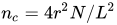
gives the number of disk centers within the circle of influence (radius 2 r).

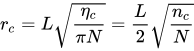
is the critical disk radius.
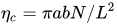
for ellipses of semi-major and semi-minor axes of a and b, respectively. Aspect ratio with .


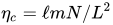
for rectangles of dimensions and . Aspect ratio with .


for power-law distributed disks with , .



equals critical area fraction.
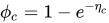
For disks, Ref.[102] use where is the density of disks of radius .
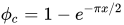


equals number of objects of maximum length per unit area.
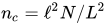

For ellipses,
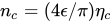
For void percolation, is the critical void fraction.

For more ellipse values, see [112][116]
For more rectangle values, see [119]
Both ellipses and rectangles belong to the superellipses, with . For more percolation values of superellipses, see.[105]

For the monodisperse particle systems, the percolation thresholds of concave-shaped superdisks are obtained as seen in [125]
For binary dispersions of disks, see [98][126][115]
Thresholds on 2D random and quasi-lattices
[edit]


| Lattice | z | Site percolation threshold | Bond percolation threshold | |
|---|---|---|---|---|
| Relative neighborhood graph | 2.5576 | 0.796(2)[127] | 0.771(2)[127] | |
| Voronoi tessellation | 3 | 0.71410(2),[129] 0.7151*[72] | 0.68,[130] 0.6670(1),[131] 0.6680(5),[132] 0.666931(5)[129] | |
| Voronoi covering/medial | 4 | 0.666931(2)[129][131] | 0.53618(2)[129] | |
| Randomized kagome/square-octagon, fraction r=1⁄2 | 4 | 0.6599[16] | ||
| Penrose rhomb dual | 4 | 0.6381(3)[69] | 0.5233(2)[69] | |
| Gabriel graph | 4 | 0.6348(8),[133] 0.62[134] | 0.5167(6),[133] 0.52[134] | |
| Random-line tessellation, dual | 4 | 0.586(2)[135] | ||
| Penrose rhomb | 4 | 0.5837(3),[69] 0.0.5610(6) (weighted bonds)[136] 0.58391(1)[137] | 0.483(5),[138] 0.4770(2)[69] | |
| Octagonal lattice, "chemical" links (Ammann–Beenker tiling) | 4 | 0.585[139] | 0.48[139] | |
| Octagonal lattice, "ferromagnetic" links | 5.17 | 0.543[139] | 0.40[139] | |
| Dodecagonal lattice, "chemical" links | 3.63 | 0.628[139] | 0.54[139] | |
| Dodecagonal lattice, "ferromagnetic" links | 4.27 | 0.617[139] | 0.495[139] | |
| Delaunay triangulation | 6 | 1⁄2[140] | 0.3333(1)[131] 0.3326(5),[132] 0.333069(2)[129] | |
| Uniform Infinite Planar Triangulation[141] | 6 | 1⁄2 | (2√3 – 1)/11 ≈ 0.2240[128][142] |
*Theoretical estimate
Thresholds on 2D correlated systems
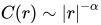
[edit]Assuming power-law correlations
| lattice | α | Site percolation threshold | Bond percolation threshold |
|---|---|---|---|
| square | 3 | 0.561406(4)[143] | |
| square | 2 | 0.550143(5)[143] | |
| square | 0.1 | 0.508(4)[143] |
Thresholds on slabs
[edit]h is the thickness of the slab, h × ∞ × ∞. Boundary conditions (b.c.) refer to the top and bottom planes of the slab.
| Lattice | h | z | Site percolation threshold | Bond percolation threshold | |
|---|---|---|---|---|---|
| simple cubic (open b.c.) | 2 | 5 | 5 | 0.47424,[144] 0.4756[145] | |
| bcc (open b.c.) | 2 | 0.4155[145] | |||
| hcp (open b.c.) | 2 | 0.2828[145] | |||
| diamond (open b.c.) | 2 | 0.5451[145] | |||
| simple cubic (open b.c.) | 3 | 0.4264[145] | |||
| bcc (open b.c.) | 3 | 0.3531[145] | |||
| bcc (periodic b.c.) | 3 | 0.21113018(38)[146] | |||
| hcp (open b.c.) | 3 | 0.2548[145] | |||
| diamond (open b.c.) | 3 | 0.5044[145] | |||
| simple cubic (open b.c.) | 4 | 0.3997,[144] 0.3998[145] | |||
| bcc (open b.c.) | 4 | 0.3232[145] | |||
| bcc (periodic b.c.) | 4 | 0.20235168(59)[146] | |||
| hcp (open b.c.) | 4 | 0.2405[145] | |||
| diamond (open b.c.) | 4 | 0.4842[145] | |||
| simple cubic (periodic b.c.) | 5 | 6 | 6 | 0.278102(5)[146] | |
| simple cubic (open b.c.) | 6 | 0.3708[145] | |||
| simple cubic (periodic b.c.) | 6 | 6 | 6 | 0.272380(2)[146] | |
| bcc (open b.c.) | 6 | 0.2948[145] | |||
| hcp (open b.c.) | 6 | 0.2261[145] | |||
| diamond (open b.c.) | 6 | 0.4642[145] | |||
| simple cubic (periodic b.c.) | 7 | 6 | 6 | 0.3459514(12)[146] | 0.268459(1)[146] |
| simple cubic (open b.c.) | 8 | 0.3557,[144] 0.3565[145] | |||
| simple cubic (periodic b.c.) | 8 | 6 | 6 | 0.265615(5)[146] | |
| bcc (open b.c.) | 8 | 0.2811[145] | |||
| hcp (open b.c.) | 8 | 0.2190[145] | |||
| diamond (open b.c.) | 8 | 0.4549[145] | |||
| simple cubic (open b.c.) | 12 | 0.3411[145] | |||
| bcc (open b.c.) | 12 | 0.2688[145] | |||
| hcp (open b.c.) | 12 | 0.2117[145] | |||
| diamond (open b.c.) | 12 | 0.4456[145] | |||
| simple cubic (open b.c.) | 16 | 0.3219,[144] 0.3339[145] | |||
| bcc (open b.c.) | 16 | 0.2622[145] | |||
| hcp (open b.c.) | 16 | 0.2086[145] | |||
| diamond (open b.c.) | 16 | 0.4415[145] | |||
| simple cubic (open b.c.) | 32 | 0.3219,[144] | |||
| simple cubic (open b.c.) | 64 | 0.3165,[144] | |||
| simple cubic (open b.c.) | 128 | 0.31398,[144] |
Percolation in 3D
[edit]| Lattice | z | filling factor* | filling fraction* | Site percolation threshold | Bond percolation threshold | |
|---|---|---|---|---|---|---|
| (10,3)-a oxide (or site-bond)[147] | 23 32 | 2.4 | 0.748713(22)[147] | = (pc,bond(10,3) – a)1⁄2 = 0.742334(25)[148] | ||
| (10,3)-b oxide (or site-bond)[147] | 23 32 | 2.4 | 0.233[149] | 0.174 | 0.745317(25)[147] | = (pc,bond(10,3) – b)1⁄2 = 0.739388(22)[148] |
| silicon dioxide (diamond site-bond)[147] | 4,22 | 2 2⁄3 | 0.638683(35)[147] | |||
| Modified (10,3)-b[150] | 32,2 | 2 2⁄3 | 0.627[150] | |||
| (8,3)-a[148] | 3 | 3 | 0.577962(33)[148] | 0.555700(22)[148] | ||
| (10,3)-a[148] gyroid[151] | 3 | 3 | 0.571404(40)[148] | 0.551060(37)[148] | ||
| (10,3)-b[148] | 3 | 3 | 0.565442(40)[148] | 0.546694(33)[148] | ||
| cubic oxide (cubic site-bond)[147] | 6,23 | 3.5 | 0.524652(50)[147] | |||
| bcc dual | 4 | 0.4560(6)[152] | 0.4031(6)[152] | |||
| ice Ih | 4 | 4 | π √3 / 16 = 0.340087 | 0.147 | 0.433(11)[153] | 0.388(10)[154] |
| diamond (Ice Ic) | 4 | 4 | π √3 / 16 = 0.340087 | 0.1462332 | 0.4299(8),[155] 0.4299870(4),[156] 0.426+0.08 −0.02,[157] 0.4297(4)[158] 0.4301(4),[159] 0.428(4),[160] 0.425(15),[161] 0.425,[42][49] 0.436(12)[153] |
0.3895892(5),[156] 0.3893(2),[159] 0.3893(3),[158] 0.388(5),[161] 0.3886(5),[155] 0.388(5)[160] 0.390(11)[154] |
| diamond dual | 6 2⁄3 | 0.3904(5)[152] | 0.2350(5)[152] | |||
| 3D kagome (covering graph of the diamond lattice) | 6 | π √2 / 12 = 0.37024 | 0.1442 | 0.3895(2)[162] =pc(site) for diamond dual and pc(bond) for diamond lattice[152] | 0.2709(6)[152] | |
| Bow-tie stack dual | 5 1⁄3 | 0.3480(4)[39] | 0.2853(4)[39] | |||
| honeycomb stack | 5 | 5 | 0.3701(2)[39] | 0.3093(2)[39] | ||
| octagonal stack dual | 5 | 5 | 0.3840(4)[39] | 0.3168(4)[39] | ||
| pentagonal stack | 5 1⁄3 | 0.3394(4)[39] | 0.2793(4)[39] | |||
| kagome stack | 6 | 6 | 0.453450 | 0.1517 | 0.3346(4)[39] | 0.2563(2)[39] |
| fcc dual | 42,8 | 5 1⁄3 | 0.3341(5)[152] | 0.2703(3)[152] | ||
| simple cubic | 6 | 6 | π / 6 = 0.5235988 | 0.1631574 | 0.307(10),[161] 0.307,[42] 0.3115(5),[163] 0.3116077(2),[164] 0.311604(6),[165] 0.311605(5),[166] 0.311600(5),[167] 0.3116077(4),[168] 0.3116081(13),[169] 0.3116080(4),[170] 0.3116060(48),[171] 0.3116004(35),[172] 0.31160768(15)[156] | 0.247(5),[161] 0.2479(4),[155] 0.2488(2),[173] 0.24881182(10),[164] 0.2488125(25),[174] 0.2488126(5),[175] |
| hcp dual | 44,82 | 5 1⁄3 | 0.3101(5)[152] | 0.2573(3)[152] | ||
| dice stack | 5,8 | 6 | π √3 / 9 = 0.604600 | 0.1813 | 0.2998(4)[39] | 0.2378(4)[39] |
| bow-tie stack | 7 | 7 | 0.2822(6)[39] | 0.2092(4)[39] | ||
| Stacked triangular / simple hexagonal | 8 | 8 | 0.26240(5),[176] 0.2625(2),[177] 0.2623(2)[39] | 0.18602(2),[176] 0.1859(2)[39] | ||
| octagonal (union-jack) stack | 6,10 | 8 | 0.2524(6)[39] | 0.1752(2)[39] | ||
| bcc | 8 | 8 | 0.243(10),[161] 0.243,[42] 0.2459615(10),[170] 0.2460(3),[178] 0.2464(7),[155] 0.2458(2)[159] | 0.178(5),[161] 0.1795(3),[155] 0.18025(15),[173] 0.1802875(10)[175] | ||
| simple cubic with 3NN (same as bcc) | 8 | 8 | 0.2455(1),[179] 0.2457(7)[180] | |||
| fcc, D3 | 12 | 12 | π / (3 √2) = 0.740480 | 0.147530 | 0.195,[42] 0.198(3),[181] 0.1998(6),[155] 0.1992365(10),[170] 0.19923517(20),[156] 0.1994(2),[159] 0.199236(4)[182] | 0.1198(3),[155] 0.1201635(10)[175] 0.120169(2)[182] |
| hcp | 12 | 12 | π / (3 √2) = 0.740480 | 0.147545 | 0.195(5),[161] 0.1992555(10)[183] | 0.1201640(10),[183] 0.119(2)[161] |
| La2−x Srx Cu O4 | 12 | 12 | 0.19927(2)[184] | |||
| simple cubic with 2NN (same as fcc) | 12 | 12 | 0.1991(1)[179] | |||
| simple cubic with NN+4NN | 12 | 12 | 0.15040(12),[185] 0.1503793(7)[51] | 0.1068263(7)[186] | ||
| simple cubic with 3NN+4NN | 14 | 14 | 0.20490(12)[185] | 0.1012133(7)[186] | ||
| bcc NN+2NN (= sc(3,4) sc-3NN+4NN) | 14 | 14 | 0.175,[42] 0.1686,(20)[187] 0.1759432(8) | 0.0991(5),[187] 0.1012133(7),[46] 0.1759432(8)[46] | ||
| Nanotube fibers on FCC | 14 | 14 | 0.1533(13)[188] | |||
| simple cubic with NN+3NN | 14 | 14 | 0.1420(1)[179] | 0.0920213(7)[186] | ||
| simple cubic with 2NN+4NN | 18 | 18 | 0.15950(12)[185] | 0.0751589(9)[186] | ||
| simple cubic with NN+2NN | 18 | 18 | 0.137,[49] 0.136,[189] 0.1372(1),[179] 0.13735(5),[citation needed] 0.1373045(5)[51] | 0.0752326(6)[186] | ||
| fcc with NN+2NN (=sc-2NN+4NN) | 18 | 18 | 0.136,[42] 0.1361408(8)[51] | 0.0751589(9)[46] | ||
| simple cubic with short-length correlation | 6+ | 6+ | 0.126(1)[190] | |||
| simple cubic with NN+3NN+4NN | 20 | 20 | 0.11920(12)[185] | 0.0624379(9)[186] | ||
| simple cubic with 2NN+3NN | 20 | 20 | 0.1036(1)[179] | 0.0629283(7)[186] | ||
| simple cubic with NN+2NN+4NN | 24 | 24 | 0.11440(12)[185] | 0.0533056(6)[186] | ||
| simple cubic with 2NN+3NN+4NN | 26 | 26 | 0.11330(12)[185] | 0.0474609(9) | ||
| simple cubic with NN+2NN+3NN | 26 | 26 | 0.097,[42] 0.0976(1),[179] 0.0976445(10), 0.0976444(6)[51] | 0.0497080(10)[186] | ||
| bcc with NN+2NN+3NN | 26 | 26 | 0.095,[49] 0.0959084(6)[51] | 0.0492760(10)[46] | ||
| simple cubic with NN+2NN+3NN+4NN | 32 | 32 | 0.10000(12),[185] 0.0801171(9)[51] | 0.0392312(8)[186] | ||
| fcc with NN+2NN+3NN | 42 | 42 | 0.061,[49] 0.0610(5),[189] 0.0618842(8)[46] | 0.0290193(7)[46] | ||
| fcc with NN+2NN+3NN+4NN | 54 | 54 | 0.0500(5)[189] | |||
| sc-1,2,3,4,5 simple cubic with NN+2NN+3NN+4NN+5NN | 56 | 56 | 0.0461815(5)[51] | 0.0210977(7)[46] | ||
| sc-1,...,6 (2x2x2 cube [53]) | 80 | 80 | 0.0337049(9),[51] 0.03373(13)[53] | 0.0143950(10)[46] | ||
| sc-1,...,7 | 92 | 92 | 0.0290800(10)[51] | 0.0123632(8)[46] | ||
| sc-1,...,8 | 122 | 122 | 0.0218686(6)[51] | 0.0091337(7)[46] | ||
| sc-1,...,9 | 146 | 146 | 0.0184060(10)[51] | 0.0075532(8)[46] | ||
| sc-1,...,10 | 170 | 170 | 0.0064352(8)[46] | |||
| sc-1,...,11 | 178 | 178 | 0.0061312(8)[46] | |||
| sc-1,...,12 | 202 | 202 | 0.0053670(10)[46] | |||
| sc-1,...,13 | 250 | 250 | 0.0042962(8)[46] | |||
| 3x3x3 cube | 274 | 274 | φc= 0.76564(1),[54] pc = 0.0098417(7),[54] 0.009854(6)[53] | |||
| 4x4x4 cube | 636 | 636 | φc=0.76362(1),[54] pc = 0.0042050(2),[54] 0.004217(3)[53] | |||
| 5x5x5 cube | 1214 | 1250 | φc=0.76044(2),[54] pc = 0.0021885(2),[54] 0.002185(4)[53] | |||
| 6x6x6 cube | 2056 | 2056 | 0.001289(2)[53] |
Filling factor = fraction of space filled by touching spheres at every lattice site (for systems with uniform bond length only). Also called Atomic Packing Factor.
Filling fraction (or Critical Filling Fraction) = filling factor * pc(site).
NN = nearest neighbor, 2NN = next-nearest neighbor, 3NN = next-next-nearest neighbor, etc.
kxkxk cubes are cubes of occupied sites on a lattice, and are equivalent to extended-range percolation of a cube of length (2k+1), with edges and corners removed, with z = (2k+1)3-12(2k-1)-9 (center site not counted in z).
Question: the bond thresholds for the hcp and fcc lattice agree within the small statistical error. Are they identical, and if not, how far apart are they? Which threshold is expected to be bigger? Similarly for the ice and diamond lattices. See [191]
| System | polymer Φc |
|---|---|
| percolating excluded volume of athermal polymer matrix (bond-fluctuation model on cubic lattice) | 0.4304(3)[192] |
3D distorted lattices
[edit]Here, one distorts a regular lattice of unit spacing by moving vertices uniformly within the cube , and considers percolation when sites are within Euclidean distance of each other.

| Lattice | Site percolation threshold | Bond percolation threshold | |||
|---|---|---|---|---|---|
| cubic | 0.05 | 1.0 | 0.60254(3)[193] | ||
| 0.1 | 1.00625 | 0.58688(4)[193] | |||
| 0.15 | 1.025 | 0.55075(2)[193] | |||
| 0.175 | 1.05 | 0.50645(5)[193] | |||
| 0.2 | 1.1 | 0.44342(3)[193] |
Overlapping shapes on 3D lattices
[edit]Site threshold is the number of overlapping objects per lattice site. The coverage φc is the net fraction of sites covered, and v is the volume (number of cubes). Overlapping cubes are given in the section on thresholds of 3D lattices. Here z is the coordination number to k-mers of either orientation, with

| System | k | z | Site coverage φc | Site percolation threshold pc |
|---|---|---|---|---|
| 1 x 2 dimer, cubic lattice | 2 | 56 | 0.24542[53] | 0.045847(2)[53] |
| 1 x 3 trimer, cubic lattice | 3 | 104 | 0.19578[53] | 0.023919(9)[53] |
| 1 x 4 stick, cubic lattice | 4 | 164 | 0.16055[53] | 0.014478(7)[53] |
| 1 x 5 stick, cubic lattice | 5 | 236 | 0.13488[53] | 0.009613(8)[53] |
| 1 x 6 stick, cubic lattice | 6 | 320 | 0.11569[53] | 0.006807(2)[53] |
| 2 x 2 plaquette, cubic lattice | 2 | 0.22710[53] | 0.021238(2)[53] | |
| 3 x 3 plaquette, cubic lattice | 3 | 0.18686[53] | 0.007632(5)[53] | |
| 4 x 4 plaquette, cubic lattice | 4 | 0.16159[53] | 0.003665(3)[53] | |
| 5 x 5 plaquette, cubic lattice | 5 | 0.14316[53] | 0.002058(5)[53] | |
| 6 x 6 plaquette, cubic lattice | 6 | 0.12900[53] | 0.001278(5)[53] |
The coverage is calculated from by for sticks, and for plaquettes.


Dimer percolation in 3D
[edit]| System | Site percolation threshold | Bond percolation threshold |
|---|---|---|
| Simple cubic | 0.2555(1)[194] |
Thresholds for 3D continuum models
[edit]All overlapping except for jammed spheres and polymer matrix.
| System | Φc | ηc |
|---|---|---|
| Spheres of radius r | 0.289,[195] 0.293,[196] 0.286,[197] 0.295.[104] 0.2895(5),[198] 0.28955(7),[199] 0.2896(7),[200] 0.289573(2),[201] 0.2896,[202] 0.2854,[203] 0.290,[204] 0.290,[205] 0.2895693(26)[206] | 0.3418(7),[198] 0.3438(13),[207] 0.341889(3),[201] 0.3360,[203] 0.34189(2)[117] [corrected], 0.341935(8),[208] 0.335,[209] |
| Oblate ellipsoids with major radius r and aspect ratio 4⁄3 | 0.2831[203] | 0.3328[203] |
| Prolate ellipsoids with minor radius r and aspect ratio 3⁄2 | 0.2757,[202] 0.2795,[203] 0.2763[204] | 0.3278[203] |
| Oblate ellipsoids with major radius r and aspect ratio 2 | 0.2537,[202] 0.2629,[203] 0.254[204] | 0.3050[203] |
| Prolate ellipsoids with minor radius r and aspect ratio 2 | 0.2537,[202] 0.2618,[203] 0.25(2),[210] 0.2507[204] | 0.3035,[203] 0.29(3)[210] |
| Oblate ellipsoids with major radius r and aspect ratio 3 | 0.2289[203] | 0.2599[203] |
| Prolate ellipsoids with minor radius r and aspect ratio 3 | 0.2033,[202] 0.2244,[203] 0.20(2)[210] | 0.2541,[203] 0.22(3)[210] |
| Oblate ellipsoids with major radius r and aspect ratio 4 | 0.2003[203] | 0.2235[203] |
| Prolate ellipsoids with minor radius r and aspect ratio 4 | 0.1901,[203] 0.16(2)[210] | 0.2108,[203] 0.17(3)[210] |
| Oblate ellipsoids with major radius r and aspect ratio 5 | 0.1757[203] | 0.1932[203] |
| Prolate ellipsoids with minor radius r and aspect ratio 5 | 0.1627,[203] 0.13(2)[210] | 0.1776,[203] 0.15(2)[210] |
| Oblate ellipsoids with major radius r and aspect ratio 10 | 0.0895,[202] 0.1058[203] | 0.1118[203] |
| Prolate ellipsoids with minor radius r and aspect ratio 10 | 0.0724,[202] 0.08703,[203] 0.07(2)[210] | 0.09105,[203] 0.07(2)[210] |
| Oblate ellipsoids with major radius r and aspect ratio 100 | 0.01248[203] | 0.01256[203] |
| Prolate ellipsoids with minor radius r and aspect ratio 100 | 0.006949[203] | 0.006973[203] |
| Oblate ellipsoids with major radius r and aspect ratio 1000 | 0.001275[203] | 0.001276[203] |
| Oblate ellipsoids with major radius r and aspect ratio 2000 | 0.000637[203] | 0.000637[203] |
| Spherocylinders with H/D = 1 | 0.2439(2)[200] | |
| Spherocylinders with H/D = 4 | 0.1345(1)[200] | |
| Spherocylinders with H/D = 10 | 0.06418(20)[200] | |
| Spherocylinders with H/D = 50 | 0.01440(8)[200] | |
| Spherocylinders with H/D = 100 | 0.007156(50)[200] | |
| Spherocylinders with H/D = 200 | 0.003724(90)[200] | |
| Aligned cylinders | 0.2819(2)[211] | 0.3312(1)[211] |
| Aligned cubes of side | 0.2773(2)[118] 0.27727(2),[54] 0.27730261(79)[171] | 0.3247(3),[117] 0.3248(3),[118] 0.32476(4)[211] 0.324766(1)[171] |
| Randomly oriented icosahedra | 0.3030(5)[212] | |
| Randomly oriented dodecahedra | 0.2949(5)[212] | |
| Randomly oriented octahedra | 0.2514(6)[212] | |
| Randomly oriented cubes of side | 0.2168(2)[118] 0.2174,[202] | 0.2444(3),[118] 0.2443(5)[212] |
| Randomly oriented tetrahedra | 0.1701(7)[212] | |
| Randomly oriented disks of radius r (in 3D) | 0.9614(5)[213] | |
| Randomly oriented square plates of side | 0.8647(6)[213] | |
| Randomly oriented triangular plates of side | 0.7295(6)[213] | |
| Jammed spheres (average z = 6) | 0.183(3),[214] 0.1990,[215] see also contact network of jammed spheres below. | 0.59(1)[214] (volume fraction of all spheres) |


is the total volume (for spheres), where N is the number of objects and L is the system size.

is the critical volume fraction, valid for overlapping randomly placed objects.
For disks and plates, these are effective volumes and volume fractions.
For void ("Swiss-Cheese" model), is the critical void fraction.
For more results on void percolation around ellipsoids and elliptical plates, see.[216]
For more ellipsoid percolation values see.[203]
For spherocylinders, H/D is the ratio of the height to the diameter of the cylinder, which is then capped by hemispheres. Additional values are given in.[200]
For superballs, m is the deformation parameter, the percolation values are given in.,[217][218] In addition, the thresholds of concave-shaped superballs are also determined in [125]
For cuboid-like particles (superellipsoids), m is the deformation parameter, more percolation values are given in.[202]
Void percolation in 3D
[edit]Void percolation refers to percolation in the space around overlapping objects. Here refers to the fraction of the space occupied by the voids (not of the particles) at the critical point, and is related to by . is defined as in the continuum percolation section above.

| System | Φc | ηc |
|---|---|---|
| Voids around disks of radius r | 22.86(2)[216] | |
| Voids around randomly oriented tetrahedra | 0.0605(6)[219] | |
| Voids around oblate ellipsoids of major radius r and aspect ratio 32 | 0.5308(7)[220] | 0.6333[220] |
| Voids around oblate ellipsoids of major radius r and aspect ratio 16 | 0.3248(5)[220] | 1.125[220] |
| Voids around oblate ellipsoids of major radius r and aspect ratio 10 | 1.542(1)[216] | |
| Voids around oblate ellipsoids of major radius r and aspect ratio 8 | 0.1615(4)[220] | 1.823[220] |
| Voids around oblate ellipsoids of major radius r and aspect ratio 4 | 0.0711(2)[220] | 2.643,[220] 2.618(5)[216] |
| Voids around oblate ellipsoids of major radius r and aspect ratio 2 | 3.239(4) [216] | |
| Voids around prolate ellipsoids of aspect ratio 8 | 0.0415(7)[221] | |
| Voids around prolate ellipsoids of aspect ratio 6 | 0.0397(7)[221] | |
| Voids around prolate ellipsoids of aspect ratio 4 | 0.0376(7)[221] | |
| Voids around prolate ellipsoids of aspect ratio 3 | 0.03503(50)[221] | |
| Voids around prolate ellipsoids of aspect ratio 2 | 0.0323(5)[221] | |
| Voids around aligned square prisms of aspect ratio 2 | 0.0379(5)[222] | |
| Voids around randomly oriented square prisms of aspect ratio 20 | 0.0534(4)[222] | |
| Voids around randomly oriented square prisms of aspect ratio 15 | 0.0535(4)[222] | |
| Voids around randomly oriented square prisms of aspect ratio 10 | 0.0524(5)[222] | |
| Voids around randomly oriented square prisms of aspect ratio 8 | 0.0523(6)[222] | |
| Voids around randomly oriented square prisms of aspect ratio 7 | 0.0519(3)[222] | |
| Voids around randomly oriented square prisms of aspect ratio 6 | 0.0519(5)[222] | |
| Voids around randomly oriented square prisms of aspect ratio 5 | 0.0515(7)[222] | |
| Voids around randomly oriented square prisms of aspect ratio 4 | 0.0505(7)[222] | |
| Voids around randomly oriented square prisms of aspect ratio 3 | 0.0485(11)[222] | |
| Voids around randomly oriented square prisms of aspect ratio 5/2 | 0.0483(8)[222] | |
| Voids around randomly oriented square prisms of aspect ratio 2 | 0.0465(7)[222] | |
| Voids around randomly oriented square prisms of aspect ratio 3/2 | 0.0461(14)[222] | |
| Voids around hemispheres | 0.0455(6)[223] | |
| Voids around aligned tetrahedra | 0.0605(6)[219] | |
| Voids around randomly oriented tetrahedra | 0.0605(6)[219] | |
| Voids around aligned cubes | 0.036(1),[54] 0.0381(3)[219] | |
| Voids around randomly oriented cubes | 0.0452(6),[219] 0.0449(5)[222] | |
| Voids around aligned octahedra | 0.0407(3)[219] | |
| Voids around randomly oriented octahedra | 0.0398(5)[219] | |
| Voids around aligned dodecahedra | 0.0356(3)[219] | |
| Voids around randomly oriented dodecahedra | 0.0360(3)[219] | |
| Voids around aligned icosahedra | 0.0346(3)[219] | |
| Voids around randomly oriented icosahedra | 0.0336(7)[219] | |
| Voids around spheres | 0.034(7),[224] 0.032(4),[225] 0.030(2),[123] 0.0301(3),[226] 0.0294,[221] 0.0300(3),[227] 0.0317(4),[228] 0.0308(5)[223] 0.0301(1),[220] 0.0301(1)[219] | 3.506(8),[227] 3.515(6),[216] 3.510(2)[108] |
Thresholds on 3D random and quasi-lattices
[edit]| Lattice | z | Site percolation threshold | Bond percolation threshold | |
|---|---|---|---|---|
| Contact network of packed spheres | 6 | 0.310(5),[214] 0.287(50),[229] 0.3116(3),[215] | ||
| Random-plane tessellation, dual | 6 | 0.290(7)[230] | ||
| Icosahedral Penrose | 6 | 0.285[231] | 0.225[231] | |
| Penrose w/2 diagonals | 6.764 | 0.271[231] | 0.207[231] | |
| Penrose w/8 diagonals | 12.764 | 0.188[231] | 0.111[231] | |
| Voronoi network | 15.54 | 0.1453(20)[187] | 0.0822(50)[187] |
Thresholds for other 3D models
[edit]| Lattice | z | Site percolation threshold | Critical coverage fraction | Bond percolation threshold | |
|---|---|---|---|---|---|
| Drilling percolation, simple cubic lattice* | 6 | 6 | 0.6345(3),[232] 0.6339(5),[233] 0.633965(15)[234] | 0.25480 | |
| Drill in z direction on cubic lattice, remove single sites | 6 | 6 | 0.592746 (columns), 0.4695(10) (sites)[235] | 0.2784 | |
| Random tube model, simple cubic lattice† | 0.231456(6)[236] | ||||
| Pac-Man percolation, simple cubic lattice | 0.139(6)[237] |
In drilling percolation, the site threshold represents the fraction of columns in each direction that have not been removed, and . For the 1d drilling, we have (columns) (sites).


† In tube percolation, the bond threshold represents the value of the parameter such that the probability of putting a bond between neighboring vertical tube segments is , where is the overlap height of two adjacent tube segments.[236]


Thresholds in different dimensional spaces
[edit]Continuum models in higher dimensions
[edit]| d | System | Φc | ηc |
|---|---|---|---|
| 4 | Overlapping hyperspheres | 0.1223(4)[117] | 0.1300(13),[207] 0.1304(5),[117] 0.1210268(19)[206] |
| 4 | Aligned hypercubes | 0.1132(5),[117] 0.1132348(17)[171] | 0.1201(6)[117] |
| 4 | Voids around hyperspheres | 0.00211(2)[124] | 6.161(10)[124] 6.248(2),[108] |
| 5 | Overlapping hyperspheres | 0.0544(6),[207] 0.05443(7),[117] 0.0522524(69)[206] | |
| 5 | Aligned hypercubes | 0.04900(7),[117] 0.0481621(13)[171] | 0.05024(7)[117] |
| 5 | Voids around hyperspheres | 1.26(6)x10−4[124] | 8.98(4),[124] 9.170(8)[108] |
| 6 | Overlapping hyperspheres | 0.02391(31),[207] 0.02339(5)[117] | |
| 6 | Aligned hypercubes | 0.02082(8),[117] 0.0213479(10)[171] | 0.02104(8)[117] |
| 6 | Voids around hyperspheres | 8.0(6)x10−6[124] | 11.74(8),[124] 12.24(2),[108] |
| 7 | Overlapping hyperspheres | 0.01102(16),[207] 0.01051(3)[117] | |
| 7 | Aligned hypercubes | 0.00999(5),[117] 0.0097754(31)[171] | 0.01004(5)[117] |
| 7 | Voids around hyperspheres | 15.46(5)[108] | |
| 8 | Overlapping hyperspheres | 0.00516(8),[207] 0.004904(6)[117] | |
| 8 | Aligned hypercubes | 0.004498(5)[117] | |
| 8 | Voids around hyperspheres | 18.64(8)[108] | |
| 9 | Overlapping hyperspheres | 0.002353(4)[117] | |
| 9 | Aligned hypercubes | 0.002166(4)[117] | |
| 9 | Voids around hyperspheres | 22.1(4)[108] | |
| 10 | Overlapping hyperspheres | 0.001138(3)[117] | |
| 10 | Aligned hypercubes | 0.001058(4)[117] | |
| 11 | Overlapping hyperspheres | 0.0005530(3)[117] | |
| 11 | Aligned hypercubes | 0.0005160(3)[117] |
![{\displaystyle \eta _{c}=(\pi ^{d/2}/\Gamma [d/2+1])r^{d}N/L^{d}.}](https://wikimedia.org/api/rest_v1/media/math/render/svg/90173c0ef117e66cd6feaf99b7e0f615aa0d83b7)
In 4d, .

In 5d, .

In 6d, .

is the critical volume fraction, valid for overlapping objects.
For void models, is the critical void fraction, and is the total volume of the overlapping objects
Thresholds on hypercubic lattices
[edit]| d | z | Site thresholds | Bond thresholds |
|---|---|---|---|
| 4 | 8 | 0.198(1)[238] 0.197(6),[239] 0.1968861(14),[240] 0.196889(3),[241] 0.196901(5),[242] 0.19680(23),[243] 0.1968904(65),[171] 0.19688561(3)[244] | 0.1600(1),[245] 0.16005(15),[173] 0.1601314(13),[240] 0.160130(3),[241] 0.1601310(10),[174] 0.1601312(2),[246] 0.16013122(6)[244] |
| 5 | 10 | 0.141(1),0.198(1)[238] 0.141(3),[239] 0.1407966(15),[240] 0.1407966(26),[171] 0.14079633(4)[244] | 0.1181(1),[245] 0.118(1),[247] 0.11819(4),[173] 0.118172(1),[240] 0.1181718(3)[174] 0.11817145(3)[244] |
| 6 | 12 | 0.106(1),[238] 0.108(3),[239] 0.109017(2),[240] 0.1090117(30),[171] 0.109016661(8)[244] | 0.0943(1),[245] 0.0942(1),[248] 0.0942019(6),[240] 0.09420165(2)[244] |
| 7 | 14 | 0.05950(5),[248] 0.088939(20),[249] 0.0889511(9),[240] 0.0889511(90),[171] 0.088951121(1),[244] | 0.0787(1),[245] 0.078685(30),[248] 0.0786752(3),[240] 0.078675230(2)[244] |
| 8 | 16 | 0.0752101(5),[240] 0.075210128(1)[244] | 0.06770(5),[248] 0.06770839(7),[240] 0.0677084181(3)[244] |
| 9 | 18 | 0.0652095(3),[240] 0.0652095348(6)[244] | 0.05950(5),[248] 0.05949601(5),[240] 0.0594960034(1)[244] |
| 10 | 20 | 0.0575930(1),[240] 0.0575929488(4)[244] | 0.05309258(4),[240] 0.0530925842(2)[244] |
| 11 | 22 | 0.05158971(8),[240] 0.0515896843(2)[244] | 0.04794969(1),[240] 0.04794968373(8)[244] |
| 12 | 24 | 0.04673099(6),[240] 0.0467309755(1)[244] | 0.04372386(1),[240] 0.04372385825(10)[244] |
| 13 | 26 | 0.04271508(8),[240] 0.04271507960(10)[244] | 0.04018762(1),[240] 0.04018761703(6)[244] |
For thresholds on high dimensional hypercubic lattices, we have the asymptotic series expansions [239] [247] [250]


where . For 13-dimensional bond percolation, for example, the error with the measured value is less than 10−6, and these formulas can be useful for higher-dimensional systems.

Thresholds in other higher-dimensional lattices
[edit]| d | lattice | z | Site thresholds | Bond thresholds |
|---|---|---|---|---|
| 4 | diamond | 5 | 0.2978(2)[159] | 0.2715(3)[159] |
| 4 | kagome | 8 | 0.2715(3)[162] | 0.177(1)[159] |
| 4 | bcc | 16 | 0.1037(3)[159] | 0.074(1),[159] 0.074212(1)[246] |
| 4 | fcc, D4, hypercubic 2NN | 24 | 0.0842(3),[159] 0.08410(23),[243] 0.0842001(11)[182] | 0.049(1),[159] 0.049517(1),[246] 0.0495193(8)[182] |
| 4 | hypercubic NN+2NN | 32 | 0.06190(23),[243] 0.0617731(19)[251] | 0.035827(1),[246] 0.0338047(27)[251] |
| 4 | hypercubic 3NN | 32 | 0.04540(23)[243] | |
| 4 | hypercubic NN+3NN | 40 | 0.04000(23)[243] | 0.0271892(22)[251] |
| 4 | hypercubic 2NN+3NN | 56 | 0.03310(23)[243] | 0.0194075(15)[251] |
| 4 | hypercubic NN+2NN+3NN | 64 | 0.03190(23),[243] 0.0319407(13)[251] | 0.0171036(11)[251] |
| 4 | hypercubic NN+2NN+3NN+4NN | 88 | 0.0231538(12)[251] | 0.0122088(8)[251] |
| 4 | hypercubic NN+...+5NN | 136 | 0.0147918(12)[251] | 0.0077389(9)[251] |
| 4 | hypercubic NN+...+6NN | 232 | 0.0088400(10)[251] | 0.0044656(11)[251] |
| 4 | hypercubic NN+...+7NN | 296 | 0.0070006(6)[251] | 0.0034812(7)[251] |
| 4 | hypercubic NN+...+8NN | 320 | 0.0064681(9)[251] | 0.0032143(8)[251] |
| 4 | hypercubic NN+...+9NN | 424 | 0.0048301(9)[251] | 0.0024117(7)[251] |
| 5 | diamond | 6 | 0.2252(3)[159] | 0.2084(4)[162] |
| 5 | kagome | 10 | 0.2084(4)[162] | 0.130(2)[159] |
| 5 | bcc | 32 | 0.0446(4)[159] | 0.033(1)[159] |
| 5 | fcc, D5, hypercubic 2NN | 40 | 0.0431(3),[159] 0.0435913(6)[182] | 0.026(2),[159] 0.0271813(2)[182] |
| 5 | hypercubic NN+2NN | 50 | 0.0334(2)[252] | 0.0213(1)[252] |
| 6 | diamond | 7 | 0.1799(5)[159] | 0.1677(7)[162] |
| 6 | kagome | 12 | 0.1677(7)[162] | |
| 6 | fcc, D6 | 60 | 0.0252(5),[159] 0.02602674(12)[182] | 0.01741556(5)[182] |
| 6 | bcc | 64 | 0.0199(5)[159] | |
| 6 | E6[182] | 72 | 0.02194021(14)[182] | 0.01443205(8)[182] |
| 7 | fcc, D7 | 84 | 0.01716730(5)[182] | 0.012217868(13)[182] |
| 7 | E7[182] | 126 | 0.01162306(4)[182] | 0.00808368(2)[182] |
| 8 | fcc, D8 | 112 | 0.01215392(4)[182] | 0.009081804(6)[182] |
| 8 | E8[182] | 240 | 0.00576991(2)[182] | 0.004202070(2)[182] |
| 9 | fcc, D9 | 144 | 0.00905870(2)[182] | 0.007028457(3)[182] |
| 9 | [182] | 272 | 0.00480839(2)[182] | 0.0037006865(11)[182] |
| 10 | fcc, D10 | 180 | 0.007016353(9)[182] | 0.005605579(6)[182] |
| 11 | fcc, D11 | 220 | 0.005597592(4)[182] | 0.004577155(3)[182] |
| 12 | fcc, D12 | 264 | 0.004571339(4)[182] | 0.003808960(2)[182] |
| 13 | fcc, D13 | 312 | 0.003804565(3)[182] | 0.0032197013(14)[182] |

Thresholds in one-dimensional long-range percolation
[edit]
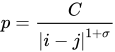
In a one-dimensional chain we establish bonds between distinct sites and with probability decaying as a power-law with an exponent . Percolation occurs[253][254] at a critical value for . The numerically determined percolation thresholds are given by:[255]




| Critical thresholds as a function of .[255] The dotted line is the rigorous lower bound.[253] | ||
| 0.1 | 0.047685(8) | 
|
| 0.2 | 0.093211(16) | |
| 0.3 | 0.140546(17) | |
| 0.4 | 0.193471(15) | |
| 0.5 | 0.25482(5) | |
| 0.6 | 0.327098(6) | |
| 0.7 | 0.413752(14) | |
| 0.8 | 0.521001(14) | |
| 0.9 | 0.66408(7) |


Thresholds on hyperbolic, hierarchical, and tree lattices
[edit]In these lattices there may be two percolation thresholds: the lower threshold is the probability above which infinite clusters appear, and the upper is the probability above which there is a unique infinite cluster.


| Lattice | z | Site percolation threshold | Bond percolation threshold | |||
|---|---|---|---|---|---|---|
| Lower | Upper | Lower | Upper | |||
| {3,7} hyperbolic | 7 | 7 | 0.26931171(7),[258] 0.20[259] | 0.73068829(7),[258] 0.73(2)[259] | 0.20,[260] 0.1993505(5)[258] | 0.37,[260] 0.4694754(8)[258] |
| {3,8} hyperbolic | 8 | 8 | 0.20878618(9)[258] | 0.79121382(9)[258] | 0.1601555(2)[258] | 0.4863559(6)[258] |
| {3,9} hyperbolic | 9 | 9 | 0.1715770(1)[258] | 0.8284230(1)[258] | 0.1355661(4)[258] | 0.4932908(1)[258] |
| {4,5} hyperbolic | 5 | 5 | 0.29890539(6)[258] | 0.8266384(5)[258] | 0.27,[260] 0.2689195(3)[258] | 0.52,[260] 0.6487772(3)[258] |
| {4,6} hyperbolic | 6 | 6 | 0.22330172(3)[258] | 0.87290362(7)[258] | 0.20714787(9)[258] | 0.6610951(2)[258] |
| {4,7} hyperbolic | 7 | 7 | 0.17979594(1)[258] | 0.89897645(3)[258] | 0.17004767(3)[258] | 0.66473420(4)[258] |
| {4,8} hyperbolic | 8 | 8 | 0.151035321(9)[258] | 0.91607962(7)[258] | 0.14467876(3)[258] | 0.66597370(3)[258] |
| {4,9} hyperbolic | 8 | 8 | 0.13045681(3)[258] | 0.92820305(3)[258] | 0.1260724(1)[258] | 0.66641596(2)[258] |
| {5,5} hyperbolic | 5 | 5 | 0.26186660(5)[258] | 0.89883342(7)[258] | 0.263(10),[261] 0.25416087(3)[258] | 0.749(10)[261] 0.74583913(3)[258] |
| {7,3} hyperbolic | 3 | 3 | 0.54710885(10)[258] | 0.8550371(5),[258] 0.86(2)[259] | 0.53,[260] 0.551(10),[261] 0.5305246(8)[258] | 0.72,[260] 0.810(10),[261] 0.8006495(5)[258] |
| {∞,3} Cayley tree | 3 | 3 | 1⁄2 | 1⁄2[260] | 1[260] | |
| Enhanced binary tree (EBT) | 0.304(1),[262] 0.306(10),[261] (√13 − 3)/2 = 0.302776[263] | 0.48,[260] 0.564(1),[262] 0.564(10),[261] 1⁄2[263] | ||||
| Enhanced binary tree dual | 0.436(1),[262] 0.452(10)[261] | 0.696(1),[262] 0.699(10)[261] | ||||
| Non-Planar Hanoi Network (HN-NP) | 0.319445[257] | 0.381996[257] | ||||
| Cayley tree with grandparents | 8 | 0.158656326[264] | ||||
Note: {m,n} is the Schläfli symbol, signifying a hyperbolic lattice in which n regular m-gons meet at every vertex
For bond percolation on {P,Q}, we have by duality . For site percolation, because of the self-matching of triangulated lattices.


Cayley tree (Bethe lattice) with coordination number

Thresholds for directed percolation
[edit]D_Kagome_Lattice.png)
D_Square_Lattice.png)
D_Triangular_Lattice.png)
D_SC_Lattice.png)
D_BCC_Lattice.png)
| Lattice | z | Site percolation threshold | Bond percolation threshold |
|---|---|---|---|
| (1+1)-d honeycomb | 1.5 | 0.8399316(2),[265] 0.839933(5),[266] of (1+1)-d sq. | 0.8228569(2),[265] 0.82285680(6)[265] |
| (1+1)-d kagome | 2 | 0.7369317(2),[265] 0.73693182(4)[267] | 0.6589689(2),[265] 0.65896910(8)[265] |
| (1+1)-d square, diagonal | 2 | 0.705489(4),[268] 0.705489(4),[269] 0.70548522(4),[270] 0.70548515(20),[267] 0.7054852(3),[265] | 0.644701(2),[271] 0.644701(1),[272] 0.644701(1),[268] 0.6447006(10),[266] 0.64470015(5),[273] 0.644700185(5),[270] 0.6447001(2),[265] 0.643(2)[274] |
| (1+1)-d triangular | 3 | 0.595646(3),[268] 0.5956468(5),[273] 0.5956470(3)[265] | 0.478018(2),[268] 0.478025(1),[273] 0.4780250(4)[265] 0.479(3)[274] |
| (2+1)-d simple cubic, diagonal planes | 3 | 0.43531(1),[275] 0.43531411(10)[265] | 0.382223(7),[275] 0.38222462(6)[265] 0.383(3)[274] |
| (2+1)-d square nn (= bcc) | 4 | 0.3445736(3),[276] 0.344575(15)[277] 0.3445740(2)[265] | 0.2873383(1),[278] 0.287338(3)[275] 0.28733838(4)[265] 0.287(3)[274] |
| (2+1)-d fcc | 0.199(2))[274] | ||
| (3+1)-d hypercubic, diagonal | 4 | 0.3025(10),[279] 0.30339538(5)[265] | 0.26835628(5),[265] 0.2682(2)[274] |
| (3+1)-d cubic, nn | 6 | 0.2081040(4)[276] | 0.1774970(5)[174] |
| (3+1)-d bcc | 8 | 0.160950(30),[277] 0.16096128(3)[265] | 0.13237417(2)[265] |
| (4+1)-d hypercubic, diagonal | 5 | 0.23104686(3)[265] | 0.20791816(2),[265] 0.2085(2)[274] |
| (4+1)-d hypercubic, nn | 8 | 0.1461593(2),[276] 0.1461582(3)[280] | 0.1288557(5)[174] |
| (4+1)-d bcc | 16 | 0.075582(17),[277] 0.0755850(3),[280] 0.07558515(1)[265] | 0.063763395(5)[265] |
| (5+1)-d hypercubic, diagonal | 6 | 0.18651358(2)[265] | 0.170615155(5),[265] 0.1714(1)[274] |
| (5+1)-d hypercubic, nn | 10 | 0.1123373(2)[276] | 0.1016796(5)[174] |
| (5+1)-d hypercubic bcc | 32 | 0.035967(23),[277] 0.035972540(3)[265] | 0.0314566318(5)[265] |
| (6+1)-d hypercubic, diagonal | 7 | 0.15654718(1)[265] | 0.145089946(3),[265] 0.1458[274] |
| (6+1)-d hypercubic, nn | 12 | 0.0913087(2)[276] | 0.0841997(14)[174] |
| (6+1)-d hypercubic bcc | 64 | 0.017333051(2)[265] | 0.01565938296(10)[265] |
| (7+1)-d hypercubic, diagonal | 8 | 0.135004176(10)[265] | 0.126387509(3),[265] 0.1270(1)[274] |
| (7+1)-d hypercubic,nn | 14 | 0.07699336(7)[276] | 0.07195(5)[174] |
| (7+1)-d bcc | 128 | 0.008 432 989(2)[265] | 0.007 818 371 82(6)[265] |

nn = nearest neighbors. For a (d + 1)-dimensional hypercubic system, the hypercube is in d dimensions and the time direction points to the 2D nearest neighbors.
Directed percolation with multiple neighbors
[edit]
(1+1)-d square with z NN, square lattice for z odd, tilted square lattice for z even
| Lattice | z | Site percolation threshold | Bond percolation threshold |
|---|---|---|---|
| (1+1)-d square | 3 | 0.4395(3),[281] | |
| (1+1)-d square | 5 | 0.2249(3)[281] | |
| (1+1)-d square | 7 | 0.1470(2)[281] | |
| (1+1)-d square | 9 | 0.1081(2)[281] | |
| (1+1)-d square | 11 | 0.0851(2)[281] | |
| (1+1)-d square | 13 | 0.0701(2)[281] | |
| (1+1)-d tilted sq | 2 | 0.6447(2)[281] | |
| (1+1)-d tilted sq | 4 | 0.3272(2)[281] | |
| (1+1)-d tilted sq | 6 | 0.2121(3)[281] | |
| (1+1)-d tilted sq | 8 | 0.1553(3)[281] | |
| (1+1)-d tilted sq | 10 | 0.1220(2)[281] | |
| (1+1)-d tilted sq | 12 | 0.0999(2)[281] |
For large z, pc ~ 1/z [281]
Site-Bond Directed Percolation
[edit]pb = bond threshold
ps = site threshold
Site-bond percolation is equivalent to having different probabilities of connections:
P0 = probability that no sites are connected = (1-ps) + ps(1-pb)2
P2 = probability that exactly one descendant is connected to the upper vertex (two connected together) = ps pb (1-pb)
P3 = probability that both descendants are connected to the original vertex (all three connected together)= ps pb2
Normalization: P0 + 2P2 + P3 = 1
| Lattice | z | ps | pb | P0 | P2 | P3 |
|---|---|---|---|---|---|---|
| (1+1)-d square [282] | 3 | 0.644701 | 1 | 0.126237 | 0.229062 | 0.415639 |
| 0.7 | 0.93585 | 0.148376 | 0.196529 | 0.458567 | ||
| 0.75 | 0.88565 | 0.169703 | 0.166059 | 0.498178 | ||
| 0.8 | 0.84135 | 0.192304 | 0.134616 | 0.538464 | ||
| 0.85 | 0.80190 | 0.216143 | 0.102242 | 0.579373 | ||
| 0.9 | 0.76645 | 0.241215 | 0.068981 | 0.620825 | ||
| 0.95 | 0.73450 | 0.267336 | 0.034889 | 0.662886 | ||
| 1 | 0.705489 | 0.294511 | 0 | 0.705489 |
Isotropic/Directed Percolation
[edit]Here we have a cross between ordinary bond percolation (OP) and directed percolation (DP)[283]. On an oriented system such as shown in the figure "(1+1)d Square Lattice" above, we consider the down probability p↓ = p pd and the up probability p↑ = p(1 − pd ), with p representing the average bond occupation probability and pd controlling the anisotropy. When pd = 0 or 1, we have pure DP, while when pd = 1/2 we have the random diode model or essentially OP, with the threshold twice the OP value. For other values of pd, we have a mixture of the two types of percolation. For a given pd, the critical values of p = pc are given below:
| Lattice | d | z | pd | pc | p↓ | p↑ |
|---|---|---|---|---|---|---|
| (1+1)-d DP | 2 | 2 | 1 | 0.644700185(5)[270] | 0.644700185(5) | 0 |
| diagonal square [283] | 2 | 4 | 0.8 | 0.768708(1) | 0.614966 | 0.153742 |
| diagonal square [283] | 2 | 4 | 0.6 | 0.929668(3) | 0.557801s | 0.371867 |
| 2d ordinary perc. | 2 | 4 | 0.5 | 1.0 | 0.5 | 0.5 |
| (2+1)-d diagonal DP | 3 | 3 | 1 | 0.38222462(6)[265] | 0.38222462 | 0 |
| diagonal cubic | 3 | 6 | 0.8 | 0.430941(2)[283] | 0.34475282 | 0.086188 |
| diagonal cubic | 3 | 6 | 0.6 | 0.481310(2)[283] | 0.288786 | 0.192524 |
| 3d Ordinary perc. | 3 | 6 | 0.5 | 0.49762364(20)[164] | 0.24881182 | 0.24881182 |
Exact critical manifolds of inhomogeneous systems
[edit]Inhomogeneous triangular lattice bond percolation[20]

Inhomogeneous honeycomb lattice bond percolation = kagome lattice site percolation[20]

Inhomogeneous (3,12^2) lattice, site percolation[7][284]
or


Inhomogeneous union-jack lattice, site percolation with probabilities [285]


Inhomogeneous martini lattice, bond percolation[76][286]

Inhomogeneous martini lattice, site percolation. r = site in the star

Inhomogeneous martini-A (3–7) lattice, bond percolation. Left side (top of "A" to bottom): . Right side: . Cross bond: .



Inhomogeneous martini-B (3–5) lattice, bond percolation
Inhomogeneous martini lattice with outside enclosing triangle of bonds, probabilities from inside to outside, bond percolation[286]

![{\displaystyle 1-3z+z^{3}-(1-z^{2})[3x^{2}y(1+y-y^{2})(1+z)+x^{3}y^{2}(3-2y)(1+2z)]=0}](https://wikimedia.org/api/rest_v1/media/math/render/svg/bca37fb3504d909546e2e4e7311696782d08b37c)
Inhomogeneous checkerboard lattice, bond percolation[60][96]

Inhomogeneous bow-tie lattice, bond percolation[59][96]

where are the four bonds around the square and is the diagonal bond connecting the vertex between bonds and .


Rigidity percolation
[edit]Assuming a finite graph with unbending bonds, rigidity percolation refers to a situation where the entire graph is rigid everywhere with respect to shear forces being put on it.[287][288][289][290] Another way to say this is that constraints are sufficient to eliminate all zero-frequency vibrational modes, transforming a mechanically floppy network into one capable of supporting stress[291].
The Geiringer–Laman theorem gives a combinatorial characterization of generically rigid graphs in 2-dimensional Euclidean space
Generic lattices have bonds of different lengths, and can be made by randomly displacing the sites of a regular lattice.
Results:
2d
Bond threshold, triangular lattice: pc = 0.6602(3)[292] 0.6602778(10)[291]
Site percolation, triangular lattice pc = 0.69755(3),[292] 0.6975(3)[293]
Correlation-length exponent: ν = 1.16(3), 1.19(1),[294] 1.21(6)[292], 1/ν = 0.850(3)[291]
Moukarzel and Duxbury (1995): 𝛼 = -0.48(5)[293] β = 0.175(2)[293]
Fractal dimension df = 1.86(2)[292]. 1.853(5)[295], 1.850(2)[291]
Backbone fractal dimension db = 1.80(3),[292] 1.78(2)[293]
Arbibi Sahimi (1993)[296]: 2d bond tri: pc = 0.641(1), site: pc = 0.713(2).
Chubynsky and Thorpe 07[297]. 3d: bond fcc, pc = 0.495. bcc: pc = 0.7485
Javerzam[298] 2d hull fractal dimension: df = 1.355(10).
Roux, Hansen (1988): central force elastic network: p* = 0.642(2), flv = 3.0(4) , glv = 0.97(2)[299]
Arababi, Sahimi (1988): [300]. 3d bond cubic elastic network pc = 0.2492,
Sahimi, Goddard (1985) bond triangular pc=0.65[301]
Lemieux, Breton, Tremblay (1985)[302] pc= 0.649, f = 1.4
Feng, Sen (1984)[303] pc = 0.58, f = 2.4 ± 0.4.
A fast algorithm for 2D Rigidity Percolation, Nina Javerzat and Daniele Notarmuzi.[304]
Duxbury, Jacobs, Thorpe, Moukarzel (1999)[305] Bethe lattice z = 6, pc = 0.656
See also
[edit]References
[edit]- ^ Stauffer, Dietrich; Aharony, Amnon (2003). Introduction to percolation theory (Rev. 2nd ed.). London: Taylor & Francis. ISBN 978-0-7484-0253-3.
- ^ Kasteleyn, P. W.; Fortuin, C. M. (1969). "Phase transitions in lattice systems with random local properties". Journal of the Physical Society of Japan Supplement. 26: 11–14. Bibcode:1969JPSJS..26...11K.
- ^ a b c d e Grünbaum, Branko & Shephard, G. C. (1987). Tilings and Patterns. New York: W. H. Freeman. ISBN 978-0-7167-1193-3.
- ^ Berchenko, Yakir; Artzy-Randrup, Yael; Teicher, Mina; Stone, Lewi (March 30, 2009). "Emergence and Size of the Giant Component in Clustered Random Graphs with a Given Degree Distribution". Physical Review Letters. 102 (13) 138701. Bibcode:2009PhRvL.102m8701B. doi:10.1103/PhysRevLett.102.138701. ISSN 0031-9007. PMID 19392410.
- ^ Li, Ming; Liu, Run-Ran; Lü, Linyuan; Hu, Mao-Bin; Xu, Shuqi; Zhang, Yi-Cheng (April 25, 2021). "Percolation on complex networks: Theory and application". Physics Reports. 907: 1–68. arXiv:2101.11761. Bibcode:2021PhR...907....1L. doi:10.1016/j.physrep.2020.12.003. ISSN 0370-1573. S2CID 231719831.
- ^ a b c d e f g Parviainen, Robert (2005). Connectivity Properties of Archimedean and Laves Lattices. Vol. 34. Uppsala Dissertations in Mathematics. p. 37. ISBN 978-91-506-1751-1.
- ^ a b c d e f g h i Suding, P. N.; R. M. Ziff (1999). "Site percolation thresholds for Archimedean lattices". Physical Review E. 60 (1): 275–283. Bibcode:1999PhRvE..60..275S. doi:10.1103/PhysRevE.60.275. PMID 11969760.
- ^ a b c d e f g Parviainen, Robert (2007). "Estimation of bond percolation thresholds on the Archimedean lattices". Journal of Physics A. 40 (31): 9253–9258. arXiv:0704.2098. Bibcode:2007JPhA...40.9253P. doi:10.1088/1751-8113/40/31/005. S2CID 680787.
- ^ a b c d e f g h i Ding, Chengxiang; Zhe Fu. Wenan Guo; F. Y. Wu (2010). "Critical frontier for the Potts and percolation models on triangular-type and kagome-type lattices II: Numerical analysis". Physical Review E. 81 (6) 061111. arXiv:1001.1488. Bibcode:2010PhRvE..81f1111D. doi:10.1103/PhysRevE.81.061111. PMID 20866382. S2CID 29625353.
- ^ a b Scullard, C. R.; J. L. Jacobsen (2012). "Transfer matrix computation of generalised critical polynomials in percolation". arXiv:1209.1451 [cond-mat.stat-mech].
- ^ a b c d e f g h i j k l m n o p q r s t u v Jacobsen, J. L. (2014). "High-precision percolation thresholds and Potts-model critical manifolds from graph polynomials". Journal of Physics A. 47 (13) 135001. arXiv:1401.7847. Bibcode:2014JPhA...47m5001G. doi:10.1088/1751-8113/47/13/135001. S2CID 119614758.
- ^ a b Jacobsen, Jesper L.; Christian R. Scullard (2013). "Critical manifolds, graph polynomials, and exact solvability" (PDF). StatPhys 25, Seoul, Korea July 21–26.
- ^ a b c d e f g h Scullard, Christian R.; Jesper Lykke Jacobsen (2020). "Bond percolation thresholds on Archimedean lattices from critical polynomial roots". Physical Review Research. 2 (1) 012050. arXiv:1910.12376. Bibcode:2020PhRvR...2a2050S. doi:10.1103/PhysRevResearch.2.012050. S2CID 204904858.
- ^ a b c d e d'Iribarne, C.; Rasigni, M.; Rasigni, G. (1995). "Determination of site percolation transitions for 2D mosaics by means of the minimal spanning tree approach". Physics Letters A. 209 (1–2): 95–98. Bibcode:1995PhLA..209...95D. doi:10.1016/0375-9601(95)00794-8.
- ^ a b c d e f g h i j k d'Iribarne, C.; Rasigni, M.; Rasigni, G. (1999). "From lattice long-range percolation to the continuum one". Phys. Lett. A. 263 (1–2): 65–69. Bibcode:1999PhLA..263...65D. doi:10.1016/S0375-9601(99)00585-X.
- ^ a b Schliecker, G.; C. Kaiser (1999). "Percolation on disordered mosaics". Physica A. 269 (2–4): 189–200. Bibcode:1999PhyA..269..189S. doi:10.1016/S0378-4371(99)00093-X.
- ^ Djordjevic, Z. V.; H. E. Stanley; Alla Margolina (1982). "Site percolation threshold for honeycomb and square lattices". Journal of Physics A. 15 (8): L405–L412. Bibcode:1982JPhA...15L.405D. doi:10.1088/0305-4470/15/8/006.
- ^ a b c d e Feng, Xiaomei; Youjin Deng; H. W. J. Blöte (2008). "Percolation transitions in two dimensions". Physical Review E. 78 (3) 031136. arXiv:0901.1370. Bibcode:2008PhRvE..78c1136F. doi:10.1103/PhysRevE.78.031136. PMID 18851022. S2CID 29282598.
- ^ a b c d e f g Ziff, R. M.; Hang Gu (2008). "Universal condition for critical percolation thresholds of kagomé-like lattices". Physical Review E. 79 (2) 020102. arXiv:0812.0181. doi:10.1103/PhysRevE.79.020102. PMID 19391694. S2CID 18051122.
- ^ a b c d e Sykes, M. F.; J. W. Essam (1964). "Exact critical percolation probabilities for site and bond problems in two dimensions". Journal of Mathematical Physics. 5 (8): 1117–1127. Bibcode:1964JMP.....5.1117S. doi:10.1063/1.1704215.
- ^ Ziff, R. M.; P. W. Suding (1997). "Determination of the bond percolation threshold for the kagome lattice". Journal of Physics A. 30 (15): 5351–5359. arXiv:cond-mat/9707110. Bibcode:1997JPhA...30.5351Z. doi:10.1088/0305-4470/30/15/021. S2CID 28814369.
- ^ Scullard, C. R. (2012). "Percolation critical polynomial as a graph invariant". Physical Review E. 86 (4) 041131: 1131. arXiv:1111.1061. Bibcode:2012PhRvE..86d1131S. doi:10.1103/PhysRevE.86.041131. PMID 23214553. S2CID 33348328.
- ^ a b Jacobsen, J. L. (2015). "Critical points of Potts and O(N) models from eigenvalue identities in periodic Temperley-Lieb algebras". Journal of Physics A. 48 (45) 454003. arXiv:1507.03027. Bibcode:2015JPhA...48S4003L. doi:10.1088/1751-8113/48/45/454003. S2CID 119146630.
- ^ Lin, Keh Ying; Wen Jong Ma (1983). "Two-dimensional Ising model on a ruby lattice". Journal of Physics A. 16 (16): 3895–3898. Bibcode:1983JPhA...16.3895L. doi:10.1088/0305-4470/16/16/027.
- ^ Derrida, B.; D. Stauffer (1985). "Corrections to scaling and phenomenological renormalization for 2-dimensional percolation and lattice animal problems" (PDF). Journal de Physique. 46 (45): 1623. doi:10.1051/jphys:0198500460100162300. S2CID 8289499.
- ^ Yang, Y.; S. Zhou.; Y. Li. (2013). "Square++: Making a connection game win-lose complementary and playing-fair". Entertainment Computing. 4 (2): 105–113. doi:10.1016/j.entcom.2012.10.004.
- ^ Newman, M. E. J.; R. M. Ziff (2000). "Efficient Monte-Carlo algorithm and high-precision results for percolation". Physical Review Letters. 85 (19): 4104–7. arXiv:cond-mat/0005264. Bibcode:2000PhRvL..85.4104N. CiteSeerX 10.1.1.310.4632. doi:10.1103/PhysRevLett.85.4104. PMID 11056635. S2CID 747665.
- ^ Mertens, Stephan (2022). "Exact site-percolation probability on the square lattice". Journal of Physics A: Mathematical and Theoretical. 55 (33): 334002. arXiv:2109.12102. Bibcode:2022JPhA...55G4002M. doi:10.1088/1751-8121/ac4195. ISSN 1751-8113.
- ^ Yang, Yi; Zhou, Shuigeng (2024). "Comment on 'Critical points of Potts and O(N) models from eigenvalue identities in periodic Temperley–Lieb algebras'". Journal of Physics A: Mathematical and Theoretical. 57 (25): 258001. doi:10.1088/1751-8121/ad4d2c.
- ^ de Oliveira, P.M.C.; R. A. Nobrega; D. Stauffer (2003). "Corrections to finite size scaling in percolation". Brazilian Journal of Physics. 33 (3): 616–618. arXiv:cond-mat/0308525. Bibcode:2003BrJPh..33..616O. doi:10.1590/S0103-97332003000300025. S2CID 8972025.
- ^ Lee, M. J. (2007). "Complementary algorithms for graphs and percolation". Physical Review E. 76 (2) 027702. arXiv:0708.0600. Bibcode:2007PhRvE..76b7702L. doi:10.1103/PhysRevE.76.027702. PMID 17930184. S2CID 304257.
- ^ Lee, M. J. (2008). "Pseudo-random-number generators and the square site percolation threshold". Physical Review E. 78 (3) 031131. arXiv:0807.1576. Bibcode:2008PhRvE..78c1131L. doi:10.1103/PhysRevE.78.031131. PMID 18851017. S2CID 7027694.
- ^ Levenshteĭn, M. E.; B. I. Shklovskiĭ; M. S. Shur; A. L. Éfros (1975). "The relation between the critical exponents of percolation theory". Zh. Eksp. Teor. Fiz. 69: 386–392. Bibcode:1975JETP...42..197L.
- ^ Dean, P.; Bird, N. F. (1967). "Monte Carlo estimates of critical percolation probabilities". Mathematical Proceedings of the Cambridge Philosophical Society. 63 (2): 477–479. Bibcode:1967PCPS...63..477D. doi:10.1017/s0305004100041438. S2CID 137386357.
- ^ Dean, P. (1963). "A new Monte Carlo method for percolation problems on a lattice". Mathematical Proceedings of the Cambridge Philosophical Society. 59 (2): 397–410. Bibcode:1963PCPS...59..397D. doi:10.1017/s0305004100037026. S2CID 122985645.
- ^ Tencer, John; Forsberg, Kelsey Meeks (2021). "Postprocessing techniques for gradient percolation predictions on the square lattice". Physical Review E. 103 (1) 012115. Bibcode:2021PhRvE.103a2115T. doi:10.1103/PhysRevE.103.012115. OSTI 1778027. PMID 33601521. S2CID 231961701.
- ^ Betts, D. D. (1995). "A new two-dimensional lattice of coordination number five". Proc. Nova Scotian Inst. Sci. 40: 95–100. hdl:10222/35332.
- ^ a b d'Iribarne, C.; Rasigni, M.; Rasigni, G. (1999). "Minimal spanning tree and percolation on mosaics: graph theory and percolation". J. Phys. A: Math. Gen. 32 (14): 2611–2622. Bibcode:1999JPhA...32.2611D. doi:10.1088/0305-4470/32/14/002.
- ^ a b c d e f g h i j k l m n o p q r s t u v w van der Marck, Steven C. (1997). "Percolation thresholds and universal formulas". Physical Review E. 55 (2): 1514–1517. Bibcode:1997PhRvE..55.1514V. doi:10.1103/PhysRevE.55.1514.
- ^ a b c d e f Malarz, K.; S. Galam (2005). "Square-lattice site percolation at increasing ranges of neighbor bonds". Physical Review E. 71 (1) 016125. arXiv:cond-mat/0408338. Bibcode:2005PhRvE..71a6125M. doi:10.1103/PhysRevE.71.016125. PMID 15697676. S2CID 119087463.
- ^ a b c d e f g h i j k l m n o p q r s t u v w x y z aa Majewski, M.; K. Malarz (2007). "Square lattice site percolation thresholds for complex neighbourhoods". Acta Phys. Pol. B. 38 (38): 2191. arXiv:cond-mat/0609635. Bibcode:2007AcPPB..38.2191M.
- ^ a b c d e f g h i j Dalton, N. W.; C. Domb; M. F. Sykes (1964). "Dependence of critical concentration of a dilute ferromagnet on the range of interaction". Proc. Phys. Soc. 83 (3): 496–498. doi:10.1088/0370-1328/83/3/118.
- ^ Collier, Andrew. "Percolation Threshold: Including Next-Nearest Neighbours".
- ^ a b c d e f g h i j k l m n Ouyang, Yunqing; Y. Deng; Henk W. J. Blöte (2018). "Equivalent-neighbor percolation models in two dimensions: Crossover between mean-field and short-range behavior". Physical Review E. 98 (6) 062101. arXiv:1808.05812. Bibcode:2018PhRvE..98f2101O. doi:10.1103/PhysRevE.98.062101. S2CID 119328197.
- ^ a b Xu, Wenhui; Junfeng Wang; Hao Hu; Youjin Deng (2021). "Critical polynomials in the nonplanar and continuum percolation models". Physical Review E. 103 (2) 022127. arXiv:2010.02887. Bibcode:2021PhRvE.103b2127X. doi:10.1103/PhysRevE.103.022127. ISSN 2470-0045. PMID 33736116. S2CID 222140792.
- ^ a b c d e f g h i j k l m n o p Xun, Zhipeng; DaPeng Hao; Robert M. Ziff (2022). "Site and bond percolation thresholds on regular lattices with compact extended-range neighborhoods in two and three dimensions". Physical Review E. 105 (2) 024105. arXiv:2111.10975. Bibcode:2022PhRvE.105b4105X. doi:10.1103/PhysRevE.105.024105. PMID 35291074. S2CID 244478657.
- ^ a b c d e f g Malarz, Krzysztop (2021). "Percolation thresholds on a triangular lattice for neighborhoods containing sites up to the fifth coordination zone". Physical Review E. 103 (5) 052107. arXiv:2102.10066. Bibcode:2021PhRvE.103e2107M. doi:10.1103/PhysRevE.103.052107. PMID 34134312. S2CID 231979514.
- ^ a b c d e f g Malarz, Krzysztof (2020). "Site percolation thresholds on triangular lattice with complex neighborhoods". Chaos: An Interdisciplinary Journal of Nonlinear Science. 30 (12) 123123. arXiv:2006.15621. Bibcode:2020Chaos..30l3123M. doi:10.1063/5.0022336. PMID 33380057. S2CID 220250058.
- ^ a b c d e f Domb, C.; N. W. Dalton (1966). "Crystal statistics with long-range forces I. The equivalent neighbour model". Proc. Phys. Soc. 89 (4): 859–871. Bibcode:1966PPS....89..859D. doi:10.1088/0370-1328/89/4/311.
- ^ a b c d e Gouker, Mark; Family, Fereydoon (1983). "Evidence for classical critical behavior in long-range site percolation". Physical Review B. 28 (3): 1449. Bibcode:1983PhRvB..28.1449G. doi:10.1103/PhysRevB.28.1449.
- ^ a b c d e f g h i j k l m n o p q Xun, Zhipeng; Dapeng Hao; Robert M. Ziff (2021). "Site percolation on square and simple cubic lattices with extended neighborhoods and their continuum limit". Physical Review E. 103 (2) 022126. arXiv:2010.02895. Bibcode:2021PhRvE.103b2126X. doi:10.1103/PhysRevE.103.022126. PMID 33735955. S2CID 222141832.
- ^ Malarz, Krzysztof (2022). "Random site percolation on honeycomb lattices with complex neighborhoods". Chaos: An Interdisciplinary Journal of Nonlinear Science. 32 (8) 083123. arXiv:2204.12593. doi:10.1063/5.0099066. PMID 36049902. S2CID 248405741.
- ^ a b c d e f g h i j k l m n o p q r s t u v w x y z aa ab ac ad ae af ag ah ai aj ak al am an ao ap aq Mecke, K. R.; Seyfried, A (2002). "Strong dependence of percolation thresholds on polydispersity". Europhysics Letters. 58 (1): 28–34. Bibcode:2002EL.....58...28M. doi:10.1209/epl/i2002-00601-y. S2CID 250737562.
- ^ a b c d e f g h i j k l m n o p q r s t u v w x y z aa ab Koza, Zbigniew; Kondrat, Grzegorz; Suszczyński, Karol (2014). "Percolation of overlapping squares or cubes on a lattice". Journal of Statistical Mechanics: Theory and Experiment. 2014 (11) P11005. arXiv:1606.07969. Bibcode:2014JSMTE..11..005K. doi:10.1088/1742-5468/2014/11/P11005. S2CID 118623466.
- ^ Malarz, Krzysztof (2023). "Random site percolation thresholds on square lattice for complex neighborhoods containing sites up to the sixth coordination zone". Physica A. 632 (1) 129347. doi:10.1016/j.physa.2023.129347.
- ^ a b c d e f Deng, Youjin; Yunqing Ouyang; Henk W. J. Blöte (2019). "Medium-range percolation in two dimensions". J. Phys.: Conf. Ser. 1163 (1) 012001. Bibcode:2019JPhCS1163a2001D. doi:10.1088/1742-6596/1163/1/012001. hdl:1887/82550.
- ^ a b c Mitra, S.; D. Saha; A. Sensharma (2019). "Percolation in a distorted square lattice". Physical Review E. 99 (1) 012117. arXiv:1808.10665. Bibcode:2019PhRvE..99a2117M. doi:10.1103/PhysRevE.99.012117. PMID 30780325.
- ^ a b c d e f Jasna, C. K.; V. Sasidevan (2024). "Effect of shape asymmetry on percolation of aligned and overlapping objects on lattices". Phys. Rev. E. 109 064118. arXiv:2308.12932. doi:10.1103/PhysRevE.109.064118. PMID 39020917.
- ^ a b c d Scullard, C. R.; R. M. Ziff (2010). "Critical surfaces for general inhomogeneous bond percolation problems". Journal of Statistical Mechanics: Theory and Experiment. 2010 (3) P03021. arXiv:0911.2686. Bibcode:2010JSMTE..03..021S. doi:10.1088/1742-5468/2010/03/P03021. S2CID 119230786.
- ^ a b Wu, F. Y. (1979). "Critical point of planar Potts models". Journal of Physics C. 12 (17): L645–L650. Bibcode:1979JPhC...12L.645W. doi:10.1088/0022-3719/12/17/002.
- ^ a b Mai, T.; Halley, J. W. (1980). Sinha, S. K. (ed.). Ordering in two dimensions. North-Holland, Amsterdam. pp. 369–371.
- ^ a b c d e f g h i j Kundu, Sumanta; Manna, S. S. (May 15, 2017). "Colored percolation". Physical Review E. 95 (5) 052124. arXiv:1709.00887. doi:10.1103/PhysRevE.95.052124. ISSN 2470-0045. PMID 28618459.
- ^ Nakanishi, H (1987). "Critical behaviour of AB percolation in two dimensions". Journal of Physics A: Mathematical and General. 20 (17): 6075–6083. doi:10.1088/0305-4470/20/17/040. ISSN 0305-4470.
- ^ Debierre, J -M; Bradley, R M (1992). "Scaling properties of antipercolation hulls on the triangular lattice". Journal of Physics A: Mathematical and General. 25 (2): 335–343. doi:10.1088/0305-4470/25/2/014. ISSN 0305-4470.
- ^ Wu, Xian-Yuan; Popov, S. Yu. (2003). "On AB Bond Percolation on the Square Lattice and AB Site Percolation on Its Line Graph". Journal of Statistical Physics. 110 (1/2): 443–449. doi:10.1023/A:1021091316925.
- ^ a b c d e f g Hovi, J.-P.; A. Aharony (1996). "Scaling and universality in the spanning probability for percolation". Physical Review E. 53 (1): 235–253. Bibcode:1996PhRvE..53..235H. doi:10.1103/PhysRevE.53.235. PMID 9964253.
- ^ a b c d e f g h i j k l m n o p q r s Tarasevich, Yuriy Yu; Steven C. van der Marck (1999). "An investigation of site-bond percolation on many lattices". Int. J. Mod. Phys. C. 10 (7): 1193–1204. arXiv:cond-mat/9906078. Bibcode:1999IJMPC..10.1193T. doi:10.1142/S0129183199000978. S2CID 16917458.
- ^ a b c d e f g h i j González-Flores, M. I.; A. A. Torres; W. Lebrecht; A. J. Ramirez-Pastor (2021). "Site-bond percolation in two-dimensional kagome lattices: Analytical approach and numerical simulations". Physical Review E. 104 (1) 014130. Bibcode:2021PhRvE.104a4130G. doi:10.1103/PhysRevE.104.014130. PMID 34412224. S2CID 237243188.
- ^ a b c d e Sakamoto, S.; F. Yonezawa; M. Hori (1989). "A proposal for the estimation of percolation thresholds in two-dimensional lattices". J. Phys. A. 22 (14): L699–L704. Bibcode:1989JPhA...22L.699S. doi:10.1088/0305-4470/22/14/009.
- ^ Deng, Y.; Y. Huang; J. L. Jacobsen; J. Salas; A. D. Sokal (2011). "Finite-temperature phase transition in a class of four-state Potts antiferromagnets". Physical Review Letters. 107 (15) 150601. arXiv:1108.1743. Bibcode:2011PhRvL.107o0601D. doi:10.1103/PhysRevLett.107.150601. PMID 22107278. S2CID 31777818.
- ^ Syozi, I (1972). "Transformation of Ising Models". In Domb, C.; Green, M. S. (eds.). Phase Transitions in Critical Phenomena. Vol. 1. Academic Press, London. pp. 270–329.
- ^ a b c d e f g h i j k l m n o p q r s t u Neher, Richard; Mecke, Klaus; Wagner, Herbert (2008). "Topological estimation of percolation thresholds". Journal of Statistical Mechanics: Theory and Experiment. 2008 (1) P01011. arXiv:0708.3250. Bibcode:2008JSMTE..01..011N. doi:10.1088/1742-5468/2008/01/P01011. S2CID 8584164.
- ^ Grimmett, G.; Manolescu, I (2012). "Bond percolation on isoradial graphs: Criticality and universality". Probability Theory and Related Fields. 159 (1–2): 273–327. arXiv:1204.0505. doi:10.1007/s00440-013-0507-y. S2CID 15031903.
- ^ a b Scullard, C. R. (2006). "Exact site percolation thresholds using a site-to-bond transformation and the star-triangle transformation". Physical Review E. 73 (1) 016107. arXiv:cond-mat/0507392. Bibcode:2006PhRvE..73a6107S. doi:10.1103/PhysRevE.73.016107. PMID 16486216. S2CID 17948429.
- ^ a b c d Ziff, R. M. (2006). "Generalized cell–dual-cell transformation and exact thresholds for percolation". Physical Review E. 73 (1) 016134. Bibcode:2006PhRvE..73a6134Z. doi:10.1103/PhysRevE.73.016134. PMID 16486243.
- ^ a b c d e f g h i j k l m Scullard, C. R.; Robert M Ziff (2006). "Exact bond percolation thresholds in two dimensions". Journal of Physics A. 39 (49): 15083–15090. arXiv:cond-mat/0610813. Bibcode:2006JPhA...3915083Z. doi:10.1088/0305-4470/39/49/003. S2CID 14332146.
- ^ Ding, Chengxiang; Yancheng Wang; Yang Li (2012). "Potts and percolation models on bowtie lattices". Physical Review E. 86 (2) 021125. arXiv:1203.2244. Bibcode:2012PhRvE..86b1125D. doi:10.1103/PhysRevE.86.021125. PMID 23005740. S2CID 27190130.
- ^ Wierman, John (1984). "A bond percolation critical probability determination based on the star-triangle transformation". J. Phys. A: Math. Gen. 17 (7): 1525–1530. Bibcode:1984JPhA...17.1525W. doi:10.1088/0305-4470/17/7/020.
- ^ Mahmood Maher al-Naqsh (1983). "MAH 007". The Design and Execution of Drawings in Iranian Tilework. Archived from the original on January 9, 2017. Retrieved November 18, 2019.
- ^ "Western tomb tower, Kharraqan".
- ^ a b c d e f g h i j k l m n Melchert, Oliver; Helmut G. Katzgraber; Mark A. Novotny (2016). "Site and bond percolation thresholds in Kn,n-based lattices: Vulnerability of quantum annealers to random qubit and coupler failures on Chimera topologies". Physical Review E. 93 (4) 042128. arXiv:1511.07078. Bibcode:2016PhRvE..93d2128M. doi:10.1103/PhysRevE.93.042128. PMID 27176275. S2CID 206249608.
- ^ Okubo, S.; M. Hayashi; S. Kimura; H. Ohta; M. Motokawa; H. Kikuchi; H. Nagasawa (1998). "Submillimeter wave ESR of triangular-kagome antiferromagnet Cu9X2(cpa)6 (X=Cl, Br)". Physica B. 246–247 (2): 553–556. Bibcode:1998PhyB..246..553O. doi:10.1016/S0921-4526(97)00985-X.
- ^ a b c d e f g h i j k Haji Akbari, Amir; R. M. Ziff (2009). "Percolation in networks with voids and bottlenecks". Physical Review E. 79 (2) 021118. arXiv:0811.4575. Bibcode:2009PhRvE..79b1118H. doi:10.1103/PhysRevE.79.021118. PMID 19391717. S2CID 2554311.
- ^ a b Cornette, V.; A. J. Ramirez-Pastor; F. Nieto (2003). "Dependence of the percolation threshold on the size of the percolating species". Physica A. 327 (1): 71–75. Bibcode:2003PhyA..327...71C. doi:10.1016/S0378-4371(03)00453-9. hdl:11336/138178.
- ^ a b c Lebrecht, W.; P. M. Centres; A. J. Ramirez-Pastor (2019). "Analytical approximation of the site percolation thresholds for monomers and dimers on two-dimensional lattices". Physica A. 516: 133–143. Bibcode:2019PhyA..516..133L. doi:10.1016/j.physa.2018.10.023. S2CID 125418069.
- ^ a b c d e f g h i Longone, Pablo; P.M. Centres; A. J. Ramirez-Pastor (2019). "Percolation of aligned rigid rods on two-dimensional triangular lattices". Physical Review E. 100 (5) 052104. arXiv:1906.03966. Bibcode:2019PhRvE.100e2104L. doi:10.1103/PhysRevE.100.052104. PMID 31870027. S2CID 182953009.
- ^ a b c d Budinski-Petkovic, Lj; I. Loncarevic; Z. M. Jacsik; S. B. Vrhovac (2016). "Jamming and percolation in random sequential adsorption of extended objects on a triangular lattice with quenched impurities". Journal of Statistical Mechanics: Theory and Experiment. 2016 (5) 053101. Bibcode:2016JSMTE..05.3101B. doi:10.1088/1742-5468/2016/05/053101. S2CID 3913989.
- ^ a b Cherkasova, V. A.; Yu. Yu. Tarasevich; N. I. Lebovka; N.V. Vygornitskii (2010). "Percolation of the aligned dimers on a square lattice". Eur. Phys. J. B. 74 (2): 205–209. arXiv:0912.0778. Bibcode:2010EPJB...74..205C. doi:10.1140/epjb/e2010-00089-2. S2CID 118485353.
- ^ a b c d Leroyer, Y.; E. Pommiers (1994). "Monte Carlo analysis of percolation of line segments on a square lattice". Physical Review B. 50 (5): 2795–2799. arXiv:cond-mat/9312066. Bibcode:1994PhRvB..50.2795L. doi:10.1103/PhysRevB.50.2795. PMID 9976520. S2CID 119495907.
- ^ a b c d e f g Vanderwalle, N.; S. Galam; M. Kramer (2000). "A new universality for random sequential deposition of needles". Eur. Phys. J. B. 14 (3): 407–410. arXiv:cond-mat/0004271. Bibcode:2000EPJB...14..407V. doi:10.1007/s100510051047. S2CID 11142384.
- ^ Kondrat, Grzegorz; Andrzej Pękalski (2001). "Percolation and jamming in random sequential adsorption of linear segments on a square lattice". Physical Review E. 63 (5) 051108. arXiv:cond-mat/0102031. Bibcode:2001PhRvE..63e1108K. doi:10.1103/PhysRevE.63.051108. PMID 11414888. S2CID 44490067.
- ^ a b c d e f g Haji-Akbari, A.; Nasim Haji-Akbari; Robert M. Ziff (2015). "Dimer Covering and Percolation Frustration". Physical Review E. 92 (3) 032134. arXiv:1507.04411. Bibcode:2015PhRvE..92c2134H. doi:10.1103/PhysRevE.92.032134. PMID 26465453. S2CID 34100812.
- ^ Zia, R. K. P.; W. Yong; B. Schmittmann (2009). "Percolation of a collection of finite random walks: a model for gas permeation through thin polymeric membranes". Journal of Mathematical Chemistry. 45: 58–64. doi:10.1007/s10910-008-9367-6. S2CID 94092783.
- ^ a b c d Wu, Yong; B. Schmittmann; R. K. P. Zia (2008). "Two-dimensional polymer networks near percolation". Journal of Physics A. 41 (2): 025008. Bibcode:2008JPhA...41b5004W. doi:10.1088/1751-8113/41/2/025004. S2CID 13053653.
- ^ a b c d e f g h i j k l m n o p q r s t u v w x y z aa ab ac ad Cornette, V.; A.J. Ramirez-Pastor; F. Nieto (2003). "Percolation of polyatomic species on a square lattice". European Physical Journal B. 36 (3): 391–399. Bibcode:2003EPJB...36..391C. doi:10.1140/epjb/e2003-00358-1. S2CID 119852589.
- ^ a b c Ziff, R. M.; C. R. Scullard; J. C. Wierman; M. R. A. Sedlock (2012). "The critical manifolds of inhomogeneous bond percolation on bow-tie and checkerboard lattices". Journal of Physics A. 45 (49) 494005. arXiv:1210.6609. Bibcode:2012JPhA...45W4005Z. doi:10.1088/1751-8113/45/49/494005. S2CID 2121370.
- ^ a b c d e f g h i j k Mertens, Stephan; Cristopher Moore (2012). "Continuum percolation thresholds in two dimensions". Physical Review E. 86 (6) 061109. arXiv:1209.4936. Bibcode:2012PhRvE..86f1109M. doi:10.1103/PhysRevE.86.061109. PMID 23367895. S2CID 15107275.
- ^ a b c d Quintanilla, John A.; R. M. Ziff (2007). "Asymmetry in the percolation thresholds of fully penetrable disks with two different radii". Physical Review E. 76 (5): 051115 [6 pages]. Bibcode:2007PhRvE..76e1115Q. doi:10.1103/PhysRevE.76.051115. PMID 18233631.
- ^ a b c Quintanilla, J; S. Torquato; R. M. Ziff (2000). "Efficient measurement of the percolation threshold for fully penetrable discs". J. Phys. A: Math. Gen. 33 (42): L399–L407. Bibcode:2000JPhA...33L.399Q. CiteSeerX 10.1.1.6.8207. doi:10.1088/0305-4470/33/42/104.
- ^ a b Lorenz, B; I. Orgzall; H.-O. Heuer (1993). "Universality and cluster structures in continuum models of percolation with two different radius distributions". J. Phys. A: Math. Gen. 26 (18): 4711–4712. Bibcode:1993JPhA...26.4711L. doi:10.1088/0305-4470/26/18/032.
- ^ Rosso, M (1989). "Concentration gradient approach to continuum percolation in two dimensions". J. Phys. A: Math. Gen. 22 (4): L131–L136. Bibcode:1989JPhA...22L.131R. doi:10.1088/0305-4470/22/4/004.
- ^ a b Gawlinski, Edward T; H. Eugene Stanley (1981). "Continuum percolation in two dimensions: Monte Carlo tests of scaling and universality for non-interacting discs". J. Phys. A: Math. Gen. 14 (8): L291–L299. Bibcode:1981JPhA...14L.291G. doi:10.1088/0305-4470/14/8/007.
- ^ a b c d e f g h i j k l m n o p q r Yi, Y.-B.; A. M. Sastry (2004). "Analytical approximation of the percolation threshold for overlapping ellipsoids of revolution". Proceedings of the Royal Society A. 460 (5): 2353–2380. Bibcode:2004RSPSA.460.2353Y. doi:10.1098/rspa.2004.1279. S2CID 2475482.
- ^ a b c d Pike, G. E.; C. H. Seager (1974). "Percolation and conductivity: A computer study I". Physical Review B. 10 (4): 1421–1434. Bibcode:1974PhRvB..10.1421P. doi:10.1103/PhysRevB.10.1421.
- ^ a b c d e f g h i j k Lin, Jianjun; Chen, Huisu (2019). "Measurement of continuum percolation properties of two-dimensional particulate systems comprising congruent and binary superellipses". Powder Technology. 347: 17–26. doi:10.1016/j.powtec.2019.02.036. S2CID 104332397.
- ^ Li, Mingqi; Chen, Huisu; Lin, Jianjun; Zhang, Rongling; Liu, Lin (July 2021). "Effects of the pore shape polydispersity on the percolation threshold and diffusivity of porous composites: Theoretical and numerical studies". Powder Technology. 386: 382–393. doi:10.1016/j.powtec.2021.03.055. ISSN 0032-5910. S2CID 233675695.
- ^ Koza, Zbigniew; Piotr Brzeski; Grzegorz Kondrat (2023). "Percolation of fully penetrable disks using the three-leg cluster method". J. Phys. A: Math. Theor. (in press) (16): 165001. Bibcode:2023JPhA...56p5001K. doi:10.1088/1751-8121/acc3d0. S2CID 257524315.
- ^ a b c d e f g h Charbonneau, Benoit; Patrick Charbonneau; Yi Hu; Zhen Yang (2021). "High-dimensional percolation criticality and hints of mean-field-like caging of the random Lorentz gas". Physical Review E. 104 (2) 024137. arXiv:2105.04711. Bibcode:2021PhRvE.104b4137C. doi:10.1103/PhysRevE.104.024137. PMID 34525662. S2CID 234357912.
- ^ Gilbert, E. N. (1961). "Random Plane Networks". J. Soc. Indust. Appl. Math. 9 (4): 533–543. doi:10.1137/0109045.
- ^ Xu, Wenhui; Junfeng Wang; Hao Hu; Youjin Deng (2021). "Critical polynomials in the nonplanar and continuum percolation models". Physical Review E. 103 (2) 022127. arXiv:2010.02887. Bibcode:2021PhRvE.103b2127X. doi:10.1103/PhysRevE.103.022127. ISSN 2470-0045. PMID 33736116. S2CID 222140792.
- ^ a b c Tarasevich, Yuri Yu.; Andrei V. Eserkepov (2020). "Percolation thresholds for discorectangles: numerical estimation for a range of aspect ratios". Physical Review E. 101 (2) 022108. arXiv:1910.05072. Bibcode:2020PhRvE.101b2108T. doi:10.1103/PhysRevE.101.022108. PMID 32168641. S2CID 204401814.
- ^ a b c d e f g h i j k l m n o p q r s Li, Jiantong; Mikael Östling (2016). "Precise percolation thresholds of two-dimensional random systems comprising overlapping ellipses". Physica A. 462: 940–950. Bibcode:2016PhyA..462..940L. doi:10.1016/j.physa.2016.06.020.
- ^ Nguyen, Van Lien; Enrique Canessa (1999). "Finite-size scaling in two-dimensional continuum percolation models". Modern Physics Letters B. 13 (17): 577–583. arXiv:cond-mat/9909200. Bibcode:1999MPLB...13..577N. doi:10.1142/S0217984999000737. S2CID 18560722.
- ^ Roberts, F. D. K. (1967). "A Monte Carlo Solution of a Two-Dimensional Unstructured Cluster Problem". Biometrika. 54 (3/4): 625–628. doi:10.2307/2335053. JSTOR 2335053. PMID 6064024.
- ^ a b c Quintanilla, John A. (2001). "Measurement of the percolation threshold for fully penetrable disks of different radii". Physical Review E. 63 (6) 061108. Bibcode:2001PhRvE..63f1108Q. doi:10.1103/PhysRevE.63.061108. PMID 11415069.
- ^ a b c d e f g h i j k l m n o p q r s t u Xia, W.; M. F. Thorpe (1988). "Percolation properties of random ellipses". Physical Review A. 38 (5): 2650–2656. Bibcode:1988PhRvA..38.2650X. doi:10.1103/PhysRevA.38.2650. PMID 9900674.
- ^ a b c d e f g h i j k l m n o p q r s t u v w x y z Torquato, S.; Y. Jiao (2012). "Effect of dimensionality on the continuum percolation of overlapping hyperspheres and hypercubes. II. Simulation results and analyses". J. Chem. Phys. 137 (7): 074106. arXiv:1208.3720. Bibcode:2012JChPh.137g4106T. doi:10.1063/1.4742750. PMID 22920102. S2CID 13188197.
- ^ a b c d e f g h i j k l Baker, Don R.; Gerald Paul; Sameet Sreenivasan; H. Eugene Stanley (2002). "Continuum percolation threshold for interpenetrating squares and cubes". Physical Review E. 66 (4): 046136 [5 pages]. arXiv:cond-mat/0203235. Bibcode:2002PhRvE..66d6136B. doi:10.1103/PhysRevE.66.046136. PMID 12443288. S2CID 9561586.
- ^ a b c d e f g h i j k l m n o Li, Jiantong; Mikael Östling (2013). "Percolation thresholds of two-dimensional continuum systems of rectangles". Physical Review E. 88 (1) 012101. Bibcode:2013PhRvE..88a2101L. doi:10.1103/PhysRevE.88.012101. PMID 23944408. S2CID 21438506.
- ^ Li, Jiantong; Shi-Li Zhang (2009). "Finite-size scaling in stick percolation". Physical Review E. 80 (4): 040104(R). Bibcode:2009PhRvE..80d0104L. doi:10.1103/PhysRevE.80.040104. PMID 19905260.
- ^ a b c Tarasevich, Yuri Yu.; Andrei V. Eserkepov (2018). "Percolation of sticks: Effect of stick alignment and length dispersity". Physical Review E. 98 (6) 062142. arXiv:1811.06681. Bibcode:2018PhRvE..98f2142T. doi:10.1103/PhysRevE.98.062142. S2CID 54187951.
- ^ a b c d e f g h i Sasidevan, V. (2013). "Continuum percolation of overlapping discs with a distribution of radii having a power-law tail". Physical Review E. 88 (2) 022140. arXiv:1302.0085. Bibcode:2013PhRvE..88b2140S. doi:10.1103/PhysRevE.88.022140. PMID 24032808. S2CID 24046421.
- ^ a b van der Marck, Steven C. (1996). "Network approach to void percolation in a pack of unequal spheres". Physical Review Letters. 77 (9): 1785–1788. Bibcode:1996PhRvL..77.1785V. doi:10.1103/PhysRevLett.77.1785. PMID 10063171.
- ^ a b c d e f g Jin, Yuliang; Patrick Charbonneau (2014). "Mapping the arrest of the random Lorentz gas onto the dynamical transition of a simple glass former". Physical Review E. 91 (4) 042313. arXiv:1409.0688. Bibcode:2015PhRvE..91d2313J. doi:10.1103/PhysRevE.91.042313. PMID 25974497. S2CID 16117644.
- ^ a b Lin, Jianjun; Zhang, Wulong; Chen, Huisu; Zhang, Rongling; Liu, Lin (2019). "Effect of pore characteristic on the percolation threshold and diffusivity of porous media comprising overlapping concave-shaped pores". International Journal of Heat and Mass Transfer. 138: 1333–1345. doi:10.1016/j.ijheatmasstransfer.2019.04.110. S2CID 164424008.
- ^ Meeks, Kelsey; J. Tencer; M.L. Pantoya (2017). "Percolation of binary disk systems: Modeling and theory". Physical Review E. 95 (1) 012118. Bibcode:2017PhRvE..95a2118M. doi:10.1103/PhysRevE.95.012118. PMID 28208494.
- ^ a b c Melchert, Oliver (2013). "Percolation thresholds on planar Euclidean relative-neighborhood graphs". Physical Review E. 87 (4) 042106. arXiv:1301.6967. Bibcode:2013PhRvE..87d2106M. doi:10.1103/PhysRevE.87.042106. PMID 23679372. S2CID 9691279.
- ^ a b Bernardi, Olivier; Curien, Nicolas; Miermont, Grėgory (2019). "A Boltzmann approach to percolation on random triangulations". Canadian Journal of Mathematics. 71: 1–43. arXiv:1705.04064. doi:10.4153/CJM-2018-009-x. S2CID 6817693.
- ^ a b c d e Becker, A.; R. M. Ziff (2009). "Percolation thresholds on two-dimensional Voronoi networks and Delaunay triangulations". Physical Review E. 80 (4) 041101. arXiv:0906.4360. Bibcode:2009PhRvE..80d1101B. doi:10.1103/PhysRevE.80.041101. PMID 19905267. S2CID 22549508.
- ^ Shante, K. S.; S. Kirkpatrick (1971). "An introduction to percolation theory". Advances in Physics. 20 (85): 325–357. Bibcode:1971AdPhy..20..325S. doi:10.1080/00018737100101261.
- ^ a b c Hsu, H. P.; M. C. Huang (1999). "Percolation thresholds, critical exponents, and scaling functions on planar random lattices and their duals". Physical Review E. 60 (6): 6361–6370. Bibcode:1999PhRvE..60.6361H. doi:10.1103/PhysRevE.60.6361. PMID 11970550. S2CID 8750738.
- ^ a b Huang, Ming-Chang; Hsiao-Ping Hsu (2002). "Percolation thresholds, critical exponents, and scaling functions on spherical random lattices". International Journal of Modern Physics C. 13 (3): 383–395. doi:10.1142/S012918310200319X.
- ^ a b Norrenbrock, C. (2014). "Percolation threshold on planar Euclidean Gabriel Graphs". Journal of Physics A. 40 (31): 9253–9258. arXiv:0704.2098. Bibcode:2007JPhA...40.9253P. doi:10.1088/1751-8113/40/31/005. S2CID 680787.
- ^ a b Bertin, E; J.-M. Billiot; R. Drouilhet (2002). "Continuum percolation in the Gabriel graph". Adv. Appl. Probab. 34 (4): 689. doi:10.1239/aap/1037990948. S2CID 121288601.
- ^ Lepage, Thibaut; Lucie Delaby; Fausto Malvagi; Alain Mazzolo (2011). "Monte Carlo simulation of fully Markovian stochastic geometries". Progress in Nuclear Science and Technology. 2: 743–748. doi:10.15669/pnst.2.743.
- ^ Zhang, C.; K. De'Bell (1993). "Reformulation of the percolation problem on a quasilattice: Estimates of the percolation threshold, chemical dimension, and amplitude ratio". Physical Review B. 47 (14): 8558–8564. Bibcode:1993PhRvB..47.8558Z. doi:10.1103/PhysRevB.47.8558. PMID 10004894.
- ^ Ziff, R. M.; F. Babalievski (1999). "Site percolation on the Penrose rhomb lattice". Physica A. 269 (2–4): 201–210. Bibcode:1999PhyA..269..201Z. doi:10.1016/S0378-4371(99)00166-1.
- ^ Lu, Jian Ping; Joseph L. Birman (1987). "Percolation and Scaling on a Quasilattice". Journal of Statistical Physics. 46 (5/6): 1057–1066. Bibcode:1987JSP....46.1057L. doi:10.1007/BF01011156. S2CID 121645524.
- ^ a b c d e f g h Babalievski, F. (1995). "Percolation thresholds and percolation conductivities of octagonal and dodecagonal quasicrystalline lattices". Physica A. 220 (1995): 245–250. Bibcode:1995PhyA..220..245B. doi:10.1016/0378-4371(95)00260-E.
- ^ Bollobás, Béla; Oliver Riordan (2006). "The critical probability for random Voronoi percolation in the plane is 1/2". Probab. Theory Relat. Fields. 136 (3): 417–468. arXiv:math/0410336. doi:10.1007/s00440-005-0490-z. S2CID 15985691.
- ^ Angel, Omer; Schramm, Oded (2003). "Uniform infinite planar triangulation". Commun. Math. Phys. 241 (2–3): 191–213. arXiv:math/0207153. Bibcode:2003CMaPh.241..191A. doi:10.1007/s00220-003-0932-3. S2CID 17718301.
- ^ Angel, O.; Curien, Nicolas (2014). "Percolations on random maps I: Half-plane models". Annales de l'Institut Henri Poincaré, Probabilités et Statistiques. 51 (2): 405–431. arXiv:1301.5311. Bibcode:2015AIHPB..51..405A. doi:10.1214/13-AIHP583. S2CID 14964345.
- ^ a b c Zierenberg, Johannes; Niklas Fricke; Martin Marenz; F. P. Spitzner; Viktoria Blavatska; Wolfhard Janke (2017). "Percolation thresholds and fractal dimensions for square and cubic lattices with long-range correlated defects". Physical Review E. 96 (6) 062125. arXiv:1708.02296. Bibcode:2017PhRvE..96f2125Z. doi:10.1103/PhysRevE.96.062125. PMID 29347311. S2CID 22353394.
- ^ a b c d e f g Sotta, P.; D. Long (2003). "The crossover from 2D to 3D percolation: Theory and numerical simulations". Eur. Phys. J. E. 11 (4): 375–388. Bibcode:2003EPJE...11..375S. doi:10.1140/epje/i2002-10161-6. PMID 15011039. S2CID 32831742.
- ^ a b c d e f g h i j k l m n o p q r s t u v w x y z aa ab Horton, M. K.; Moram, M. A. (April 17, 2017). "Alloy composition fluctuations and percolation in semiconductor alloy quantum wells". Applied Physics Letters. 110 (16): 162103. Bibcode:2017ApPhL.110p2103H. doi:10.1063/1.4980089. ISSN 0003-6951.
- ^ a b c d e f g Gliozzi, F.; S. Lottini; M. Panero; A. Rago (2005). "Random percolation as a gauge theory". Nuclear Physics B. 719 (3): 255–274. arXiv:cond-mat/0502339. Bibcode:2005NuPhB.719..255G. doi:10.1016/j.nuclphysb.2005.04.021. hdl:2318/5995. S2CID 119360708.
- ^ a b c d e f g h Yoo, Ted Y.; Jonathan Tran; Shane P. Stahlheber; Carina E. Kaainoa; Kevin Djepang; Alexander R. Small (2014). "Site percolation on lattices with low average coordination numbers". Journal of Statistical Mechanics: Theory and Experiment. 2014 (6) P06014. arXiv:1403.1676. Bibcode:2014JSMTE..06..014Y. doi:10.1088/1742-5468/2014/06/p06014. S2CID 119290405.
- ^ a b c d e f g h i j k Tran, Jonathan; Ted Yoo; Shane Stahlheber; Alex Small (2013). "Percolation thresholds on 3-dimensional lattices with 3 nearest neighbors". Journal of Statistical Mechanics: Theory and Experiment. 2013 (5) P05014. arXiv:1211.6531. Bibcode:2013JSMTE..05..014T. doi:10.1088/1742-5468/2013/05/P05014. S2CID 119182062.
- ^ Wells, A. F. (1984). "Structures Based on the 3-Connected Net 103 – b". Journal of Solid State Chemistry. 54 (3): 378–388. Bibcode:1984JSSCh..54..378W. doi:10.1016/0022-4596(84)90169-5.
- ^ a b Pant, Mihir; Don Towsley; Dirk Englund; Saikat Guha (2017). "Percolation thresholds for photonic quantum computing". Nature Communications. 10 (1): 1070. arXiv:1701.03775. doi:10.1038/s41467-019-08948-x. PMC 6403388. PMID 30842425.
- ^ Hyde, Stephen T.; O'Keeffe, Michael; Proserpio, Davide M. (2008). "A short history of an elusive yet ubiquitous structure in chemistry, materials, and mathematics". Angew. Chem. Int. Ed. 47 (42): 7996–8000. doi:10.1002/anie.200801519. PMID 18767088.
- ^ a b c d e f g h i j van der Marck, Steven C. (1997). "Percolation thresholds of the duals of the face-centered-cubic, hexagonal-close-packed, and diamond lattices". Physical Review E. 55 (6): 6593–6597. Bibcode:1997PhRvE..55.6593V. doi:10.1103/PhysRevE.55.6593.
- ^ a b Frisch, H. L.; E. Sonnenblick; V. A. Vyssotsky; J. M. Hammersley (1961). "Critical Percolation Probabilities (Site Problem)". Physical Review. 124 (4): 1021–1022. Bibcode:1961PhRv..124.1021F. doi:10.1103/PhysRev.124.1021.
- ^ a b Vyssotsky, V. A.; S. B. Gordon; H. L. Frisch; J. M. Hammersley (1961). "Critical Percolation Probabilities (Bond Problem)". Physical Review. 123 (5): 1566–1567. Bibcode:1961PhRv..123.1566V. doi:10.1103/PhysRev.123.1566.
- ^ a b c d e f g Gaunt, D. S.; M. F. Sykes (1983). "Series study of random percolation in three dimensions". J. Phys. A. 16 (4): 783. Bibcode:1983JPhA...16..783G. doi:10.1088/0305-4470/16/4/016.
- ^ a b c d Xu, Xiao; Junfeng Wang; Jian-Ping Lv; Youjin Deng (2014). "Simultaneous analysis of three-dimensional percolation models". Frontiers of Physics. 9 (1): 113–119. arXiv:1310.5399. Bibcode:2014FrPhy...9..113X. doi:10.1007/s11467-013-0403-z. S2CID 119250232.
- ^ Silverman, Amihal; J. Adler (1990). "Site-percolation threshold for a diamond lattice with diatomic substitution". Physical Review B. 42 (2): 1369–1373. Bibcode:1990PhRvB..42.1369S. doi:10.1103/PhysRevB.42.1369. PMID 9995550.
- ^ a b van der Marck, Steven C. (1997). "Erratum: Percolation thresholds and universal formulas [Phys. Rev. E 55, 1514 (1997)]". Physical Review E. 56 (3): 3732. Bibcode:1997PhRvE..56.3732V. doi:10.1103/PhysRevE.56.3732.2.
- ^ a b c d e f g h i j k l m n o p q r s t van der Marck, Steven C. (1998). "Calculation of Percolation Thresholds in High Dimensions for FCC, BCC and Diamond Lattices". International Journal of Modern Physics C. 9 (4): 529–540. arXiv:cond-mat/9802187. Bibcode:1998IJMPC...9..529V. doi:10.1142/S0129183198000431. S2CID 119097158.
- ^ a b Sykes, M. F.; D. S. Gaunt; M. Glen (1976). "Percolation processes in three dimensions". J. Phys. A: Math. Gen. 9 (10): 1705–1712. Bibcode:1976JPhA....9.1705S. doi:10.1088/0305-4470/9/10/021.
- ^ a b c d e f g h Sykes, M. F.; J. W. Essam (1964). "Critical percolation probabilities by series method". Physical Review. 133 (1A): A310–A315. Bibcode:1964PhRv..133..310S. doi:10.1103/PhysRev.133.A310.
- ^ a b c d e f van der Marck, Steven C. (1998). "Site percolation and random walks on d-dimensional Kagome lattices". Journal of Physics A. 31 (15): 3449–3460. arXiv:cond-mat/9801112. Bibcode:1998JPhA...31.3449V. doi:10.1088/0305-4470/31/15/010. S2CID 18989583.
- ^ Sur, Amit; Joel L. Lebowitz; J. Marro; M. H. Kalos; S. Kirkpatrick (1976). "Monte Carlo studies of percolation phenomena for a simple cubic lattice". Journal of Statistical Physics. 15 (5): 345–353. Bibcode:1976JSP....15..345S. doi:10.1007/BF01020338. S2CID 38734613.
- ^ a b c Wang, J; Z. Zhou; W. Zhang; T. Garoni; Y. Deng (2013). "Bond and site percolation in three dimensions". Physical Review E. 87 (5) 052107. arXiv:1302.0421. Bibcode:2013PhRvE..87e2107W. doi:10.1103/PhysRevE.87.052107. PMID 23767487. S2CID 14087496.
- ^ Grassberger, P. (1992). "Numerical studies of critical percolation in three dimensions". J. Phys. A. 25 (22): 5867–5888. Bibcode:1992JPhA...25.5867G. doi:10.1088/0305-4470/25/22/015.
- ^ Acharyya, M.; D. Stauffer (1998). "Effects of Boundary Conditions on the Critical Spanning Probability". Int. J. Mod. Phys. C. 9 (4): 643–647. arXiv:cond-mat/9805355. Bibcode:1998IJMPC...9..643A. doi:10.1142/S0129183198000534. S2CID 15684907.
- ^ Jan, N.; D. Stauffer (1998). "Random Site Percolation in Three Dimensions". Int. J. Mod. Phys. C. 9 (4): 341–347. Bibcode:1998IJMPC...9..341J. doi:10.1142/S0129183198000261.
- ^ Deng, Youjin; H. W. J. Blöte (2005). "Monte Carlo study of the site-percolation model in two and three dimensions". Physical Review E. 72 (1) 016126. Bibcode:2005PhRvE..72a6126D. doi:10.1103/PhysRevE.72.016126. PMID 16090055.
- ^ Ballesteros, P. N.; L. A. Fernández; V. Martín-Mayor; A. Muñoz Sudepe; G. Parisi; J. J. Ruiz-Lorenzo (1999). "Scaling corrections: site percolation and Ising model in three dimensions". Journal of Physics A. 32 (1): 1–13. arXiv:cond-mat/9805125. Bibcode:1999JPhA...32....1B. doi:10.1088/0305-4470/32/1/004. S2CID 2787294.
- ^ a b c Lorenz, C. D.; R. M. Ziff (1998). "Universality of the excess number of clusters and the crossing probability function in three-dimensional percolation". Journal of Physics A. 31 (40): 8147–8157. arXiv:cond-mat/9806224. Bibcode:1998JPhA...31.8147L. doi:10.1088/0305-4470/31/40/009. S2CID 12493873.
- ^ a b c d e f g h i j k Koza, Zbigniew; Jakub Poła (2016). "From discrete to continuous percolation in dimensions 3 to 7". Journal of Statistical Mechanics: Theory and Experiment. 2016 (10) 103206. arXiv:1606.08050. Bibcode:2016JSMTE..10.3206K. doi:10.1088/1742-5468/2016/10/103206. S2CID 118580056.
- ^ Škvor, Jiří; Ivo Nezbeda (2009). "Percolation threshold parameters of fluids". Physical Review E. 79 (4) 041141. Bibcode:2009PhRvE..79d1141S. doi:10.1103/PhysRevE.79.041141. PMID 19518207.
- ^ a b c d Adler, Joan; Yigal Meir; Amnon Aharony; A. B. Harris; Lior Klein (1990). "Low-Concentration Series in General Dimension". Journal of Statistical Physics. 58 (3/4): 511–538. Bibcode:1990JSP....58..511A. doi:10.1007/BF01112760. S2CID 122109020.
- ^ a b c d e f g h Dammer, Stephan M; Haye Hinrichsen (2004). "Spreading with immunization in high dimensions". Journal of Statistical Mechanics: Theory and Experiment. 2004 (7) P07011. arXiv:cond-mat/0405577. Bibcode:2004JSMTE..07..011D. doi:10.1088/1742-5468/2004/07/P07011. S2CID 118981083.
- ^ a b c Lorenz, C. D.; R. M. Ziff (1998). "Precise determination of the bond percolation thresholds and finite-size scaling corrections for the sc, fcc, and bcc lattices". Physical Review E. 57 (1): 230–236. arXiv:cond-mat/9710044. Bibcode:1998PhRvE..57..230L. doi:10.1103/PhysRevE.57.230. S2CID 119074750.
- ^ a b Schrenk, K. J.; N. A. M. Araújo; H. J. Herrmann (2013). "Stacked triangular lattice: percolation properties". Physical Review E. 87 (3) 032123. arXiv:1302.0484. Bibcode:2013PhRvE..87c2123S. doi:10.1103/PhysRevE.87.032123. S2CID 2917074.
- ^ Martins, P.; J. Plascak (2003). "Percolation on two- and three-dimensional lattices". Physical Review. 67 (4) 046119. arXiv:cond-mat/0304024. Bibcode:2003PhRvE..67d6119M. doi:10.1103/physreve.67.046119. PMID 12786448. S2CID 31891392.
- ^ Bradley, R. M.; P. N. Strenski; J.-M. Debierre (1991). "Surfaces of percolation clusters in three dimensions". Physical Review B. 44 (1): 76–84. Bibcode:1991PhRvB..44...76B. doi:10.1103/PhysRevB.44.76. PMID 9998221.
- ^ a b c d e f Kurzawski, Ł.; K. Malarz (2012). "Simple cubic random-site percolation thresholds for complex neighbourhoods". Rep. Math. Phys. 70 (2): 163–169. arXiv:1111.3254. Bibcode:2012RpMP...70..163K. CiteSeerX 10.1.1.743.1726. doi:10.1016/S0034-4877(12)60036-6. S2CID 119120046.
- ^ Gallyamov, S. R.; S.A. Melchukov (2013). "Percolation threshold of a simple cubic lattice with fourth neighbors: the theory and numerical calculation with parallelization" (PDF). Third International Conference "High Performance Computing" HPC-UA 2013 (Ukraine, Kyiv, October 7–11, 2013). Archived from the original (PDF) on August 23, 2019. Retrieved August 23, 2019.
- ^ Sykes, M. F.; D. S. Gaunt; J. W. Essam (1976). "The percolation probability for the site problem on the face-centred cubic lattice". Journal of Physics A. 9 (5): L43–L46. Bibcode:1976JPhA....9L..43S. doi:10.1088/0305-4470/9/5/002.
- ^ a b c d e f g h i j k l m n o p q r s t u v w x y z aa ab ac ad ae af ag ah Hu, Yi; Patrick Charbonneau (2021). "Percolation thresholds on high-dimensional Dn and E8-related lattices". Physical Review E. 103 (6) 062115. arXiv:2102.09682. Bibcode:2021PhRvE.103f2115H. doi:10.1103/PhysRevE.103.062115. PMID 34271715. S2CID 231979212.
- ^ a b Lorenz, C. D.; R. May; R. M. Ziff (2000). "Similarity of Percolation Thresholds on the HCP and FCC Lattices" (PDF). Journal of Statistical Physics. 98 (3/4): 961–970. doi:10.1023/A:1018648130343. hdl:2027.42/45178. S2CID 10950378.
- ^ Tahir-Kheli, Jamil; W. A. Goddard III (2007). "Chiral plaquette polaron theory of cuprate superconductivity". Physical Review B. 76 (1) 014514. arXiv:0707.3535. Bibcode:2007PhRvB..76a4514T. doi:10.1103/PhysRevB.76.014514. S2CID 8882419.
- ^ a b c d e f g Malarz, Krzysztof (2015). "Simple cubic random-site percolation thresholds for neighborhoods containing fourth-nearest neighbors". Physical Review E. 91 (4) 043301. arXiv:1501.01586. Bibcode:2015PhRvE..91d3301M. doi:10.1103/PhysRevE.91.043301. PMID 25974606. S2CID 37943657.
- ^ a b c d e f g h i j Xun, Zhipeng; Robert M. Ziff (2020). "Bond percolation on simple cubic lattices with extended neighborhoods". Physical Review E. 102 (4) 012102. arXiv:2001.00349. Bibcode:2020PhRvE.102a2102X. doi:10.1103/PhysRevE.102.012102. PMID 32795057. S2CID 209531616.
- ^ a b c d Jerauld, G. R.; L. E. Scriven; H. T. Davis (1984). "Percolation and conduction on the 3D Voronoi and regular networks: a second case study in topological disorder". J. Phys. C: Solid State Phys. 17 (19): 3429–3439. Bibcode:1984JPhC...17.3429J. doi:10.1088/0022-3719/17/19/017.
- ^ Xu, Fangbo; Zhiping Xu; Boris I. Yakobson (2014). "Site-Percolation Threshold of Carbon Nanotube Fibers---Fast Inspection of Percolation with Markov Stochastic Theory". Physica A. 407: 341–349. arXiv:1401.2130. Bibcode:2014PhyA..407..341X. doi:10.1016/j.physa.2014.04.013. S2CID 119267606.
- ^ a b c Gawron, T. R.; Marek Cieplak (1991). "Site percolation thresholds of the FCC lattice" (PDF). Acta Physica Polonica A. 80 (3): 461. Bibcode:1991AcPPA..80..461G. doi:10.12693/APhysPolA.80.461.
- ^ Harter, T. (2005). "Finite-size scaling analysis of percolation in three-dimensional correlated binary Markov chain random fields". Physical Review E. 72 (2) 026120. Bibcode:2005PhRvE..72b6120H. doi:10.1103/PhysRevE.72.026120. PMID 16196657. S2CID 2708506.
- ^ Sykes, M. F.; Rehr, J. J.; Glen, Maureen (1996). "A note on the percolation probabilities of pairs of closely similar lattices". Mathematical Proceedings of the Cambridge Philosophical Society. 76: 389–392. doi:10.1017/S0305004100049021. S2CID 96528423.
- ^ Weber, H.; W. Paul (1996). "Penetrant diffusion in frozen polymer matrices: A finite-size scaling study of free volume percolation". Physical Review E. 54 (4): 3999–4007. Bibcode:1996PhRvE..54.3999W. doi:10.1103/PhysRevE.54.3999. PMID 9965547.
- ^ a b c d e Mitra, S.; D. Saha; A. Sensharma (2022). "Percolation in a simple cubic lattice with distortion". Physical Review E. 106 (3) 034109. arXiv:2207.12079. Bibcode:2022PhRvE.106c4109M. doi:10.1103/PhysRevE.106.034109. PMID 36266842.
- ^ Tarasevich, Yu. Yu.; V. A. Cherkasova (2007). "Dimer percolation and jamming on simple cubic lattice". European Physical Journal B. 60 (1): 97–100. arXiv:0709.3626. Bibcode:2007EPJB...60...97T. doi:10.1140/epjb/e2007-00321-2. S2CID 5419806.
- ^ Holcomb, D F..; J. J. Rehr, Jr. (1969). "Percolation in heavily doped semiconductors*". Physical Review. 183 (3): 773–776. Bibcode:1969PhRv..183..773H. doi:10.1103/PhysRev.183.773.
- ^ Holcomb, D F.; F. Holcomb; M. Iwasawa (1972). "Clustering of randomly placed spheres". Biometrika. 59: 207–209. doi:10.1093/biomet/59.1.207.
- ^ Shante, Vinod K. S.; Scott Kirkpatrick (1971). "An introduction to percolation theory". Advances in Physics. 20 (85): 325–357. Bibcode:1971AdPhy..20..325S. doi:10.1080/00018737100101261.
- ^ a b Rintoul, M. D.; S. Torquato (1997). "Precise determination of the critical threshold and exponents in a three-dimensional continuum percolation model". J. Phys. A: Math. Gen. 30 (16): L585. Bibcode:1997JPhA...30L.585R. CiteSeerX 10.1.1.42.4284. doi:10.1088/0305-4470/30/16/005.
- ^ Consiglio, R.; R. Baker; G. Paul; H. E. Stanley (2003). "Continuum percolation of congruent overlapping spherocylinders". Physica A. 319: 49–55. doi:10.1016/S0378-4371(02)01501-7.
- ^ a b c d e f g h Xu, Wenxiang; Xianglong Su; Yang Jiao (2016). "Continuum percolation of congruent overlapping spherocylinders". Physical Review E. 93 (3) 032122. Bibcode:2016PhRvE..94c2122X. doi:10.1103/PhysRevE.94.032122. PMID 27078307.
- ^ a b Lorenz, C. D.; R. M. Ziff (2000). "Precise determination of the critical percolation threshold for the three dimensional Swiss cheese model using a growth algorithm" (PDF). J. Chem. Phys. 114 (8): 3659. Bibcode:2001JChPh.114.3659L. doi:10.1063/1.1338506. hdl:2027.42/70114.
- ^ a b c d e f g h i Lin, Jianjun; Chen, Huisu; Xu, Wenxiang (2018). "Geometrical percolation threshold of congruent cuboidlike particles in overlapping particle systems". Physical Review E. 98 (1) 012134. Bibcode:2018PhRvE..98a2134L. doi:10.1103/PhysRevE.98.012134. PMID 30110832. S2CID 52017287.
- ^ a b c d e f g h i j k l m n o p q r s t u v w x y z aa ab ac ad ae af ag ah ai Garboczi, E. J.; K. A. Snyder; J. F. Douglas (1995). "Geometrical percolation threshold of overlapping ellipsoids". Physical Review E. 52 (1): 819–827. Bibcode:1995PhRvE..52..819G. doi:10.1103/PhysRevE.52.819. PMID 9963485.
- ^ a b c d Li, Mingqi; Chen, Huisu; Lin, Jianjun (January 2020). "Efficient measurement of the percolation threshold for random systems of congruent overlapping ovoids". Powder Technology. 360: 598–607. doi:10.1016/j.powtec.2019.10.044. ISSN 0032-5910. S2CID 208693526.
- ^ Li, Mingqi; Chen, Huisu; Lin, Jianjun (April 2020). "Numerical study for the percolation threshold and transport properties of porous composites comprising non-centrosymmetrical superovoidal pores". Computer Methods in Applied Mechanics and Engineering. 361 112815. Bibcode:2020CMAME.361k2815L. doi:10.1016/j.cma.2019.112815. ISSN 0045-7825. S2CID 213152892.
- ^ a b c Brzeski, Piotr; Kondrat, Grzegorz (2022). "Percolation of hyperspheres in dimensions 3 to 5: from discrete to continuous". Journal of Statistical Mechanics: Theory and Experiment. 2022 (5): 053202. Bibcode:2022JSMTE2022e3202B. doi:10.1088/1742-5468/ac6519. ISSN 1742-5468.
- ^ a b c d e f Dall, Jesper; Michael Christensen (2002). "Random geometric graphs". Physical Review E. 66 (1) 016121. arXiv:cond-mat/0203026. Bibcode:2002PhRvE..66a6121D. doi:10.1103/PhysRevE.66.016121. PMID 12241440. S2CID 15193516.
- ^ Gori, Giacomo; Andrea Trombettoni (2015). "Conformal invariance in three dimensional percolation". Journal of Statistical Mechanics: Theory and Experiment. 2015 (7) P07014. arXiv:1504.07209. Bibcode:2015JSMTE..07..014G. doi:10.1088/1742-5468/2015/07/P07014. S2CID 119292052.
- ^ Balberg, I.; N. Binenbaum (1984). "Percolation thresholds in the three-dimensional sticks system". Physical Review Letters. 52 (17): 1465. Bibcode:1984PhRvL..52.1465B. doi:10.1103/PhysRevLett.52.1465.
- ^ a b c d e f g h i j Yi, Y.-B.; A. M. Sastry (2004). "Analytical approximation of the percolation threshold for overlapping ellipsoids of revolution". Proc. R. Soc. Lond. A. 460 (2048): 2353–2380. Bibcode:2004RSPSA.460.2353Y. doi:10.1098/rspa.2004.1279. S2CID 2475482.
- ^ a b c Hyytiä, E.; J. Virtamo; P. Lassila; J. Ott (2012). "Continuum percolation threshold for permeable aligned cylinders and opportunistic networking". IEEE Communications Letters. 16 (7): 1064–1067. doi:10.1109/LCOMM.2012.051512.120497. S2CID 1056865.
- ^ a b c d e Torquato, S.; Y. Jiao (2012). "Effect of Dimensionality on the Percolation Threshold of Overlapping Nonspherical Hyperparticles". Physical Review E. 87 (2) 022111. arXiv:1210.0134. Bibcode:2013PhRvE..87b2111T. doi:10.1103/PhysRevE.87.022111. PMID 23496464. S2CID 11417012.
- ^ a b c Yi, Y. B.; E. Tawerghi (2009). "Geometric percolation thresholds of interpenetrating plates in three-dimensional space". Physical Review E. 79 (4) 041134. Bibcode:2009PhRvE..79d1134Y. doi:10.1103/PhysRevE.79.041134. PMID 19518200.
- ^ a b c Powell, M. J. (1979). "Site percolation in randomly packed spheres". Physical Review B. 20 (10): 4194–4198. Bibcode:1979PhRvB..20.4194P. doi:10.1103/PhysRevB.20.4194.
- ^ a b Ziff, R. M.; Salvatore Torquato (2016). "Percolation of disordered jammed sphere packings". Journal of Physics A: Mathematical and Theoretical. 50 (8): 085001. arXiv:1611.00279. Bibcode:2017JPhA...50h5001Z. doi:10.1088/1751-8121/aa5664. S2CID 53003822.
- ^ a b c d e f Yi, Y. B.; K. Esmail (2012). "Computational measurement of void percolation thresholds of oblate particles and thin plate composites". J. Appl. Phys. 111 (12): 124903–124903–6. Bibcode:2012JAP...111l4903Y. doi:10.1063/1.4730333.
- ^ Lin, Jianjun; Chen, Huisu (2018). "Continuum percolation of porous media via random packing of overlapping cube-like particles". Theoretical & Applied Mechanics Letters. 8 (5): 299–303. doi:10.1016/j.taml.2018.05.007.
- ^ Lin, Jianjun; Chen, Huisu (2018). "Effect of particle morphologies on the percolation of particulate porous media: A study of superballs". Powder Technology. 335: 388–400. doi:10.1016/j.powtec.2018.05.015. S2CID 103471554.
- ^ a b c d e f g h i j k l Priour, Jr., D. J.; N. J. McGuigan (2018). "Percolation through voids around randomly oriented polyhedra and axially symmetric grains". Physical Review Letters. 121 (22) 225701. arXiv:1801.09970. Bibcode:2018PhRvL.121v5701P. doi:10.1103/PhysRevLett.121.225701. PMID 30547614. S2CID 119185480.
- ^ a b c d e f g h i Novak, Igor L.; Fei Gao; Pavel Kraikivski; Boris M. Slepchenko (2011). "Diffusion amid random overlapping obstacles: Similarities, invariants, approximations". J. Chem. Phys. 134 (15): 154104. Bibcode:2011JChPh.134o4104N. doi:10.1063/1.3578684. PMC 3094463. PMID 21513372.
- ^ a b c d e f Yi, Y. B. (2006). "Void percolation and conduction of overlapping ellipsoids". Physical Review E. 74 (3) 031112. Bibcode:2006PhRvE..74c1112Y. doi:10.1103/PhysRevE.74.031112. PMID 17025599.
- ^ a b c d e f g h i j k l m n Ballow, A.; P. Linton; D. J. Priour Jr. (2023). "Percolation through voids around toroidal inclusions". Physical Review E. 107 (1) 014902. arXiv:2208.10582. Bibcode:2023PhRvE.107a4902B. doi:10.1103/PhysRevE.107.014902. PMID 36797924. S2CID 251741342.
- ^ a b Priour, Jr., D. J.; N. J. McGuigan (2017). "Percolation through voids around randomly oriented faceted inclusions". arXiv:1712.10241 [cond-mat.stat-mech].
- ^ Kertesz, Janos (1981). "Percolation of holes between overlapping spheres: Monte Carlo calculation of the critical volume fraction" (PDF). Journal de Physique Lettres. 42 (17): L393–L395. doi:10.1051/jphyslet:019810042017039300. S2CID 122115573.
- ^ Elam, W. T.; A. R. Kerstein; J. J. Rehr (1984). "Critical properties of the void percolation problem for spheres". Physical Review Letters. 52 (7): 1516–1519. Bibcode:1984PhRvL..52.1516E. doi:10.1103/PhysRevLett.52.1516.
- ^ Rintoul, M. D. (2000). "Precise determination of the void percolation threshold for two distributions of overlapping spheres". Physical Review E. 62 (6): 68–72. Bibcode:2000PhRvE..62...68R. doi:10.1103/PhysRevE.62.68. OSTI 751216. PMID 11088435.
- ^ a b Höfling, F.; T. Munk; E. Frey; T. Franosch (2008). "Critical dynamics of ballistic and Brownian particles in a heterogeneous environment". J. Chem. Phys. 128 (16): 164517. arXiv:0712.2313. Bibcode:2008JChPh.128p4517H. doi:10.1063/1.2901170. PMID 18447469. S2CID 25509814.
- ^ Priour, Jr., D.J. (2014). "Percolation through voids around overlapping spheres: A dynamically based finite-size scaling analysis". Physical Review E. 89 (1) 012148. arXiv:1208.0328. Bibcode:2014PhRvE..89a2148P. doi:10.1103/PhysRevE.89.012148. PMID 24580213. S2CID 20349307.
- ^ Clerc, J. P.; G. Giraud; S. Alexander; E. Guyon (1979). "Conductivity of a mixture of conducting and insulating grains: Dimensionality effects". Physical Review B. 22 (5): 2489–2494. doi:10.1103/PhysRevB.22.2489.
- ^ C. Larmier; E. Dumonteil; F. Malvagi; A. Mazzolo; A. Zoia (2016). "Finite-size effects and percolation properties of Poisson geometries". Physical Review E. 94 (1) 012130. arXiv:1605.04550. Bibcode:2016PhRvE..94a2130L. doi:10.1103/PhysRevE.94.012130. PMID 27575099. S2CID 19361619.
- ^ a b c d e f Zakalyukin, R. M.; V. A. Chizhikov (2005). "Calculations of the Percolation Thresholds of a Three-Dimensional (Icosahedral) Penrose Tiling by the Cubic Approximant Method". Crystallography Reports. 50 (6): 938–948. Bibcode:2005CryRp..50..938Z. doi:10.1134/1.2132400. S2CID 94290876.
- ^ Kantor, Yacov (1986). "Three-dimensional percolation with removed lines of sites". Physical Review B. 33 (5): 3522–3525. Bibcode:1986PhRvB..33.3522K. doi:10.1103/PhysRevB.33.3522. PMID 9938740.
- ^ Schrenk, K. J.; M. R. Hilário; V. Sidoravicius; N. A. M. Araújo; H. J. Herrmann; M. Thielmann; A. Teixeira (2016). "Critical Fragmentation Properties of Random Drilling: How Many Holes Need to Be Drilled to Collapse a Wooden Cube?". Physical Review Letters. 116 (5) 055701. arXiv:1601.03534. Bibcode:2016PhRvL.116e5701S. doi:10.1103/PhysRevLett.116.055701. PMID 26894717. S2CID 3145131.
- ^ Grassberger, P. (2017). "Some remarks on drilling percolation". Physical Review E. 95 (1) 010103. arXiv:1611.07939. doi:10.1103/PhysRevE.95.010103. PMID 28208497. S2CID 12476714.
- ^ Grassberger, Peter; Marcelo R. Hilário; Vladas Sidoravicius (2017). "Percolation in Media with Columnar Disorder". J. Stat. Phys. 168 (4): 731–745. arXiv:1704.04742. Bibcode:2017JSP...168..731G. doi:10.1007/s10955-017-1826-7. S2CID 15915864.
- ^ a b Szczygieł, Bartłomiej; Kamil Kwiatkowski; Maciej Lewenstein; Gerald John Lapeyre, Jr.; Jan Wehr (2016). "Percolation thresholds for discrete-continuous models with nonuniform probabilities of bond formation". Physical Review E. 93 (2) 022127. arXiv:1509.07401. Bibcode:2016PhRvE..93b2127S. doi:10.1103/PhysRevE.93.022127. PMID 26986308. S2CID 18110437.
- ^ Abete, T.; A. de Candia; D. Lairez; A. Coniglio (2004). "Percolation Model for Enzyme Gel Degradation". Physical Review Letters. 93 (22) 228301. arXiv:cond-mat/0402551. doi:10.1103/PhysRevLett.93.228301. PMID 15601123.
- ^ a b c Kirkpatrick, Scott (1976). "Percolation phenomena in higher dimensions: Approach to the mean-field limit". Physical Review Letters. 36 (2): 69–72. Bibcode:1976PhRvL..36...69K. doi:10.1103/PhysRevLett.36.69.
- ^ a b c d Gaunt, D. S.; Sykes, M. F.; Ruskin, Heather (1976). "Percolation processes in d-dimensions". J. Phys. A: Math. Gen. 9 (11): 1899–1911. Bibcode:1976JPhA....9.1899G. doi:10.1088/0305-4470/9/11/015.
- ^ a b c d e f g h i j k l m n o p q r s t Grassberger, Peter (2003). "Critical percolation in high dimensions". Physical Review E. 67 (3) 036101: 4. arXiv:cond-mat/0202144. Bibcode:2003PhRvE..67c6101G. doi:10.1103/PhysRevE.67.036101. PMID 12689126. S2CID 43707822.
- ^ a b Paul, Gerald; Robert M. Ziff; H. Eugene Stanley (2001). "Percolation threshold, Fisher exponent, and shortest path exponent for four and five dimensions". Physical Review E. 64 (2): 8. arXiv:cond-mat/0101136. Bibcode:2001PhRvE..64b6115P. doi:10.1103/PhysRevE.64.026115. PMID 11497659. S2CID 18271196.
- ^ Ballesteros, H. G.; L. A. Fernández; V. Martín-Mayor; A. Muñoz Sudupe; G. Parisi; J. J. Ruiz-Lorenzo (1997). "Measures of critical exponents in the four dimensional site percolation". Phys. Lett. B. 400 (3–4): 346–351. arXiv:hep-lat/9612024. Bibcode:1997PhLB..400..346B. doi:10.1016/S0370-2693(97)00337-7. S2CID 10242417.
- ^ a b c d e f g Kotwica, M.; P. Gronek; K. Malarz (2019). "Efficient space virtualisation for Hoshen–Kopelman algorithm". International Journal of Modern Physics C. 30 (8): 1950055–1950099. arXiv:1803.09504. Bibcode:2019IJMPC..3050055K. doi:10.1142/S0129183119500554. S2CID 4418563.
- ^ a b c d e f g h i j k l m n o p q r s t Mertens, Stephan; Cristopher Moore (2018). "Percolation Thresholds and Fisher Exponents in Hypercubic Lattices". Physical Review E. 98 (2) 022120. arXiv:1806.08067. Bibcode:2018PhRvE..98b2120M. doi:10.1103/PhysRevE.98.022120. PMID 30253462. S2CID 52821851.
- ^ a b c d Harris, A. B.; Fisch, R. (1977). "Critical Behavior of Random Resistor Networks". Physical Review Letters. 38 (15): 796–799. Bibcode:1977PhRvL..38..796H. doi:10.1103/PhysRevLett.38.796.
- ^ a b c d Xun, Zhipeng (2020). "Precise bond percolation thresholds on several four-dimensional lattices". Physical Review Research. 2 (1) 013067. arXiv:1910.11408. Bibcode:2020PhRvR...2a3067X. doi:10.1103/PhysRevResearch.2.013067. S2CID 204915841.
- ^ a b Gaunt, D. S.; Ruskin, Heather (1978). "Bond percolation processes in d-dimensions". J. Phys. A: Math. Gen. 11 (7): 1369. Bibcode:1978JPhA...11.1369G. doi:10.1088/0305-4470/11/7/025.
- ^ a b c d e Adler, Joan; Yigal Meir; Amnon Aharony; A. B. Harris (1990). "Series Study of Percolation Moments in General Dimension". Physical Review B. 41 (13): 9183–9206. Bibcode:1990PhRvB..41.9183A. doi:10.1103/PhysRevB.41.9183. PMID 9993262.
- ^ Stauffer, Dietrich; Robert M. Ziff (1999). "Reexamination of Seven-Dimensional Site Percolation Thresholds". International Journal of Modern Physics C. 11 (1): 205–209. arXiv:cond-mat/9911090. Bibcode:2000IJMPC..11..205S. doi:10.1142/S0129183100000183. S2CID 119362011.
- ^ Mertens, Stephan; Moore, Cristopher (2018). "Series Expansion of Critical Densities for Percolation on ℤd". J. Phys. A: Math. Theor. 51 (47): 475001. arXiv:1805.02701. doi:10.1088/1751-8121/aae65c. S2CID 119399128.
- ^ a b c d e f g h i j k l m n o p q r Zhao, Pengyu; Jinhong Yan; Zhipeng Xun; Dapeng Hao; Robert M. Ziff (2022). "Site and bond percolation on four-dimensional simple hypercubic lattices with extended neighborhoods". Journal of Statistical Mechanics: Theory and Experiment. 2022 (3): 033202. arXiv:2109.11195. Bibcode:2022JSMTE2022c3202Z. doi:10.1088/1742-5468/ac52a8. S2CID 237605083.
- ^ a b Löbl, Matthias C. (2024). "Loss-tolerant architecture for quantum computing with quantum emitters". Quantum. 8 1302. arXiv:2304.03796. doi:10.22331/q-2024-03-28-1302.
- ^ a b Schulman, L. S. (1983). "Long range percolation in one dimension". Journal of Physics A: Mathematical and General. 16 (17): L639–L641. Bibcode:1983JPhA...16L.639S. doi:10.1088/0305-4470/16/17/001. ISSN 0305-4470.
- ^ Aizenman, M.; Newman, C. M. (December 1, 1986). "Discontinuity of the percolation density in one dimensional 1/|x−y|2 percolation models". Communications in Mathematical Physics. 107 (4): 611–647. Bibcode:1986CMaPh.107..611A. doi:10.1007/BF01205489. ISSN 0010-3616. S2CID 117904292.
- ^ a b Gori, G.; Michelangeli, M.; Defenu, N.; Trombettoni, A. (2017). "One-dimensional long-range percolation: A numerical study". Physical Review E. 96 (1) 012108. arXiv:1610.00200. Bibcode:2017PhRvE..96a2108G. doi:10.1103/physreve.96.012108. PMID 29347133. S2CID 9926800.
- ^ Baek, S.K.; Petter Minnhagen; Beom Jun Kim (2009). "Comment on 'Monte Carlo simulation study of the two-stage percolation transition in enhanced binary trees'". J. Phys. A: Math. Theor. 42 (47) 478001. arXiv:0910.4340. Bibcode:2009JPhA...42U8001B. doi:10.1088/1751-8113/42/47/478001. S2CID 102489139.
- ^ a b c Boettcher, Stefan; Jessica L. Cook; Robert M. Ziff (2009). "Patchy percolation on a hierarchical network with small-world bonds". Physical Review E. 80 (4) 041115. arXiv:0907.2717. Bibcode:2009PhRvE..80d1115B. doi:10.1103/PhysRevE.80.041115. PMID 19905281. S2CID 119265110.
- ^ a b c d e f g h i j k l m n o p q r s t u v w x y z aa ab ac ad ae af ag ah ai aj ak al am an Mertens, Stephan; Cristopher Moore (2017). "Percolation thresholds in hyperbolic lattices". Physical Review E. 96 (4) 042116. arXiv:1708.05876. Bibcode:2017PhRvE..96d2116M. doi:10.1103/PhysRevE.96.042116. PMID 29347529. S2CID 39025690.
- ^ a b c Lopez, Jorge H.; J. M. Schwarz (2017). "Constraint percolation on hyperbolic lattices". Physical Review E. 96 (5) 052108. arXiv:1512.05404. Bibcode:2017PhRvE..96e2108L. doi:10.1103/PhysRevE.96.052108. PMID 29347694. S2CID 44770310.
- ^ a b c d e f g h i Baek, S.K.; Petter Minnhagen; Beom Jun Kim (2009). "Percolation on hyperbolic lattices". Physical Review E. 79 (1) 011124. arXiv:0901.0483. Bibcode:2009PhRvE..79a1124B. doi:10.1103/PhysRevE.79.011124. PMID 19257018. S2CID 29468086.
- ^ a b c d e f g h Gu, Hang; Robert M. Ziff (2012). "Crossing on hyperbolic lattices". Physical Review E. 85 (5) 051141. arXiv:1111.5626. Bibcode:2012PhRvE..85e1141G. doi:10.1103/PhysRevE.85.051141. PMID 23004737. S2CID 7141649.
- ^ a b c d Nogawa, Tomoaki; Takehisa Hasegawa (2009). "Monte Carlo simulation study of the two-stage percolation transition in enhanced binary trees". J. Phys. A: Math. Theor. 42 (14) 145001. arXiv:0810.1602. Bibcode:2009JPhA...42n5001N. doi:10.1088/1751-8113/42/14/145001. S2CID 118367190.
- ^ a b Minnhagen, Petter; Seung Ki Baek (2010). "Analytic results for the percolation transitions of the enhanced binary tree". Physical Review E. 82 (1) 011113. arXiv:1003.6012. Bibcode:2010PhRvE..82a1113M. doi:10.1103/PhysRevE.82.011113. PMID 20866571. S2CID 21018113.
- ^ Kozáková, Iva (2009). "Critical percolation of virtually free groups and other tree-like graphs". Annals of Probability. 37 (6): 2262–2296. arXiv:0801.4153. doi:10.1214/09-AOP458.
- ^ a b c d e f g h i j k l m n o p q r s t u v w x y z aa ab ac ad ae af ag ah ai Wang, Junfeng; Zongzheng Zhou; Qingquan Liu; Timothy M. Garoni; Youjin Deng (2013). "A high-precision Monte Carlo study of directed percolation in (d + 1) dimensions". Physical Review E. 88 (4) 042102. arXiv:1201.3006. Bibcode:2013PhRvE..88d2102W. doi:10.1103/PhysRevE.88.042102. PMID 24229111. S2CID 43011467.
- ^ a b Jensen, Iwan; Anthony J. Guttmann (1995). "Series expansions of the percolation probability for directed square and honeycomb lattices". J. Phys. A: Math. Gen. 28 (17): 4813–4833. arXiv:cond-mat/9509121. Bibcode:1995JPhA...28.4813J. doi:10.1088/0305-4470/28/17/015. S2CID 118993303.
- ^ a b Jensen, Iwan (2004). "Low-density series expansions for directed percolation: III. Some two-dimensional lattices". J. Phys. A: Math. Gen. 37 (4): 6899–6915. arXiv:cond-mat/0405504. Bibcode:2004JPhA...37.6899J. CiteSeerX 10.1.1.700.2691. doi:10.1088/0305-4470/37/27/003. S2CID 119326380.
- ^ a b c d Essam, J. W.; A. J. Guttmann; K. De'Bell (1988). "On two-dimensional directed percolation". J. Phys. A. 21 (19): 3815–3832. Bibcode:1988JPhA...21.3815E. doi:10.1088/0305-4470/21/19/018.
- ^ Lübeck, S.; R. D. Willmann (2002). "Universal scaling behaviour of directed percolation and the pair contact process in an external field". J. Phys. A. 35 (48): 10205. arXiv:cond-mat/0210403. Bibcode:2002JPhA...3510205L. doi:10.1088/0305-4470/35/48/301. S2CID 11831269.
- ^ a b c Jensen, Iwan (1999). "Low-density series expansions for directed percolation: I. A new efficient algorithm with applications to the square lattice". J. Phys. A. 32 (28): 5233–5249. arXiv:cond-mat/9906036. Bibcode:1999JPhA...32.5233J. doi:10.1088/0305-4470/32/28/304. S2CID 2681356.
- ^ Essam, John; K. De'Bell; J. Adler; F. M. Bhatti (1986). "Analysis of extended series for bond percolation on the directed square lattice". Physical Review B. 33 (2): 1982–1986. Bibcode:1986PhRvB..33.1982E. doi:10.1103/PhysRevB.33.1982. PMID 9938508.
- ^ Baxter, R. J.; A. J. Guttmann (1988). "Series expansion of the percolation probability for the directed square lattice". J. Phys. A. 21 (15): 3193–3204. Bibcode:1988JPhA...21.3193B. doi:10.1088/0305-4470/21/15/008.
- ^ a b c Jensen, Iwan (1996). "Low-density series expansions for directed percolation on square and triangular lattices". J. Phys. A. 29 (22): 7013–7040. Bibcode:1996JPhA...29.7013J. doi:10.1088/0305-4470/29/22/007. S2CID 121332666.
- ^ a b c d e f g h i j Blease, J. (1977). "Series expansions for the directed-bond percolation problem". J. Phys. C: Solid State Phys. 10 (7): 917–924. Bibcode:1977JPhC...10..917B. doi:10.1088/0022-3719/10/7/003.
- ^ a b c Grassberger, P.; Y.-C. Zhang (1996). ""Self-organized" formulation of standard percolation phenomena". Physica A. 224 (1): 169–179. Bibcode:1996PhyA..224..169G. doi:10.1016/0378-4371(95)00321-5.
- ^ a b c d e f Grassberger, P. (2009). "Local persistence in directed percolation". Journal of Statistical Mechanics: Theory and Experiment. 2009 (8) P08021. arXiv:0907.4021. Bibcode:2009JSMTE..08..021G. doi:10.1088/1742-5468/2009/08/P08021. S2CID 119236556.
- ^ a b c d Lübeck, S.; R. D. Willmann (2004). "Universal scaling behavior of directed percolation around the upper critical dimension". J. Stat. Phys. 115 (5–6): 1231–1250. arXiv:cond-mat/0401395. Bibcode:2004JSP...115.1231L. CiteSeerX 10.1.1.310.8700. doi:10.1023/B:JOSS.0000028059.24904.3b. S2CID 16267627.
- ^ Perlsman, E.; S. Havlin (2002). "Method to estimate critical exponents using numerical studies". Europhys. Lett. 58 (2): 176–181. Bibcode:2002EL.....58..176P. doi:10.1209/epl/i2002-00621-7. S2CID 67818664.
- ^ Adler, Joan; J. Berger; M. A. M. S. Duarte; Y. Meir (1988). "Directed percolation in 3+1 dimensions". Physical Review B. 37 (13): 7529–7533. Bibcode:1988PhRvB..37.7529A. doi:10.1103/PhysRevB.37.7529. PMID 9944046.
- ^ a b Grassberger, Peter (2009). "Logarithmic corrections in (4 + 1)-dimensional directed percolation". Physical Review E. 79 (5) 052104. arXiv:0904.0804. Bibcode:2009PhRvE..79e2104G. doi:10.1103/PhysRevE.79.052104. PMID 19518501. S2CID 23876626.
- ^ a b c d e f g h i j k l m Soares, Danyel J. B.; José S Andrade Jr; Hans J. Herrmann (2006). "Precise calculation of the threshold of various directed percolation models on a square lattice". J. Phys. A: Math. Gen. 38 (21): L413–L415. arXiv:cond-mat/0503408. doi:10.1088/0305-4470/38/21/L06.
- ^ Tretyakov, A. Yu.; N Inui (1995). "Critical behaviour for mixed site-bond directed percolation". J. Phys. A: Math. Gen. 28 (14): 3985–3990. arXiv:cond-mat/9505019. Bibcode:1995JPhA...28.3985T. doi:10.1088/0305-4470/28/14/017.
- ^ a b c d e Zhou, Zongzheng; Ji Yang; Robert M. Ziff; Youjin Deng (2012). "Crossover from isotropic to directed percolation". Physical Review E. 86 021102. arXiv:1109.6567v4. doi:10.1103/PhysRevE.86.021102.
- ^ Wu, F. Y. (2010). "Critical frontier of the Potts and percolation models on triangular-type and kagome-type lattices I: Closed-form expressions". Physical Review E. 81 (6) 061110. arXiv:0911.2514. Bibcode:2010PhRvE..81f1110W. doi:10.1103/PhysRevE.81.061110. PMID 20866381. S2CID 31590247.
- ^ Damavandi, Ojan Khatib; Robert M. Ziff (2015). "Percolation on hypergraphs with four-edges". J. Phys. A: Math. Theor. 48 (40) 405004. arXiv:1506.06125. Bibcode:2015JPhA...48N5004K. doi:10.1088/1751-8113/48/40/405004. S2CID 118481075.
- ^ a b Wu, F. Y. (2006). "New Critical Frontiers for the Potts and Percolation Models". Physical Review Letters. 96 (9) 090602. arXiv:cond-mat/0601150. Bibcode:2006PhRvL..96i0602W. CiteSeerX 10.1.1.241.6346. doi:10.1103/PhysRevLett.96.090602. PMID 16606250. S2CID 15182833.
- ^ Jacobs, D. J.; Thorpe, M. F. (November 27, 1995). "Generic Rigidity Percolation: The Pebble Game". Physical Review Letters. 75 (22): 4051–4054. Bibcode:1995PhRvL..75.4051J. doi:10.1103/PhysRevLett.75.4051. ISSN 0031-9007. PMID 10059802.
- ^ Thorpe, M.; D. Jacobs; M. Chubynsky; J. Phillips (2000). "Self-organization in network glasses". Journal of Non-Crystalline Solids. 266–269: 859–866. Bibcode:2000JNCS..266..859T. doi:10.1016/S0022-3093(99)00856-X.
- ^ Broedersz, Chase P.; Mao, Xiaoming; Lubensky, Tom C.; MacKintosh, Frederick C. (2011s). "Criticality and isostaticity in fibre networks". Nature Physics. 7 (12): 983–988. arXiv:1011.6535. Bibcode:2011NatPh...7..983B. doi:10.1038/nphys2127. ISSN 1745-2473.
- ^ Zhang, Shang; Zhang, Leyou; Bouzid, Mehdi; Rocklin, D. Zeb; Del Gado, Emanuela; Mao, Xiaoming (July 30, 2019). "Correlated Rigidity Percolation and Colloidal Gels". Physical Review Letters. 123 (5) 058001. arXiv:1807.08858. Bibcode:2019PhRvL.123e8001Z. doi:10.1103/PhysRevLett.123.058001. ISSN 0031-9007. PMID 31491284.
- ^ a b c d Lu, Mingzhong; Yufeng Song; Qiyuan Shi; Ming Li; Youjin Deng (2026). "High-precision Dynamic Monte Carlo Study of Rigidity Percolation". arXiv:2601.21399v1 [cond-mat.stat-mech].
- ^ a b c d e Jacobs, D. J.; Thorpe, M. F. (April 1, 1996). "Generic rigidity percolation in two dimensions". Physical Review E. 53 (4): 3682–3693. Bibcode:1996PhRvE..53.3682J. doi:10.1103/physreve.53.3682. ISSN 1063-651X. PMID 9964678.
- ^ a b c d Moukarzel, C.; Duxbury, P. M. (November 27, 1995). "Stressed Backbone and Elasticity of Random Central-Force Systems". Physical Review Letters. 75 (22): 4055–4058. arXiv:cond-mat/9612237. Bibcode:1995PhRvL..75.4055M. doi:10.1103/physrevlett.75.4055. ISSN 0031-9007. PMID 10059803.
- ^ Javerzat, Nina; Bouzid, Mehdi (June 28, 2023). "Evidences of Conformal Invariance in 2D Rigidity Percolation". Physical Review Letters. 130 (26) 268201. arXiv:2210.06271. Bibcode:2023PhRvL.130z8201J. doi:10.1103/PhysRevLett.130.268201. ISSN 0031-9007. PMID 37450798.
- ^ Moukarzel, C.; Duxbury, P. M. (1999). "Comparison of rigidity and connectivity percolation in two dimensions". Physical Review E. 59 (3): 2614–2622. arXiv:cond-mat/9702249. Bibcode:1999PhRvE..59.2614M. doi:10.1103/physreve.59.2614. ISSN 1063-651X.
- ^ Arbabi, Sepehr; Sahimi, Muhammad (January 1, 1993). "Mechanics of disordered solids. I. Percolation on elastic networks with central forces". Physical Review B. 47 (2): 695–702. Bibcode:1993PhRvB..47..695A. doi:10.1103/PhysRevB.47.695. ISSN 0163-1829. PMID 10005543.
- ^ Chubynsky, M. V.; Thorpe, M. F. (October 25, 2007). "Algorithms for three-dimensional rigidity analysis and a first-order percolation transition". Physical Review E. 76 (4) 041135. arXiv:cond-mat/0702635. Bibcode:2007PhRvE..76d1135C. doi:10.1103/PhysRevE.76.041135. ISSN 1539-3755. PMID 17994964.
- ^ Javerzat, Nina (January 2, 2024). "Schramm-Loewner Evolution in 2D Rigidity Percolation". Physical Review Letters. 132 (1) 018201. arXiv:2301.07614. Bibcode:2024PhRvL.132a8201J. doi:10.1103/PhysRevLett.132.018201. ISSN 0031-9007. PMID 38242671.
- ^ Roux, S; Hansen, A (June 15, 1988). "Transfer-Matrix Study of the Elastic Properties of Central-Force Percolation". Europhysics Letters (EPL). 6 (4): 301–306. Bibcode:1988EL......6..301R. doi:10.1209/0295-5075/6/4/004. ISSN 0295-5075.
- ^ Arbabi, Sepehr; Sahimi, Muhammad (October 1, 1988). "Elastic properties of three-dimensional percolation networks with stretching and bond-bending forces". Physical Review B. 38 (10): 7173–7176. Bibcode:1988PhRvB..38.7173A. doi:10.1103/PhysRevB.38.7173. ISSN 0163-1829. PMID 9945432.
- ^ Sahimi, Muhammad; Goddard, Joe D. (August 1, 1985). "Superelastic percolation networks and the viscosity of gels". Physical Review B. 32 (3): 1869–1871. Bibcode:1985PhRvB..32.1869S. doi:10.1103/PhysRevB.32.1869. ISSN 0163-1829. PMID 9937245.
- ^ Lemieux, M.A.; Breton, P.; Tremblay, A.-M.S. (1985). "Unified approach to numerical transfer matrix methods for disordered systems : applications to mixed crystals and to elasticity percolation". Journal de Physique Lettres. 46 (1): 1–7. doi:10.1051/jphyslet:019850046010100. ISSN 0302-072X.
- ^ Feng, Shechao; Sen, Pabitra N. (January 16, 1984). "Percolation on Elastic Networks: New Exponent and Threshold". Physical Review Letters. 52 (3): 216–219. Bibcode:1984PhRvL..52..216F. doi:10.1103/PhysRevLett.52.216. ISSN 0031-9007.
- ^ Javerzat, Nina; Notarmuzi, Daniele (July 1, 2025). "A fast algorithm for 2D Rigidity Percolation". arXiv:2507.00741 [cond-mat.soft].
- ^ Duxbury, P. M.; Jacobs, D. J.; Thorpe, M. F.; Moukarzel, C. (February 1, 1999). "Floppy modes and the free energy: Rigidity and connectivity percolation on Bethe lattices". Physical Review E. 59 (2): 2084–2092. arXiv:cond-mat/9807073. Bibcode:1999PhRvE..59.2084D. doi:10.1103/PhysRevE.59.2084. ISSN 1063-651X.
Percolation threshold
View on GrokipediaFundamentals of Percolation Theory
Definition and Core Concepts
The percolation threshold represents a fundamental concept in percolation theory, introduced by Broadbent and Hammersley in 1957 to model the random spread of a fluid through a porous medium, such as the flow of liquid in a lattice-like structure where permeability arises from stochastic processes.[2] This framework captures the transition from localized to extended connectivity in disordered systems, analogous to phase transitions in statistical mechanics.[5] In site percolation, the threshold is the critical occupation probability at which an infinite cluster of occupied sites emerges in an infinite lattice, where each site is independently occupied with probability , and clusters form via nearest-neighbor connections among occupied sites.[5] Similarly, in bond percolation, the threshold is the critical probability for bonds (edges between sites) to be present, enabling a spanning path or infinite cluster through connected bonds.[5] These thresholds mark the point where the system undergoes a connectivity phase transition from disconnected components to a macroscopic connected structure.[5] The percolation probability , also denoted , quantifies the likelihood that a given site belongs to the infinite cluster, serving as the order parameter for the transition; it satisfies for and for .[5] In finite systems of size , this is approximated by the relative size of the largest cluster, with the order parameter formally defined as where is the size of the largest cluster.[5] The subcritical regime () features only finite clusters with exponentially decaying tail probabilities for large cluster sizes, ensuring no spanning connectivity.[5] In contrast, the supercritical regime () exhibits a unique infinite cluster with positive density , enabling long-range connectivity across the system.[5] These regimes highlight the sharp nature of the percolation transition, akin to critical phenomena in other physical systems.[5]Critical Phenomena and Universality
At the percolation threshold , the system exhibits critical behavior characterized by the divergence of the correlation length , which quantifies the spatial extent of connected clusters and scales as , where is the correlation length critical exponent.[6] Near this critical point, key observables display power-law behaviors governed by critical exponents. For , the percolation strength , defined as the probability that a site belongs to the infinite cluster, scales as , with the order parameter exponent.[6] The susceptibility, typically the average cluster size, diverges as on both sides of , where is the susceptibility exponent.[6] These exponents capture the singular behavior at the transition, analogous to phase transitions in other statistical systems. The universality hypothesis posits that critical exponents depend only on the dimensionality and the range of interactions, not on microscopic details, placing systems into universality classes.[6] In two dimensions, exact values for percolation exponents have been derived using mapping to the Potts model and conformal field theory techniques, yielding and . Percolation corresponds to the limit of the q-state Potts model via the Fortuin-Kasteleyn representation, which unifies Ising-like models with geometric cluster descriptions.[7] In this framework, exact solutions in two dimensions leverage conformal invariance to compute exponents and scaling functions precisely. In finite systems of linear size , finite-size scaling bridges simulations to infinite-volume criticality, where quantities like scale as , with a universal scaling function.[8] The threshold is estimated by identifying where scaling-invariant ratios, such as crossing probabilities in rectangular geometries or the Binder cumulant (measuring cluster size distribution moments), become independent of .[9] Hyperscaling relations connect exponents to dimensionality, such as , where is the exponent for the singular part of the "specific heat" analog (mean-squared cluster size fluctuations). This relation holds below the upper critical dimension for percolation, validating scaling assumptions in low dimensions while failing above due to mean-field dominance.[6]Types of Percolation Models
Lattice-Based Models
Lattice-based models in percolation theory consider discrete, regular grids where sites or bonds are randomly occupied to study connectivity transitions. These models, foundational to the field, abstract physical systems like porous media or crystal lattices into graphs where percolation occurs through nearest-neighbor connections. Introduced by Broadbent and Hammersley in their seminal work on stochastic processes modeling fluid flow through random media, lattice models emphasize the role of structural homogeneity in determining percolation behavior.[2] In site percolation, each vertex (site) of the lattice is independently occupied with probability , and unoccupied otherwise. Connectivity forms between occupied sites that are nearest neighbors, creating clusters of linked sites; the percolation threshold marks the point where an infinite cluster emerges, spanning the lattice. This model captures scenarios where blockages occur at particle positions rather than connections between them.[10] Bond percolation, in contrast, involves the edges (bonds) between nearest-neighbor sites on the lattice, each independently open with probability to allow passage, or closed otherwise. Paths connect sites through sequences of open bonds, with the threshold indicating the emergence of an infinite connected component via these bond-linked routes. This variant is particularly suited to modeling flow through channels or pipes in a network.[10] A generalization is the mixed site-bond percolation model, where sites are occupied independently with probability and bonds are open independently with probability . Here, connectivity requires both an occupied site and an open bond, leading to correlated occupations that influence the effective percolation threshold; the model interpolates between pure site and bond cases, enabling analysis of crossover behaviors through the joint parameter space.[11] The coordination number , defined as the number of nearest neighbors per site in the lattice, plays a central role in approximations for percolation thresholds. In the mean-field theory, applicable to high-dimensional lattices or tree-like Bethe lattices where loops are negligible, the critical probability approximates for bond percolation, reflecting the branching factor needed for infinite connectivity. This approximation captures the scaling behavior as dimensionality increases, providing an upper bound for finite-dimensional systems.[12] Simple lattices illustrate these concepts: the square lattice has coordination number , with each site connected to four orthogonal neighbors, forming a planar grid suitable for studying two-dimensional transitions. The triangular lattice, with , connects sites to six equidistant neighbors in a hexagonal arrangement, offering denser connectivity and often serving as a dual to the hexagonal lattice in percolation studies.[13] Dimer coverings represent special cases of lattice percolation, where the lattice is tiled with dimers (pairs of adjacent sites or bonds) either fully or partially. In full coverings, every site is paired via a perfect matching, restricting subsequent percolation to the remaining bonds and effectively raising the frustration for connectivity; thresholds for such perfect matchings emerge as limiting behaviors in bond or site models on bipartite lattices like the square grid. Partial coverings, achieved through random sequential addition, similarly constrain cluster formation, linking dimer statistics to percolation universality.[14]Continuum and Overlapping Models
Continuum percolation extends the concepts of percolation theory to continuous space, where geometric objects such as disks or spheres are placed randomly according to a Poisson point process, allowing for overlaps. The coverage fraction η, defined as the expected number of objects covering any given point, is given by η = ρ v, with ρ the number density of object centers and v the volume (or area in 2D) of a single object. The percolation threshold η_c is the critical value of η at which a spanning connected component emerges from the union of overlapping objects, marking the transition from isolated clusters to long-range connectivity.[15] A canonical example is the Boolean model of overlapping disks in two dimensions, where disks of fixed radius are centered at Poisson points. For unit radius disks, high-precision simulations yield η_c ≈ 1.12808737(6), corresponding to a critical covered area fraction φ_c = 1 - e^{-η_c} ≈ 0.6763. This threshold has been determined through efficient Monte Carlo methods that track cluster formation near criticality.[16] In general, for continuum systems, the percolation threshold relates to the excluded volume or area between objects. For spheres in three dimensions, η_c = \frac{4}{3} \pi r^3 \rho_c, where ρ_c is the critical density at which overlaps form a percolating network; numerical estimates place η_c ≈ 0.2895 for unit radius spheres, though focus remains on the structural analogy across dimensions.[17] Void percolation describes the connectivity of empty space amid packed objects, such as in hard-core packings where overlaps are forbidden, contrasting with the occupied percolation in overlapping models. This process is dual to the overlapping case, where the threshold for void spanning corresponds to a critical occupied fraction of 1 - φ_c ≈ 0.3237 in 2D, beyond which isolated void pockets form without long-range connectivity; this duality arises because the blocking structures in packed systems mirror the percolating clusters in the overlapping Boolean model.[18] Random sequential adsorption (RSA) provides another continuum framework, involving the irreversible deposition of non-overlapping objects onto a substrate until jamming occurs, with percolation assessed for the adsorbed phase prior to saturation. In 2D for disks, spanning clusters form at a reduced coverage φ_p ≈ 0.36, well below the jamming limit φ_j ≈ 0.547, as determined by simulations tracking cluster growth during sequential addition.[19] Polymers in continuum space can be modeled as percolating paths, such as self-avoiding walks or random walks that connect via overlaps or proximity, reaching percolation when the density of chain segments enables a spanning network. For random walks in 2D, the threshold occurs at a critical segment density where the effective connectivity mimics overlapping objects, with η_c scaling similarly to disk models but adjusted for path dimensionality and self-avoidance.[20]Network and Graph Models
In network and graph models of percolation, the focus shifts from regular lattices to arbitrary or random graph structures, where connectivity emerges through edges linking nodes without imposed geometric regularity. These models capture the behavior of complex systems like social networks, communication infrastructures, and biological webs, where the topology is often irregular and heterogeneous. Percolation here typically involves randomly occupying or removing edges (bond percolation) or nodes (site percolation), with the threshold defined as the probability at which a giant connected component spanning a finite fraction of the system appears. Unlike lattice models, the absence of spatial embedding allows for exact analytical treatments in many cases, particularly for infinite systems or large random graphs.[21] Bond percolation on graphs proceeds by retaining each edge independently with probability , effectively removing edges with probability , until a giant component emerges at the threshold . This process models scenarios such as random link failures in communication networks, where the graph's structure determines the onset of global connectivity. In random graphs, the threshold marks the transition from fragmented small components to a macroscopic connected cluster, analogous to the emergence of long-range order in physical systems. Seminal analyses show that for sparse random graphs, this threshold aligns with the point where the expected number of connections supports unbounded cluster growth.[21] Site percolation on networks, in contrast, involves removing nodes (and their incident edges) with probability , leading to the threshold where the surviving subgraph develops a giant component. For the Erdős–Rényi random graph with nodes and edge probability , the mean degree is , and the site percolation threshold is , meaning the giant component forms when the average surviving degree exceeds 1. This result arises from the branching process approximation, where clusters grow like a Galton-Watson process with offspring distribution Poisson(). For tree-like graphs, such as infinite regular trees with no cycles, the site percolation threshold is exactly , as any disconnects the structure into finite branches.[22][21] A general criterion for the emergence of the giant component in random graphs with arbitrary degree distributions is provided by the Molloy-Reed condition, which states that a giant component exists if , or equivalently, the site percolation threshold is , where and are the first and second moments of the degree distribution. This criterion, derived from generating function analysis of the branching process, applies to configuration model graphs and highlights how heterogeneity in degrees influences robustness. For Erdős–Rényi graphs, where degrees are Poisson-distributed, it recovers , but for broader distributions, higher variance in degrees lowers by facilitating easier cluster coalescence.[23] Scale-free networks, characterized by degree distributions with , exhibit exceptional robustness to random node or edge failures, with due to the diverging second moment , ensuring a giant component persists even for infinitesimal . This implies that random percolation nearly always yields global connectivity, as rare high-degree hubs anchor the structure. However, targeted attacks removing high-degree nodes first raise to a finite value, exposing fragility; for , becomes positive even under random failure, resembling mean-field behavior. These insights underscore the dual nature of scale-free topologies in real-world systems like the internet. Percolation on interdependent networks, where nodes in one network depend on specific nodes in another (e.g., power grids relying on communication lines), introduces coupling that amplifies failures through cascades, drastically lowering the overall threshold compared to isolated networks. In mutually connected pairs of Erdős–Rényi networks, random failure of a fraction of nodes triggers iterative collapses: a node fails if disconnected in its primary network or if its interdependent partner fails, leading to a first-order percolation transition at for equal-sized networks with , far above the single-network value of .[24] This cascading mechanism explains vulnerabilities in coupled infrastructures, where even minor initial damage propagates system-wide. Explosive percolation refers to modified growth processes, such as the Achlioptas process, where edges are added selectively to suppress large clusters—e.g., by choosing the edge connecting the smallest pair of clusters from randomly sampled options—resulting in an apparently abrupt transition to the giant component. Initially observed in random graphs, this yields a sharper-than-usual crossover, mimicking a discontinuous phase transition, though rigorous analysis confirms it remains continuous but with suppressed critical window and anomalous scaling exponents. Such processes highlight how non-random rules can alter the universality class of percolation, with applications to controlled network design.[25]Percolation Thresholds in Low Dimensions
One-Dimensional Systems
In one-dimensional systems, the percolation threshold for bond percolation on a linear chain is exactly , meaning an infinite spanning cluster forms only if every bond is occupied, as any unoccupied bond creates a disconnection that prevents long-range connectivity.[26] Similarly, for site percolation, the threshold is , since even a single unoccupied site acts as a gap that isolates clusters and blocks spanning across the chain.[26] Below the threshold (), clusters in one-dimensional percolation exhibit an exponential size distribution, with the probability of a cluster of size following a geometric form , leading to finite clusters and no infinite component due to the absence of alternative paths around gaps.[26] This trivial threshold and rapid decay contrast with higher dimensions, where mean-field approximations begin to apply for large .[26] In long-range one-dimensional percolation, bonds connect sites with probability , where is the distance; for , the threshold remains with no percolation possible, but for , long-range links enable percolation at , allowing infinite clusters through power-law connections that bypass local gaps.[27] Numerical studies confirm this regime shift, showing for small and finite approaching 1 as nears 2. For directed one-dimensional percolation, the threshold stays at in equilibrium models, as directed bonds along the chain require full occupancy for spanning paths, though nonequilibrium variants introduce temporal dynamics where activity can propagate below unity probability in processes like the contact model.[28] One-dimensional percolation models serve as simple baselines for applications in linear polymers, where chain connectivity mimics site or bond occupation to predict gelation or mechanical reinforcement thresholds, and in one-dimensional transport, such as electron conduction in nanowires, where gaps model scattering events limiting current flow.[29][30]Two-Dimensional Lattices and Variants
In two-dimensional percolation models, the square lattice serves as a fundamental example for both site and bond percolation. For bond percolation on the square lattice, the critical threshold is exactly , derived from the self-duality of the lattice under the star-triangle transformation.[31] For site percolation, high-precision numerical simulations yield , obtained through hull-gradient methods that refine estimates by analyzing cluster boundaries near criticality.[32] The triangular lattice exhibits exact thresholds due to its symmetry and duality relations. Site percolation has , reflecting the lattice's equivalence to its dual under occupation duality.[31] Bond percolation achieves criticality at , also exact via the star-triangle approximation, which maps the problem to solvable polynomial equations.[31] The honeycomb lattice, dual to the triangular lattice, shows complementary behavior. Its site percolation threshold is approximately , determined by gradient-percolation simulations that track spanning clusters across occupation gradients.[33] Bond percolation occurs at , exactly following from the duality with the triangular lattice's bond threshold.[31] Archimedean lattices, the 11 uniform tilings of the plane by regular polygons, extend these results to more complex coordination numbers . Site percolation thresholds vary systematically with lattice geometry, as quantified by hull-walk simulations on finite systems extrapolated to infinity. For example, the kagome lattice (3.6.3.6) has , while the snub square (3^4.4^2) reaches higher values around 0.586. Bond thresholds follow an approximate relation , which captures the scaling with average degree for many cases, though exact values require numerical refinement. The following table summarizes representative site and bond thresholds for select Archimedean lattices, based on high-precision computations:| Lattice (Schläfli symbol) | Coordination | Site (approx.) | Bond (approx.) |
|---|---|---|---|
| Triangular (3^6) | 6 | 0.500000 | 0.3473 |
| Square (4^4) | 4 | 0.5927 | 0.5000 |
| Honeycomb (6^3) | 3 | 0.6970 | 0.6527 |
| Kagome (3.6.3.6) | 4 | 0.6527 | 0.5244 |
| Elongated triangular (3^3.4^2) | 6 | 0.5491 | 0.4194 |
| Snub square (3^4.4^2) | 5 | 0.5864 | 0.4755 |
Two-Dimensional Continuum Systems
In two-dimensional continuum percolation, systems involving overlapping geometric shapes provide a fundamental framework for understanding connectivity transitions without underlying lattice structures. For overlapping disks of unit radius, the critical reduced density at which percolation occurs is φ_c ≈ 0.676, corresponding to an area coverage parameter η_c ≈ 1.128, determined through efficient Monte Carlo simulations using union-find algorithms with periodic boundary conditions.[15] Similarly, for overlapping squares, the threshold varies with orientation: aligned squares yield η_c ≈ 1.099 and φ_c ≈ 0.667, while randomly rotated squares exhibit η_c ≈ 0.982 and φ_c ≈ 0.626, highlighting the influence of shape alignment on connectivity.[15] These values underscore how isotropic overlaps in continuous media lead to percolation thresholds distinct from discrete lattices, with universality class matching two-dimensional percolation (correlation length exponent ν = 4/3).[15] Random sequential adsorption (RSA) in two dimensions introduces irreversibility, where disks are sequentially placed without overlap until jamming occurs, affecting percolation of the adsorbed phase. The jamming coverage for monodisperse disks reaches θ_j ≈ 0.547, beyond which no further adsorption is possible. Percolation of the adsorbed phase (defined by disk centers within distance 2r) emerges before jamming, though spanning clusters remain finite at saturation in standard models due to the irreversible nature limiting large cluster growth.[15] In RSA variants involving self-avoiding walks, extended objects formed by k-step walks on a continuous plane or quasi-continuous embedding exhibit percolation thresholds that decrease with increasing k, reflecting enhanced connectivity from elongated shapes. For linear k-mers modeled as self-avoiding chains, numerical studies show the critical coverage θ_p^* diminishing as chain length grows, approaching lower values for larger k due to improved bridging across voids before full jamming. This behavior emphasizes the role of particle anisotropy in lowering the onset of global connectivity in irreversible deposition processes. Random quasi-lattices, such as those derived from Voronoi or Delaunay triangulations of Poisson point processes, bridge continuum and lattice models, with percolation thresholds approaching those of square lattices but exhibiting slight deviations due to irregular cell geometries. Site percolation on random Voronoi networks in 2D yields p_c ≈ 0.714, close to the square lattice value of ≈0.593, as computed via Monte Carlo methods that account for the network's topological randomness. These structures model disordered media like cellular materials, where thresholds reflect averaged local coordinations akin to lattices but adapted to continuous spatial distributions. Percolation in slab geometries, which confine continuum systems to finite thickness while allowing infinite extent in one direction, behaves as quasi-one-dimensional, with thresholds increasing toward the 1D limit of 1 as thickness decreases. In thin slabs of overlapping disks or voids, the critical density rises monotonically with reducing height, eventually mimicking exact 1D blockage where any finite occupation prevents spanning, as analyzed in scaling studies of confined random media.[15] This crossover illustrates dimensional reduction effects in continuum settings. Colored or AB percolation in two-dimensional continua involves two species (A and B) with mutual exclusion, where connectivity forms via same-species overlaps, and thresholds are informed by duality relations analogous to lattice models. In antagonistic RSA variants for disks, where A and B cannot overlap, the single-species percolation threshold aligns with standard RSA values, but dual exclusion leads to symmetric critical points where A and B clusters emerge complementarily, leveraging Monte Carlo estimates for exclusion-driven duality. This setup models competitive resource allocation in random media, with thresholds tied to balanced occupation fractions.Percolation Thresholds in Three Dimensions
Three-Dimensional Lattices
In three-dimensional lattices, unlike their two-dimensional counterparts, exact percolation thresholds remain unknown and are determined through high-precision numerical simulations or rigorous bounds. These lattices exhibit coordination numbers typically ranging from 6 to 12, influencing the critical occupation probabilities required for spanning clusters. Site percolation involves random occupation of vertices, while bond percolation concerns random occupation of edges connecting nearest neighbors. Seminal Monte Carlo studies have provided precise estimates for common Bravais lattices, revealing that thresholds decrease with increasing coordination number due to enhanced connectivity opportunities.[42] The simple cubic (SC) lattice, with a coordination number of 6, serves as a benchmark for isotropic 3D percolation. Numerical simulations yield a site percolation threshold of approximately 0.3116 and a bond percolation threshold of approximately 0.2488. For the body-centered cubic (BCC) lattice (coordination number 8), the site threshold is about 0.246 and the bond threshold about 0.1803. The face-centered cubic (FCC) lattice (coordination number 12) has the lowest thresholds among these, with site percolation at roughly 0.199 and bond percolation at about 0.1202. These values highlight the inverse relationship between coordination number and threshold, as higher connectivity facilitates percolation at lower occupation fractions. Recent high-precision simulations (as of 2022) refine the SC site threshold to ≈0.3116077.[42][43]| Lattice Type | Coordination Number | Site Threshold () | Bond Threshold () |
|---|---|---|---|
| Simple Cubic (SC) | 6 | ≈ 0.3116 | ≈ 0.2488 |
| Body-Centered Cubic (BCC) | 8 | ≈ 0.246 | ≈ 0.1803 |
| Face-Centered Cubic (FCC) | 12 | ≈ 0.199 | ≈ 0.1202 |