



Community hub
Recent from talks
Contribute something to knowledge base
Content stats: 0 posts, 0 articles, 0 media, 0 notes
Members stats: 0 subscribers, 0 contributors, 0 moderators, 0 supporters
Subscribers
Supporters
Contributors
Moderators
Hub AI
Eigendecomposition of a matrix AI simulator
(@Eigendecomposition of a matrix_simulator)
Hub AI
Eigendecomposition of a matrix AI simulator
(@Eigendecomposition of a matrix_simulator)
Eigendecomposition of a matrix
In linear algebra, eigendecomposition is the factorization of a matrix into a canonical form, whereby the matrix is represented in terms of its eigenvalues and eigenvectors. Only diagonalizable matrices can be factorized in this way. When the matrix being factorized is a normal or real symmetric matrix, the decomposition is called "spectral decomposition", derived from the spectral theorem.
A (nonzero) vector v of dimension N is an eigenvector of a square N × N matrix A if it satisfies a linear equation of the form for some scalar λ. Then λ is called the eigenvalue corresponding to v. Geometrically speaking, the eigenvectors of A are the vectors that A merely elongates or shrinks, and the amount that they elongate/shrink by is the eigenvalue. The above equation is called the eigenvalue equation or the eigenvalue problem.

This yields an equation for the eigenvalues We call p(λ) the characteristic polynomial, and the equation, called the characteristic equation, is an Nth-order polynomial equation in the unknown λ. This equation will have Nλ distinct solutions, where 1 ≤ Nλ ≤ N. The set of solutions, that is, the eigenvalues, is called the spectrum of A.

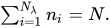
If the field of scalars is algebraically closed, then we can factor p as The integer ni is termed the algebraic multiplicity of eigenvalue λi. The algebraic multiplicities sum to N:

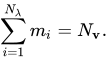
For each eigenvalue λi, we have a specific eigenvalue equation There will be 1 ≤ mi ≤ ni linearly independent solutions to each eigenvalue equation. The linear combinations of the mi solutions (except the one which gives the zero vector) are the eigenvectors associated with the eigenvalue λi. The integer mi is termed the geometric multiplicity of λi. It is important to keep in mind that the algebraic multiplicity ni and geometric multiplicity mi may or may not be equal, but we always have mi ≤ ni. The simplest case is of course when mi = ni = 1. The total number of linearly independent eigenvectors, Nv, can be calculated by summing the geometric multiplicities

The eigenvectors can be indexed by eigenvalues, using a double index, with vij being the jth eigenvector for the ith eigenvalue. The eigenvectors can also be indexed using the simpler notation of a single index vk, with k = 1, 2, ..., Nv.
Let A be a square n × n matrix with n linearly independent eigenvectors qi (where i = 1, ..., n). Then A can be factored as where Q is the square n × n matrix whose ith column is the eigenvector qi of A, and Λ is the diagonal matrix whose diagonal elements are the corresponding eigenvalues, Λii = λi. Note that only diagonalizable matrices can be factorized in this way. For example, the defective matrix (which is a shear matrix) cannot be diagonalized.

![{\displaystyle \left[{\begin{smallmatrix}1&1\\0&1\end{smallmatrix}}\right]}](https://wikimedia.org/api/rest_v1/media/math/render/svg/86645fac7ab74a9bf79acc20abb7a56a1a1ce54b)
The n eigenvectors qi are usually normalized, but they don't have to be. A non-normalized set of n eigenvectors, vi can also be used as the columns of Q. That can be understood by noting that the magnitude of the eigenvectors in Q gets canceled in the decomposition by the presence of Q−1. If one of the eigenvalues λi has multiple linearly independent eigenvectors (that is, the geometric multiplicity of λi is greater than 1), then these eigenvectors for this eigenvalue λi can be chosen to be mutually orthogonal; however, if two eigenvectors belong to two different eigenvalues, it may be impossible for them to be orthogonal to each other (see Example below). One special case is that if A is a normal matrix, then by the spectral theorem, it's always possible to diagonalize A in an orthonormal basis {qi}.
Eigendecomposition of a matrix
In linear algebra, eigendecomposition is the factorization of a matrix into a canonical form, whereby the matrix is represented in terms of its eigenvalues and eigenvectors. Only diagonalizable matrices can be factorized in this way. When the matrix being factorized is a normal or real symmetric matrix, the decomposition is called "spectral decomposition", derived from the spectral theorem.
A (nonzero) vector v of dimension N is an eigenvector of a square N × N matrix A if it satisfies a linear equation of the form for some scalar λ. Then λ is called the eigenvalue corresponding to v. Geometrically speaking, the eigenvectors of A are the vectors that A merely elongates or shrinks, and the amount that they elongate/shrink by is the eigenvalue. The above equation is called the eigenvalue equation or the eigenvalue problem.
This yields an equation for the eigenvalues We call p(λ) the characteristic polynomial, and the equation, called the characteristic equation, is an Nth-order polynomial equation in the unknown λ. This equation will have Nλ distinct solutions, where 1 ≤ Nλ ≤ N. The set of solutions, that is, the eigenvalues, is called the spectrum of A.
If the field of scalars is algebraically closed, then we can factor p as The integer ni is termed the algebraic multiplicity of eigenvalue λi. The algebraic multiplicities sum to N:
For each eigenvalue λi, we have a specific eigenvalue equation There will be 1 ≤ mi ≤ ni linearly independent solutions to each eigenvalue equation. The linear combinations of the mi solutions (except the one which gives the zero vector) are the eigenvectors associated with the eigenvalue λi. The integer mi is termed the geometric multiplicity of λi. It is important to keep in mind that the algebraic multiplicity ni and geometric multiplicity mi may or may not be equal, but we always have mi ≤ ni. The simplest case is of course when mi = ni = 1. The total number of linearly independent eigenvectors, Nv, can be calculated by summing the geometric multiplicities
The eigenvectors can be indexed by eigenvalues, using a double index, with vij being the jth eigenvector for the ith eigenvalue. The eigenvectors can also be indexed using the simpler notation of a single index vk, with k = 1, 2, ..., Nv.
Let A be a square n × n matrix with n linearly independent eigenvectors qi (where i = 1, ..., n). Then A can be factored as where Q is the square n × n matrix whose ith column is the eigenvector qi of A, and Λ is the diagonal matrix whose diagonal elements are the corresponding eigenvalues, Λii = λi. Note that only diagonalizable matrices can be factorized in this way. For example, the defective matrix (which is a shear matrix) cannot be diagonalized.
The n eigenvectors qi are usually normalized, but they don't have to be. A non-normalized set of n eigenvectors, vi can also be used as the columns of Q. That can be understood by noting that the magnitude of the eigenvectors in Q gets canceled in the decomposition by the presence of Q−1. If one of the eigenvalues λi has multiple linearly independent eigenvectors (that is, the geometric multiplicity of λi is greater than 1), then these eigenvectors for this eigenvalue λi can be chosen to be mutually orthogonal; however, if two eigenvectors belong to two different eigenvalues, it may be impossible for them to be orthogonal to each other (see Example below). One special case is that if A is a normal matrix, then by the spectral theorem, it's always possible to diagonalize A in an orthonormal basis {qi}.