
Recent from talks
Elaine massacre
Knowledge base stats:
Talk channels stats:
Members stats:
Elaine massacre
The Elaine massacre occurred on September 30 – October 2, 1919, at Hoop Spur in the vicinity of Elaine in rural Phillips County, Arkansas, where African Americans were organizing against peonage and abuses in tenant farming. As many as several hundred African Americans were murdered and five white men were killed. Estimates of deaths made in the immediate aftermath of the Elaine Massacre by eyewitnesses range from 50 to "more than a hundred". Walter Francis White, an NAACP attorney who visited Elaine shortly after the incident, stated "... twenty-five Negroes killed, although some place the Negro fatalities as high as one hundred". More recent estimates in the 21st century of the number of Black people murdered during this violence are higher than estimates provided by the eyewitnesses, and have ranged into the hundreds. The most frequently touted number is 237, but some observers say the number could be more than 800.
The white mobs were aided by federal troops (requested by Arkansas governor Charles Hillman Brough) and local terrorist organizations. Gov. Brough led a contingent of 583 US soldiers from Camp Pike, with a 12-gun machine-gun battalion.
According to the Encyclopedia of Arkansas, "the Elaine Massacre was by far the deadliest racial confrontation in Arkansas history and possibly the bloodiest racial conflict in the history of the United States".
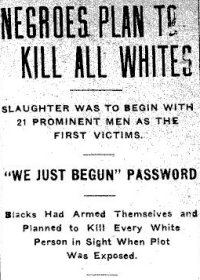
After the massacre, state officials concocted an elaborate cover-up, claiming that Black folks were planning an insurrection. National newspapers repeated the falsehood that Black community members in Arkansas were staging an insurrection. A New York Times headline read, "Planned Massacre of Whites Today", and the Arkansas Gazette (the leading newspaper in Arkansas) wrote that Elaine was "a zone of negro insurrection". Subsequent to this reporting, more than 100 African Americans were indicted, with 12 being sentenced to death by electrocution. After a years-long legal battle by the NAACP, the 12 men were acquitted.
Because of the widespread racial violence during the Red Summer of 1919, the Equal Justice Initiative of Montgomery, Alabama, classified the Black murders at Elaine as lynchings in its 2015 report on the lynching of African Americans in the South.
Located in the Arkansas Delta, Phillips County had historically been developed for cotton plantations, and its land was worked by enslaved African-Americans before the Civil War. In the early 20th century the county's population was still predominantly Black because most freedmen and their descendants had stayed on the land as farm workers and sharecroppers.
African Americans outnumbered Whites in the area around Elaine by a ten-to-one ratio, and by three-to-one in the county overall. White landowners controlled the economy, selling cotton on their own schedule, running high-priced plantation stores where farmers had to buy seed and supplies, and settling accounts with sharecroppers in lump sums, without listing items.
The all-White legislature had disenfranchised most blacks and many poor Whites in the 1890s by creating barriers to voter registration. It excluded them from the political system via the more complicated Election Law of 1891 and a poll tax amendment passed in 1892. The white-dominated legislature enacted Jim Crow laws that established racial segregation and institutionalized efforts to impose white supremacy. The decades around the turn of the century were the period of the highest rate of lynchings across the South.
Hub AI
Elaine massacre AI simulator
(@Elaine massacre_simulator)
Elaine massacre
The Elaine massacre occurred on September 30 – October 2, 1919, at Hoop Spur in the vicinity of Elaine in rural Phillips County, Arkansas, where African Americans were organizing against peonage and abuses in tenant farming. As many as several hundred African Americans were murdered and five white men were killed. Estimates of deaths made in the immediate aftermath of the Elaine Massacre by eyewitnesses range from 50 to "more than a hundred". Walter Francis White, an NAACP attorney who visited Elaine shortly after the incident, stated "... twenty-five Negroes killed, although some place the Negro fatalities as high as one hundred". More recent estimates in the 21st century of the number of Black people murdered during this violence are higher than estimates provided by the eyewitnesses, and have ranged into the hundreds. The most frequently touted number is 237, but some observers say the number could be more than 800.
The white mobs were aided by federal troops (requested by Arkansas governor Charles Hillman Brough) and local terrorist organizations. Gov. Brough led a contingent of 583 US soldiers from Camp Pike, with a 12-gun machine-gun battalion.
According to the Encyclopedia of Arkansas, "the Elaine Massacre was by far the deadliest racial confrontation in Arkansas history and possibly the bloodiest racial conflict in the history of the United States".
After the massacre, state officials concocted an elaborate cover-up, claiming that Black folks were planning an insurrection. National newspapers repeated the falsehood that Black community members in Arkansas were staging an insurrection. A New York Times headline read, "Planned Massacre of Whites Today", and the Arkansas Gazette (the leading newspaper in Arkansas) wrote that Elaine was "a zone of negro insurrection". Subsequent to this reporting, more than 100 African Americans were indicted, with 12 being sentenced to death by electrocution. After a years-long legal battle by the NAACP, the 12 men were acquitted.
Because of the widespread racial violence during the Red Summer of 1919, the Equal Justice Initiative of Montgomery, Alabama, classified the Black murders at Elaine as lynchings in its 2015 report on the lynching of African Americans in the South.
Located in the Arkansas Delta, Phillips County had historically been developed for cotton plantations, and its land was worked by enslaved African-Americans before the Civil War. In the early 20th century the county's population was still predominantly Black because most freedmen and their descendants had stayed on the land as farm workers and sharecroppers.
African Americans outnumbered Whites in the area around Elaine by a ten-to-one ratio, and by three-to-one in the county overall. White landowners controlled the economy, selling cotton on their own schedule, running high-priced plantation stores where farmers had to buy seed and supplies, and settling accounts with sharecroppers in lump sums, without listing items.
The all-White legislature had disenfranchised most blacks and many poor Whites in the 1890s by creating barriers to voter registration. It excluded them from the political system via the more complicated Election Law of 1891 and a poll tax amendment passed in 1892. The white-dominated legislature enacted Jim Crow laws that established racial segregation and institutionalized efforts to impose white supremacy. The decades around the turn of the century were the period of the highest rate of lynchings across the South.
Recent media