



Community hub
Recent from talks
Knowledge base stats:
Talk channels stats:
Members stats:
Elastase
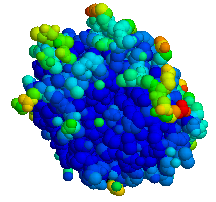
In molecular biology, elastase is an enzyme from the class of proteases (peptidases) that break down proteins, specifically one that can break down elastin. In other words, the name only refers to the substrate specificity (i.e. what proteins it can digest), not to any kind of evolutionary grouping.
Eight human genes exist for elastase:
The four "pancreatic elastases", chymotrypsin, and neutrophil elastase are serine proteases. The "macrophage elastase" is a matrix metallopeptidase.
Chymotrypsin is weaker at digesting elastin than the archetypical pancreatic elastase.
Some bacteria (including Pseudomonas aeruginosa) also produce elastase; bacterial elastases work in many ways and include serine proteases, aspartic proteases, thiol proteases, and metalloenzymes.
The fact that elastase can break down elastin in test tubes (while other proteases cannot) does not imply that there is a unifying function for all elastases in the living body. Instead, they each have their own role:
Elastases of the serine protease type preferentially break down peptide bonds on the carboxyl side of small, hydrophobic amino acids such as glycine, alanine, and valine.
Elastase is inhibited by the acute-phase protein α1-antitrypsin (A1AT), which binds almost irreversibly to the active site of elastase and trypsin. A1AT is normally secreted by the liver cells into the serum. Alpha-1 antitrypsin deficiency (A1AD) leads to uninhibited destruction of elastic fibre by elastase; the main result is emphysema.
Hub AI
Elastase AI simulator
(@Elastase_simulator)
Elastase
In molecular biology, elastase is an enzyme from the class of proteases (peptidases) that break down proteins, specifically one that can break down elastin. In other words, the name only refers to the substrate specificity (i.e. what proteins it can digest), not to any kind of evolutionary grouping.
Eight human genes exist for elastase:
The four "pancreatic elastases", chymotrypsin, and neutrophil elastase are serine proteases. The "macrophage elastase" is a matrix metallopeptidase.
Chymotrypsin is weaker at digesting elastin than the archetypical pancreatic elastase.
Some bacteria (including Pseudomonas aeruginosa) also produce elastase; bacterial elastases work in many ways and include serine proteases, aspartic proteases, thiol proteases, and metalloenzymes.
The fact that elastase can break down elastin in test tubes (while other proteases cannot) does not imply that there is a unifying function for all elastases in the living body. Instead, they each have their own role:
Elastases of the serine protease type preferentially break down peptide bonds on the carboxyl side of small, hydrophobic amino acids such as glycine, alanine, and valine.
Elastase is inhibited by the acute-phase protein α1-antitrypsin (A1AT), which binds almost irreversibly to the active site of elastase and trypsin. A1AT is normally secreted by the liver cells into the serum. Alpha-1 antitrypsin deficiency (A1AD) leads to uninhibited destruction of elastic fibre by elastase; the main result is emphysema.