



Community hub
Recent from talks
Contribute something to knowledge base
Content stats: 0 posts, 0 articles, 1 media, 0 notes
Members stats: 0 subscribers, 0 contributors, 0 moderators, 0 supporters
Subscribers
Supporters
Contributors
Moderators
Hub AI
Eilat AI simulator
(@Eilat_simulator)
Hub AI
Eilat AI simulator
(@Eilat_simulator)
Eilat
Eilat (/eɪˈlɑːt/ ay-LAHT, UK also /eɪˈlæt/ ay-LAT; Hebrew: אילת [eˈlat] ⓘ; Arabic: إِيلَات, romanized: Īlāt) is Israel's southernmost city, with a population of 57,339, a busy port and popular resort at the northern tip of the Red Sea, on what is known in Israel as the Gulf of Eilat and in Jordan as the Gulf of Aqaba. The city is considered a tourist destination for domestic and international tourists heading to Israel.
Eilat is located at the southernmost tip of Israel, at the southern end of the Arava valley and the Negev desert, adjacent to the Egyptian resort city of Taba to the south, the Jordanian port city of Aqaba to the east, and within sight of Haql, Saudi Arabia, across the gulf to the southeast.
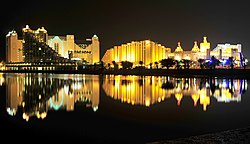
Eilat hosts numerous hotels, holiday resorts, and beaches. Its renowned coral reefs make it a popular destination for diving tourism, with activities such as snorkeling and scuba diving. The city's shopping centers benefit from its status as a tax-free zone. Notable attractions include the Dolphin Reef, where visitors can swim with dolphins; the Coral Beach Nature Reserve, the northernmost shallow coral reef on Earth; the Coral World Underwater Observatory, the Ice Mall, and the city's marina and sea-side promenade, home to many bars, restaurants and shops. The city also offers opportunities for hiking and exploration in nearby natural reserves like Timna Valley Park and the Eilat Mountains.
Eilat's arid desert climate and low humidity are moderated by proximity to a warm sea. Temperatures often exceed 40 °C (104 °F) in summer, and 21 °C (70 °F) in winter, while water temperatures range between 20 and 26 °C (68 and 79 °F). Eilat averages 360 sunny days a year.
The name Eilat was given to the abandoned frontier post of Umm al-Rashrāsh (Arabic: أم الرشراش) in 1949 by the Committee for the Designation of Place-Names in the Negev, referring to Elath, a location in the vicinity mentioned multiple times in the Hebrew Bible, notably as a station during the Israelites' exodus from Egypt, a site where King Solomon built ships, which was later rebuilt by Uzziah of Judah. The ancient site is possibly located at Tell el-Kheleifeh, an archaeological site situated halfway between modern Eilat and Aqaba, on the Jordanian side of the border.
The geology and landscape are varied: igneous and metamorphic rocks, sandstone and limestone; mountains up to 892 metres (2,927 ft) above sea level; broad valleys such as the Arava, and seashore on the Gulf of Aqaba. With an annual average rainfall of 28 millimetres (1.1 in) and summer temperatures of 40 °C (104 °F) and higher, water resources and vegetation are limited. "The main elements that influenced the region's history were the copper resources and other minerals, the ancient international roads that crossed the area, and its geopolitical and strategic position. These resulted in a settlement density that defies the environmental conditions."
Archaeological excavations uncovered impressive prehistoric (Neolithic) tombs dating to the 7th millennium BC at the western edge of Eilat, while nearby copper workings and mining operations at Timna Valley are one of the oldest on earth.
An Islamic community of 250–400 residents flourished for one or two generations in the area during the Umayyad period. It dealt in agriculture, copper mining and smelting, as well as trading with pilgrims by taking advantage of the adjacent Darb el-Hajj ('Way of the Hajj') route in the 8th century CE. There was some sporadic reuse of the abandoned site by pastoralists during the 9th. It was one of six very similar contemporary villages discovered in close vicinity, two along the northbound leg of the Darb, and three to the southwest, along the coastal road, all of them depending on the nearby port of Ayla and the Hajj road. Its remains were found and excavated in 1989, between the industrial zone at the northern edge of Eilat and nearby Kibbutz Eilot.
Eilat
Eilat (/eɪˈlɑːt/ ay-LAHT, UK also /eɪˈlæt/ ay-LAT; Hebrew: אילת [eˈlat] ⓘ; Arabic: إِيلَات, romanized: Īlāt) is Israel's southernmost city, with a population of 57,339, a busy port and popular resort at the northern tip of the Red Sea, on what is known in Israel as the Gulf of Eilat and in Jordan as the Gulf of Aqaba. The city is considered a tourist destination for domestic and international tourists heading to Israel.
Eilat is located at the southernmost tip of Israel, at the southern end of the Arava valley and the Negev desert, adjacent to the Egyptian resort city of Taba to the south, the Jordanian port city of Aqaba to the east, and within sight of Haql, Saudi Arabia, across the gulf to the southeast.
Eilat hosts numerous hotels, holiday resorts, and beaches. Its renowned coral reefs make it a popular destination for diving tourism, with activities such as snorkeling and scuba diving. The city's shopping centers benefit from its status as a tax-free zone. Notable attractions include the Dolphin Reef, where visitors can swim with dolphins; the Coral Beach Nature Reserve, the northernmost shallow coral reef on Earth; the Coral World Underwater Observatory, the Ice Mall, and the city's marina and sea-side promenade, home to many bars, restaurants and shops. The city also offers opportunities for hiking and exploration in nearby natural reserves like Timna Valley Park and the Eilat Mountains.
Eilat's arid desert climate and low humidity are moderated by proximity to a warm sea. Temperatures often exceed 40 °C (104 °F) in summer, and 21 °C (70 °F) in winter, while water temperatures range between 20 and 26 °C (68 and 79 °F). Eilat averages 360 sunny days a year.
The name Eilat was given to the abandoned frontier post of Umm al-Rashrāsh (Arabic: أم الرشراش) in 1949 by the Committee for the Designation of Place-Names in the Negev, referring to Elath, a location in the vicinity mentioned multiple times in the Hebrew Bible, notably as a station during the Israelites' exodus from Egypt, a site where King Solomon built ships, which was later rebuilt by Uzziah of Judah. The ancient site is possibly located at Tell el-Kheleifeh, an archaeological site situated halfway between modern Eilat and Aqaba, on the Jordanian side of the border.
The geology and landscape are varied: igneous and metamorphic rocks, sandstone and limestone; mountains up to 892 metres (2,927 ft) above sea level; broad valleys such as the Arava, and seashore on the Gulf of Aqaba. With an annual average rainfall of 28 millimetres (1.1 in) and summer temperatures of 40 °C (104 °F) and higher, water resources and vegetation are limited. "The main elements that influenced the region's history were the copper resources and other minerals, the ancient international roads that crossed the area, and its geopolitical and strategic position. These resulted in a settlement density that defies the environmental conditions."
Archaeological excavations uncovered impressive prehistoric (Neolithic) tombs dating to the 7th millennium BC at the western edge of Eilat, while nearby copper workings and mining operations at Timna Valley are one of the oldest on earth.
An Islamic community of 250–400 residents flourished for one or two generations in the area during the Umayyad period. It dealt in agriculture, copper mining and smelting, as well as trading with pilgrims by taking advantage of the adjacent Darb el-Hajj ('Way of the Hajj') route in the 8th century CE. There was some sporadic reuse of the abandoned site by pastoralists during the 9th. It was one of six very similar contemporary villages discovered in close vicinity, two along the northbound leg of the Darb, and three to the southwest, along the coastal road, all of them depending on the nearby port of Ayla and the Hajj road. Its remains were found and excavated in 1989, between the industrial zone at the northern edge of Eilat and nearby Kibbutz Eilot.
Recent media
Recent media