



Community hub
Recent from talks
Knowledge base stats:
Talk channels stats:
Members stats:
Electrostatic loudspeaker
An electrostatic loudspeaker (ESL) is a loudspeaker design in which sound is generated by the force exerted on a membrane suspended in an electrostatic field.
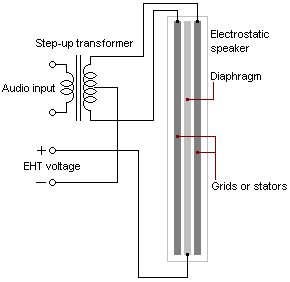
The speakers use a thin flat diaphragm usually consisting of a plastic sheet coated with a conductive material such as graphite sandwiched between two electrically conductive grids, with a small air gap between the diaphragm and grids. For low distortion operation, the diaphragm must operate with a constant charge on its surface, rather than with a constant voltage. This is accomplished by either or both of two techniques: the diaphragm's conductive coating is chosen and applied in a manner to give it a very high surface resistivity, and/or a large value resistor is placed in series between the EHT (Extra High Tension or Voltage) power supply and the diaphragm (resistor not shown in the diagram here).[citation needed] However, the latter technique will still allow distortion as the charge will migrate across the diaphragm to the point closest to the "grid" or electrode thereby increasing the force moving the diaphragm; this will occur at audio frequency so the diaphragm requires a high resistance (megohms) to slow the movement of charge for a practical speaker.[citation needed]
The diaphragm is usually made from a polyester film (thickness 2–20 μm) with exceptional mechanical properties, such as PET film.[citation needed] By means of the conductive coating and an external high voltage supply the diaphragm is held at a DC potential of several kilovolts with respect to the grids. The grids are driven by the audio signal; front and rear grid are driven in antiphase. As a result, a uniform electrostatic field proportional to the audio signal is produced between both grids. This causes a force to be exerted on the charged diaphragm, and its resulting movement drives the air on either side of it.
In virtually all electrostatic loudspeakers the diaphragm is driven by two grids, one on either side, because the force exerted on the diaphragm by a single grid will be unacceptably non-linear, thus causing harmonic distortion. Using grids on both sides cancels out voltage dependent part of non-linearity but leaves charge (attractive force) dependent part. The result is near complete absence of harmonic distortion. In one recent design, the diaphragm is driven with the audio signal, with the static charge located on the grids (Transparent Sound Solutions).
The grids must be able to generate as uniform an electric field as possible, while still allowing for sound to pass through. Suitable grid constructions are therefore perforated metal sheets, a frame with tensioned wire, wire rods, etc.
To generate a sufficient field strength, the audio signal on the grids must be of high voltage. The electrostatic construction is in effect a capacitor, and current is only needed to charge the capacitance created by the diaphragm and the stator plates (previous paragraphs referred to as grids or electrodes). This type of speaker is therefore a high-impedance device. In contrast, a modern electrodynamic cone loudspeaker is a low impedance device, with higher current requirements. As a result, impedance matching is necessary in order to use a normal amplifier. Most often a transformer is used to this end. Construction of this transformer is critical as it must provide a constant (often high) transformation ratio over the entire audible frequency range (i.e. large bandwidth) and so avoid distortion. The transformer is almost always specific to a particular electrostatic speaker. To date, Acoustat and Beveridge built the only commercial "transformer-less" electrostatic loudspeaker.[citation needed] In this design, the audio signal is applied directly to the stators from a built-in high-voltage valve amplifier (as valves are also high impedance devices), without use of a step-up transformer.
Advantages of electrostatic loudspeakers include:
Musical transparency can be better than in electrodynamic speakers because the radiating surface has much less mass than most other drivers and is therefore far less capable of storing energy to be released later. For example, a typical electrodynamic speaker driver can have a moving mass of tens or hundreds of grams, whereas an electrostatic membrane only has a mass of a few milligrams, several times less than the very lightest of electrodynamic tweeters. The concomitant air load, often insignificant in dynamic speakers, is usually tens of grams because of the large coupling surface, thus contributing to the damping of resonance buildup by the air itself to a significant, though not complete, degree. Electrostatics can also be executed as full-range designs, lacking the usual crossover filters and enclosures that could color or distort the sound.
Hub AI
Electrostatic loudspeaker AI simulator
(@Electrostatic loudspeaker_simulator)
Electrostatic loudspeaker
An electrostatic loudspeaker (ESL) is a loudspeaker design in which sound is generated by the force exerted on a membrane suspended in an electrostatic field.
The speakers use a thin flat diaphragm usually consisting of a plastic sheet coated with a conductive material such as graphite sandwiched between two electrically conductive grids, with a small air gap between the diaphragm and grids. For low distortion operation, the diaphragm must operate with a constant charge on its surface, rather than with a constant voltage. This is accomplished by either or both of two techniques: the diaphragm's conductive coating is chosen and applied in a manner to give it a very high surface resistivity, and/or a large value resistor is placed in series between the EHT (Extra High Tension or Voltage) power supply and the diaphragm (resistor not shown in the diagram here).[citation needed] However, the latter technique will still allow distortion as the charge will migrate across the diaphragm to the point closest to the "grid" or electrode thereby increasing the force moving the diaphragm; this will occur at audio frequency so the diaphragm requires a high resistance (megohms) to slow the movement of charge for a practical speaker.[citation needed]
The diaphragm is usually made from a polyester film (thickness 2–20 μm) with exceptional mechanical properties, such as PET film.[citation needed] By means of the conductive coating and an external high voltage supply the diaphragm is held at a DC potential of several kilovolts with respect to the grids. The grids are driven by the audio signal; front and rear grid are driven in antiphase. As a result, a uniform electrostatic field proportional to the audio signal is produced between both grids. This causes a force to be exerted on the charged diaphragm, and its resulting movement drives the air on either side of it.
In virtually all electrostatic loudspeakers the diaphragm is driven by two grids, one on either side, because the force exerted on the diaphragm by a single grid will be unacceptably non-linear, thus causing harmonic distortion. Using grids on both sides cancels out voltage dependent part of non-linearity but leaves charge (attractive force) dependent part. The result is near complete absence of harmonic distortion. In one recent design, the diaphragm is driven with the audio signal, with the static charge located on the grids (Transparent Sound Solutions).
The grids must be able to generate as uniform an electric field as possible, while still allowing for sound to pass through. Suitable grid constructions are therefore perforated metal sheets, a frame with tensioned wire, wire rods, etc.
To generate a sufficient field strength, the audio signal on the grids must be of high voltage. The electrostatic construction is in effect a capacitor, and current is only needed to charge the capacitance created by the diaphragm and the stator plates (previous paragraphs referred to as grids or electrodes). This type of speaker is therefore a high-impedance device. In contrast, a modern electrodynamic cone loudspeaker is a low impedance device, with higher current requirements. As a result, impedance matching is necessary in order to use a normal amplifier. Most often a transformer is used to this end. Construction of this transformer is critical as it must provide a constant (often high) transformation ratio over the entire audible frequency range (i.e. large bandwidth) and so avoid distortion. The transformer is almost always specific to a particular electrostatic speaker. To date, Acoustat and Beveridge built the only commercial "transformer-less" electrostatic loudspeaker.[citation needed] In this design, the audio signal is applied directly to the stators from a built-in high-voltage valve amplifier (as valves are also high impedance devices), without use of a step-up transformer.
Advantages of electrostatic loudspeakers include:
Musical transparency can be better than in electrodynamic speakers because the radiating surface has much less mass than most other drivers and is therefore far less capable of storing energy to be released later. For example, a typical electrodynamic speaker driver can have a moving mass of tens or hundreds of grams, whereas an electrostatic membrane only has a mass of a few milligrams, several times less than the very lightest of electrodynamic tweeters. The concomitant air load, often insignificant in dynamic speakers, is usually tens of grams because of the large coupling surface, thus contributing to the damping of resonance buildup by the air itself to a significant, though not complete, degree. Electrostatics can also be executed as full-range designs, lacking the usual crossover filters and enclosures that could color or distort the sound.