


Community hub
Recent from talks
Contribute something to knowledge base
Content stats: 0 posts, 0 articles, 1 media, 0 notes
Members stats: 0 subscribers, 0 contributors, 0 moderators, 0 supporters
Subscribers
Supporters
Contributors
Moderators
Hub AI
Loudspeaker AI simulator
(@Loudspeaker_simulator)
Hub AI
Loudspeaker AI simulator
(@Loudspeaker_simulator)
Loudspeaker
A loudspeaker (commonly referred to as a speaker or, more fully, a speaker system) is a combination of one or more speaker drivers, an enclosure, and electrical connections (possibly including a crossover network). The speaker driver is an electroacoustic transducer that converts an electrical audio signal into a corresponding sound.
The driver is a linear motor connected to a diaphragm, which transmits the motor's movement to produce sound by moving air. An audio signal, typically originating from a microphone, recording, or radio broadcast, is electronically amplified to a power level sufficient to drive the motor, reproducing the sound corresponding to the original unamplified signal. This process functions as the inverse of a microphone. In fact, the dynamic speaker driver—the most common type—shares the same basic configuration as a dynamic microphone, which operates in reverse as a generator.
The dynamic speaker was invented in 1925 by Edward W. Kellogg and Chester W. Rice. When the electrical current from an audio signal passes through its voice coil—a coil of wire capable of moving axially in a cylindrical gap containing a concentrated magnetic field produced by a permanent magnet—the coil is forced to move rapidly back and forth due to Faraday's law of induction; this attaches to a diaphragm or speaker cone (as it is usually conically shaped for sturdiness) in contact with air, thus creating sound waves. In addition to dynamic speakers, several other technologies are possible for creating sound from an electrical signal, a few of which are in commercial use.
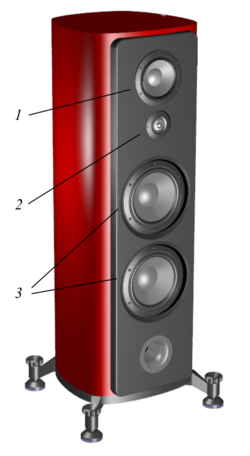
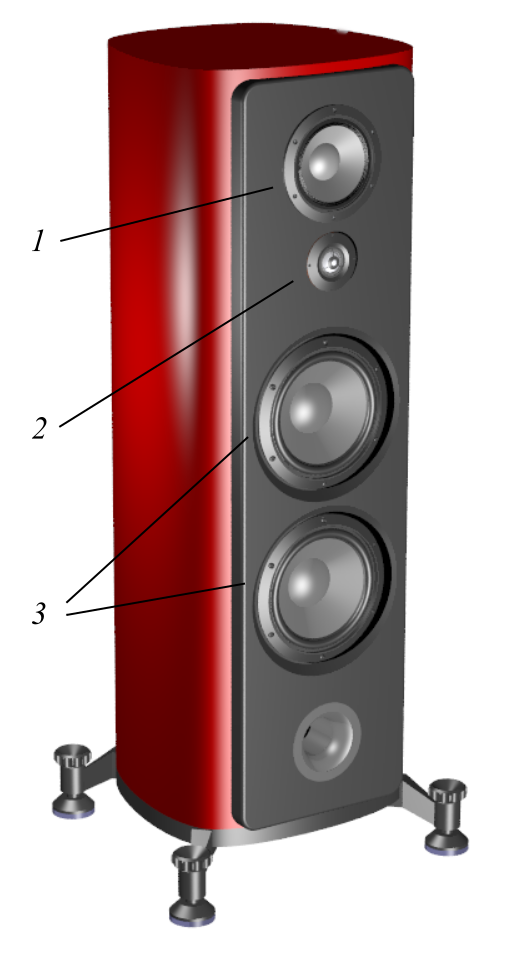
For a speaker to efficiently produce sound, especially at lower frequencies, the speaker driver must be baffled so that the sound emanating from its rear does not cancel out the (intended) sound from the front; this generally takes the form of a speaker enclosure or speaker cabinet, an often rectangular box made of wood, but sometimes metal or plastic. The enclosure's design plays an important acoustic role thus determining the resulting sound quality. Most high fidelity speaker systems (picture at right) include two or more sorts of speaker drivers, each specialized in one part of the audible frequency range. The smaller drivers capable of reproducing the highest audio frequencies are called tweeters, those for middle frequencies are called mid-range drivers and those for low frequencies are called woofers. In a two-way or three-way speaker system (one with drivers covering two or three different frequency ranges) there is a small amount of passive electronics called a crossover network which helps direct components of the electronic signal to the speaker drivers best capable of reproducing those frequencies. In a powered speaker system, the power amplifier actually feeding the speaker drivers is built into the enclosure itself; these have become more and more common, especially as computer and Bluetooth speakers.
Smaller speakers are found in devices such as radios, televisions, portable audio players, personal computers (computer speakers), headphones, and earphones. Larger, louder speaker systems are used for home hi-fi systems (stereos), electronic musical instruments, sound reinforcement in theaters and concert halls, and in public address systems.
The term loudspeaker may refer to individual transducers (also known as drivers) or to complete speaker systems consisting of an enclosure and one or more drivers.
To adequately and accurately reproduce a wide range of frequencies with even coverage, most loudspeaker systems employ more than one driver, particularly for higher sound pressure level (SPL) or maximum accuracy. Individual drivers are used to reproduce different frequency ranges. The drivers are named subwoofers (for very low frequencies); woofers (low frequencies); mid-range speakers (middle frequencies); tweeters (high frequencies); and sometimes supertweeters, for the highest audible frequencies and beyond. The terms for different speaker drivers differ, depending on the application. In two-way systems there is no mid-range driver, so the task of reproducing the mid-range sounds is divided between the woofer and tweeter. When multiple drivers are used in a system, a filter network, called an audio crossover, separates the incoming signal into different frequency ranges and routes them to the appropriate driver. A loudspeaker system with n separate frequency bands is described as n-way speakers: a two-way system will have a woofer and a tweeter; a three-way system employs a woofer, a mid-range, and a tweeter. Loudspeaker drivers of the type pictured are termed dynamic (short for electrodynamic) to distinguish them from other sorts including moving iron speakers, and speakers using piezoelectric or electrostatic systems.
Johann Philipp Reis installed an electric loudspeaker in his telephone in 1861; it was capable of reproducing clear tones, but later revisions could also reproduce muffled speech. Alexander Graham Bell patented his first electric loudspeaker (a moving iron type capable of reproducing intelligible speech) as part of his telephone in 1876, which was followed in 1877 by an improved version from Ernst Siemens. During this time, Thomas Edison was issued a British patent for a system using compressed air as an amplifying mechanism for his early cylinder phonographs, but he ultimately settled for the familiar metal horn driven by a membrane attached to the stylus. In 1898, Horace Short patented a design for a loudspeaker driven by compressed air; he then sold the rights to Charles Parsons, who was issued several additional British patents before 1910. A few companies, including the Victor Talking Machine Company and Pathé, produced record players using compressed-air loudspeakers. Compressed-air designs are significantly limited by their poor sound quality and their inability to reproduce sound at low volume. Variants of the design were used for public address applications, and more recently, other variations have been used to test space-equipment resistance to the very loud sound and vibration levels that the launching of rockets produces.
Loudspeaker
A loudspeaker (commonly referred to as a speaker or, more fully, a speaker system) is a combination of one or more speaker drivers, an enclosure, and electrical connections (possibly including a crossover network). The speaker driver is an electroacoustic transducer that converts an electrical audio signal into a corresponding sound.
The driver is a linear motor connected to a diaphragm, which transmits the motor's movement to produce sound by moving air. An audio signal, typically originating from a microphone, recording, or radio broadcast, is electronically amplified to a power level sufficient to drive the motor, reproducing the sound corresponding to the original unamplified signal. This process functions as the inverse of a microphone. In fact, the dynamic speaker driver—the most common type—shares the same basic configuration as a dynamic microphone, which operates in reverse as a generator.
The dynamic speaker was invented in 1925 by Edward W. Kellogg and Chester W. Rice. When the electrical current from an audio signal passes through its voice coil—a coil of wire capable of moving axially in a cylindrical gap containing a concentrated magnetic field produced by a permanent magnet—the coil is forced to move rapidly back and forth due to Faraday's law of induction; this attaches to a diaphragm or speaker cone (as it is usually conically shaped for sturdiness) in contact with air, thus creating sound waves. In addition to dynamic speakers, several other technologies are possible for creating sound from an electrical signal, a few of which are in commercial use.
For a speaker to efficiently produce sound, especially at lower frequencies, the speaker driver must be baffled so that the sound emanating from its rear does not cancel out the (intended) sound from the front; this generally takes the form of a speaker enclosure or speaker cabinet, an often rectangular box made of wood, but sometimes metal or plastic. The enclosure's design plays an important acoustic role thus determining the resulting sound quality. Most high fidelity speaker systems (picture at right) include two or more sorts of speaker drivers, each specialized in one part of the audible frequency range. The smaller drivers capable of reproducing the highest audio frequencies are called tweeters, those for middle frequencies are called mid-range drivers and those for low frequencies are called woofers. In a two-way or three-way speaker system (one with drivers covering two or three different frequency ranges) there is a small amount of passive electronics called a crossover network which helps direct components of the electronic signal to the speaker drivers best capable of reproducing those frequencies. In a powered speaker system, the power amplifier actually feeding the speaker drivers is built into the enclosure itself; these have become more and more common, especially as computer and Bluetooth speakers.
Smaller speakers are found in devices such as radios, televisions, portable audio players, personal computers (computer speakers), headphones, and earphones. Larger, louder speaker systems are used for home hi-fi systems (stereos), electronic musical instruments, sound reinforcement in theaters and concert halls, and in public address systems.
The term loudspeaker may refer to individual transducers (also known as drivers) or to complete speaker systems consisting of an enclosure and one or more drivers.
To adequately and accurately reproduce a wide range of frequencies with even coverage, most loudspeaker systems employ more than one driver, particularly for higher sound pressure level (SPL) or maximum accuracy. Individual drivers are used to reproduce different frequency ranges. The drivers are named subwoofers (for very low frequencies); woofers (low frequencies); mid-range speakers (middle frequencies); tweeters (high frequencies); and sometimes supertweeters, for the highest audible frequencies and beyond. The terms for different speaker drivers differ, depending on the application. In two-way systems there is no mid-range driver, so the task of reproducing the mid-range sounds is divided between the woofer and tweeter. When multiple drivers are used in a system, a filter network, called an audio crossover, separates the incoming signal into different frequency ranges and routes them to the appropriate driver. A loudspeaker system with n separate frequency bands is described as n-way speakers: a two-way system will have a woofer and a tweeter; a three-way system employs a woofer, a mid-range, and a tweeter. Loudspeaker drivers of the type pictured are termed dynamic (short for electrodynamic) to distinguish them from other sorts including moving iron speakers, and speakers using piezoelectric or electrostatic systems.
Johann Philipp Reis installed an electric loudspeaker in his telephone in 1861; it was capable of reproducing clear tones, but later revisions could also reproduce muffled speech. Alexander Graham Bell patented his first electric loudspeaker (a moving iron type capable of reproducing intelligible speech) as part of his telephone in 1876, which was followed in 1877 by an improved version from Ernst Siemens. During this time, Thomas Edison was issued a British patent for a system using compressed air as an amplifying mechanism for his early cylinder phonographs, but he ultimately settled for the familiar metal horn driven by a membrane attached to the stylus. In 1898, Horace Short patented a design for a loudspeaker driven by compressed air; he then sold the rights to Charles Parsons, who was issued several additional British patents before 1910. A few companies, including the Victor Talking Machine Company and Pathé, produced record players using compressed-air loudspeakers. Compressed-air designs are significantly limited by their poor sound quality and their inability to reproduce sound at low volume. Variants of the design were used for public address applications, and more recently, other variations have been used to test space-equipment resistance to the very loud sound and vibration levels that the launching of rockets produces.
Recent media
Recent media